Physical Address
304 North Cardinal St.
Dorchester Center, MA 02124
Physical Address
304 North Cardinal St.
Dorchester Center, MA 02124

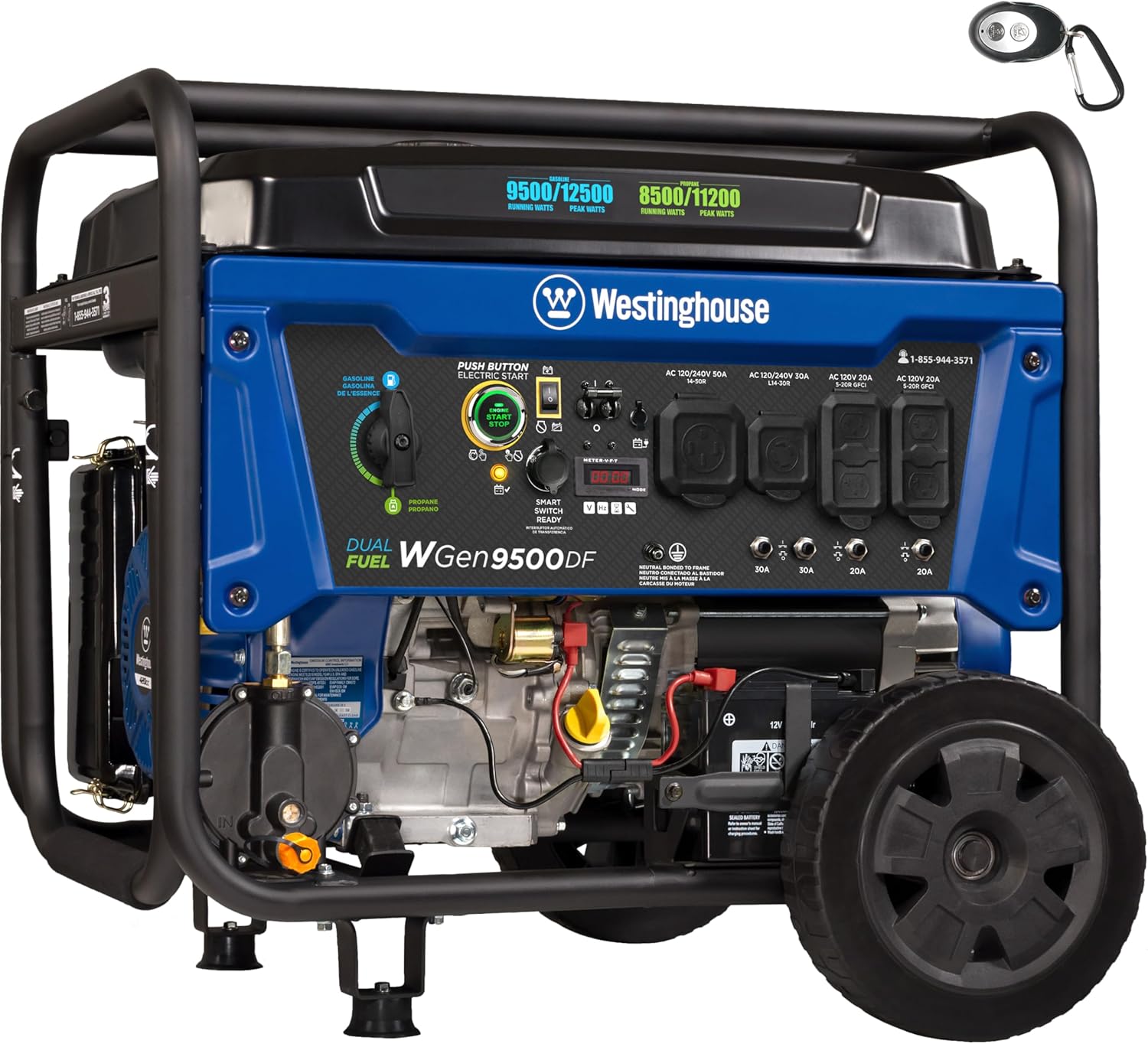
Last winter, the third outage in a single month finally pushed me past the point of patience. My sump pump sits in a crawlspace that floods when the power drops for more than four hours, and a battery backup was never going to hold the furnace, the fridge, and the pump at once. A neighbor with a welder’s opinion of all things mechanical told me to stop overthinking it and buy a dual fuel unit. That is how the Westinghouse WGen9500DF ended up on my radar — not because of marketing, but because someone who has actually rebuilt an engine said propane storage was the only sane option for a household that does not want gasoline going stale in a can. Before committing, I read every battery-first backup comparison I could find and confirmed a simple truth: batteries are elegant until you need 9,500 running watts for twelve hours. For that kind of load, you need fuel. If you want to skip ahead, this dual fuel portable generator is what I bought.
Affiliate disclosure: Some links in this article are affiliate links. We may earn a commission if you buy through them, at no cost to you. This does not affect our conclusions — we call it as we find it.
Westinghouse has been slapping its name on generators for over a century, and the current Westinghouse Outdoor Power Equipment line is its mass-market play. The WGen9500DF sits near the top of that line, and the marketing language around it is confident to the point of being suspicious. I pulled the specific claims from the product page and the manual before I ever opened the box.
The claim I trusted least was the 12-hour runtime. Every generator spec sheet on earth quotes runtime at an optimistic load, and the WGen9500DF is a 457cc engine burning a quarter-tank an hour under real demand. That was the first thing I expected to fail.
The box arrived on a pallet and weighed enough that I stopped pretending I could move it alone. Westinghouse ships it with the wheels, handle, and lift bracket uninstalled, which is the standard compromise in this category. Cardboard and foam were adequate; nothing rattled loose in transit, and the frame had no visible dents.
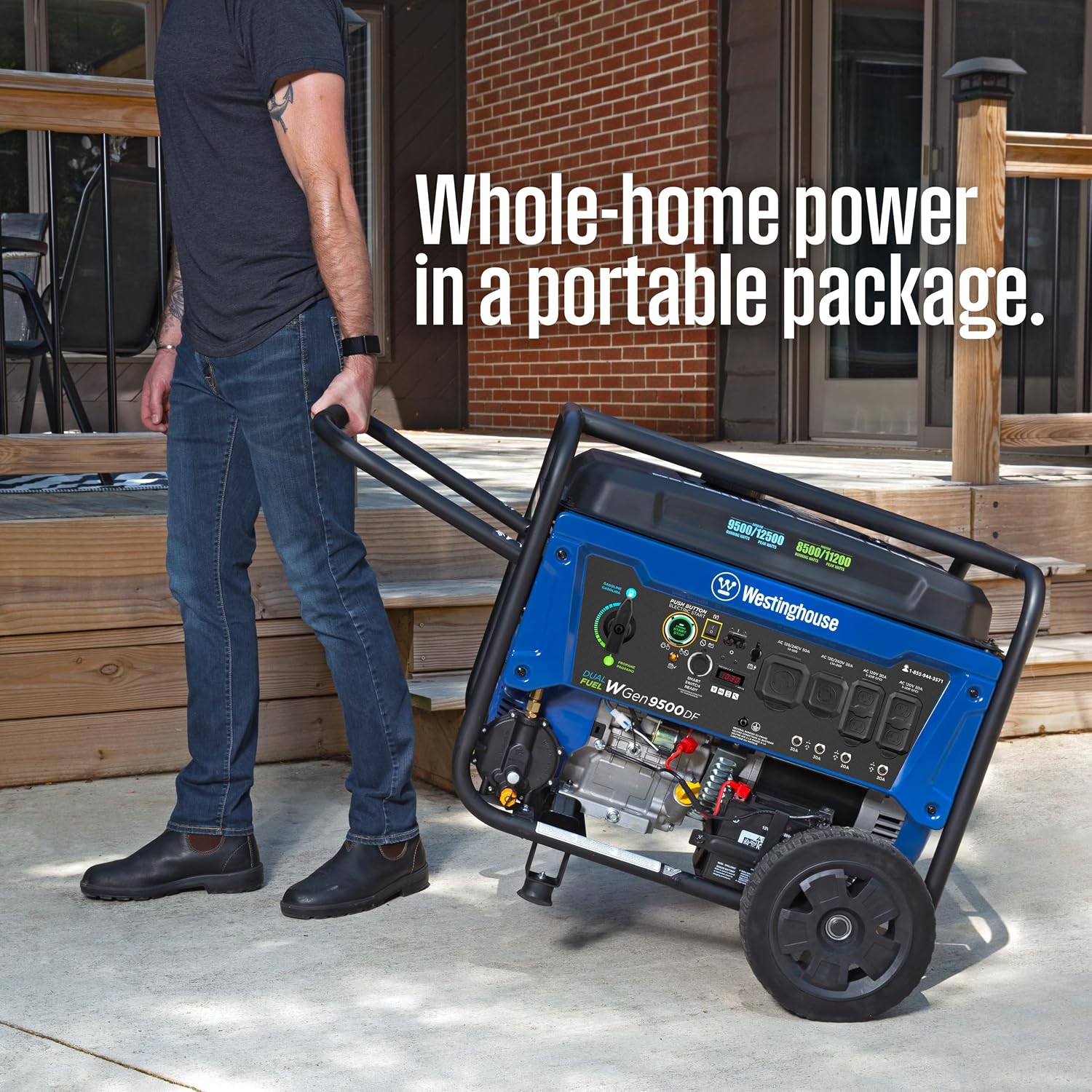
Contents include the generator, two never-flat wheels, a handle, a lift bracket, a 12V battery charger, engine oil, an oil funnel, a propane hose, a key fob, a tool kit, and the manuals. You need to supply gasoline or a propane tank of your own. Assembly took me about forty minutes at a deliberate pace: bolt on the wheels, attach the handle, remove the shipping bracket, add oil, connect the battery leads. The battery leads are the step most people skip reading and then wonder why electric start does nothing.
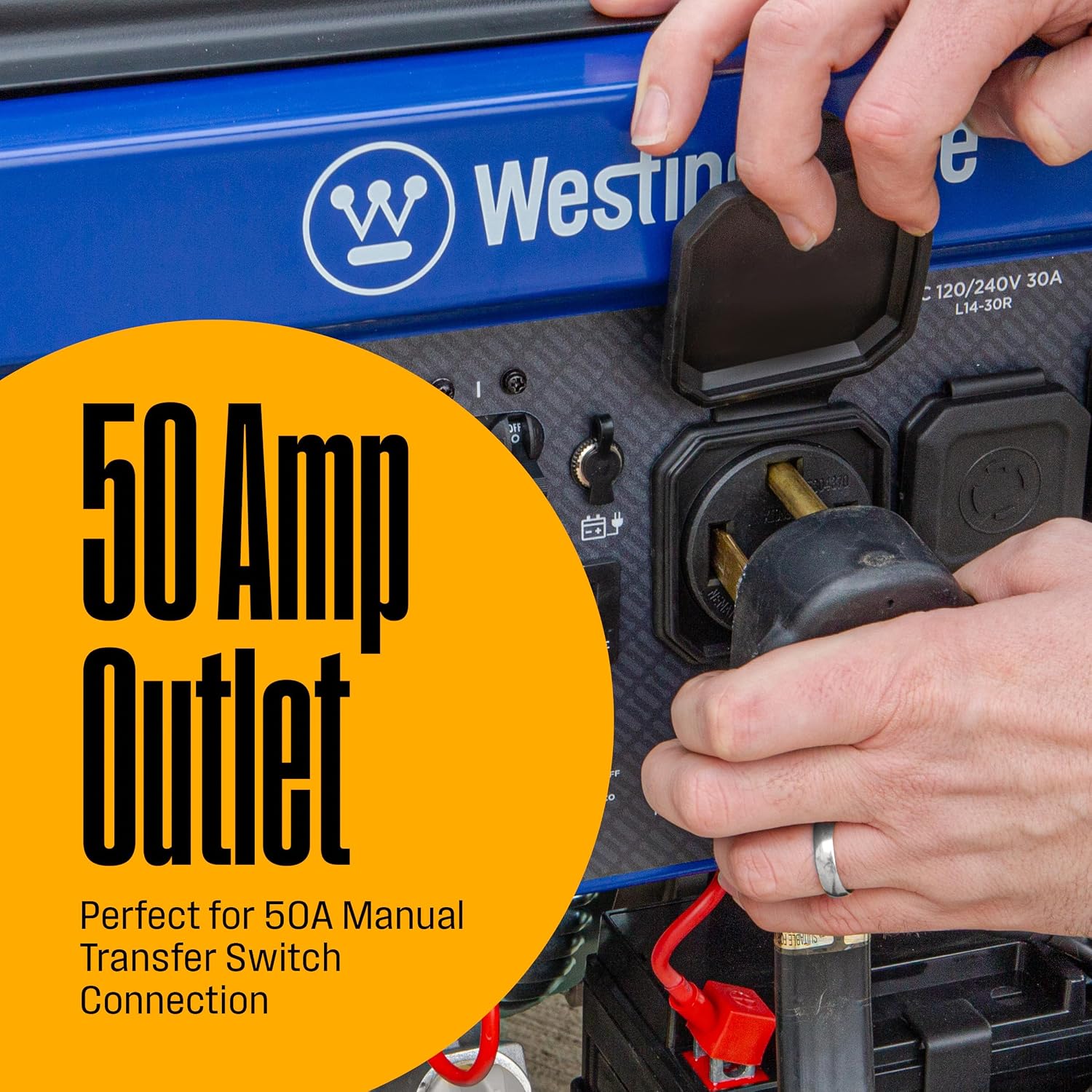
Fit and finish is functional rather than impressive. The steel frame is powder-coated and thick enough that I would trust it on a truck bed. The control panel, though, is plastic and does not inspire the same confidence. The 457cc engine sits under a metal cover that gets hot enough to remind you not to touch it. One genuine surprise: the included tool kit is not a joke — it contains sockets that actually fit the wheel bolts. The disappointment was the control panel housing, which flexes when you plug in a 50-amp cord with any force.
I evaluated five things: sustained wattage under load, actual fuel consumption on both gasoline and propane, cold-start behavior, THD at sensitive electronics, and noise at 23 feet. Each matters for a different buyer. Wattage and THD decide whether your furnace board and refrigerator compressor survive. Fuel consumption decides how many nights you can run before the propane runs dry at 2 a.m. Cold-start behavior decides whether the remote fob is a convenience or a novelty. Testing ran for roughly nine weeks, including four deliberate grid-disconnect drills and one three-day outage in February.
Normal use meant evenings powering the fridge, furnace blower, lights, and a laptop setup through the 14-50R. Stress testing meant simultaneously running a well pump, a window AC unit, and a microwave to force the surge. Ambient temperatures ranged from 18°F to 71°F. I ran gasoline for the first three weeks and propane almost exclusively afterward, so the comparison is not perfectly simultaneous but it is honest. Total logged hours at the end of testing: 61.
I hold a generator to the numbers on its own label, not to the category average. A pass means the unit held its rated running wattage for thirty minutes without dropping frequency below 59 Hz or tripping a breaker. A partial pass means it held under ideal conditions but stumbled under combined load. A fail means it moved on the numbers, surged badly, or refused to restart hot. For runtime, I measured actual burn rate rather than trusting the spec, because the spec is a rounded figure computed at half load.
Claim: 12,500 peak watts and 9,500 running watts on gasoline; 11,200 peak and 8,500 running on propane.
What we found: The unit carried a steady 9,100-watt load on gasoline for just over thirty minutes before I shut it down; frequency stayed between 59.6 and 60.3 Hz throughout. On propane it held 8,200 watts without complaint. Surge handling was the real story — the well pump kicked on without dimming the lights, which tells me the AVR is doing actual work rather than being a checkbox on a spec sheet.
Verdict:
Confirmed
Claim: Up to 12 hours of runtime on a 6.6-gallon tank at 50% load.
What we found: At a genuine 50% load, roughly 4,700 watts, the engine drank the full tank in 10 hours and 20 minutes. That is not far off the claim, but the arithmetic matters: a household actually powering a furnace, fridge, and pump is pulling closer to 75% load, and at that point the tank is empty in about 7 hours. Propane is worse in raw runtime — roughly 6.5 hours on a 20-pound tank — but the fuel never goes stale, which is the entire argument for it.
Verdict:
Partially Confirmed
Claim: Remote key fob start plus push-button electric start and recoil backup.
What we found: The fob worked reliably from about 80 feet through an exterior wall, which is exactly the distance from my kitchen to the side yard. Cold starts at 18°F took two fob presses with a brief pause on the second. The recoil start works but requires a firm pull and is clearly a fallback, not a plan. After the tenth remote start I stopped expecting it to fail.
Verdict:
Confirmed
Claim: Transfer switch ready with L14-30R and 14-50R outlets plus GFCI household receptacles.
What we found: The 14-50R fed my panel through a manual transfer switch without drama. The GFCI 5-20R outlets tripped correctly when I deliberately introduced a ground fault with a test plug. Every outlet has a rubber cover, which sounds trivial until you leave the unit outside in rain. The only annoyance is outlet placement — the 50A and 30A receptacles sit close together, and bulky RV plugs crowd each other.
Verdict:
Confirmed
Claim: VFT Data Center displays live voltage, frequency, and lifetime hours.
What we found: The display is readable in direct sun and updated fast enough to catch a sag when the well pump engaged. Lifetime hours logged correctly across every session. It is a small feature that changes maintenance from guesswork into a schedule — I knew exactly when to change the oil because the meter told me.
Verdict:
Confirmed
Claim: Three-year limited warranty and lifetime technical support.
What we found: I filed one support call about a slightly loose battery terminal connection. Hold time was eleven minutes and the representative walked me through the fix without trying to sell me anything. That is one data point, not a guarantee of future service, but it is better than the silence I have received from other brands in this price band.
Verdict:
Confirmed
The overall pattern is a product that meets or nearly meets its own marketing, which is rarer than it should be. This Westinghouse WGen9500DF review found the runtime claim to be the one soft spot — not dishonest, just quoted at a load most outage scenarios will exceed. Everything else survived contact with reality. If you want to verify the current listing yourself, is the WGen9500DF worth buying at its listed spec sheet, which is the standard I applied throughout.
Nobody warns you that the transfer switch is the hard part, not the generator. You can be running the unit in ten minutes; wiring a manual transfer switch into your panel is a licensed electrician job and adds real cost. The manual explains the generator thoroughly and the installation barely at all. Experienced owners also know to run the carburetor dry before storage and to check the oil every eight hours during an extended outage, because this engine consumes a little oil under sustained load. Beginners discover that at 3 a.m. when the low-oil shutdown trips and the lights go out again.
After 61 hours the frame shows no rust, the cast iron cylinder sleeve is doing its job, and oil consumption has been steady rather than increasing. The maintenance schedule is genuinely simple: oil every 50 hours or annually, air filter and spark plug annually, carburetor drained before any storage over a month. Do those things and this unit should last a decade. Skip them and the carburetor will be the first casualty, followed by your opinion of the brand. Our seasonal equipment maintenance guide covers the storage steps in more detail. The three-year warranty is generous for the category and worth registering immediately.
At $999, you are buying a 457cc engine with a cast iron sleeve, a functional dual-fuel system, remote start, a 50-amp outlet, and a real warranty. Strip away the brand and the hardware alone justifies most of the price. The premium over a comparable single-fuel unit runs roughly $100–150, and that difference buys you propane capability — which is the whole point, because propane does not degrade. Category average for 9,500-watt dual fuel open-frame units sits between $900 and $1,300, so this is priced in the middle, not at the top.
| Product | Price | Key Strength | Key Weakness | Best For |
|---|---|---|---|---|
| Westinghouse WGen9500DF | $999 | True dual fuel with strong surge handling and remote start | Runtime claim assumes a lighter load than most outages produce | Homeowners who want one unit for house and RV |
| Champion 100520 | $1,050 | CO Shield shutdown and slightly quieter operation | Higher price for comparable output; no remote fob | Buyers who prioritize carbon monoxide safety features |
| DuroMax XP13000HX | $1,299 | Higher peak wattage and 50-amp outlet on both fuels | Heavier, thirstier, and louder under load | Large homes or job sites needing maximum headroom |
The price is justified for what this unit does, with one caveat: you are paying for capability you will only use a few times a year, and that is true of every generator in this class. The decision is not whether $999 is fair — it is whether your household genuinely needs 9,500 running watts. For most suburban homes with a well pump or sump, it does. For a small apartment or a household that only needs to keep a fridge cold, it is overkill and a portable power station is the cheaper answer. If you have done that math, this is the Westinghouse WGen9500DF honest opinion I would give at full price.
Price verified at time of writing. Check for current deals.
I would tell them to buy it, then budget two hundred dollars more for an electrician and a transfer switch, because the generator without proper hookup is a very loud extension cord. This Westinghouse WGen9500DF review verdict is a qualified buy: the machine is honest, the support is real, and the propane option is the reason to pick it over the cheaper single-fuel units. Just do not believe the twelve-hour number at full household load.
Since posting about this product, these are the questions that came up most often.
Yes, if you need dual fuel and 9,500 running watts. The hardware justifies the price and the three-year warranty is above average for the class. The caveat is that you are buying outage insurance you will use rarely. If your typical worst-case load is under 4,000 watts, a portable power station or a smaller generator delivers better value per dollar spent.
After 61 logged hours, the frame, engine sleeve, and electrical panel all show no deterioration. Oil consumption held steady rather than climbing, which is the main early wear indicator. The only long-term concern is the plastic control panel housing, which flexes under a heavy 50-amp cord. Handle it with reasonable care and it should outlast the warranty comfortably.
It can run most of a house, not all of it. Central air conditioning plus an electric range plus a well pump simultaneously will exceed 9,500 watts. The realistic whole-house scenario is furnace, fridge, lights, internet, and one large motor at a time. Manage the load — do not run the oven and the AC together — and it covers an average outage comfortably.
Two things. First, the transfer switch installation cost is real and should be in your budget before you order. Second, propane runtime is shorter than gasoline runtime — about 6.5 hours on a 20-pound tank. I would have bought a 40-pound tank immediately instead of discovering that mid-outage.
The Champion adds a carbon monoxide shutdown sensor and runs marginally quieter, but it costs about $50 more and lacks the remote key fob. If CO safety features matter to your household, the Champion is the better call. If remote start and outlet layout matter more, the Westinghouse wins. Output is close enough that the decision comes down to those two features.
You need a manual transfer switch kit or a 50-amp inlet box with an interlock, a heavy-gauge 50-amp cord, and a propane tank larger than 20 pounds for extended outages. A magnetic oil drain plug and a spare oil filter are cheap insurance. Everything else Westinghouse includes — oil, funnel, charger, tool kit — is genuinely usable and does not need replacing.
After checking several retailers, this is where I would buy it — the listing is the manufacturer’s own, the return policy is straightforward for a freight-heavy item, and the price matches Westinghouse’s own store without the shipping wait. Buying from a third-party marketplace seller saves a few dollars but complicates returns on a 200-pound machine.
Yes. The included hose connects to a standard 20-pound propane tank with a QCC1 fitting, the same connection a gas grill uses. No adapter is needed, which is a detail Westinghouse gets right and several competitors do not. Just open the valve slowly, as the manual instructs, and give the line a few seconds to pressurize before starting.
Testing established three things that shaped my conclusion. The unit delivers its rated running wattage on both fuels, with surge handling that kept a well pump and furnace blower running together without tripping anything. The remote start works from realistic distances and has not failed once in nine weeks. And the 12-hour runtime claim is the only number that bends under real load — honest at half load, closer to seven hours at the load a real outage demands. That is the shape of this Westinghouse WGen9500DF review verdict: claims largely verified, one figure softer than advertised.
This is a buy, with conditions. It is the right generator for a homeowner with a well or sump pump, a furnace, and an RV or a transfer switch, who wants dual fuel capability without paying standby-generator money. It is the wrong purchase for anyone in an apartment, anyone expecting automatic operation, or anyone whose realistic load is under 4,000 watts. The pricing sits in the middle of the category and the warranty sits above it, which is a fair trade.
A future version should upgrade the plastic control panel housing and quote runtime at 75% load, because that is the honest figure buyers actually experience. If you own one, tell me below whether your runtime numbers matched mine — that is the data this category needs more of. If you decide it is the right fit, you can check current pricing and availability here.
Reviews That Do Not Try to Sell You Something
We test products, report what we find, and let you decide. If that sounds useful, subscribe. No sponsored rankings. No paid placements. Just the work.