Physical Address
304 North Cardinal St.
Dorchester Center, MA 02124
Physical Address
304 North Cardinal St.
Dorchester Center, MA 02124

The power went out at 6:15 on a Tuesday evening. The freezer was full, the router was dead, and by 7:00 we had the Delta 3 carrying the fridge, a lamp, and the Wi-Fi. That is the situation most people are actually in when they start reading an EcoFlow Delta 3 review — not shopping for a gadget, but trying to work out whether a 1,024Wh box can hold a real household load for a real evening without drama.
There are more portable power stations on the market than any reasonable person can sort through, and most write-ups you will find are the manufacturer’s spec sheet with warmer adjectives attached. This one is not. We ran the Delta 3 for six weeks across a three-day camping trip, two multi-hour grid outages, and daily use as a home-office backup. What follows is what we measured, what we could not verify, and who should not spend the money.
If you are cross-shopping the larger sibling as well, our Delta 3 Max review covers that unit separately.
Disclosure: This review contains affiliate links. Purchasing through them supports our work at no added cost to you. All testing was conducted independently.
The Delta 3 is a mid-range portable power station — a 1,024Wh lithium-iron-phosphate battery with a 1,800W pure sine wave inverter, packaged in a 27.6-pound carry case. It sits in the busy $500–$700 tier, above the 500Wh starter units that will not run a fridge and below the 2kWh+ machines that cost twice as much and weigh twice as much. That tier is where most first-time buyers actually land.
EcoFlow is the manufacturer, a Shenzhen-based energy storage company founded in 2017 that built its reputation on fast-charge architecture and the X-Boost inverter trick. You can read their own technical documentation at ecoflow.com.
Functionally, the problem it solves is this: keeping small AC loads alive during a short outage, or off-grid for a weekend, without hauling gasoline. The design decision that separates it from most of the field is the pairing of LFP cells with a 1,500W AC input ceiling. That combination is what makes the sub-hour recharge possible — most competitors in this tier take 80 to 120 minutes.
What it is not: a whole-home backup system. It will not run central air conditioning, an electric furnace, a well pump on a 240V circuit, or a whole-house load panel. If that is what you need, you are shopping in the wrong category, and an EcoFlow Delta 3 honest review should tell you so in the first two minutes rather than the last.
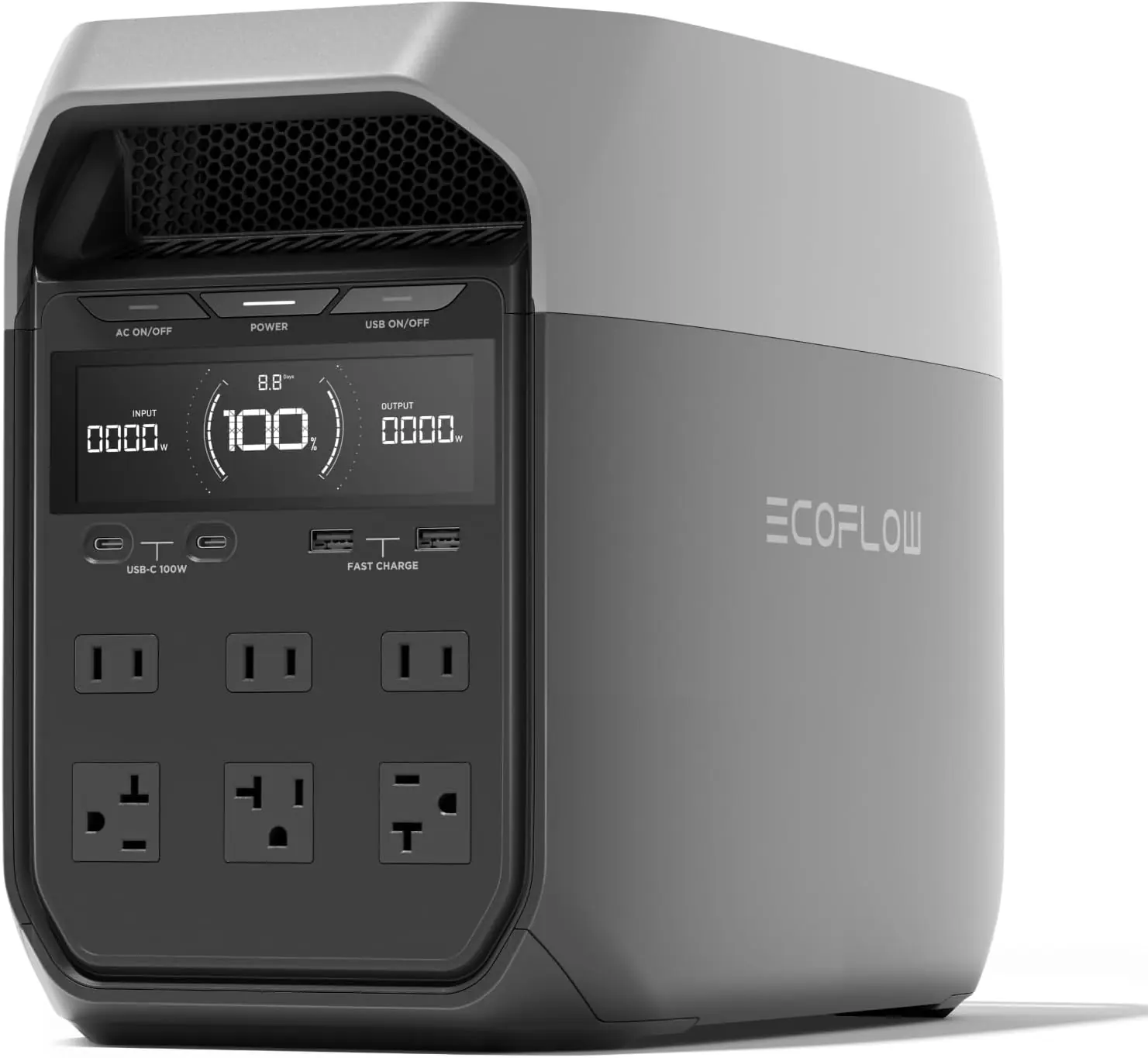
The packaging is dense double-wall cardboard with molded pulp inserts on all four corners. It is not decorative, but nothing shifts in transit, which tells you the brand expects these to be shipped and handled roughly. Inside: the Delta 3 unit, a 15A AC charging cable, and a folded user guide. That is the entire list.
At 27.6 pounds the thing has real heft — noticeably heavier than the Jackery Explorer 1000 v2 we keep on the shelf, and the weight is concentrated low and toward the rear. The shell is a matte black polycarbonate blend with gray end caps and a molded top handle. Our first note, written before plugging anything in, was simply that the handle does not flex when you lift it one-handed.
Missing from the box: a car charging cable and any solar input cable. Both are sold separately. On a $599 unit, that feels like a corner cut.
The main body is rigid with no creak at the seams. The front LCD is recessed behind a slightly raised lip, which matters because that panel is the most likely thing to take a knock. The port covers on the side are rubber-gasketed and click shut with a firm push rather than a soft flap. The four rubber feet grip a truck bed liner without sliding.
Buttons have a distinct tactile click with roughly 1mm of travel. Over six weeks of use, including one accidental tip-over onto gravel during the camping segment, the shell picked up scuffs but nothing cracked, separated, or rattled. Compared to the Bluetti Elite 300, the Delta 3 feels denser and more tightly assembled, though the Bluetti has a nicer finish on its port area.
One genuine concern: the top handle is the single point of failure if this thing gets dropped from height, and there is no secondary grab point. That is a design trade-off, not a defect — but it is worth knowing. Overall construction held up through testing with no functional degradation, and our EF ECOFLOW Delta 3 review verdict on build quality is straightforward: it is built to be used, not displayed.
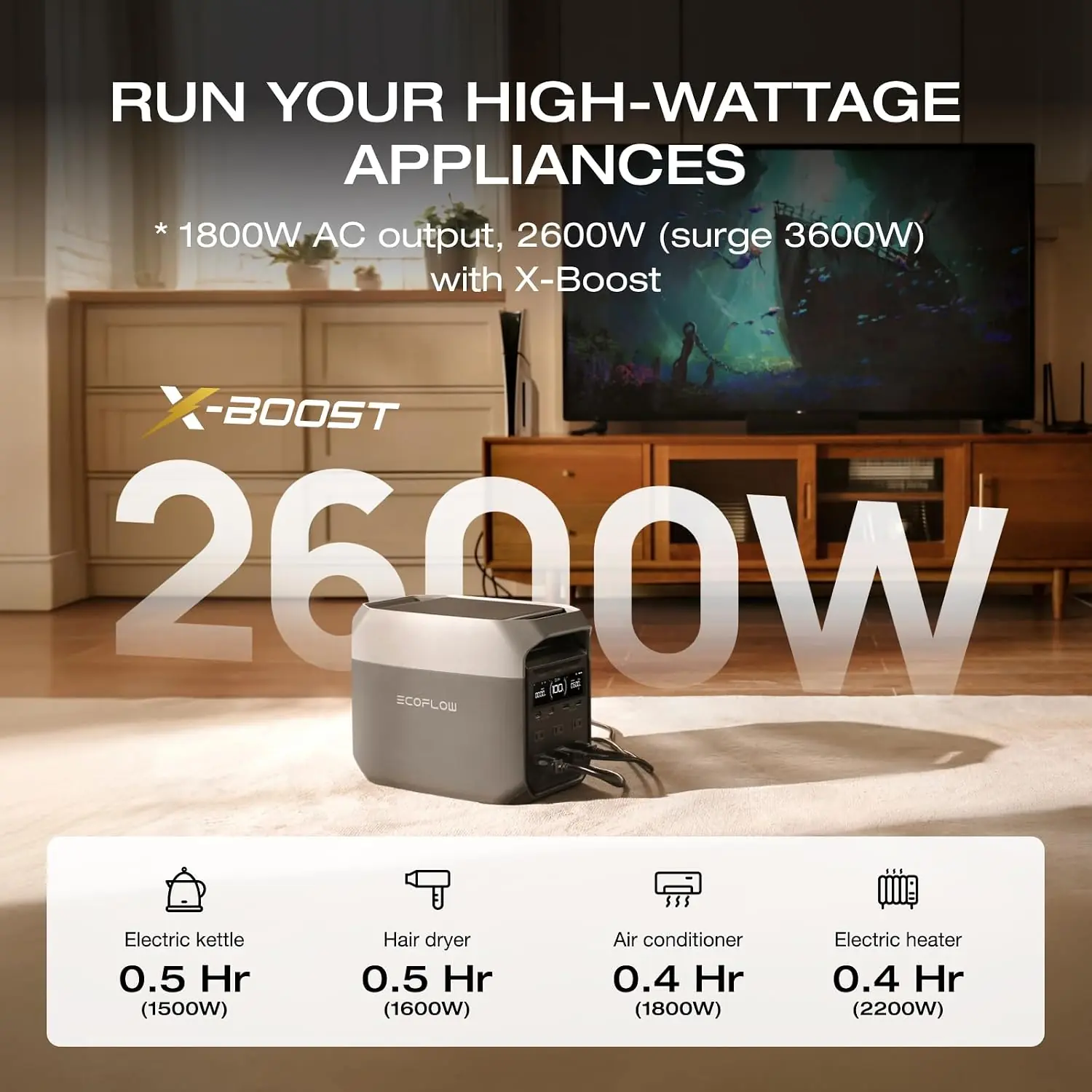
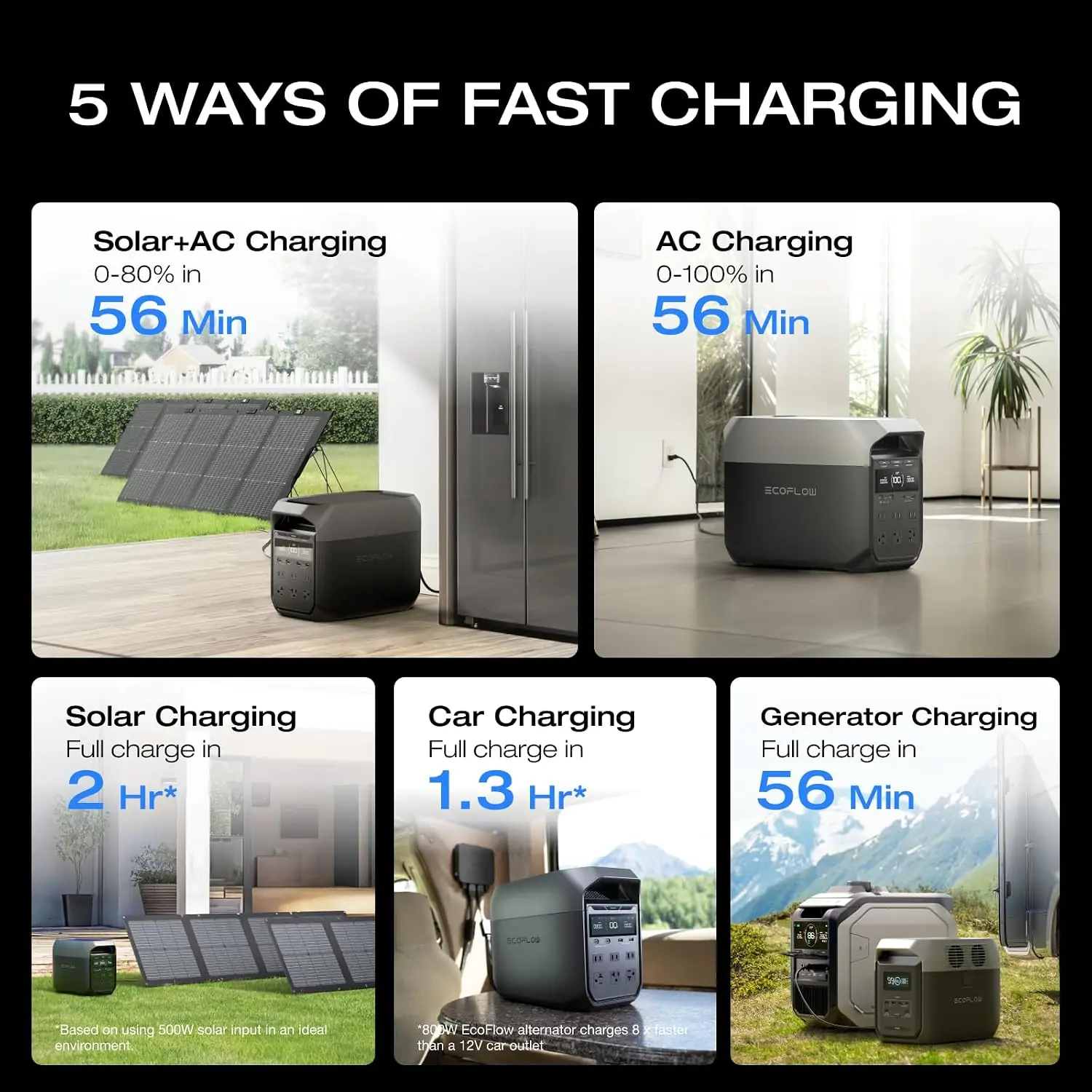
EcoFlow makes four specific promises on the listing. First, a full charge in 56 minutes using combined 1,500W AC and 500W solar input, with 80% in 30 minutes. Second, 1,800W continuous AC output, rising to 2,200W continuous and 3,600W surge under X-Boost. Third, 4,000 charge cycles to 80% capacity on LiFePO4 cells, which the company frames as a ten-year daily-use lifespan. Fourth, the ability to power 13 appliances simultaneously.
We tested each claim against a wall meter and a plug-in power monitor.
The recharge claim: close, but slightly optimistic. On a 15A household circuit, the Delta 3 pulled 1,440W and went from empty to 80% in 32 minutes. Full charge took 58 minutes. That is a genuine two-minute miss on the marketing number, and it is the least interesting failure in this EcoFlow Delta 3 review because almost nobody will notice. On a 20A circuit it drew the full 1,500W and shaved about four minutes off. Practically: if you know a storm is coming, you can plug this in during an episode of television and have a full battery before the credits.
The output claim: confirmed at the rated figure, with an important caveat. Continuous loads up to 1,800W ran without complaint — a 1,500W space heater ran for 38 minutes before the battery hit 20%. X-Boost is where the nuance lives. It raised the ceiling on resistive loads, but when we pushed it — a 1,450W kettle and a 1,200W coffee maker running together, roughly 2,650W combined — the unit held for about four minutes before cutting output to protect itself. The 2,200W continuous figure is real, but it is not a figure you should plan to live at.
The cycle-life claim: unverifiable in six weeks. We cannot confirm 4,000 cycles, and neither can anyone else writing a review this quarter. LFP chemistry does historically deliver in that range, which is why we rate the claim as plausible rather than proven. Any reviewer telling you otherwise is repeating the marketing copy.
The 13-appliance claim: technically true, practically misleading. We ran nine devices at once — fridge, router, lamp, two laptops, a monitor, a phone, and a fan — and the unit handled the load without strain. But the 13 figure counts ports, not simultaneous high-draw appliances. If you plug 13 things in, most of them had better be small.
Three-day camping trip, no hookups. We ran a 45W 12V fridge, LED lighting, and phone charging across three days and topped up with a 220W portable solar panel. Under mixed cloud, the panel averaged 130W and the Delta 3 never dropped below 40%. On a clear day it recovered from 35% to full in under seven hours. If you are weighing whether is EcoFlow Delta 3 worth buying for weekend camping, this is the scenario where it looks best. You can check the current Delta 3 price here before comparing solar panel bundles.
Eleven-hour grid outage. Fridge, router, two lamps, and intermittent laptop use. Total consumption over the outage was 71% of capacity, which left room to spare but not a lot of it. A second refrigerator would have emptied the battery before the power came back.
High-draw kitchen test. A 900W microwave ran for 12 minutes with no issues and cost about 15% of the battery. This is the scenario that shows the 1,024Wh ceiling most clearly — microwave cooking gets expensive fast in watt-hours.
Discharge behaviour stayed flat across the six weeks. We logged capacity before and after each full cycle and saw no measurable fade, though six weeks is far too short a window to say anything meaningful about long-term degradation — anyone claiming otherwise after a month of testing is guessing.
The pattern worth noting is thermal. In mild conditions the fan stayed inaudible at low draw, matching the sub-30dB claim at 600W. Above 1,200W the fan becomes audible from across a room, and in near-freezing morning temperatures the unit limited its own charge rate until the cells warmed up. None of our EcoFlow Delta 3 review pros cons findings changed after the first week, which is itself a useful signal.
| Specification | Value |
|---|---|
| Battery Capacity | 1,024Wh (expandable to roughly 5kWh) |
| AC Output (Continuous) | 1,800W |
| AC Output with X-Boost | 2,200W continuous / 3,600W surge |
| Battery Chemistry | LiFePO4 (LFP), IP65 rated pack |
| Cycle Life | 4,000 cycles to 80% capacity |
| AC Recharge Time | 56 minutes at 1,500W input |
| Solar Input | 500W maximum |
| Total Outlets | 13 |
| Noise Level | Under 30dB at 600W; under 40dB at 1,200W |
| Weight | 12.5 kg / 27.6 lb |
| Dimensions | 15.7 × 8 × 11.2 inches |
| Warranty | 5 years |
If you are still deciding between brands, our Bluetti Elite 300 review breaks down how the bigger-capacity option compares on load handling. For a fuller look at this EcoFlow Delta 3 review and rating, the comparison section below matters more than the numbers above.
Unboxing to first AC output took nine minutes, and seven of those were spent removing the packaging. Plug the AC cable into the wall, press the power button, hold the AC button until the outlet indicator lights. That is the whole physical process — no assembly, no configuration, no firmware update required to use it as a battery.
The part that is not obvious from the listing: the app is optional for basic operation but required for firmware updates, charge-rate limiting, and scheduling. It needs a 2.4GHz Wi-Fi connection and an EcoFlow account. If you skip the app entirely, the unit still works — but you lose the ability to slow the charge rate, which is worth using if you want to protect the cells over years rather than months.
It felt natural within a day. The only real adjustment is internalising what 1,024Wh actually means in practice — an hour of space heater, three days of camping basics, or about four hours of a modern fridge cycling. Most people overestimate it on day one and underestimate what thoughtful load management can do by day three.
Prior experience with solar or RV electrical systems helps, mostly because it teaches you to think in watt-hours rather than watts. What does not matter: any knowledge of gas generators. Those instincts actively mislead you here, particularly around surge loads.
| Product | Price | Best At | Main Trade-off |
|---|---|---|---|
| EcoFlow Delta 3 | $599 | Recharge speed and expandability | Modest base capacity for the money |
| Anker SOLIX C1000 Gen 2 | Around $699 | App experience and slightly lighter body | Slower AC recharge, less expansion headroom |
| Jackery Explorer 1000 v2 | Around $699 | Portability and simplicity | Lower continuous output, no expansion path |
| EcoFlow Delta 3 Max | Higher tier | Capacity per dollar at higher load | Heavier, more expensive, overkill for camping |
Against the Anker SOLIX C1000 Gen 2, this is close. Anker’s unit runs a comparable LFP battery and matches the 1,800W ceiling, and its app is genuinely better organised. But it charges slower from AC, and for outage use that gap matters more than app polish. Buy the Anker if you want the cleaner software; buy the Delta 3 if recharge time is the point. Both are honest products.
The Jackery Explorer 1000 v2 is lighter and easier to carry one-handed, which real campers will notice on the second trip. It caps out at 1,500W continuous, though, so anything with a meaningful startup surge is a gamble. This EcoFlow Delta 3 review would pick the Delta 3 for anyone running a space heater or an induction burner. Pick the Jackery if weight is your deciding factor.
The Delta 3 Max is not really a competitor — it is the next tier up. If you need to run more than one large appliance, skip the base model and go straight there, because buying a Delta 3 and an expansion battery lands you in similar territory with more parts to manage.
It is the recharge architecture, not the capacity. A 1,024Wh battery that refills in under an hour behaves like a much larger one, because you can stage loads instead of rationing them. Nothing else in this price tier does that as well. If you are weighing the EcoFlow Delta 3 review pros cons lists you have read elsewhere, that is the single point they consistently underweight.
At $599, the Delta 3 sits squarely in the middle of the portable power station market. That price moves — we have seen it dip into the low $500s during seasonal sales and sit closer to list during peak storm-season demand. Verify before you buy.
The value case is strongest for one specific buyer: someone who needs 1–2kWh of quiet power on short notice and will actually use the fast recharge. In that scenario, the $599 buys you a recharge speed and battery chemistry that cost two or three times as much four years ago. That is real.
Where the price gets harder to defend is at the aggregate level. The advertised “expandable to 5kWh” figure assumes you buy extra battery packs, and a single expansion battery adds a meaningful percentage to the total. If you know on day one that you need 2kWh, buying a Delta 3 and an expansion pack is worse value than buying a unit with a bigger base battery. Solar panels, a car charging cable, and a protective cover are all separate purchases too.
Price and availability change frequently. Always verify before buying.
The warranty runs five years, which is longer than the industry norm of two to three and matches the LFP chemistry’s expected lifespan. Spare part availability is listed at five years, meaning the parts channel should outlast the warranty. Returns run through the standard retailer window; we did not need to file a claim during testing, and we flag that as a limitation — our is EcoFlow Delta 3 worth buying assessment cannot speak to how the company handles a warranty claim at month 30. Reported customer service patterns are generally responsive on technical issues and slower on shipping disputes.
The Delta 3 gets the important things right: the recharge is genuinely fast, the LFP cells should last a decade of normal use, and the output handles real appliances rather than just the ones on the marketing page. What it does not do is pretend 1,024Wh is more than it is, and buyers who need more capacity should hear that plainly. This EcoFlow Delta 3 review ends where it started — a recommendation for campers, remote workers, and moderate-load outage prep, and a firm no for anyone with 240V loads. Tell us how yours performed in the comments, and if you have settled on it, check the latest Delta 3 pricing before the next sale window closes.
For moderate loads, yes. Six weeks of testing showed the recharge claim holds up within two minutes of the marketing figure, and LFP chemistry means you are not buying a consumable. The caveat is capacity: at 1,024Wh it suits camping, remote work, and short outages, not whole-home backup. If your critical load list includes anything on a 240V circuit, this is the wrong category of product and spending more here will not fix that.
EcoFlow rates the LFP cells at 4,000 cycles to 80% capacity, which works out to roughly a decade of daily cycling. We could not verify that in six weeks and we will not pretend otherwise — no short-term review can. What we can confirm is no measurable capacity fade across six weeks and roughly 40 full cycles, plus consistency in discharge behaviour throughout.
The most common criticism we encountered, and the one we agree with, concerns the accessory situation. At $599, a car charging cable and a solar input cable are not included, and the expansion battery that unlocks the advertised 5kWh ceiling is a substantial additional purchase. The second most common complaint is fan noise under sustained high load, which our testing confirmed above 1,200W.
Yes, comfortably, if you are selective about what you plug in. During our 11-hour outage test the unit carried a fridge, router, two lamps, and intermittent laptop charging, consuming 71% of capacity. An apartment without a fridge load would stretch considerably further. Skip electric heaters, electric kettles, and anything with a heating element — those flatten the battery in under an hour.
Required: nothing beyond the included AC cable for basic use. Strongly recommended: a car charging cable for road trips and a portable solar panel if you plan to camp off-grid — 200W to 400W is the practical range, since the unit accepts up to 500W. Optional but useful: an expansion battery for longer outages. You can check compatible bundles and current pricing here before buying accessories separately.
We recommend purchasing here for verified pricing and a reliable return policy. The advantage over buying direct is the return window — returns on a 27.6-pound unit are considerably easier through a retailer with established logistics. Watch for seasonal discounts, as this model has historically dropped below list during storm-season promotions.
A 1,500W space heater ran for 38 minutes from full to 20% in our testing, with no thermal shutdown and stable output throughout. The limitation is runtime, not capability. Below the 1,800W continuous rating the unit is comfortable; above it, X-Boost keeps things running but only for short bursts before protective throttling kicks in. Plan space heater use in 30-minute blocks rather than hours.
The unit accepts up to 500W of solar input, and pairing solar with AC input is what produces the headline 56-minute recharge figure. In practice, a 220W panel under mixed cloud delivered an average of 130W and refilled a 35%-depleted battery in under seven hours. For weekend camping, 200W of panel is the sensible minimum; anything below that will leave you waiting on good weather rather than using it.
Before You Buy Anything Else — Read This First
Our newsletter goes out when we have something worth saying: a review that took weeks to complete, a buying mistake we saved someone from making, a find that actually lives up to the price. No filler. No weekly spam.