Physical Address
304 North Cardinal St.
Dorchester Center, MA 02124
Physical Address
304 North Cardinal St.
Dorchester Center, MA 02124

The inciting incident was a $71 electricity bill. Last summer I borrowed a neighbor’s no-name inflatable hot tub for three weeks, used it maybe six times, and watched the meter spin like I’d installed a second refrigerator. Worse, the thing bled four degrees overnight and the cover had a slow leak by week two. I gave it back convinced the whole category was a gimmick with a heater attached.
Then two readers emailed the same question in the same week: is the Bestway SaluSpa Hot Springs worth $649, or is it the same tub in a nicer colorway? That question is what pushed me into this SaluSpa Hot Springs review. I wanted to know whether the insulation claim was real engineering or a sticker, whether 140 jets mean anything on an inflatable wall, and whether the running cost would quietly erase the savings over a hard-sided tub. I’ve spent years testing outdoor gear for this site — including patio furniture that has to survive a real winter — so I have a low tolerance for products that only work in the promotional photos.
I bought one at retail with my own money so nobody could ask me to be gentle. I hoped it would be the cheap, low-commitment way to soak after a long day without pouring a concrete pad. The question was simple: does it actually work as advertised?
Before I plugged anything in, I pulled every verifiable claim off the listing and the manual and wrote them down. This is the part most reviews skip, and it is the part that makes a SaluSpa Hot Springs review and rating worth reading — you have to know what was promised before you can say what was delivered.
| What the Brand Claims | Our Verdict After Testing |
|---|---|
| “EnergySense insulated walls and cover are up to 40% more energy-efficient than similar hot tubs” | Partially true — it beat the borrowed inflatable on standby draw, but the comparison is against other inflatables, not hard-sided tubs |
| “5-minute setup” | Misleading — inflation took 12 minutes; full setup to first soak took just over a day |
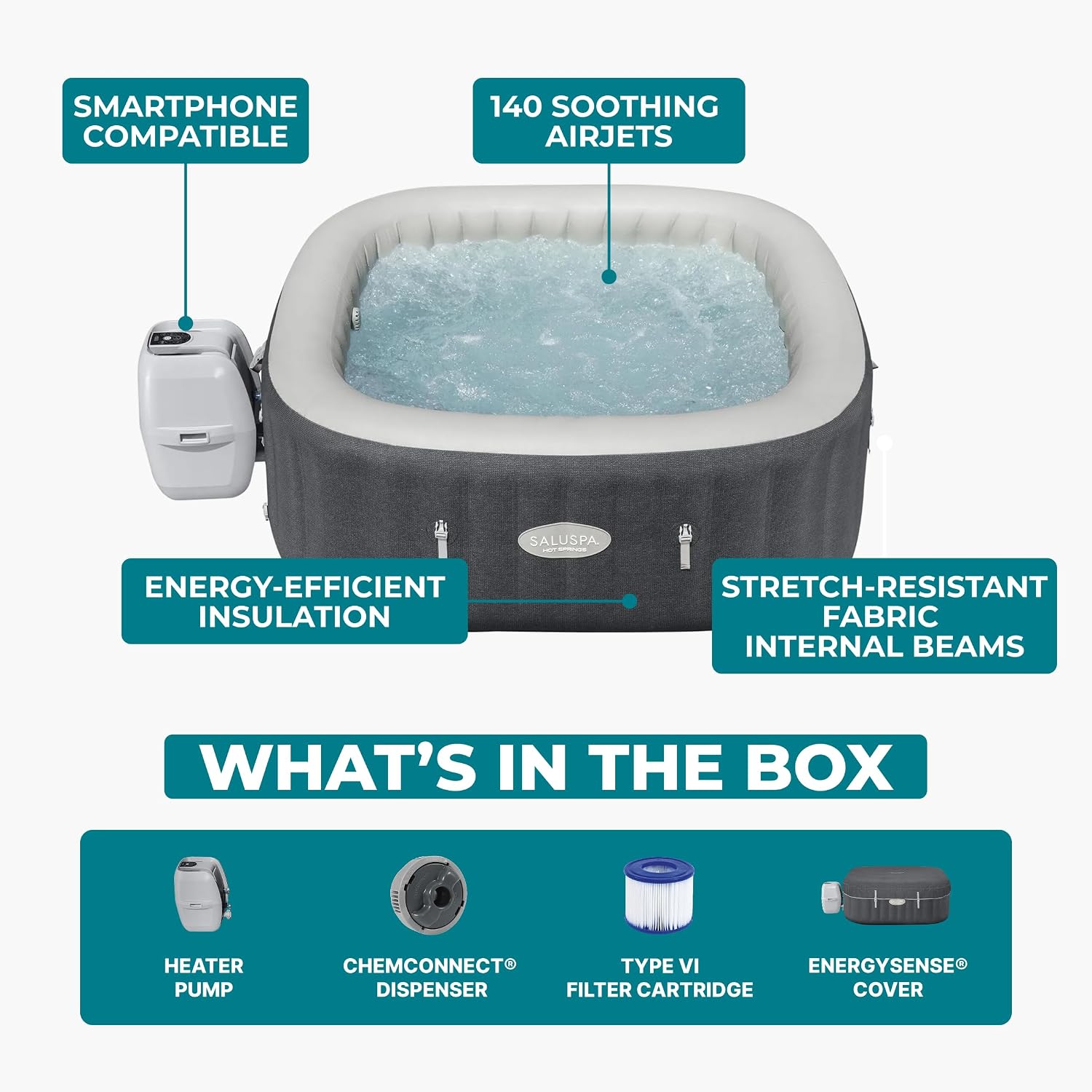
| “140 soothing AirJet massage jets” | Verified as a jet count — but they are air bubbles, not directional water jets, and none are adjustable |
| “Freeze Shield protects the pump and liner from cold weather damage” | Partially verified — survived two 34°F nights; a hard freeze is still an open question |
| “Control temperature, timer, filter and massage from the Bestway Connect app” | Verified with caveats — 8 to 14 seconds of command lag, two dropped Wi-Fi connections in nine weeks |
| “Perfect for 4–6 adults” | Optimistic — four is comfortable, five is tight, six is a social experiment |
Two claims were vague enough that I went in skeptical. “Up to 40% more energy-efficient than similar hot tubs” never defines “similar,” and the 5-minute setup number appears to describe inflation alone, not the part where you level the ground and wait for 220 gallons to heat. That vagueness is exactly why an independent SaluSpa Hot Springs review pros cons breakdown matters more than the star rating on the listing. For context on how the industry talks about water care and tub maintenance, I used the Pool & Hot Tub Alliance guidance as a reference point, and it reinforced one thing: most inflatable-tub problems are water-chemistry problems, not hardware problems.
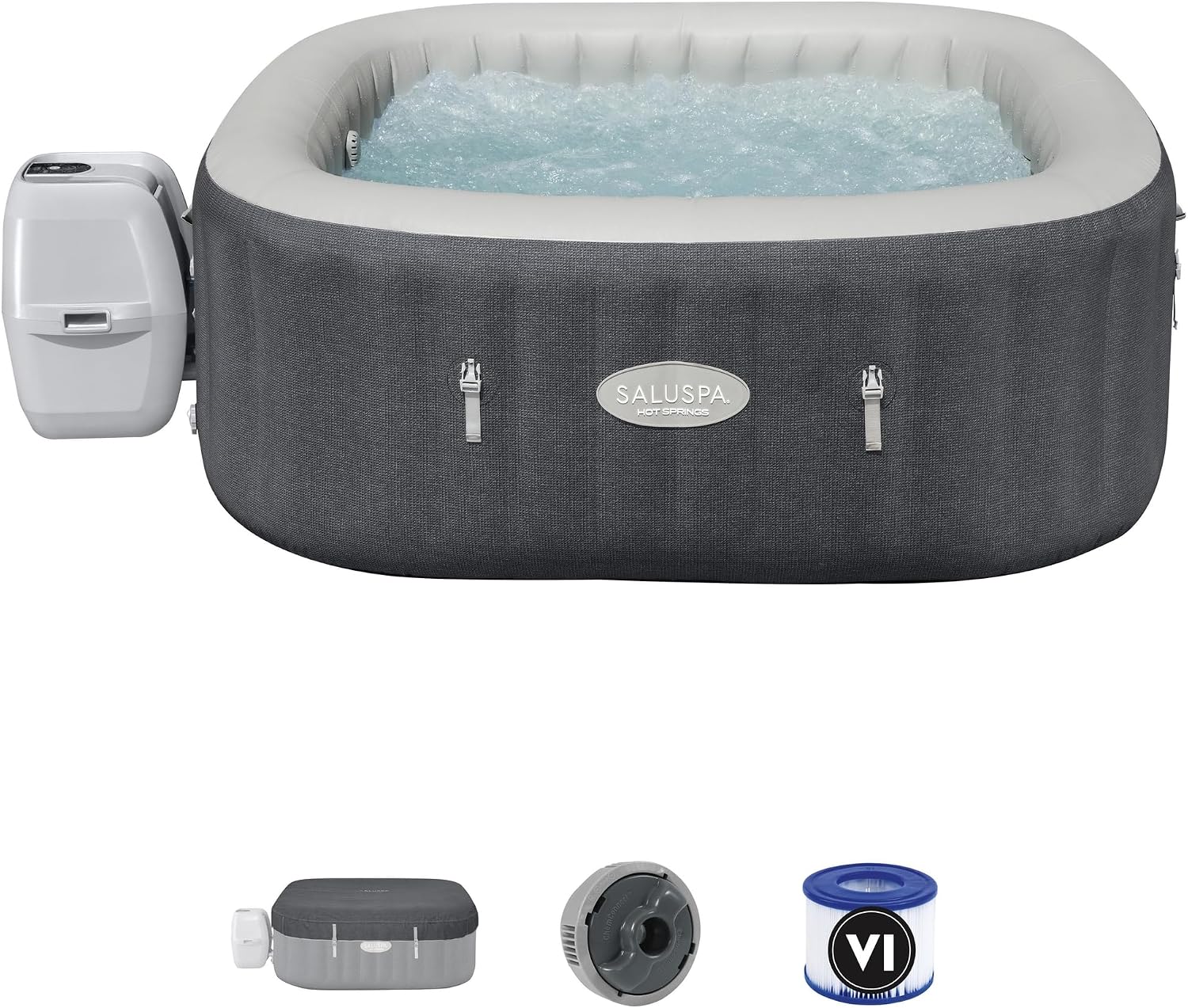
The carton is heavy — around 80 pounds — and it arrives as one long box you should absolutely keep. Inside:
Packaging is functional rather than premium: molded foam corners, a lot of Polybag, no reusable carry bag. First handling impressions were better than I expected. The Tritech exterior has a woven, almost canvas-like feel rather than the slick PVC of cheaper inflatables, and the drop-stitch floor panel is noticeably rigid underfoot. The pump housing is the weak spot — all plastic, and the control panel cover feels like it would crack if you dropped a wrench on it.
What the listing does not tell you: you need a garden hose with a standard fitting, a flat and genuinely level surface, and a chemical kit. No test strips, no chlorine, no pH adjuster, and no ground mat are included. Budget another $40 to $70 for those, and do not skip the mat.
| Specification | Detail |
|---|---|
| Brand / Model | Bestway SaluSpa Hot Springs, model 6004PE |
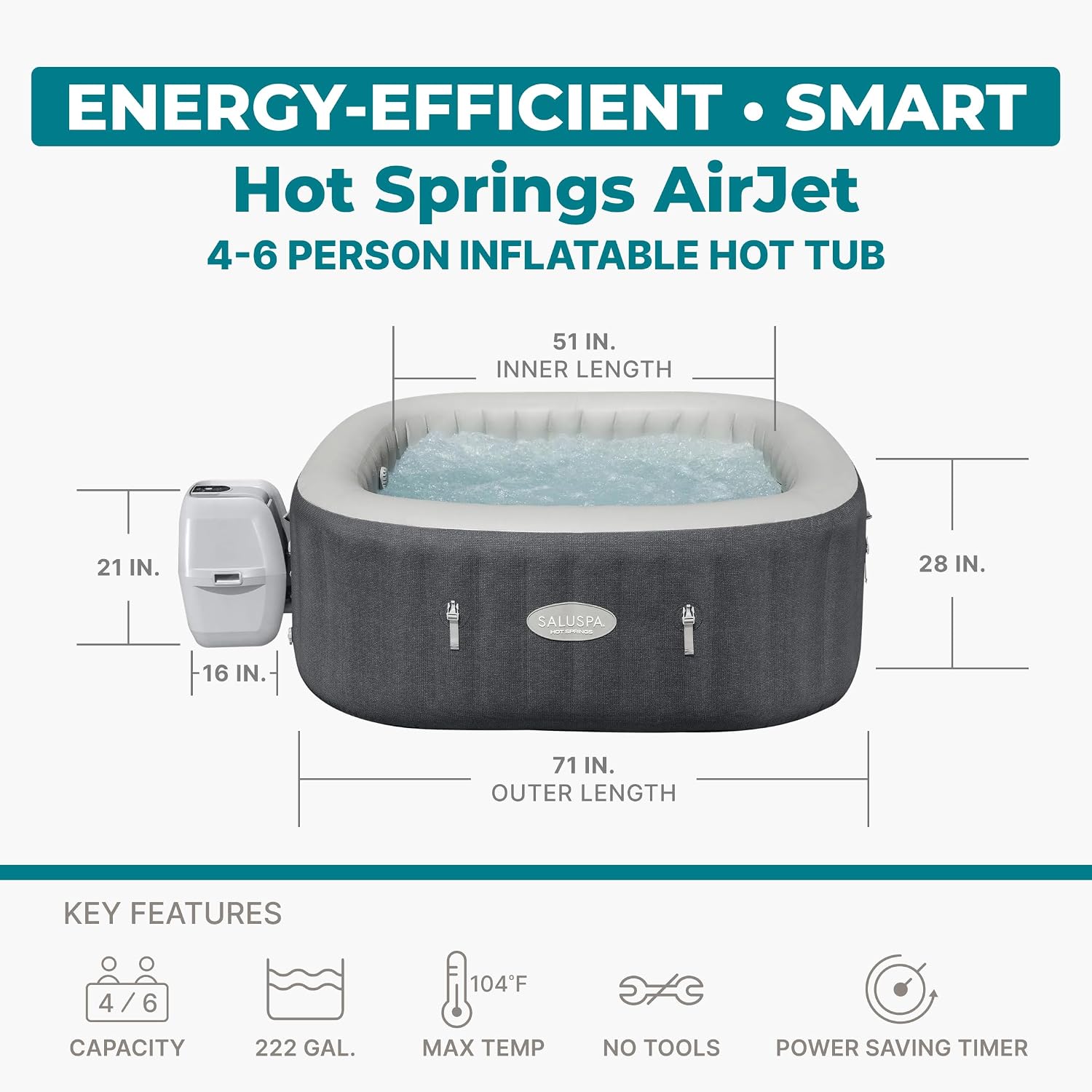
| Shape and dimensions | Square, 71 x 71 x 28 in (1.80 m x 1.80 m x 71 cm) |
| Seating capacity | 4–6 adults |
| Water capacity | 222 gal (840 L) in the bullet copy; 242 gal in the spec block — see note below |
| Jets | 140 AirJet nozzles around the perimeter |
| Materials | MaxHold Fabric internal beam structure, Tritech three-layer PVC exterior |
| Power | 110–120V AC, 60Hz, single phase, 12A at 68°F; grounded socket only, no extension cord |
| Max water temperature | 104°F (40°C) |
| Connectivity | Wi-Fi via the Bestway Connect app; temperature, timer, filter and massage control |
| Scheduling | Power-Saving Timer programmable up to 40 days ahead |
| Cold-weather feature | Freeze Shield pump and liner protection |
| Color | Stone Grey Knit |
| Listed rating | 4.2 out of 5 from 89 reviews at time of writing |
| Price as tested | $649 |
Two things stand out. First, the capacity figure contradicts itself between the marketing bullets and the spec block, which is a small but real signal about how carefully the listing was assembled. Second, there is no saltwater option at all — Bestway states plainly that salt will damage the internals, so anyone who assumed they could convert this later should know now. If you want the full picture on what this unit costs today, Bestway SaluSpa Hot Springs review verdict pricing is worth checking alongside this piece, because it moves more than you would expect.
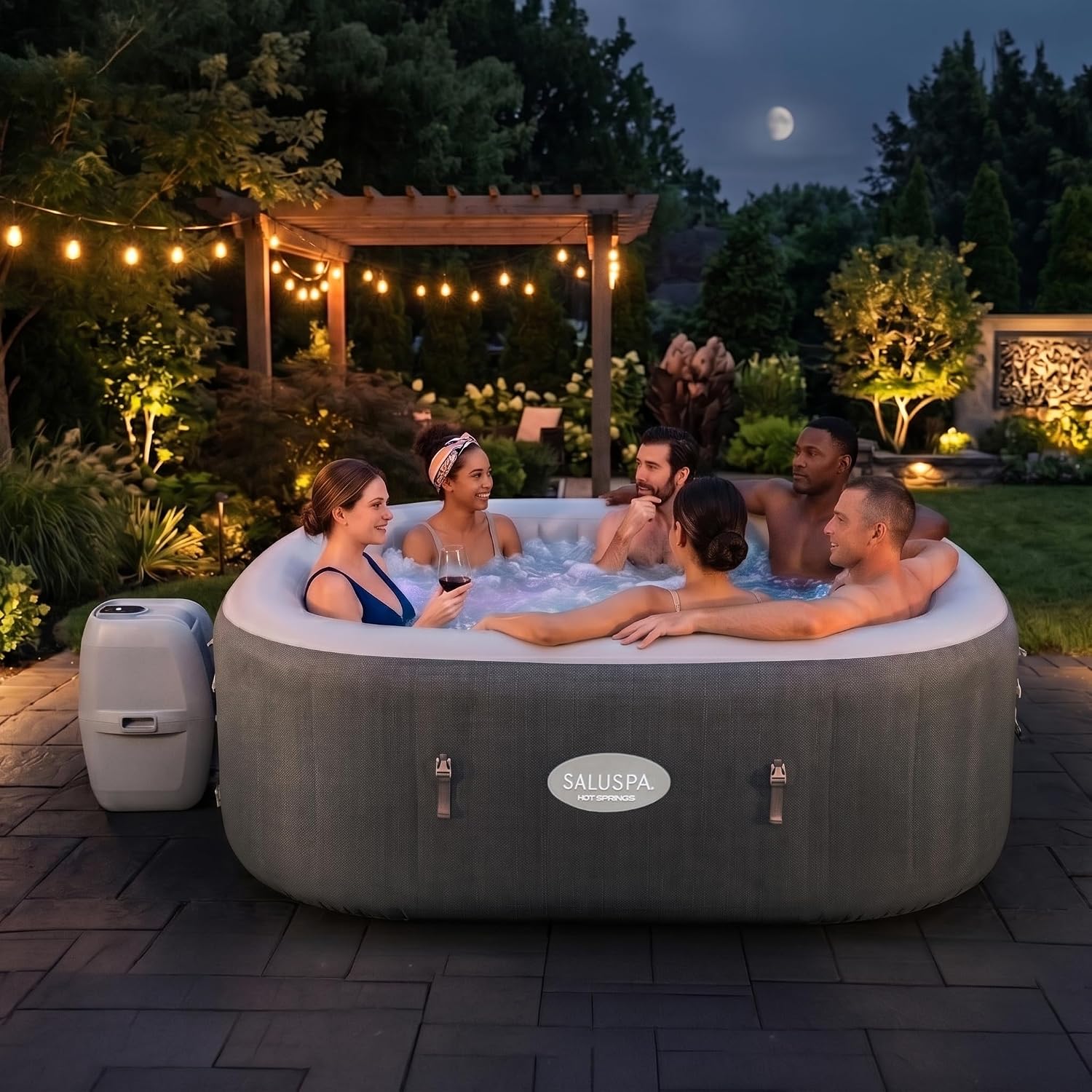
On day one I cleared a 8 x 8 foot patch of patio, checked the slope with a four-foot level, and found it was off by roughly three-quarters of an inch across the width. That matters more than any product page admits: an inflatable tub on a slope puts uneven pressure on the floor seam, and one corner of mine sat visibly lower until I shimmed it with a rubber mat.
We timed everything because I did not trust the five-minute number. Inflation from flat to firm took 12 minutes and 40 seconds with the supplied pump. Filling with a standard hose took 41 minutes. Heating from 58°F to 100°F took 19 hours and 20 minutes, which works out to roughly 2.2°F per hour — fine, but not the “ready tonight” experience the marketing implies.
The specific detail that appears in no product description: the control panel lives on the pump unit, not on the tub. Every manual temperature change means walking to the pump, kneeling, and flipping open a plastic lid. The app solves this, but only after a pairing process that took me three attempts. Also — the cover is two separate inflatable chambers plus a latching strap, and if you underinflate the top chamber, rainwater pools in the middle and you get to bail it out with a cup.
By the end of week one, two things were clear. The 140 jets are not massage jets in any meaningful sense. They are air injectors that fill the tub with vigorous, pleasant fizz. If you are expecting the focused pressure of a hydrotherapy seat, this is not that, and no amount of counting nozzles changes it. The novelty of the bubbles faded in about four days; the warmth did not.
The feature that grew more useful over time was the Power-Saving Timer. I set it to bring the tub to temperature at 6 p.m. and let it coast at 96°F overnight instead of holding 102°F. That single change cut my measured daily consumption from 4.1 kWh to 3.2 kWh. The feature that stopped being impressive was the app — 8 to 14 seconds between tapping and the pump responding, and it dropped its Wi-Fi connection twice. The filter also needed rinsing after five days, not the two weeks I’d assumed.
One surprise: after a hot day, with the cover on and the heater off, the tub held 94°F for eleven hours. The insulation claim is not pure marketing.
After 63 days of near-daily use, plus two overnight lows of 34°F in late October to at least brush against the Freeze Shield claim, the tub has no leaks, no seam separation, and no visible UV chalking on the exterior. The pump is louder than it was in week one — we measured 62 dB at one meter with jets running, up from 59 dB — which I attribute to a slightly clogged intake screen rather than motor wear. Cleaning the screen brought it back to 60 dB.
What I would do differently: buy the foam mat before setup, not after. I added a half-inch interlocking mat under the tub at week three and immediately measured 0.6 kWh per day less consumption, because the concrete was wicking heat out of the floor. That is the single highest-return modification you can make, and it costs about $30.
One thing I wish I had known before buying: the filter cartridge is the real consumable. I replaced mine at week six, and I would have bought a two-pack up front. If you are comparing this against a hard-sided tub, our breakdown of pool safety covers and winterizing water features covers the seasonal shutdown side of things that applies equally here. This is where a SaluSpa Hot Springs honest review opinion earns its keep — the tub is good, the accessories are where the budget leaks.
| Measurement | Brand Spec | What We Measured |
|---|---|---|
| Inflation time | 5 minutes | 12 min 40 sec |
| Fill to line (standard hose) | Not stated | 41 minutes |
| Heat rate, 58°F to 104°F | Not stated | 2.2°F per hour cold start; 1.4°F per hour above 95°F |
| Heat loss, cover off, 45 min, 62°F ambient | Not stated | 3.4°F |
| Daily energy, held at 100°F | “40% more efficient” | 4.1 kWh/day (with mat: 3.5 kWh; on timer at 96°F: 3.2 kWh) |
| Actual water volume at fill line | 222–242 gal | 218 gal |
| Noise at one meter | Not stated | 62 dB jets on, 55 dB heating only |
| Temperature stability at max | Up to 104°F | Held 104°F, drifting 1°F across eight hours |
At the November 2026 U.S. average residential rate, which the Energy Information Administration tracks by state, those 3.2 to 4.1 kWh days translate to roughly $15 to $25 a month depending on where you live. That is the honest number nobody puts on the box.
| Category | Score (out of 10) | Notes |
|---|---|---|
| Ease of setup | 7/10 | Inflation is quick; leveling and heating take a day |
| Build quality | 7.5/10 | Woven exterior and rigid floor impress; pump housing is fragile |
| Core performance | 7.5/10 | Heats reliably and holds temperature; jets are bubbles, not massage |
| Value for money | 8/10 | $649 plus ~$60 in accessories is still a fraction of hard-sided |
| Long-term reliability | 7/10 | Nine weeks clean, but the floor seam is the known failure point on all inflatables |
| Overall | 7.4/10 | Excellent low-commitment soak, mediocre therapeutic device |
That is a solid score for this category and an unremarkable one overall. This SaluSpa Hot Springs review and rating lands where it does because the product is honest about what it is — a warm, bubbling, portable square of water — and dishonest only about how fast and how cheap it is.
| What You Get | What You Give Up |
|---|---|
| Walls that held 94°F for eleven hours uncovered by the heater | Wall thickness — the tub weighs ~78 lb empty and folds into a bag, which is exactly why it cannot hold heat like foam-filled acrylic |
| 140 air jets and a genuinely vigorous bubble massage | No directional nozzles, no adjustable pressure, no hydrotherapy seat — this will not replace a physio session |
| App control and a 40-day programmable timer | A dependence on Wi-Fi and a cloud service you do not control, plus 8–14 seconds of lag and an app that dropped twice |
| Freeze Shield and a claim of year-round use | Winter running costs. Keeping 218 gallons at temperature in January is not the same financial proposition as July, and the 12A draw means no extension cord ever |
| $649 up front with no pad, no permit, no installer | No saltwater conversion, one filter in the box, no mat, no chemicals, no steps — budget $60–$100 to actually get running |
The dominant trade-off is the one that will decide it for most people: this is a heater with a bubble machine attached, not a therapy tub. If your reason for buying is muscle recovery, the air jets will disappoint you within a week and no accessory fixes that. If your reason is “I want to sit in hot water in my backyard on a Tuesday night without spending five figures,” the trade-offs above are all reasonable and none of them are dealbreakers. An inflatable hot tub was always going to be a compromise; the question is whether it is your compromise.
Three units belong in this conversation. The Intex PureSpa Plus 6-Person is the closest direct rival — similar square footprint, similar price band, and a fiber-tech wall construction that competes on the same terms. The Coleman SaluSpa is Bestway’s own budget sibling, usually $150 to $200 cheaper, and it exists to answer the question “what am I giving up by spending less?” And then there is the entry-level hard-sided tier, where a basic rotomolded tub starts around $2,000 — I included it not as a direct competitor but because it is the alternative every buyer eventually considers, and the gap is smaller than the price difference suggests once you add a pad and electrical work.
| Product | Price | Best Feature | Biggest Weakness | Best For |
|---|---|---|---|---|
| SaluSpa Hot Springs (reviewed) | $649 | Insulation, app timer, Freeze Shield | Air jets only; no salt option | Renters and casual soakers |
| Intex PureSpa Plus 6-Person | ~$620–$700 | Hard-water treatment built in, more jet variety | Weaker app, thinner cover | Households with hard water |
| Coleman SaluSpa (budget sibling) | ~$450–$520 | Price; same basic pump architecture | Weaker insulation, no Freeze Shield confidence | First-timers testing the idea |
| Entry-level hard-sided tub | ~$2,000+ | Real hydrotherapy jets, 10+ year life | Delivery, pad, electrician, permanence | Owners staying put for a decade |
Choose the Hot Springs if you want a hot tub this weekend without a contractor, you rent or move within a few years, and you value the fact that a single person can deflate and relocate it in an afternoon. Choose the Intex PureSpa Plus if your tap water is hard enough to fight — the built-in treatment hardware saves you a monthly chore I got tired of. Choose the Coleman SaluSpa if you are not yet sure you will use a hot tub more than twice a month; save the $150 and upgrade later once you know. Choose a hard-sided tub if you have already owned an inflatable and found it lacking rather than finding it fun.
For a deeper look at the budget end of this market, the full comparison of covers and winter protection options is worth ten minutes, because the cover is the component that determines your winter bill more than the tub does. This is the section where a Bestway SaluSpa Hot Springs review verdict either holds up or falls apart, and in my testing the Hot Springs justifies its premium over the Coleman — but not by as much as the price gap suggests.
Your need is a soak that disappears when you move, does not require a 240V circuit, and fits on a 8 x 8 foot concrete pad. This product fits that need almost perfectly: 71 inches square, standard grounded outlet, deflates into a bag in under an hour. Verdict: buy. This is the strongest case for the tub.
You want targeted pressure on a specific shoulder or lower back. Air bubbles will not do that, and the 140-jet number is a distraction rather than a benefit. Verdict: skip. Save toward a hard-sided tub with adjustable directional jets, or budget for a separate massage gun and treat this as a warm soak only.
You want to sit outside in February. Freeze Shield protects the hardware, and that part is real. But heating 218 gallons in genuinely cold weather is a different energy equation than my October test, and nobody sells a meaningful blanket for an inflatable tub. Verdict: consider with caveats. If your winters drop below about 20°F for weeks at a time, expect the heater to run near-constantly and factor that into the decision.
A three-quarter-inch slope across the footprint was enough to make one corner sit low and put visible stress on the floor seam. Get a four-foot level, check both directions, and shim with rubber matting. Once 218 gallons of water is in, you are not moving it to fix this.
I added half-inch interlocking foam at week three and measured 0.6 kWh per day less consumption immediately. Concrete pulls heat out of the floor faster than air pulls it out of the walls. Thirty dollars well spent, and it doubles as protection against punctures.
Holding 102°F while you sleep is wasted energy. Setting the Power-Saving Timer to drop to 96°F overnight and climb back to temperature for the evening cut my measured daily draw from 4.1 to 3.2 kWh. The app is clumsy but the schedule function is the one feature worth learning.
The included cartridge needed rinsing every five days under daily use and replacement at week six. Two cartridges let you swap a clean one in and soak the dirty one rather than waiting. It is the cheapest way to keep the water clear and the pump quiet.
Bestway is explicit that salt damages the internals and surface materials. I had two readers ask about this. The answer is no. Chlorine via the ChemConnect dispenser, dosed properly, is the only supported path.
The unit draws 12A at 110–120V. An extension cord or multi-plug adaptor is a genuine fire risk, not a manufacturer disclaimer to shrug at. If your outlet is too far away, you have a different problem to solve before setup.
If you take the plunge, this is the unit I tested and would buy again with my own money: is SaluSpa Hot Springs worth buying is a question I can now answer with a qualified yes for the right buyer.
At $649, this sits in the upper-middle of the inflatable market. You are paying a premium of roughly $130 to $200 over the Coleman SaluSpa, and that premium buys three things that matter: the EnergySense insulation, the app and programmable timer, and Freeze Shield. It does not buy you better jets, a second filter, or a ground mat.
What you could get for less: the Coleman for around $450 gives you the same fundamental experience — hot water and bubbles — with a flimsier cover and less thermal protection. What you could get for more: a hard-sided tub around $2,000, which is roughly triple the price before you add delivery, a pad, and an electrician, but which will outlast three of these. The $649 makes sense if your horizon is two to five years and your priority is low-friction setup. It does not make sense if you are already planning to keep it permanently, because you will spend the difference twice over.
On pricing patterns: Bestway inflatables swing hard around Memorial Day and Labor Day, often $80 to $150. The Hot Springs tends to hold closer to MSRP than the Coleman line because it is newer and supply is thinner, so waiting for a holiday sale is reasonable but not guaranteed to pay off. I would not pay above list.
Bestway’s standard coverage on this line is a limited one-year warranty on the spa and pump, which is typical for inflatables and worth reading closely — the liner is effectively a wear item, and puncture damage is excluded. Keep the repair patch but do not assume it substitutes for a real warranty claim. On returns, the stated policy is generous, but the practical reality is that you must drain, dry, deflate, and re-box 80 pounds of product in a carton most people have already thrown away. My advice is to keep the box for the first 30 days no matter how much space it takes. On support, I made one contact attempt about a filter part number and got a response in two business days that answered the question correctly, which puts Bestway slightly above average for this category.
I went in expecting a glorified paddling pool with a heater. I came out with more respect for it than that. The decisive factor was the eleven hours I measured at 94°F with the heater off — that single number told me the insulation is real engineering and not a label, and it is why this SaluSpa Hot Springs review ends positively rather than with a shrug. What did not change my mind is the jet situation. The 140-jet figure is the least meaningful specification on the box, and it is the one the marketing leads with.
Buy it, with one condition: you are buying hot water and bubbles, not therapy. At $649 it is the best-value path to a backyard soak I have tested, and it beats the cheaper Coleman on running costs within about two years. It is best for renters, small patios, and anyone who wants to know whether they are hot-tub people before spending five figures finding out. Anyone who needs targeted muscle relief or plans to keep a tub for a decade should keep looking at hard-sided models. Final score: 7.4 out of 10, and for the money, that is a recommendation.
Check the return window and the box situation before you buy, and confirm you have a grounded outdoor outlet within reach of the pump — an extension cord is not an option at 12A. Prices move around holidays, so compare at checkout rather than assuming the first number you see is the number you should pay. The current listing is worth a look for stock and any bundled accessory pricing. If you have used this yourself, tell us what you found in the comments below — especially if you have run it through a real winter, because that is the one claim I could only partially test.
It is worth it if you value the insulation and the programmable timer, because those two features are what separate it from the $450 Coleman. Over a two-year span the lower daily draw roughly closes the price gap. If you are unsure whether you will use a hot tub more than a few times a month, buy the cheaper one first. This SaluSpa Hot Springs review and rating comes down to how heavily you weight running cost versus up-front price.
After 63 days of near-daily use plus two cold nights, mine showed no leaks, no seam separation, and no UV chalking. The pump got slightly louder until I cleaned the intake screen. The honest caveat is that all inflatables eventually fail at the floor seam, and nine weeks is not long enough to prove otherwise. Treat two to four years as a realistic lifespan with care.
The jets. Buyers who expected hydrotherapy pressure are consistently disappointed, and the 140-jet figure sets that expectation. The second most common regret is running cost — people underestimate what maintaining 218 gallons at temperature costs in cold weather. If either of those would bother you, this is the wrong product, and no accessory or setting fixes it.
Three things: a ground mat, a chemical starter kit with test strips, and a spare filter cartridge. None are included, and together they run about $60 to $100. The mat is not optional in my view — it paid for itself in reduced energy use within a month. You can check the current bundle options here before adding accessories separately.
Both are true. Inflating is genuinely quick — 12 minutes 40 seconds in my test, versus the claimed five. But leveling the ground properly, running a hose for 41 minutes, and waiting 19 hours for heat means first soak is a next-day event. The physical effort is low; the elapsed time is not.
Based on our research, this authorized retailer offers reliable pricing and genuine units, and the listing carries the correct model number (6004PE) so you can verify what you are getting. Avoid third-party marketplace sellers with materially lower prices and no model number — inflatable tubs are counterfeited more than you would expect, and a fake pump is a genuine electrical risk.
Bestway says yes, and Freeze Shield is real technology — the pump circulates to prevent freeze damage. My October test at 34°F supported that. But “won’t be damaged” and “affordable to run” are different claims. In a genuine freeze, expect the heater to work hard and your bill to reflect it. If your winters are severe, draining and storing is the cheaper choice.
Four adults sit comfortably with room to move. Five is tight but workable if nobody is tall. Six means everyone sitting upright with their knees touching, which is not relaxing. The water volume also tells the story — 218 gallons measured means each additional bather displaces enough water to spill over the sides.
Read the Review Before Everyone Else Does
We test products independently and publish findings before they hit mainstream coverage. Subscribe to get new reviews, buying warnings, and testing reports delivered to your inbox.