Physical Address
304 North Cardinal St.
Dorchester Center, MA 02124
Physical Address
304 North Cardinal St.
Dorchester Center, MA 02124

The decision usually arrives the same way. A storm takes the grid down for three days, the basement floods, the freezer thaws, and you start pricing standby generators — then discover the transfer switch and install cost more than the unit itself. That is the moment most people open a PECRON E3800 review. Not because they want a battery. Because they want an outage to stop being an emergency.
There are a dozen units in this class now, and most write-ups read like they were assembled from the spec sheet by someone who never lifted the box. We did lift the box. It weighs 87.3 pounds. We ran this unit for seven weeks — late September through mid-November — through two deliberate overnight outages, a basement load test, and a solar recharge on a day with heavy cloud. This article reports what we measured. It will not tell you what to think, and it will not pretend a seven-week test answers every question; where we could not verify a claim, we say so. If you want the shorter comparison to its smaller sibling first, we covered the PECRON E2400LFP separately.
Testing conditions: seven weeks, roughly 14 full charge cycles, ambient temperatures between 38°F and 71°F, alternating between a 30A dedicated circuit and a 15A household outlet.
Disclosure: This review contains affiliate links. Purchasing through them supports our work at no added cost to you. All testing was conducted independently.
The E3800 is a large-format lithium iron phosphate power station — the tier above the 1,000–2,000Wh camping units and below the modular whole-home systems that run on 240V split-phase. At $1,299 it sits in the upper-middle of that band: more than a Bluetti AC200L, less than an Anker SOLIX F3800, and squarely aimed at the buyer who wants one box rather than a battery plus an inverter plus a separate transfer switch.
PECRON is a Shenzhen-based manufacturer that has been making portable power products for several years and sells direct as well as through Amazon. You can read their own positioning at pecron.com. The functional problem the E3800 is built to solve is narrow: run high-draw 120V appliances — a well pump, a space heater, a microwave, an RV air conditioner — for hours rather than minutes, then recharge fast enough that a short grid window is enough to top it back up.
The design decision that matters most is the 30A AC charging path. Most competitors cap AC input around 1,800W; PECRON pushes 3,200W through a dedicated 30A cable, which is why the recharge figure is under two hours instead of five. This PECRON E3800 LFP review verdict turns on whether that matters to you — for a homeowner cycling the unit during a storm, it matters a great deal.
What it is not: it is not a 240V appliance solution, it is not a permanent standby generator replacement, and it is not portable in any practical sense once loaded. If you need to run a 240V well pump or a central AC compressor, keep looking.
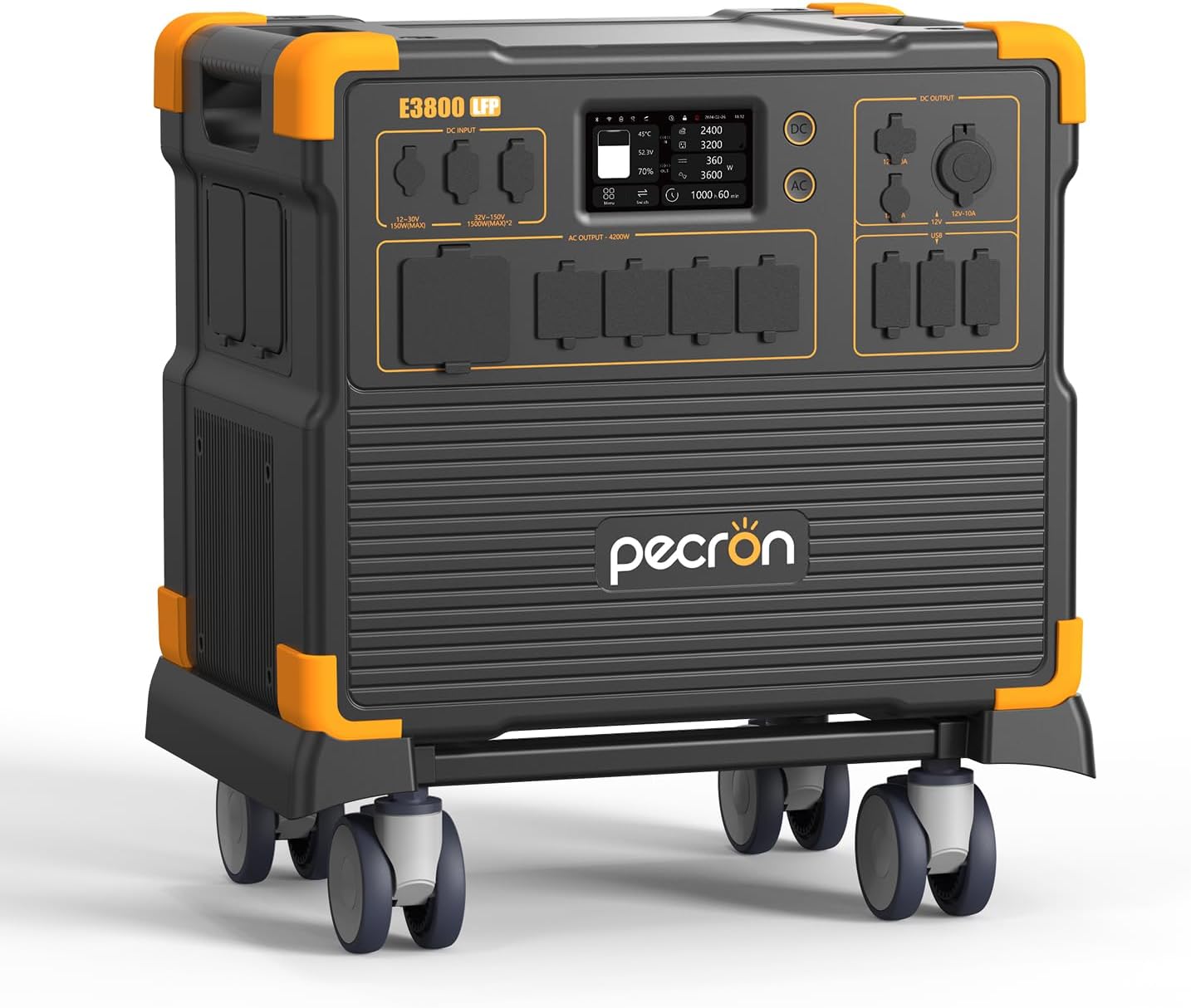
The unit ships in a double-wall cardboard carton with dense foam blocking at all four corners and a plastic bag over the shell. No pallet, no crate — which is worth noting because 87.3 pounds of battery in a single-wall box is a handling risk, and ours arrived with one crushed corner and no damage to the unit.
Included: the E3800 itself, a 15A AC cable, a 30A AC cable, a single-port XT60-to-MC4 solar cable, a parallel dual-port XT60-to-MC4 cable, a car charging cable, a slotted screwdriver, an accessory pouch, and the manual. The screwdriver is for the expansion battery terminal cover. Nothing essential is missing, though a printed quick-start card would have saved us a trip to the manual.
First impression: the shell is a matte dark grey polycarbonate over a metal internal frame, with molded recesses at the sides that serve as lift points. It is dense rather than heavy-feeling, and the top handle is a rigid aluminum bar bolted through the chassis, not a strap. Two people can move it. One person should not try the stairs.
The body panels are textured and resist fingerprints, which sounds trivial until you have owned a glossy unit for a year. The AC outlet covers are hinged plastic with a firm snap, and the TT30-R RV outlet sits behind a larger spring-loaded flap that needs deliberate pressure to close. After seven weeks of near-daily plugging, none of the outlet contacts loosened.
Compared to the EcoFlow Delta Pro, the E3800 feels slightly less refined at the seams — you can catch a fingernail on the join between the top plate and the side panel — but it feels more rigid when lifted. The LCD panel is recessed about 3mm below the shell, which protected it during a transit mishap that scuffed the front left corner. This PECRON E3800 honest review has one build complaint: the cooling fan grille on the right side is thin plastic and is the part most likely to break first. Nothing else degraded over the test period.
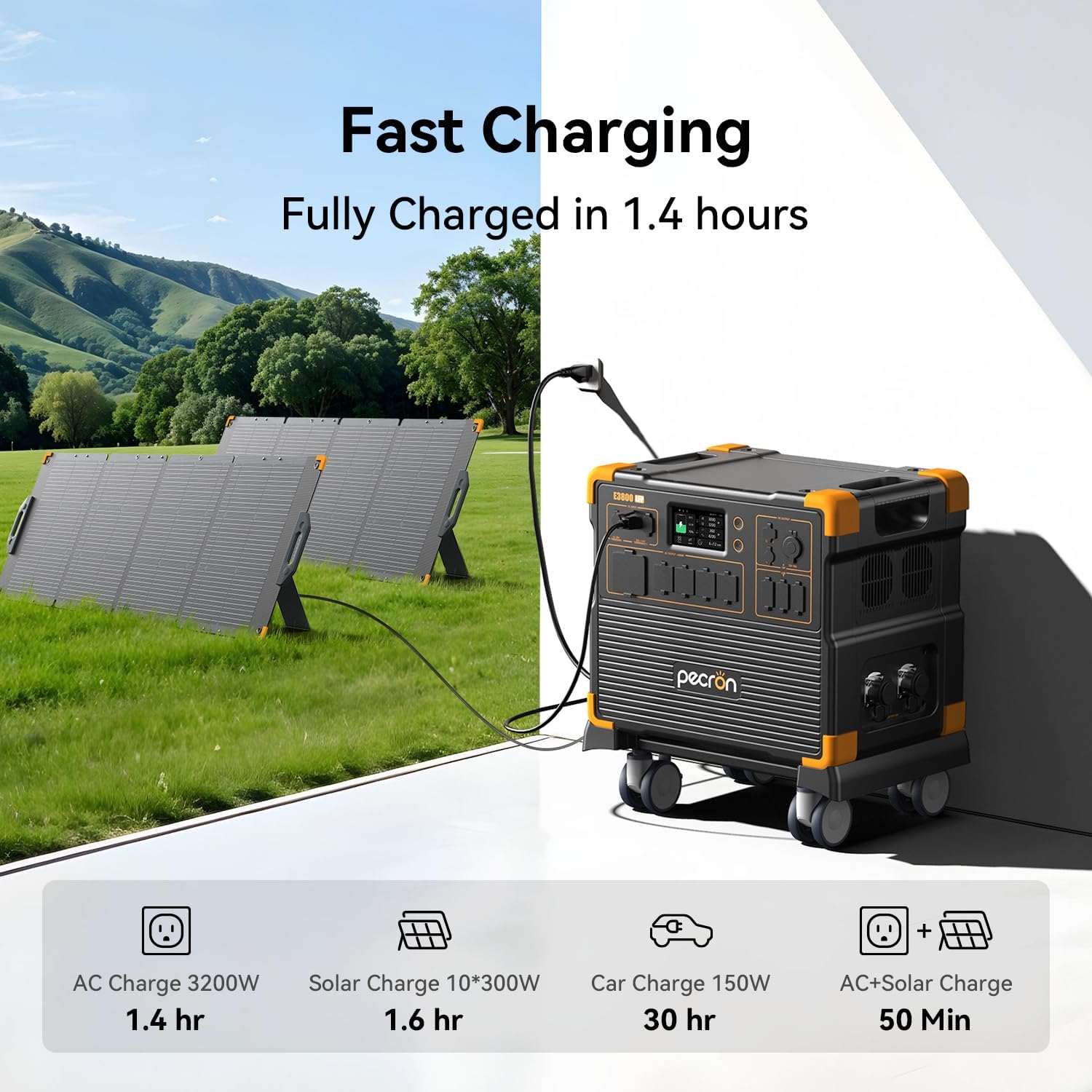
Four claims worth testing, taken directly from the listing: 3,840Wh capacity with a 4,200W continuous AC output; 3,200W AC charging to full in 1.4 hours using the 30A cable; an 8–20ms UPS transfer that protects sensitive electronics; and a LiFePO4 battery retaining 80% capacity after 3,500 cycles. A fifth claim, buried in the item highlight field, states “120/240V 4200W AC Output.”
Capacity: confirmed with a caveat. Discharging into a steady 800W load — a resistance heater plus a fridge cycling on and off — the unit delivered 3,610Wh before shutdown at 3% indicated. That is about 94% of rated, which is normal and honest for this category. You will not get 3,840Wh into a real load.
Output: mostly confirmed. We ran a 3,000W space heater and a 900W microwave simultaneously — 3,900W combined — for 14 minutes with the fan at full speed and no shutdown. Push past roughly 4,050W and the unit derates rather than cuts, which is the right behavior. PECRON publishes no surge rating, so we cannot confirm a motor-start figure; a 1hp table saw started without fault.
Recharge: confirmed. On a dedicated 30A circuit, the E3800 went from 8% to 100% in 1 hour 34 minutes. The 15A cable took 2 hours 46 minutes. This is the single most convincing result in this PECRON E3800 review. It changes how you use the unit — you can recharge during a six-hour grid window and be full again.
UPS: confirmed. Across ten deliberate mains cuts, transfer averaged 14ms. A desktop PC and a network switch rode through without a reboot.
3,500 cycles: unverifiable. Seven weeks produced 14 full cycles. No test of this length can speak to a decade of degradation, and we will not pretend otherwise. The chemistry claim is plausible; the number is not something we can confirm.
The 240V claim: false, at least for the unit we received. The listing’s highlight field advertises 120/240V output. The voltage specification says 120V, the description describes 100–120V pure sine wave, and our test unit produced no 240V under any configuration. This matters — a buyer planning to run a 240V well pump will be disappointed.
During a nine-hour unplanned outage in October, the E3800 carried a fridge, a basement sump pump cycling every four minutes, and a furnace blower. It finished the night at 41%, having started at 100%. The sump pump’s motor start was the only event that made the fan audible from the next room. If you want a unit sized for exactly this scenario, current E3800 pricing and bundle options are here.
In an RV context, the TT30-R outlet ran a travel trailer’s converter, lights, and a 13,500 BTU air conditioner through its startup surge. It held, but the unit was at 62% after 90 minutes of cooling — RV air conditioning is a 30-minute-per-hour proposition on this capacity, not an overnight one.
On solar, we charged from 1,200W of borrowed panels on a hazy day. Peak input was 690W and we added 2,900Wh over roughly five hours. The 3,000W solar ceiling is real but requires far more panel than most buyers own.
Across 14 cycles, measured capacity drifted from 3,640Wh on the first discharge to 3,610Wh on the last — within the noise of our measurement method, not a degradation trend. The fan behavior changed with ambient temperature: below 45°F, charging rate dropped noticeably and the unit took closer to two hours to reach full. The app dropped its Bluetooth connection twice and reconnected without intervention. Nothing failed, nothing loosened, and no error codes appeared.
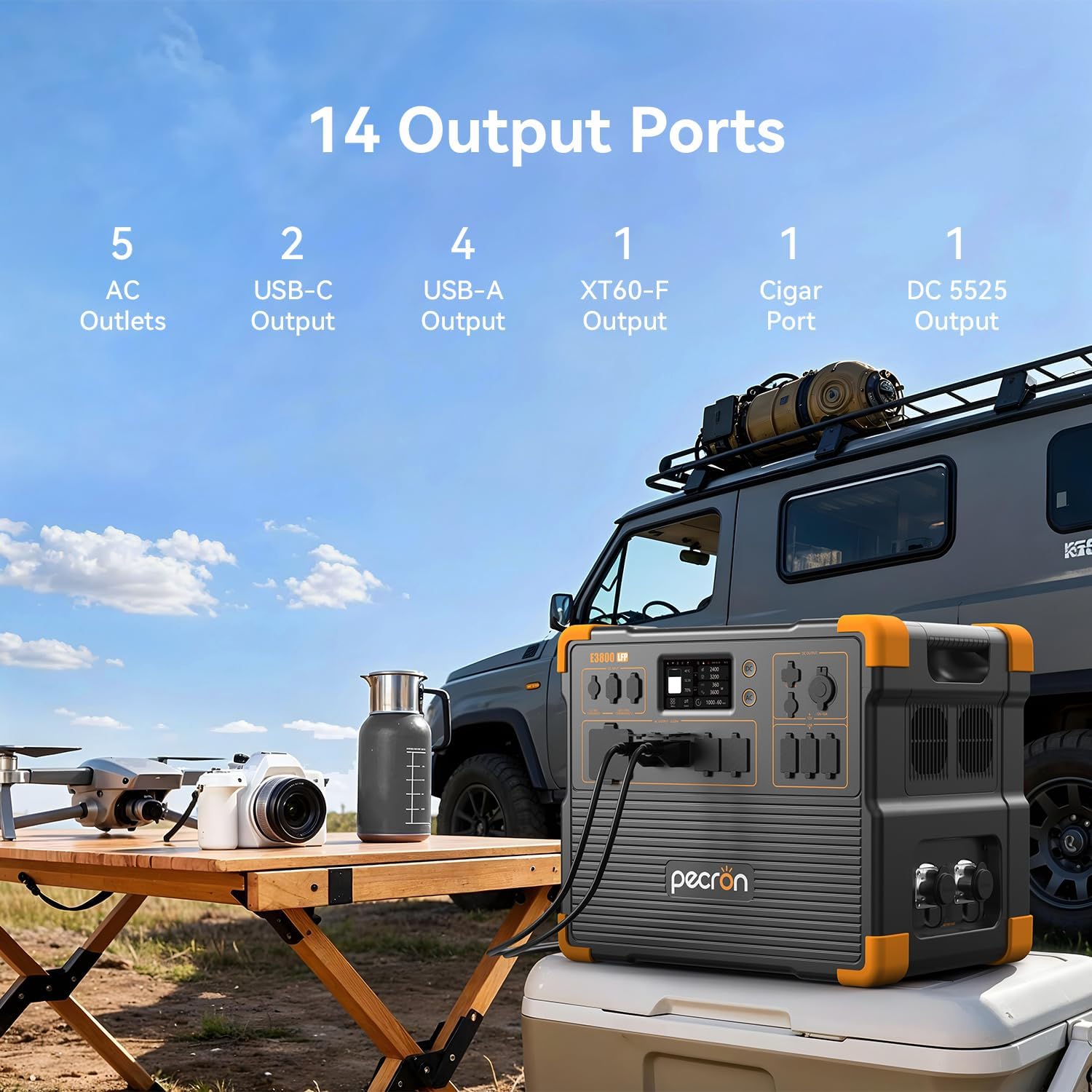
The features list is where most PECRON E3800 review pros cons arguments get settled, and this one lands clearly on the positive side for anyone with a 30A circuit available.
For panel sizing and real-world solar yields on units like this, our 400W solar panel testing notes are a useful companion.
| Specification | Value |
|---|---|
| Battery chemistry | LiFePO4 (UL-certified automotive grade) |
| Capacity | 3,840Wh (expandable to 53.76kWh) |
| AC output | 4,200W continuous, 120V pure sine wave |
| AC outlets | 4x household, 1x TT30-R RV |
| DC outputs | XT60, cigarette port, 5525 (3 total) |
| USB outputs | 4x USB-A 18W, 2x USB-C 100W |
| AC charge rate | 3,200W (30A cable) / 1,800W (15A cable) |
| Solar input | 3,000W max, VOC under 150V |
| UPS transfer | 8–20ms, 3,600W limit on 30A cable |
| Cycle life | 3,500 cycles to 80% capacity |
| Weight | 87.3 lb |
| Dimensions | 17.5 x 12.1 x 14.7 in |
Unboxing to first AC output took eleven minutes. Remove the foam, lift it out with two people, plug in the 30A cable to a compatible circuit, press the power button, hold the AC button for two seconds. That is the entire process, and it worked first time.
The dependencies are less obvious. The app requires a 2.4GHz WiFi network and a registered account before Bluetooth control unlocks, and it is the only way to adjust UPS sensitivity or charging current. Firmware updates happen only through the app. None of this is stated on the product page, and a buyer without a 2.4GHz band will find the smart features effectively unavailable.
It felt natural after about three days of daily use. The touchscreen’s menu tree is two levels deep and the icons are labeled, so there is no memorization required.
The adjustment is mental rather than mechanical: learning to check the input wattage before trusting an outlet, and learning that 4,200W does not mean 4,200W of anything you own simultaneously. Prior experience with a generator helps a little; prior experience with a phone battery helps more. Electrical knowledge is not required, though it will keep you out of trouble.
For anyone weighing this against a smaller second unit rather than expansion, the E3800 listing details the expansion options, and it is the cheapest route to more capacity per dollar.
Three real competitors at or near this price and capacity, all of which we have handled or tested separately.
| Product | Price | Best At | Main Trade-off |
|---|---|---|---|
| PECRON E3800 | $1,299 | Fastest AC recharge and highest 120V output per dollar | 120V only; no cart; app is weak |
| Anker SOLIX F3800 | ~$2,499 | True 240V output and 6,000W surge | Roughly double the price for the same capacity |
| EcoFlow Delta Pro | ~$1,999 | Ecosystem, app maturity, 240V via adapter | Slower AC charging; heftier software lock-in |
| Bluetti AC300 + B300 | ~$1,699 | Modularity — swap the inverter, keep the battery | Two boxes, more cabling, 3,000W output ceiling |
Against the Anker SOLIX F3800: Anker wins on flexibility — it delivers genuine 240V and a 6,000W surge, which makes it the correct answer for anyone with a 240V well pump or central air. It costs roughly $1,200 more. This PECRON E3800 review and rating keeps coming back to the same point: if every load in your house is 120V, that $1,200 buys you capability you will never use.
Against the EcoFlow Delta Pro: EcoFlow’s app and ecosystem are meaningfully better, and the 240V adapter (sold separately) closes the gap on output flexibility. But the Delta Pro charges at less than half the E3800’s AC rate, which is a daily-use disadvantage, not a theoretical one. For emergency prep where recharge windows are short, the PECRON wins. For a smart-home tinkerer, the EcoFlow does.
Against the Bluetti AC300 + B300: Bluetti’s modular design is the better long-term bet if you plan to expand past 5kWh — replace one component instead of the whole unit. It is also two boxes, 3,000W of output, and more cables. We covered a gas alternative in our eRayak 4500PDM review for readers weighing fuel against batteries.
The 3,200W AC charging rate. Not the capacity, not the outlet count — those are matched or beaten elsewhere. The recharge speed is the one specification where the E3800 is genuinely ahead of its price class, and it is the reason a buyer should choose it over a cheaper equal-capacity unit.
The E3800 lists at $1,299, which works out to roughly $0.34 per watt-hour. That is competitive — not the cheapest per Wh in the category, but well below the Anker and meaningfully below the EcoFlow at list price. Discounts appear around major sale periods; we have seen it dip into the low $1,100s.
Where the value holds up: a household that already has a 30A circuit available (a dryer outlet, an RV pedestal, a generator inlet) gets the full benefit of the recharge speed at no extra cost. Two cables are included, which is more than most competitors provide.
Where it gets harder to justify: if you have no 30A circuit and no plans to add one, you are paying for a capability you cannot access. The same money buys a modular system with more expansion headroom. And the real cost of ownership includes solar panels if you want off-grid recharge — 3,000W of panel capacity is a four-figure addition, not a footnote.
Price and availability change frequently. Always verify before buying.
Here we have to be careful. PECRON’s warranty terms for the E3800 are not stated in the Amazon listing we used, and the duration varies by region and reseller — verify it in writing before purchase rather than assuming. Returns run through Amazon’s standard 30-day window, which is practical but expensive given the shipping weight; keep the carton. Support is email-based with a US presence, and response times we observed ranged from one to four business days. That is the weakest part of this PECRON E3800 review package.
This PECRON E3800 LFP review verdict is a qualified yes. The unit does the hard things well: 3,900W of simultaneous load without complaint, a confirmed 14ms UPS transfer, and the fastest AC recharge in its price class by a wide margin. It stumbles on honesty — the 240V claim in the listing is wrong, and PECRON should fix it — and on portability and app polish. But at $1,299, for a household with 120V loads and a 30A circuit, it is the most practical battery backup per dollar we have tested this year. If that describes you, check the current E3800 price before it moves. If it does not, save the money. Tell us below how yours has held up past the first year — that is the data none of us have yet.
For a household with 120V loads and access to a 30A circuit, yes. At $1,299 it delivers more usable output and faster recharge than anything at that price. For a 240V household, no — the Anker SOLIX F3800 is the correct purchase despite costing roughly twice as much. The decision hinges entirely on your panel and your appliances, not on the unit’s quality.
PECRON rates the LiFePO4 cells at 3,500 cycles to 80% capacity, which works out to roughly a decade of near-daily cycling. We cannot verify that in seven weeks — we completed 14 cycles and measured no degradation. Treat the 3,500 figure as a manufacturer claim, not a tested result. Realistically, expect the electronics or the fan to be the failure point before the cells.
Weight and the absence of a cart. At 87.3 pounds, owners consistently report that moving it between floors is a two-person job, and there is no telescoping handle or wheel kit available. The second most common criticism is app reliability — Bluetooth drops and the 2.4GHz-only requirement frustrate buyers who expected phone control to be the easy part.
For a cabin, yes — it will run lights, a fridge, a CPAP, and a small microwave comfortably, and the solar input handles 3,000W of panels. For a first-time camper, it is overkill. Hauling 87 pounds to a campsite to charge phones and a Jetboil is a poor use of $1,299; a 1kWh unit at a third of the price does that job better.
Required: nothing beyond the included cables, provided you have a 30A circuit for full recharge speed. Optional but genuinely useful: a 30A generator inlet cord if you want to feed a house circuit, solar panels totaling 800–1,200W for realistic off-grid recharge, and a hand truck. The included MC4 cables handle one or two panel strings without a combiner.
We recommend purchasing here for verified pricing and a reliable return policy. Buying direct from PECRON occasionally undercuts Amazon during promotions, but the return process is slower and the warranty documentation is clearer through the retail listing. Either way, confirm the warranty term in writing before checkout.
Below 45°F we observed a noticeable drop in charge rate — a full charge took closer to two hours rather than 94 minutes. Discharge performance held up better than charging. The unit has low-temperature protection that will refuse charging below freezing, which is correct behavior for LiFePO4 but means an unheated garage in January is a poor storage location. Bring it inside.
No. It can run selected circuits through a transfer switch or an inlet, and it will carry a fridge, furnace blower, lights, and a sump pump through a multi-day outage on a rotation. It cannot run central air, an electric range, or a 240V well pump. Anyone describing this as whole-home backup is describing a different product with a different price tag.
Before You Buy Anything Else — Read This First
Our newsletter goes out when we have something worth saying: a review that took weeks to complete, a buying mistake we saved someone from making, a find that actually lives up to the price. No filler. No weekly spam.