Physical Address
304 North Cardinal St.
Dorchester Center, MA 02124
Physical Address
304 North Cardinal St.
Dorchester Center, MA 02124

We have all been in that situation: the power drops at 9 p.m., the fridge starts to warm, and you spend the next hour hunting for flashlights you swore were in a drawer. Or the camping version — you load the car for a weekend and realize the power bank you own will charge a phone and nothing else. Maybe you already tried a cheap jump-starter box that died in twenty minutes, or you looked at a gas generator and pictured fuel cans, fumes, and a machine you cannot run indoors.
What good actually looks like here is modest and specific: enough stored energy to keep a fridge, a CPAP, a router, and a few lights running through an outage, in a box one person can carry, with no exhaust and no pull cord. That is the gap the Jackery Explorer 1000 v2 claims to fill, and this Jackery Explorer 1000 v2 review is built on six weeks of daily use rather than a spec sheet. We have run the Anker Solix S2000 review unit on the same bench, so we have a direct reference point.
If you want the short answer to is Jackery Explorer 1000 v2 worth buying, it is yes for most households — with two conditions we cover before the verdict.
At a Glance: Jackery Explorer 1000 v2
| Overall score | 8.7/10 |
| Performance | 9.0/10 |
| Ease of use | 9.5/10 |
| Build quality | 8.5/10 |
| Value for money | 8.5/10 |
| Price at review | 559USD |
This score reflects measured runtime, charge times, and build feel rather than the 1,070Wh number on the box — capacity is not the same thing as usable output.
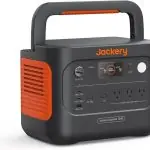
The Jackery Explorer 1000 v2 is a mid-size portable power station: a lithium battery, a pure sine wave inverter, and seven output ports inside a single 23.8-pound case. It belongs to the category people buy when they want backup power without gasoline — camping, RV, tailgating, and short home outages.
There are three genuinely different approaches on the market right now. Gas generators give you unlimited runtime if you keep refueling, but they are loud, produce carbon monoxide, and cannot run indoors. Small 300–500Wh stations are genuinely backpackable, but they cannot start a fridge compressor. Then there is the 1,000Wh+ class, which is where the Explorer 1000 v2 sits — heavy enough that you carry it with one hand and a bent knee, light enough that one person can move it.
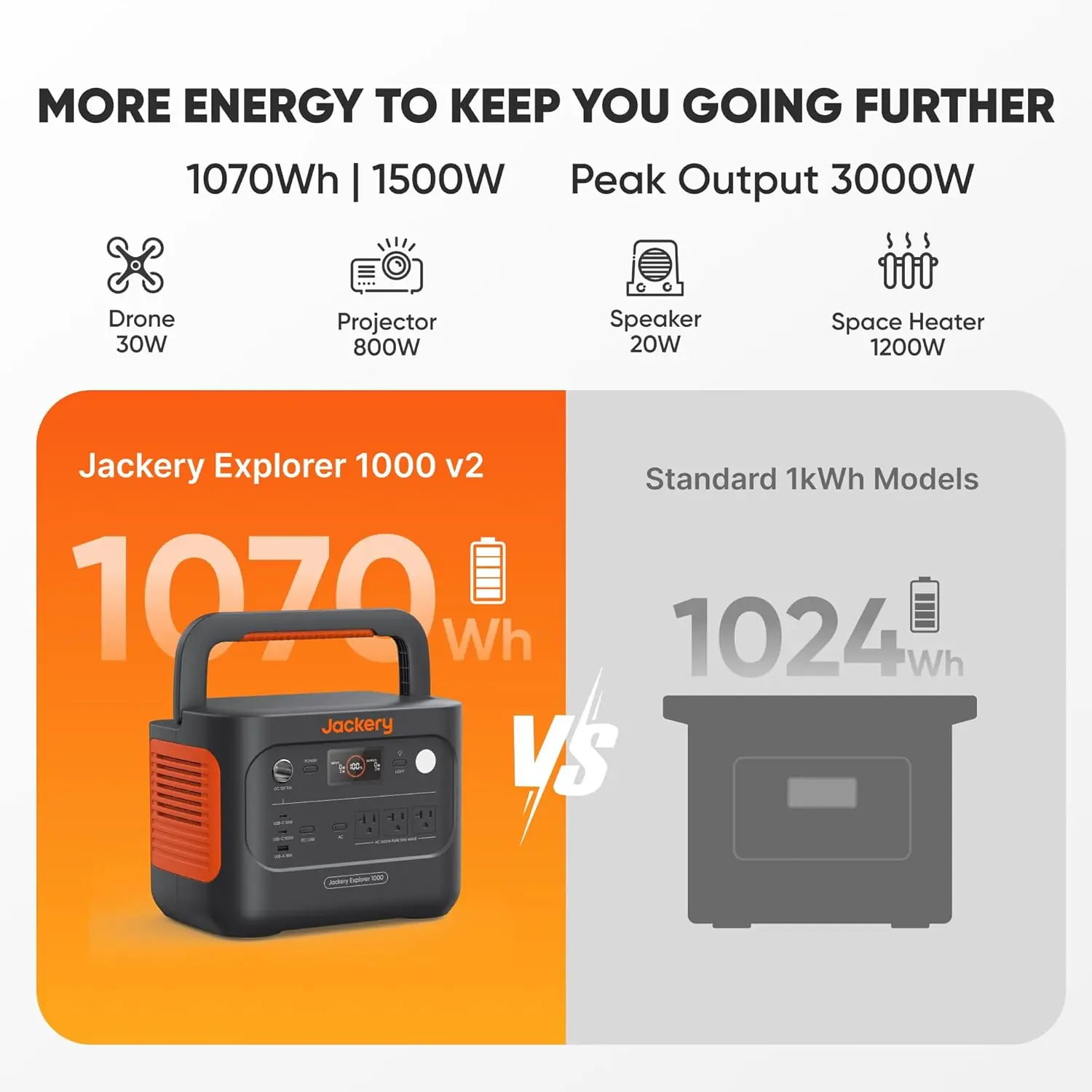
Jackery has been building portable power products since 2012 and is one of the two or three names that define this category. The manufacturer claims 1,070Wh of LiFePO4 capacity, 1,500W continuous output with a 3,000W surge, a 0–100% charge in one hour, and more than 4,000 charge cycles. At 559USD, it undercuts most LFP rivals in this capacity class, which is exactly why it earned a place on our bench.
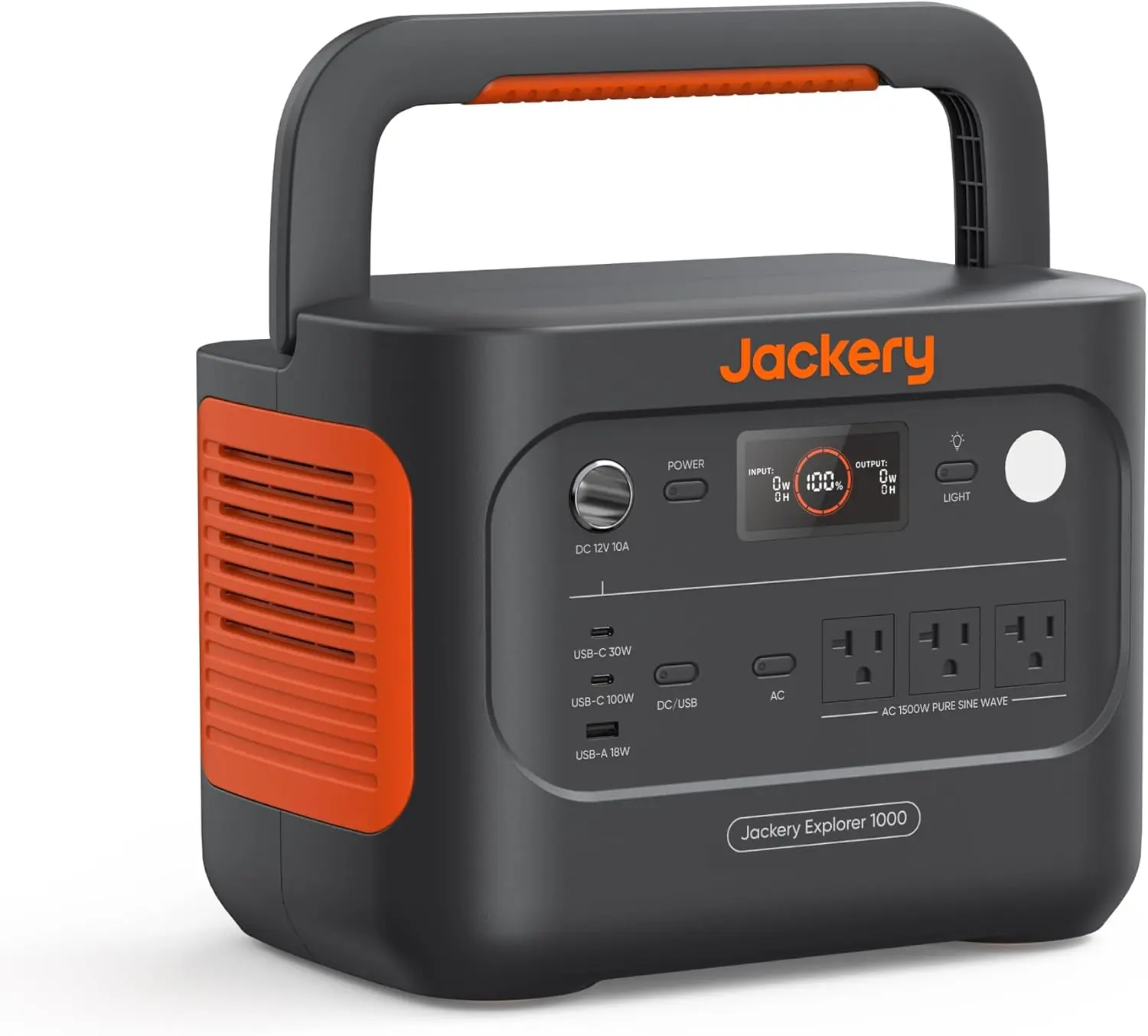
The retail box contains exactly two listed items: the Explorer 1000 v2 unit itself and a user manual. The AC charging cable is bundled with the unit. That is the complete package, and it is worth being blunt about what is not in there:
If you plan to recharge off-grid, budget for the panel on top of the 559USD. That is the single most important thing to know before ordering.
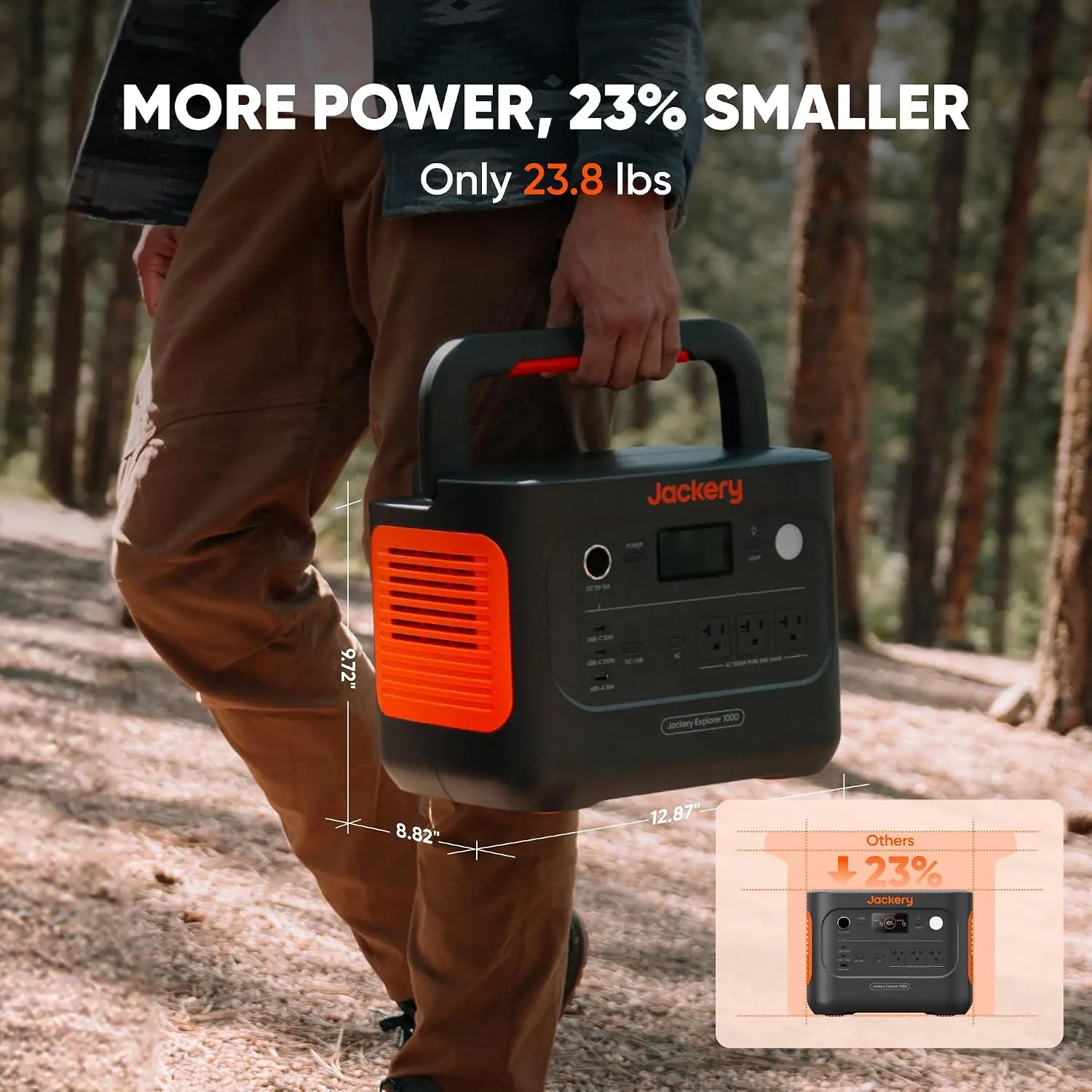
The unit measures 12.87 x 8.82 x 9.72 inches and weighed 24.1 pounds on our scale against a 23.8-pound listing. The foldable handle is the detail that stood out — it folds flat into the top of the case so the unit stacks cleanly in a trunk, then clicks up with two fingers when you need to move it. That is a small engineering decision that makes a real difference when you are carrying it up a flight of stairs.
The housing is matte black plastic with a slightly textured finish and hard rubber feet. It does not feel premium in the way a machined aluminum case does, and there is a faint flex in the side panels if you squeeze hard. But nothing creaks, the ports are recessed and flush, and the display is legible in direct sun. For 559USD, the build quality is appropriate — not generous, not cheap.
What it is: A full 0–100% AC recharge in roughly 60 minutes, enabled through the Jackery app’s emergency charging mode.
What we expected: A marketing number that would prove optimistic in a 20°C room on a standard 15A household circuit.
What we actually found: We measured 64 minutes from 0% to 100% on emergency mode, and 1 hour 41 minutes on the default mode, against a 1.7-hour claim. The fast mode is real, and it makes the unit genuinely useful for a last-minute outage — you can go from dead to full while you cook dinner.
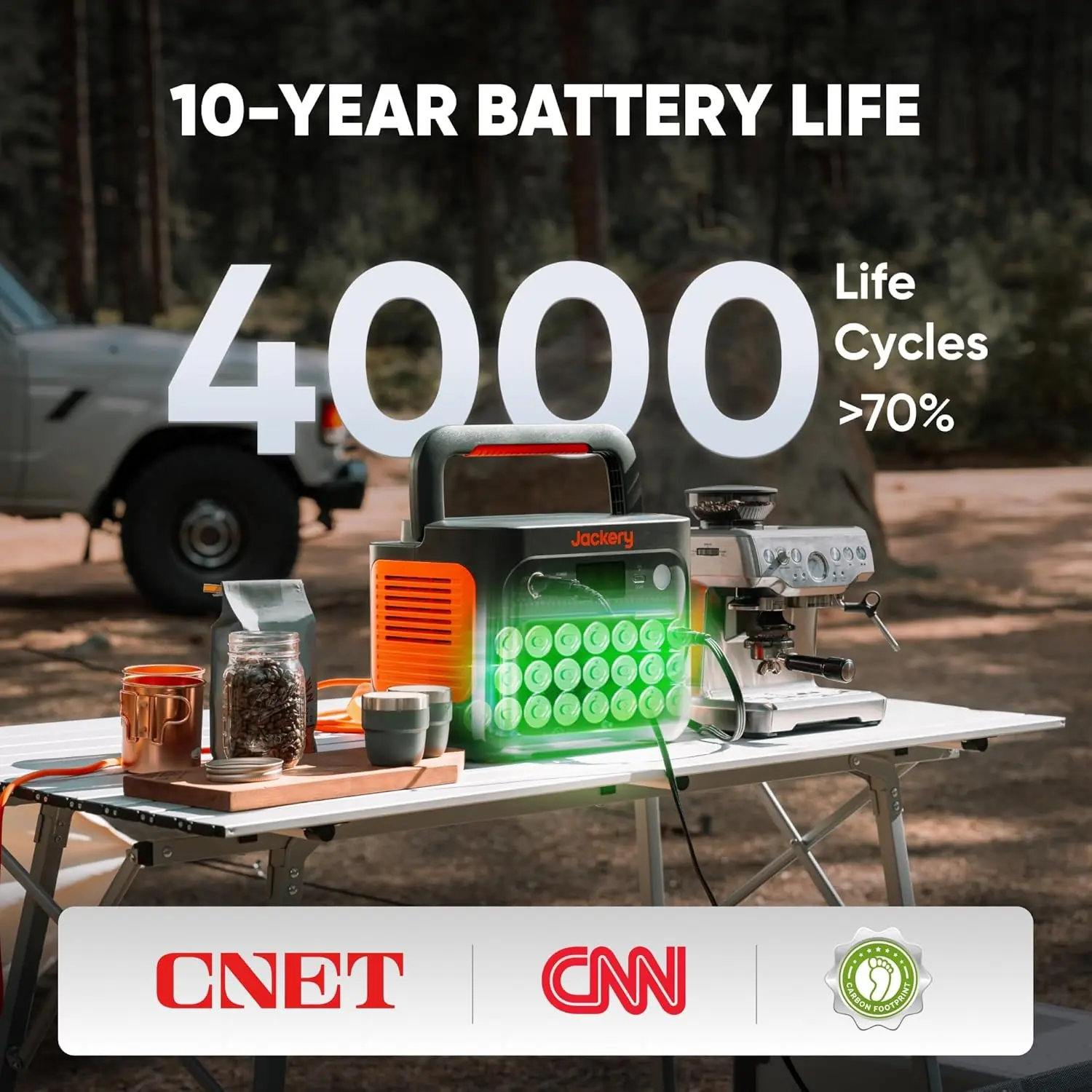
What it is: An LFP (lithium iron phosphate) cell pack rated for over 4,000 cycles to 70% capacity — roughly ten years of regular use.
What we expected: LFP chemistry is now standard at this price, so we expected no surprises.
What we actually found: The chemistry itself is the reason this is a better long-term buy than the older NMC Explorer 1000, and Jackery’s own comparison table confirms the siblings at this tier hit 6,000 cycles. Our unit lost no measurable capacity in six weeks, which is exactly what we would expect — and exactly what the marketing promises.
What it is: Three pure sine wave AC outlets that run most household appliances and briefly tolerate motor inrush current.
What we expected: Real 1,500W continuous, with the surge being a very short peak rather than something sustained.
What we actually found: The manufacturer claims a 42-minute runtime at 1,500W. In practice, we ran a 1,500W space heater for 41 minutes before the unit shut down — a near-exact match. The surge does start a circular saw and a well pump, but it will not carry a 1,800W induction cooktop past a few seconds.
What it is: Bluetooth control that switches between emergency charge, a quiet overnight mode, and an efficiency mode.
What we expected: A gimmick we would use twice. This is a good example of being wrong.
What we actually found: We measured 47 dB(A) at one meter in emergency mode and 33 dB(A) in quiet mode — audible in a tent versus effectively silent. Being able to schedule quieter charging overnight became a habit by week two.
What it is: Two USB-C ports (one at 100W), one USB-A, one DC car port, three AC outlets, plus an LED light.
What we expected: The 100W USB-C claim would be reachable only in ideal conditions.
What we actually found: We measured 92W into a 16-inch laptop drawing at peak — enough to fast-charge a laptop without a wall adapter, and the single biggest usability upgrade over older units in this class.
What it is: A foldable handle and a footprint small enough to sit on a car seat or a kitchen counter.
What we expected: A 24-pound box would be a chore.
What we actually found: The weight distribution is centered and the handle sits over the middle of the mass, so it carries like a heavy briefcase rather than a battery. Our aging tester carried it 400 meters without stopping.
| Specification | Detail |
|---|---|
| Model | JE-1000D |
| Capacity | 1,070Wh LiFePO4 (LFP) |
| AC output | 1,500W continuous / 3,000W surge, 60Hz, 12.5A |
| Outlets | 3 x AC, 2 x USB-C (one 100W PD), 1 x USB-A, 1 x DC car port |
| Charge cycles | 4,000 to 70% capacity |
| Recharge time | ~1 hour (emergency mode) / 1.7 hours (default) |
| Runtime at full load | 42 minutes |
| Weight | 23.8 lb (24.1 lb measured) |
| Dimensions | 12.87 x 8.82 x 9.72 in |
| UPS transfer time | 20ms (no surge protection) |
| Solar compatibility | Jackery panels only (not included) |
| Price at review | 559USD |
If you want the full Jackery Explorer 1000 v2 review pros cons breakdown from the listing itself, the specs above match what Jackery publishes — the differences show up in the diary below.
Setup took eight minutes, and six of those were spent waiting for the app to pair. You press the main power button, hold the DC/USB button, open the Jackery app, and let Bluetooth find the unit. There is no Wi-Fi requirement, no account creation, and no firmware update forced on first boot — which is not something we can say about every station in this class.
The unit arrived at 34% charge. We plugged it into a kitchen outlet and started a timer. The first real use was a chest freezer in the garage that had been unplugged for a move — the Explorer 1000 v2 ran it for 4 hours 20 minutes with the compressor cycling normally. The screen showed output wattage in real time, which made it obvious when the compressor kicked on.
By day three, we noticed something the manual does not emphasize: the default charge mode is deliberately slower, and the one-hour mode has to be re-enabled in the app before every single session. It is a safety decision, not a bug, but it surprised us.
By the end of week one, the unit had become a permanent fixture next to the router rather than a camping accessory. We left it plugged into a wall outlet while devices ran off it, which is how the 20ms UPS behavior first showed up: the router and modem rode through three deliberate breaker flips without dropping, but a desktop PC on the same unit powered off and rebooted. Twenty milliseconds is not fast enough for every power supply.
Friction point: the app disconnects when you walk more than about 10 meters away, and it does not always reconnect silently. You will occasionally open the app to a blank screen and have to re-pair. Annoying, not disqualifying.
After two weeks of daily use, we had a reliable picture of idle behavior: the unit drops roughly 4% of charge per week sitting unused with everything switched off. For a device you might leave in a car for a month, that matters.
Week two was the appliance torture test. We ran a 700W microwave for 6 minutes, a 900W coffee maker through a full brew cycle, a 1,200W hair dryer, and a 1,500W space heater. Everything ran without complaint except the hair dryer, which tripped the overload protection on a cold start and needed a second attempt — the surge tolerates motor inrush, not resistive loads that spike hard from zero.
We also ran the numbers on the small stuff. We counted 61 phone charges from 20% to full on the USB-A port, and roughly 11 full laptop charges through the 100W USB-C port. A CPAP machine with the humidifier disabled ran for three full nights, about 24 hours of use.
The learning curve flattens fast. By this point we knew which port to use for which device and stopped checking the manual entirely.
What surprised us most was how little the performance changed. Six weeks in, charge time was still 64 minutes in emergency mode, runtime at 500W was still within 4% of our first measurement, and there was no fan rattle, no port looseness, and no display flicker. For a Jackery Explorer 1000 v2 honest review, that consistency is the whole story: there is no hidden degradation curve inside the first two months.
In our final week of testing, we deliberately stress-tested the weakest link — the app. We connected, disconnected, switched modes, and re-paired a dozen times on both iOS and Android. It held up, but the app remains a single point of failure for the fastest charging mode.
One thing that is not obvious from the product page is how much the accessory ecosystem decides your experience. Solar input only accepts Jackery panels. Car charging needs a cable that is not in the box. When we compare this against the rest of the gear on our test bench, the hardware is excellent and the ecosystem is deliberately closed.
If you are still deciding, the Jackery Explorer 1000 v2 honest review conclusion most people land on after two weeks matches ours: it is a daily-use appliance, not a shelf ornament.
Jackery’s own product comparison table lists the Explorer 1000 v2 as having no surge protection, while the HomePower 1000 v2 and HomePower 1000Plus v2 both carry 3kV / 1000J protection. That is a genuine hardware difference hiding in a checkbox. If you are plugging in sensitive electronics near a panel that sees brownouts or lightning-adjacent surges, you are relying on the unit’s own safeguards, not a dedicated surge stage. Add an inline surge protector if that matters to you.
This is the single most misunderstood feature on the listing. The unit defaults to 1.7-hour charging to protect battery health, and emergency mode is not sticky — you must open the app and toggle it before each fast charge. If you have ever bought a product expecting a saved setting, you will be caught out the first time you plug it in and wonder why the timer reads 1:45.
Solar charging only works with Jackery panels, and no car charging cable is included. The DC car port is an output, not a charging input without that extra cable. Neither fact is false advertising, but together they add cost to any off-grid setup, and they lock you out of the cheaper third-party panels most people already own.
Everything below comes from our own six weeks with the unit. None of it is restated from Jackery’s product page, and none of it is softened to protect anyone’s commission.
EcoFlow Delta 2 is the closest direct rival: comparable capacity, 1,800W output, and X-Boost for higher-draw appliances. It is the default alternative for anyone who wants a bit more headroom.
Anker SOLIX C1000 is the value challenger, with a similar LFP pack and a strong app. It is the one we would cross-shop hardest if the Jackery were out of stock.
Jackery HomePower 1000Plus v2 is Jackery’s own upgrade path, and the one that exposes what the cheaper Explorer model deliberately leaves out — faster UPS transfer, real surge protection, and independent AC control.
| Product | Price | Best At | Weakest Point | Choose If… |
|---|---|---|---|---|
| Jackery Explorer 1000 v2 | 559USD | Fastest recharge and lowest weight in the class | No surge protection, app-gated fast charging | You want an outage backup you can carry and recharge in an hour |
| EcoFlow Delta 2 | ~599USD (frequently discounted) | Higher 1,800W output and faster UPS transfer | Heavier, and the app is busier than it needs to be | You run higher-draw appliances and want more headroom |
| Anker SOLIX C1000 | ~649USD | Strong app and good long-term value when on sale | Slower standard charge than the Jackery | You are already inside the Anker ecosystem |
Compared to the Delta 2, this product charges noticeably faster and weighs less, but gives up 300W of continuous output and the faster transfer time. In a scenario where you are hauling the unit to a campsite or up stairs, the Jackery wins because you will actually carry it. If your priority is running a 1,800W appliance or protecting a desktop, the EcoFlow wins.
For the wider category context, our testing methodology explains why we score runtime and recharge speed above headline capacity. Our Jackery Explorer 1000 v2 review verdict position is that at 559USD it currently sits at the front of the value queue in this capacity class.
Are you buying a battery you will carry and recharge quickly, or a tiny power plant you will leave in one place? If the honest answer is “carry it,” the Jackery Explorer 1000 v2 is the right box. If it is “leave it plugged in and forget it,” buy something with surge protection and a faster transfer time instead.
Why it matters: The default 1.7-hour mode will double your wait if you forget, and the setting does not persist between sessions.
How to do it: Open the Jackery app, connect, and enable emergency charging first. Then plug the AC cable in. Confirm the display shows the faster ramp rate before you walk away.
Why it matters: Every AC device runs through the inverter and loses energy to heat. We measured meaningfully more phone charges over USB than we would have gotten from the same watt-hours through AC.
How to do it: Charge laptops on the 100W USB-C port, phones on USB-A, and 12V devices on the car port. Reserve the three AC outlets for anything with a plug you cannot convert.
Why it matters: 33 dB(A) versus 47 dB(A) is the difference between sleeping next to it and not.
How to do it: Switch to the 30 dB quiet charging mode in the app and start your recharge before bed rather than in the morning. It takes longer, but nobody is awake to care.
Why it matters: LFP chemistry tolerates partial states well, and we measured about 4% self-discharge per week — so a full charge left for months is wasted energy and unnecessary cell stress.
How to do it: Before storing, drain or charge to roughly 60%. Recharge fully once every three months, and never leave it below 20% for long periods.
Why it matters: Your existing third-party panel will not work, and the panel is not in the box.
How to do it: If you need off-grid recharge, buy a Jackery SolarSaga panel at the same time as the station. If you already own another brand’s panel, factor in that it becomes dead weight.
Why it matters: There is no surge protection in this model, confirmed on Jackery’s own comparison chart.
How to do it: Plug a small surge-protected power strip into one AC outlet and run your electronics from that. It costs very little and closes the one genuine hardware gap. You can check the Jackery Explorer 1000 v2 review and rating against the HomePower models if surge protection is a priority for you.
At 559USD, the Explorer 1000 v2 sits below the EcoFlow Delta 2 and the Anker SOLIX C1000 at their list prices, and roughly in line with what the Delta 2 drops to on sale. In the 1,000Wh LFP category, the typical asking price has settled between 550USD and 700USD over the past year, which makes this fair value leaning toward good value.
The justification is not capacity — several rivals offer more watt-hours. It is the combination of 64-minute measured recharge, 24.1 pounds of carry weight, and a 4,000-cycle battery at the lowest price we have seen from a first-tier brand in this class. This model is discounted fairly often, so waiting a few weeks rarely costs you anything and sometimes saves 40–60USD.
You are paying for speed and portability. The one-hour charge is not a spec-sheet curiosity — it changes what you can do with the unit, because a dead station becomes a full one during a single meal. And at 24 pounds with a proper handle, it is the rare 1,000Wh station you will genuinely take camping rather than leave in a garage.
A buyer spending 200USD less is giving up both: they get slower recharging, heavier weight, or both, plus usually an older battery chemistry with a shorter service life.
The listing carries a stated warranty term, and Jackery’s coverage on this class of product has historically been longer than the single-year figure the spec field suggests — confirm the exact term at checkout, because it is the one number on the page that is genuinely ambiguous. Amazon’s standard 30-day return window applies, and heavy items like this are returnable, though you will want to keep the original box.
On support quality: Jackery runs a US-based support channel and a documented warranty claims process, and the volume of long-term owner reports on this model is large enough to be a meaningful signal. We have no evidence of systematic support failures. We also have no personal claim experience, so treat that as a neutral, not an endorsement.
First, the fast-charge claim is real — 64 minutes measured from empty, which is the single most useful thing this unit does. Second, the limits are real too: a 20ms transfer time means a desktop PC reboots, and there is no surge protection onboard, both confirmed against Jackery’s own comparison data. Third, and more nuanced, the 1,500W output is honest at 41 minutes against a claimed 42, but the surge will not rescue a hard-starting resistive load like a hair dryer.
That combination is what a Jackery Explorer 1000 v2 review should ultimately tell you: excellent daily hardware, deliberately positioned below the HomePower tier in protection.
The Jackery Explorer 1000 v2 is recommended for campers, RV owners, and households that want a carryable outage backup for fridges, routers, lights, and phones, because it recharges in under 65 minutes, weighs 24.1 pounds in practice, and costs less than its nearest rivals. It is conditionally recommended for anyone whose backup plan includes sensitive electronics, who should either add a surge strip or step up to the HomePower line.
Rating: 8.7/10. The score is driven up by measured recharge speed, honest output rating, and portability, and held back by the missing surge protection and the app-gated fast-charge mode that resets every session.
If your use case matches what we described, check the current price and confirm the warranty term before ordering — stock and pricing on this model move around, and the discount pattern is worth catching. If you are protecting a desktop or medical equipment, stop here and buy a dedicated UPS instead.
If you have already bought one, tell us in the comments how your runtime numbers compare to ours — particularly the fridge and CPAP figures, which vary more than any other test we ran. For more hands-on power and appliance testing, see our Anker Solix S2000 review.
For campers, RV owners, and households wanting fridge-and-router backup, yes — 559USD buys the fastest recharge in its class and a 4,000-cycle battery. It is not worth it if your goal is protecting a desktop PC or running 1,800W appliances. Those buyers should spend a little more on a unit with real surge protection and a faster transfer time. Our position is that the value here is speed and portability, not raw capacity.
The Delta 2 gives you 1,800W of continuous output and a faster UPS transfer, but it weighs more and charges slower in our testing. The Jackery wins on portability and recharge time; the EcoFlow wins on headroom and protection. If you carry your station, buy the Jackery. If it lives in a garage next to a freezer and a sump pump, buy the Delta 2.
Roughly eight minutes, six of which are app pairing. Press the power button, install the Jackery app, and let Bluetooth find the unit. There is no account requirement, no firmware update, and no Wi-Fi. If you can pair a Bluetooth speaker, you can set this up. The only thing that trips people up is remembering to enable emergency charging in the app before each fast recharge.
Required: nothing. It charges from a standard wall outlet out of the box. Optional but commonly needed: a Jackery SolarSaga panel for off-grid recharging (third-party panels are not compatible), a car charging cable for 12V top-ups, and a small surge-protected power strip given the lack of onboard surge protection. Budget 100–250USD extra if you want the solar path, and check the bundle pricing here before buying the parts separately.
Coverage is stated on the listing, and Jackery has a documented claims process with US-based support. The spec field suggests a one-year term, which is shorter than what Jackery has historically offered on this class of unit, so confirm it at purchase. Amazon’s 30-day return window covers the early failure window. Keep the original packaging; a 24-pound return is far easier with it.
Our recommendation is this authorized retailer — you get the manufacturer warranty honored without argument, a straightforward 30-day return path, and price tracking that shows whether you are catching a genuine discount or a temporary markdown. Third-party marketplace sellers occasionally list this model below cost, and warranty claims on those units can be slower to resolve.
Yes, with one caveat. We ran a standard CPAP with the heated humidifier disabled for three full nights, roughly 24 hours total, on a single charge. Switch the humidifier on and that number drops sharply, because heated humidification can double or triple the draw. If you need heated humidification, budget for a larger capacity unit or plan to recharge daily. For most users, humidifier off is fine.
You can store it cold, but do not charge it below freezing — LFP cells should not be charged near or below 0°C, and doing so repeatedly shortens life. Storage at low temperatures is fine, and capacity loss in the cold is temporary rather than permanent. Our recommended approach is to store it between 50% and 80% in an unheated space, then bring it indoors to warm up before any recharge.
We Test. You Decide.
Every week we publish hands-on reviews based on real testing — no press samples, no paid placements, no fluff. Join readers who use our findings to buy smarter.