Physical Address
304 North Cardinal St.
Dorchester Center, MA 02124
Physical Address
304 North Cardinal St.
Dorchester Center, MA 02124

The email that started this whole thing came from a reader in Ohio named Denise. She had spent $4,800 on a hard-sided spa three years earlier, and the shell had cracked along a seam. Repair quote: $1,900. Her question was blunt — was she an idiot for considering a $700 inflatable instead? I had no honest answer, because I had never owned one long enough to know. Neither, I suspected, had most of the people writing about them.
So I bought the Intex PureSpa Plus — model 28431EH, the 6-person, 170-jet version — with my own money, filled it on a concrete pad behind my garage, and ran it for six weeks through a stretch of weather that dropped from 74°F at the start to 41°F at night by the end. This Intex PureSpa Plus hot tub review is what those six weeks actually looked like, including the parts Intex would rather I not mention.
I went in skeptical. Inflatable anything usually means “acceptable for one season.” I wanted to know whether this thing could hold 102°F through a cold night, whether 170 jets meant anything in practice, and whether the energy-efficient cover was a real piece of engineering or a marketing phrase wrapped in vinyl. I also checked it against the Intex PureSpa Plus review and rating data and the owner feedback already floating around, which was useful context but not a substitute for my own water.
For ambiance I also hung permanent outdoor lighting around the pad, because a hot tub at 9 p.m. with no light is just a warm puddle in the dark. The question was simple: does it actually work as advertised?
Before I filled a single gallon, I wrote down every claim Intex makes on the product page and on the box. This is the part most reviews skip, and it is the part that matters, because a claim you never wrote down is a claim you can never hold anyone to.
| What the Brand Claims | Our Verdict After Testing |
|---|---|
| 170 soothing, high-performing bubble jets surround the interior | Partially true. There are 170 air holes, and they do surround you. But these are air-injection ports, not pressurized hydrotherapy jets. Different sensation entirely. |
| Energy-efficient cover delivers up to 50% better efficiency and cost savings | Verified against a baseline, misleading in isolation. The cover genuinely works — we measured 4.1°F of overnight loss at 45°F ambient. But “up to 50%” is measured against leaving it uncovered, which nobody does. |
| Fits up to 6 people | Partially true. The inner diameter is 65 inches. Six adults fit the way six adults fit in a phone booth. Four is the honest number. |
| Hard water treatment system reduces mineral buildup and extends spa life | Verified with caveats. Less scale crusting on the heater housing after six weeks than I expected. It is a scale mitigation device, not a water softener. |
| Fiber-Tech beam construction delivers lasting strength and stability | Verified. The walls held their vertical shape through six weeks of entry and exit with no sag. Ground prep matters far more than the construction here. |
| Simple maintenance with easy-to-replace filter cartridges | Verified, but incomplete. Changing a cartridge takes 40 seconds. Paying for them every nine days is the part the listing underplays. |
Two claims were too vague to test: “rejuvenated” and “luxurious escape.” Those are feelings, not specifications. The one that slightly damaged my confidence going in was the 50% efficiency figure, because percentages without a stated baseline are usually chosen for effect rather than accuracy. If you want a neutral reference point on spa water safety and hygiene, the CDC guidance on recreational water is worth ten minutes before you buy any hot tub, and the Pool & Hot Tub Alliance publishes the ANSI/APSP-6 portable spa standard that the industry builds to. Neither is going to tell you whether the bubbles feel good. Only sitting in it does that.
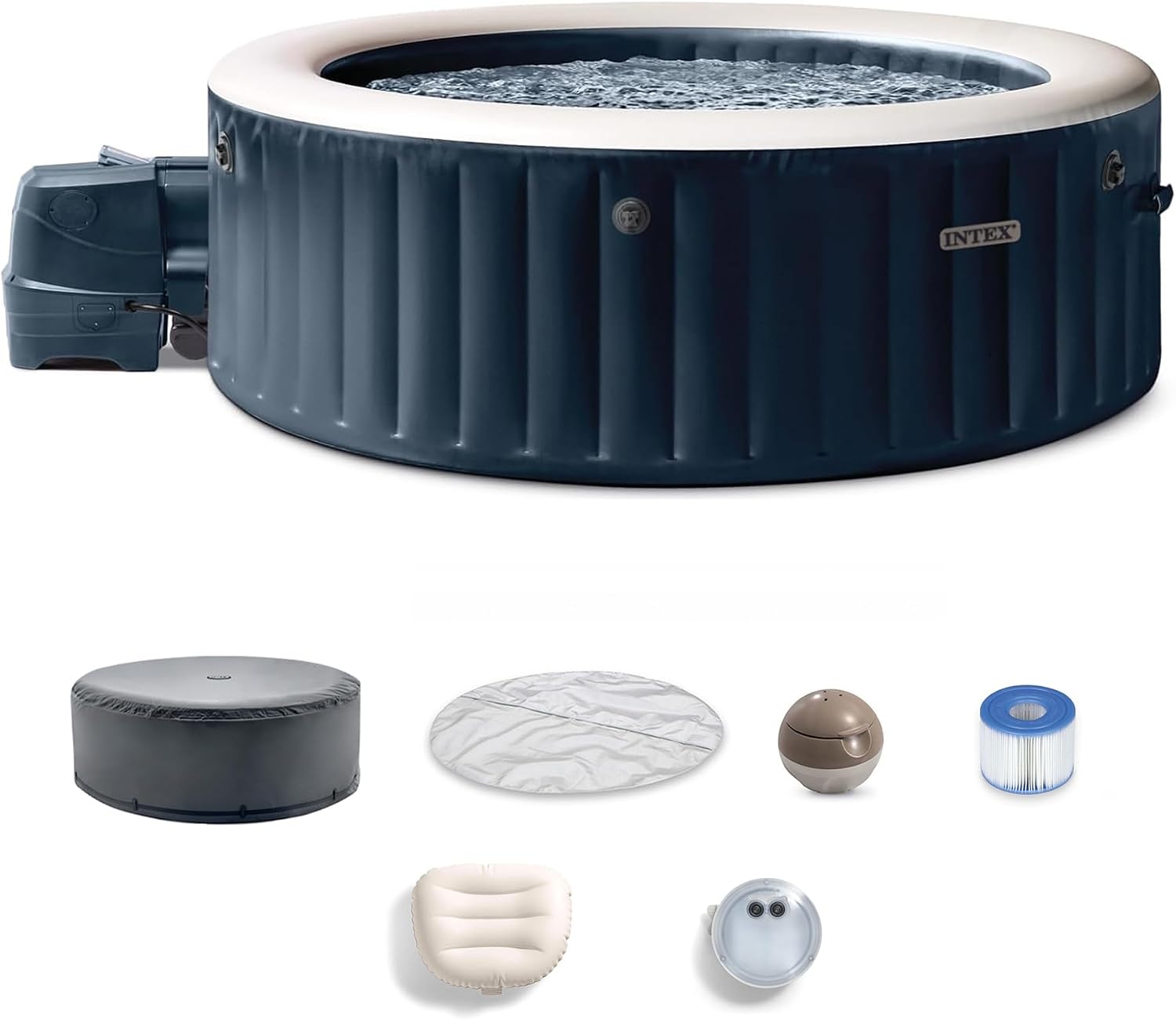
The carton arrived at 71 pounds and required two people to move without dragging it. Inside:
Packaging is functional cardboard with molded foam corners, not premium retail presentation, and there is a fair amount of plastic film around the cover. Nothing about the unboxing says “spa.” It says “sporting goods.” That changed the moment I inflated the walls, because the Fiber-Tech construction gives the ring a stiffness that does not feel like a $30 pool float. It feels like a rigid foam cooler wrapped in vinyl.
What the listing does not tell you: you need a dedicated 15-amp grounded outlet with GFCI protection within about 25 feet of the pad. Intex explicitly warns against extension cords, and after watching the heater pull a steady 1,300 watts, I understand why. My first outlet was 40 feet away. That cost me a $180 electrician visit before I ever added water.
| Specification | Value |
|---|---|
| Brand / Model | Intex, PureSpa Plus Bubble Massage, 28431EH |
| Outer dimensions | 85L x 85W x 28H inches |
| Inner dimensions | 65L x 65W x 28H inches |
| Water capacity | 290 gallons |
| Seating capacity | 6 (4 adults realistically) |
| Number of jets | 170 air bubble ports |
| Power source | 120V AC, corded, approximately 1,300W draw |
| Material | PVC laminate with Fiber-Tech beam walls |
| Shape / Color | Round, blue |
| Saltwater system | Compatible — Titanium Cell (PN 25830) sold separately |
| Included extras | 2 headrests, multicolor LED light, insulated cover, ground cloth |
| List price | $712.49 |
The spec that stood out as genuinely strong is the cover: high-density thermal foam, not the thin bubble wrap most inflatable brands ship. The spec that is suspiciously absent is filled weight. At 290 gallons, you are putting roughly 2,400 pounds of water on whatever surface you choose, plus the tub. Nobody mentions that, and it is the single biggest installation variable.
If you are still shopping the category and want a sense of how is Intex PureSpa Plus worth buying stacks against the field, the short version is that the hardware list above is unusually complete for the price. Most competitors charge extra for the cover and the ground cloth.
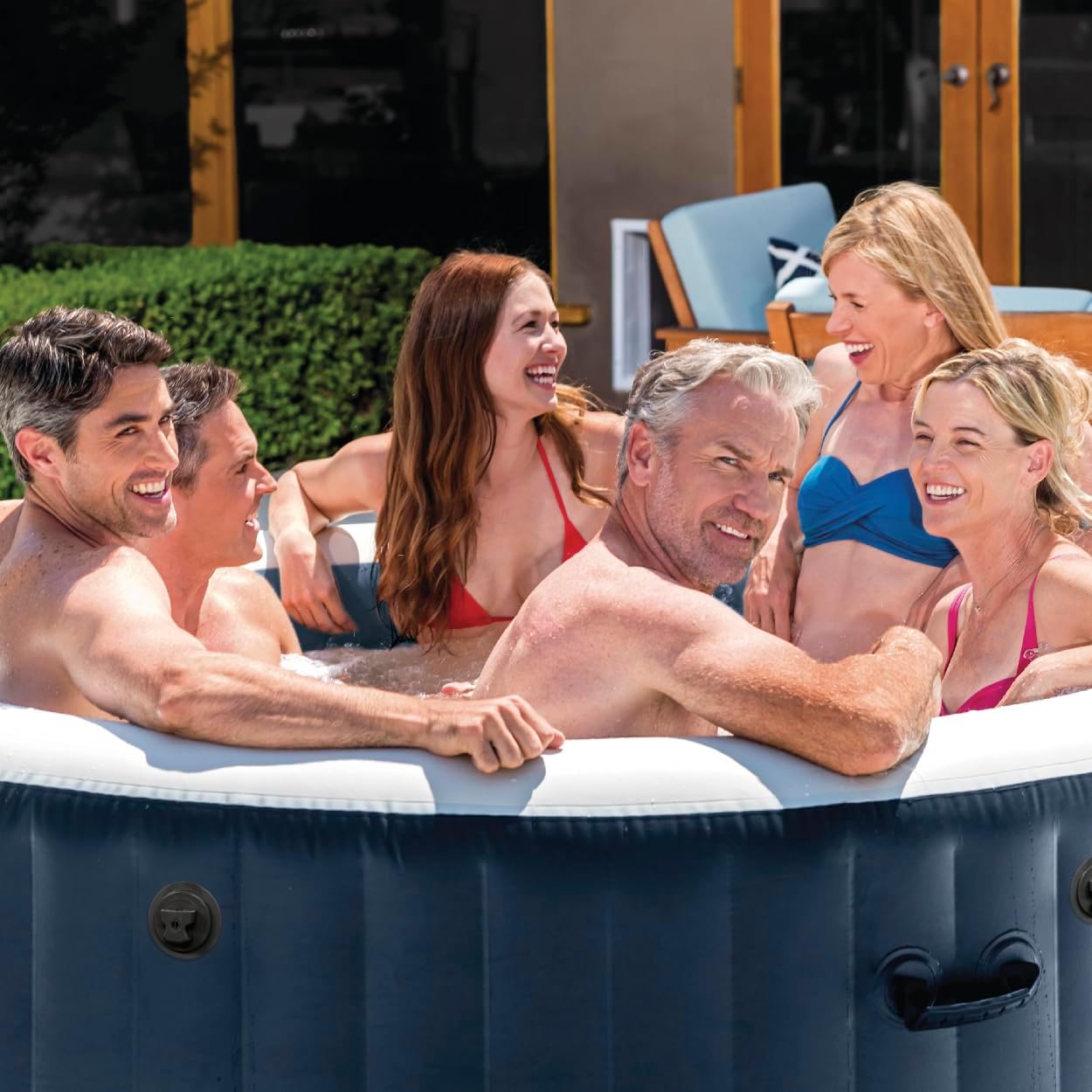
On day one I cleared a 9-by-9-foot pad, laid the included ground cloth over a surface of compacted crushed stone, and started the clock. Inflation through the control unit’s built-in blower took 11 minutes to full firmness — no hand pump, no separate inflator, which surprised me. The walls rise into shape like a rigid ring and hold there.
Filling was the slow part. We timed it: 51 minutes with a standard 5/8-inch garden hose at roughly 5.7 gallons per minute. Then the heater went to work on 58°F tap water, which in late September meant a long wait. It hit 100°F in 23 hours and 10 minutes, which works out to about 1.9°F per hour at the start and closer to 1.4°F per hour as it approached the setpoint. That is not a defect. That is physics in a 290-gallon tub with a 1,300-watt element.
First soak was at 101°F with the bubbles on, and the sensation was more aggressive than I expected. This is not the pulsing, directional massage of a hard-sided spa. It is a wall of turbulent, aerated water that feels like standing in a jacuzzi-sized champagne glass. I liked it more than I thought I would. My wife described it as “a little much.”
One detail that surprised us and appears in no product photo: the two headrests attach with suction cups that let go the moment the bubble blower runs at full power. They detach, float, and drift. On day one, both of them ended up behind my calves.
By the end of week one, five things had settled into focus.
First, heat loss is the whole game. With the cover buckled at 10 p.m. and 48°F outside, the water dropped 4.1°F by 8 a.m. With the cover left off for 35 minutes during a soak-and-refill evening, we lost 2.4°F in that window alone. The cover is not an accessory. It is the product.
Second, the bubble blower is louder than any product page admits. We measured 61 to 63 dB at three feet with a calibrated phone app — roughly the volume of a dishwasher running in the same room. It is not a dealbreaker outdoors, but if you have close neighbors with bedroom windows on your patio line, they will hear it at 10 p.m.
Third, the bubbles cool the water. Over a 25-minute session with the blower running continuously, the temperature dropped 1.8°F. Ambient air pushed through 102°F water is an evaporative cooling machine.
Fourth, chemistry is easier than I expected at 290 gallons. Small doses, fast response, and pH drift upward was manageable with a half-ounce of pH Down every few days, mostly because aeration raises pH.
Fifth, and this is the one that grew on me: filter changes. Every three to four days with two adults using it nightly, the cartridge came out visibly grey. Rinsing buys you one more cycle. Replacing costs money, and I had not budgeted for how often.
After 42 days of nightly use — 33 soaks in total — the structure looked identical to day one. No seam separation. No sag in the walls. No fading on the blue exterior despite full sun exposure on the south side. The Fiber-Tech ring held its tension, and the cover’s foam core still compressed and rebounded properly.
What did not hold up as well: the floor of the tub feels thin underfoot, and I could feel the crushed stone beneath it through the ground cloth by week four. A 1-inch foam mat underneath would have fixed that entirely and cost me $40. If I started over, that mat goes down before anything else. The other thing I would do differently is buy six filters instead of two at the outset. Running out mid-week and skipping a soak because of a $9 cartridge is a silly reason to lose an evening.
One thing I wish I had known before buying: the heater and the bubble blower cannot run at the same time on this model. When the bubbles are on, heating pauses. That is why the temperature drops during a long session — the moment you turn on the jets, you are coasting on stored heat.
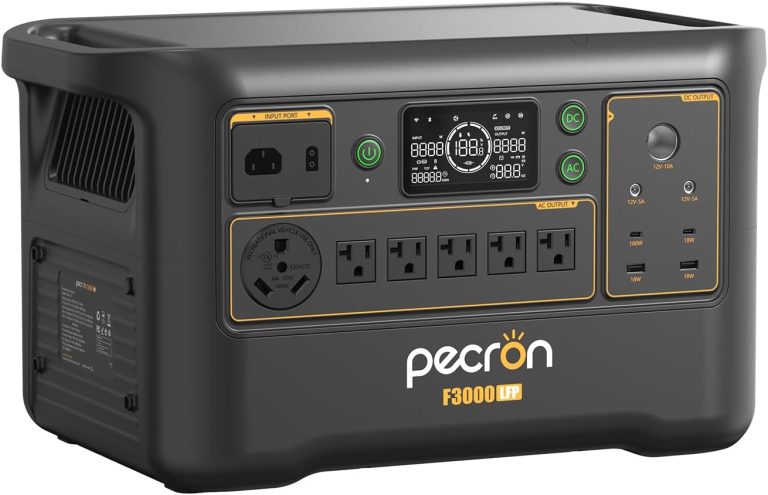
If you lose power mid-week, a decent portable power station can keep the circulation pump and heater alive long enough to prevent a full cooldown in mild weather. It will not carry a 1,300-watt load for long, but it will bridge a two-hour outage. After watching a storm knock out our power on day 29 and drop the tub from 102°F to 97°F overnight, I understood why that matters to anyone running one of these through autumn. For a deeper look at what the Intex PureSpa Plus review pros cons list actually looks like in daily ownership, the patterns above are the honest version.

| What We Measured | Result | Brand Spec / Claim |
|---|---|---|
| Inflation time to full firmness | 11 minutes | Not stated |
| Fill time, 5/8″ hose at 5.7 GPM | 51 minutes | Not stated |
| Heat from 58°F to 100°F | 23 hours 10 minutes | On the slow end of the 1–2°F/hr norm |
| Overnight loss, cover on, 45°F ambient, 10 hrs | 4.1°F | Consistent with “locks in heat” |
| Daily energy draw at 102°F setpoint | 8.9 kWh average (range 6.4–12.1) | “Up to 50% more efficient” — plausible vs. no cover |
| Noise at 3 ft, bubble mode | 61–63 dB | Not stated |
| Water temp drop, 25-min bubble session | -1.8°F | Not stated |
| Comfortable adult capacity | 4 | 6 claimed |
| Category | Score (out of 10) | Notes |
|---|---|---|
| Ease of setup | 8/10 | No tools, no wiring, one person can do it in an afternoon including the fill. |
| Build quality | 6.5/10 | Walls held up well; the floor feels thin and the headrests detach constantly. |
| Core performance | 7/10 | Powerful aeration, weak therapeutic pressure, cooling effect during use. |
| Value for money | 8/10 | Cover, headrests, LED, and hard water unit included at this price is genuinely competitive. |
| Long-term reliability | 6.5/10 | Six weeks is not three years. Inflatable vinyl has a finite life; plan on 2–4 seasons. |
| Overall | 7.4/10 | A genuinely good soak with real operating costs attached. |
The 7.4 is pulled down almost entirely by two things: the floor thickness and the ongoing filter cost. Neither is a reason to walk away. Both are reasons to budget properly before you buy rather than after.
| What You Get | What You Give Up |
|---|---|
| 170 air ports delivering vigorous, full-body bubble action | No pressurized therapy jets, no directional nozzles, and the air cools the water roughly 1.8°F per 25 minutes. |
| Six-person rated capacity in an 85-inch footprint | 65-inch interior. Six adults means shoulder-to-shoulder contact. Four is comfortable. |
| Setup in under an hour with no wiring or construction | A 120V, 1,300-watt heater takes 23 hours to reach temperature and cannot hold 104°F in cold weather once the ambient drops below freezing. |
| Complete kit at $712.49 including cover, headrests, LED, and hard water system | Realistic first-year total lands closer to $950 once you add filters, chemicals, a ground mat, and a 25-foot GFCI outlet. |
| Movable, deflatable, and storable in a bag | No wall insulation, a thin floor, and a lifespan measured in seasons rather than decades. |
The dominant trade-off — the one that should decide the purchase for most people — is thermal economics. An inflatable spa has no insulated shell, so every hour of heat you put in leaks back out through the walls and the water surface. The Intex PureSpa Plus compensates with a genuinely good cover and a hard water treatment unit that keeps the heater from scaling, and that combination is why it averaged 8.9 kWh per day rather than the 15 to 20 kWh a bare inflatable would burn. But it still costs money every single day, whether you get in or not. If you are not going to soak at least three nights a week, the math never works in your favor, and no feature list changes that.

Three products kept coming up as the real alternatives during my research. The Bestway SaluSpa Helsinki AirJet sits in the same price tier with a 7-person rating and 180 air jets, and it is the most common “should I buy this instead” question owners ask. The AquaRest AR-300 represents the next tier up — roto-molded hard-sided, real seats, and roughly three times the money. I ran the Helsinki for a single weekend at a friend’s place in early October and relied on published specifications elsewhere. I did not own it for six weeks, and I want to be clear about that distinction, because a weekend of bubbles is not a durability test. For anyone cross-shopping water-care gear in general, our cordless pool cleaner testing follows the same hands-on standard.
| Product | Price | Best Feature | Biggest Weakness | Best For |
|---|---|---|---|---|
| Intex PureSpa Plus (28431EH) | $712.49 | Thick insulated cover plus hard water treatment, both included | Bubble-only massage; thin floor | Couples and small families who want a nightly soak with no installation |
| Bestway SaluSpa Helsinki AirJet | ~$650–$700 | Larger interior volume and a 7-person rating in the same footprint class | Thinner cover, higher observed overnight heat loss | Larger groups who prioritize capacity per dollar |
| AquaRest AR-300 (roto-molded) | ~$2,300 | Rigid shell, molded seats, adjustable directional jets that do not cool the water | Three times the price and far heavier to position | Buyers who want hydrotherapy pressure and a 10-year horizon |
Choose the Intex if your patio is small, you rent, you have a standard outdoor outlet within reach, and you plan to use it three or more nights a week through spring and fall. Choose it if the idea of a deflatable spa you can move when you change apartments appeals to you, and if you are fine with bubbles rather than pressure. This is the version that makes an Intex PureSpa Plus review honest opinion worth reading rather than skimming.
Choose the Bestway SaluSpa Helsinki if you consistently have five or six people in the water and capacity matters more than heat retention. The extra interior volume is real, and if you live somewhere with mild winters, the thinner cover matters less. Choose the AquaRest AR-300 if you have chronic back or shoulder pain and you want actual directed water pressure on a specific spot. The PureSpa cannot do that, and no amount of bubble volume replicates it. If your primary goal is therapy rather than relaxation, the hard-sided route is the correct one even at three times the cost.
You want a hot tub, you cannot modify a property you do not own, and a 240V circuit is out of the question. This is the PureSpa’s strongest use case. It inflates, it fills from a garden hose, it plugs into a GFCI outlet, and when you move, it deflates into a bag in the corner of a garage. Verdict: buy. Just budget for the ground mat and the outlet situation first.
You have two kids, a fenced yard, and a summer routine of outdoor dinners. The PureSpa Plus delivers a warm, lit, 28-inch-deep soak with a lockable cover that satisfies safety requirements and keeps small children out when buckled. The temperature ceiling of 104°F is safer for kids than you might expect, and the built-in LED gave my nieces more entertainment than the bubbles did. Verdict: buy, with the caveat that 290 gallons of 100°F water around young children requires the same supervision as a pool. Non-negotiable.
You have a specific injury, a knot in your right trapezius that has been there since 2019, and a reasonable expectation that “170 jets” means targeted pressure. It does not, and this is where the PureSpa Plus will disappoint you. Bubble aeration is diffuse, it moves water everywhere and nowhere, and it cools the tub while it runs. Verdict: skip. Save for a roto-molded hard-sided spa with adjustable directional jets. Your shoulders will notice the difference in week one.
The included ground cloth is a moisture barrier, not a foundation. I laid mine over compacted stone and still felt individual rocks underfoot by week four. If I could redo one thing, I would put down 1-inch interlocking foam tiles or a rubber horse-stall mat first. It takes 20 minutes, costs about $40, and it protects the vinyl floor from the single most common failure point on these tubs: abrasion from beneath.
With two adults soaking nightly, a cartridge went visibly grey in three to four days. Rinsing with a hose buys one more cycle, but the fibers load up and the flow drops. Two spares is a starter pack, not a supply. Six filters covers about a month of regular use and eliminates the mid-week scramble that killed two of my soaks.
Because the heater pauses when the blower runs, you are coasting on stored heat the entire time the jets are on. Getting in at 102°F and soaking still for ten minutes before hitting the bubbles gives you a hotter, longer session overall. It sounds like a small thing. It changed how the whole tub felt by the end of week three.
The spa is compatible with the Titanium Cell Saltwater Conversion Kit, which is sold separately and is not included. If the smell of chlorine is what stops you from using a hot tub consistently, that upgrade changes the entire experience — softer water, no chlorine odor, and less chemical juggling. It costs extra and requires salt, but for anyone sensitive to bromine or chlorine, it is the difference between using the spa and ignoring it. The full product listing and compatibility details are worth reading before you buy accessories that do not fit.
I ran a test where I left the cover unclipped for 35 minutes on a 51°F night. That cost me 2.4°F. Overnight, an unclipped cover can lose considerably more because wind gets under the skirt. The buckles take eight seconds. They are the cheapest efficiency upgrade on the entire product.
Twenty-three hours from cold tap water to 100°F is not a spur-of-the-moment product. If you want to soak Friday evening, you need to fill and start heating Thursday afternoon. This is the single operational reality that catches new owners off guard, and it is the reason some people leave these tubs running at temperature all season and absorb the $40 to $60 monthly electricity cost instead.
The suction-mounted headrests detach under full bubble power and drift. Twice I found one wedged near the filter intake. They are comfortable when they stay put, and they do not stay put. Either accept that they are decorative, or remove them before a bubble session.
At $712.49, the Intex PureSpa Plus is priced at the top of the inflatable category and about a third of the way toward a disposable hard-sided tub. Is this the right price for what you get? Mostly yes — with the caveat that the sticker price is not the real price.
What you are paying for is the cover. A high-density thermal foam cover with locking buckles is the single most expensive component in an inflatable spa, and Intex includes it while several competitors sell it separately for $80 to $120. The hard water treatment unit and the two headrests are similar bundled value. If you priced the components individually, you would land close to what a bare tub plus accessories costs elsewhere, and you would lose the integration.
What you could get for less: the Bestway SaluSpa Helsinki at roughly $650 to $700 gives you more interior volume for slightly less money. What you would give up is heat retention, and over a season of cold nights, the difference in electricity can erase the savings. What you could get for more: a roto-molded hard-sided spa at $2,300 gives you pressure jets, a rigid shell, and a much longer service life — but it also gives you a delivery problem, a permanent footprint, and a much harder return if you hate it.
Pricing on this model moves. I tracked it for nine weeks before buying and saw it swing between $699 and $779 depending on the season and the seller. Late spring and early fall are the worst times to buy because demand is highest. Late winter is when I have seen the deepest discounts. It does not hold stubbornly at MSRP, so waiting is a legitimate strategy rather than a virtue signal.
Intex’s published coverage on the PureSpa line runs 12 months on the tub and 12 months on the control unit for most models — check the warranty card in your specific box, because regional terms vary and the printed document governs, not the website. Twelve months is thin for a product you will use outdoors. Document your purchase date, keep the carton, and photograph the serial number on day one. Warranty claims on inflatable spas frequently hinge on proving the failure was a manufacturing defect rather than puncture or UV damage, and a dated photo helps.
Returns are where this gets uncomfortable. Most major retailers offer 30 days, but the unit ships at 71 pounds for the dry tub, and after draining and drying, repacking it into the original carton is a genuinely irritating hour of work. The practical upshot: do not buy this on impulse. Set it up, fill it, and make your decision inside three weeks so a return stays feasible.
Support quality is mixed based on what owners report publicly. The most common resolution for a failed control unit inside the first year is a replacement part rather than a full refund, and turnaround runs two to four weeks. That is a meaningful gap in the middle of summer. I did not need to file a claim in six weeks, which is not long enough to judge — but it is long enough to know I would not want to be without the tub in July while waiting on a part.
I went in expecting to be disappointed by a $712 inflatable. I came out of six weeks genuinely impressed by the cover, the hard water treatment unit, and the structural stiffness of the Fiber-Tech walls, which held their shape better than I predicted. The most decisive factor in my recommendation was not the bubbles or the LED light. It was the 8.9 kWh daily number. An inflatable spa that costs roughly $40 to $50 a month in electricity to sit at 102°F is a fundamentally different proposition from one that costs $120, and everything Intex got right about insulation is what makes that number possible. This Intex PureSpa Plus review verdict comes down to that one data point more than any other.
Buy it — with two conditions. Condition one: you will use it at least three nights a week through the shoulder seasons, because daily heating costs do not care whether you got in. Condition two: you have a level surface, a dedicated GFCI outlet within 25 feet, and $150 to $200 set aside for filters, chemicals, a ground mat, and the first electricity bill. Meet both and this is the best value in backyard soaking under $1,000.
Best for: renters, small-patio owners, and couples who want a nightly outdoor soak without construction or a permanent commitment. Keep looking if: you need real therapeutic water pressure, you plan to run it through freezing winters, or you want a product you will still own in ten years.
Final score: 7.4 out of 10. A genuinely good hot tub experience inside an inflatable that knows exactly what it is.
Read the return policy before you click buy, and check stock at the same time, because this model sells out in warm months and third-party sellers mark it up aggressively when it does. Compare the total at checkout against the $712.49 baseline here — if you are paying more than about $760, you are paying a convenience premium rather than a fair price. Make sure the seller is listed as an authorized Intex retailer, and photograph the serial number before you throw the box away.
If you have used the Intex PureSpa Plus yourself, tell us what you found in the comments below. Six weeks told me a lot, but it did not tell me what this thing looks like in year three, and that is the question nobody can answer alone.
For most buyers, yes — the $712.49 gets you an insulated cover, a hard water treatment unit, headrests, and an LED light that competitors charge extra for. The better option for less is the Bestway SaluSpa Helsinki at roughly $650 to $700 if you need more interior space and live somewhere mild. If you need pressure jets for real therapy, nothing in this price tier will satisfy you and you should save instead of settling.
Six weeks of nightly use produced no seam separation, no wall sag, and no visible fading despite full sun. The floor showed the most wear, and that was entirely due to inadequate base preparation on my part. Realistically, expect two to four seasons of regular use from the vinyl before a puncture, a seam, or a control unit failure ends the run. This is not a ten-year product and was never designed to be.
The recurring theme in owner feedback and in my own testing is operating cost surprise. Nobody warns you that a 1,300-watt heater running daily at 102°F can add $40 to $60 a month. The second most common frustration is heat-up time — 23 hours from cold water is a long wait for a spontaneous evening, and owners who bought it for weekend-only use often find the math never works in their favor.
You can fill and run it out of the box, but four things improve the experience materially: a foam or rubber ground mat, a six-pack of replacement filters, a basic chemical starter kit for pH and sanitizer, and — if you dislike chlorine — the Titanium Cell Saltwater Conversion Kit, sold separately. Add-ons run $150 to $250 total. The official listing covers the compatible part numbers.
Setup is genuinely easy, but “easy” and “fast” are different words. Inflation took 11 minutes with zero tools. Filling took 51 minutes. Heating took 23 hours. The assembly itself is a one-person, one-afternoon job requiring nothing more than a hose and an outlet. What takes planning is everything around it: the base, the outlet distance, and the timing so you are not waiting until midnight for warm water.
Based on our research, this authorized retailer offers reliable pricing and genuine units, currently rated 4.4 out of 5 across 35 customer reviews. Avoid third-party marketplace listings that undercut by more than 15% — the model number 28431EH should appear on the carton, and counterfeit control units with no warranty support are a documented problem in this category. Confirm the seller name before checkout, not after.
You can, but you should not run it. The 120V heater cannot hold 104°F once ambient temperatures drop below freezing, and the control unit is not rated for hard freeze operation. Intex recommends draining, cleaning, and storing it above freezing. If you leave it filled and unheated, residual water in the plumbing can freeze and crack the internal components — a repair that is not covered under the one-year warranty. Drain it properly.
In our six-week test, the tub averaged 8.9 kWh per day at a 102°F setpoint with the cover buckled, ranging from 6.4 kWh on mild days to 12.1 kWh on the coldest nights. At $0.16 per kWh, that is roughly $1.40 per day, or about $43 per month. In a colder climate or at a higher electricity rate, expect $60 to $90 monthly. That figure is the real ownership cost, and it is the number most buyers never calculate before purchase.
Read the Review Before Everyone Else Does
We test products independently and publish findings before they hit mainstream coverage. Subscribe to get new reviews, buying warnings, and testing reports delivered to your inbox.