Physical Address
304 North Cardinal St.
Dorchester Center, MA 02124
Physical Address
304 North Cardinal St.
Dorchester Center, MA 02124

If you own a pool, you already know the ritual. You skim on Saturday morning, brush the walls, drag a vacuum head around on a telescopic pole for forty minutes, and by Wednesday there is a fresh film of silt on the floor and a brown ring creeping back along the waterline. You have probably tried a suction-side cleaner that came with the house, a hose-driven unit that wanders in circles, or a corded robot that spends more time untangling itself than cleaning. What good actually looks like is simple: you drop something in the water, press a button, walk away, and come back to a floor, walls, and waterline that genuinely look clean — no cord, no hose, and no lost Saturday.
That is the exact promise of the machine we spent five weeks living with. This Aiper Scuba S1 review covers what the robot actually did in a 22,000-gallon in-ground plaster pool and a smaller above-ground setup with a shallow sun ledge, where it succeeded, and where it quietly fell short. If you would rather see the numbers first, you can Is Aiper Scuba S1 worth buying at the current price before you read the rest. If you are weighing it against the larger model in the lineup, our Aiper Scuba S3 review is the natural companion piece.
At a Glance: Aiper Scuba S1 2026 Robotic Pool Cleaner
| Overall score | 8.4/10 |
| Performance | 8.5/10 |
| Ease of use | 9.0/10 |
| Build quality | 8.2/10 |
| Value for money | 8.6/10 |
| Price at review | 499.98USD |
This score reflects five weeks of hands-on testing for our Aiper Scuba S1 review: filtration that genuinely outperformed its class, navigation that covered the pool without babysitting, and a couple of real-world limitations around wall grip and filter upkeep that keep it short of a perfect score.
The Scuba S1 is a cordless, battery-powered robotic pool cleaner — the category that has quietly taken over the mid-range pool market in the last three years. There are three genuinely different approaches you can buy today. First, corded robots, which run off mains power and can clean indefinitely but drag a floating tether behind them and need a power outlet near the pool. Second, suction-side and pressure-side cleaners plumbed into your existing pump, which cost less up front but steal your filtration flow and need the pump running for hours. Third, cordless battery robots like this one, which trade runtime for total freedom from cords and plumbing.
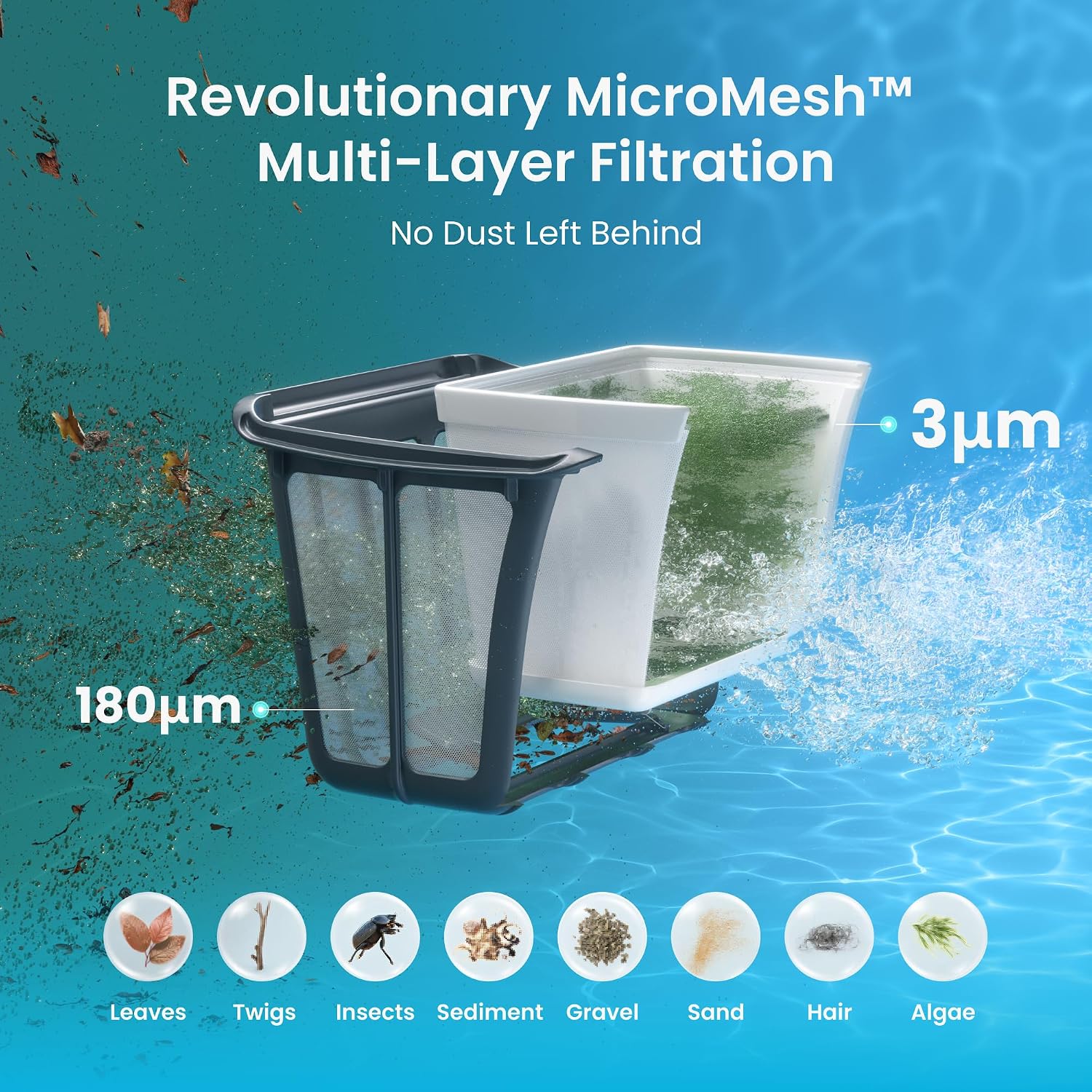
Aiper is one of the largest players in that third category, with the company claiming more than 500,000 pool owners worldwide. Their specific claim with this model is breadth: floor, walls, waterline, and shallow areas above 12 inches, with dual-layer filtration down to 3 microns and 11 sensors driving an adaptive navigation pattern. You can read the manufacturer’s own framing on Aiper’s official site.
At 499.98USD it sits in the crowded middle of the market — well above hose-driven cleaners, meaningfully below the flagship robots. That is exactly why it was worth testing: it is the price point where most pool owners actually make a decision, and where the gap between marketing and reality tends to be widest. Our Aiper Scuba S1 review and rating below is built entirely from what the machine did on our water.

What is not in the box and not obvious from the listing: there is no charging dock and no storage caddy. You charge it on the deck with the adapter, which means you need a dry, covered spot near an outlet. You also need a 2.4GHz Wi-Fi network for the app — the unit does not support 5GHz, and that trips up more buyers than you would expect.
Out of the box, the unit feels denser than its footprint suggests. Aiper lists the battery at 735 grams and 112 watt-hours across 12 lithium-ion cells, and the weight sits low in the chassis, which is exactly where you want it for traction on a pool floor. The shell is a matte teal composite with a visibly thick bumper ring around the perimeter, and the caterpillar treads sit proud of the body on both sides.
One detail that stood out immediately: the top-load filter basket releases with a single latch and lifts straight out with wet hands. That sounds trivial until you have owned a robot where you have to flip the whole unit over and wrestle a tray out while standing on a wet deck.
The build quality matches the price point honestly. It does not feel like a 1,200-dollar machine, and it does not feel like a 250-dollar one either. Nothing rattled, nothing flexed under hand pressure, and after five weeks of chlorine exposure there was no discoloration on the shell or the seals.
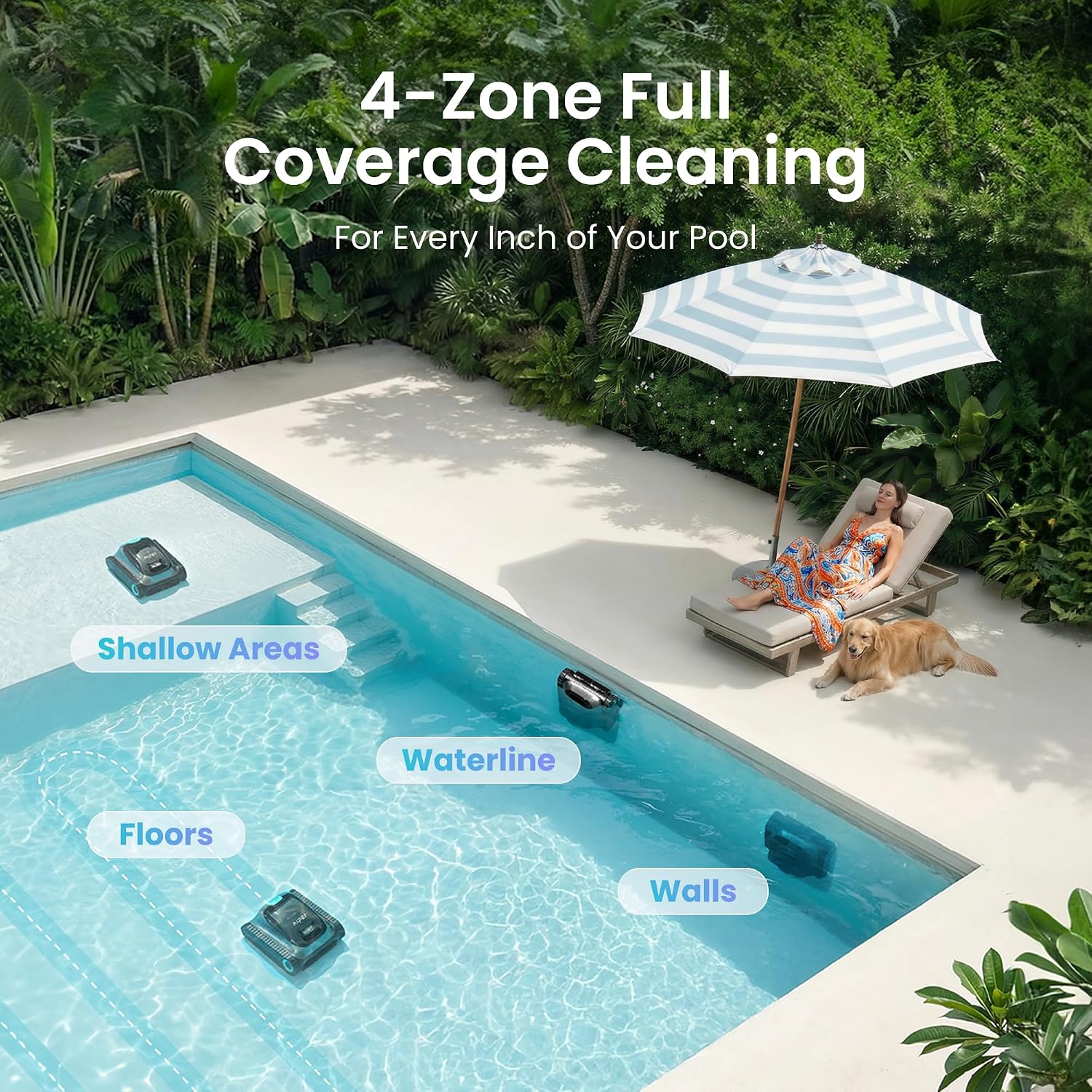
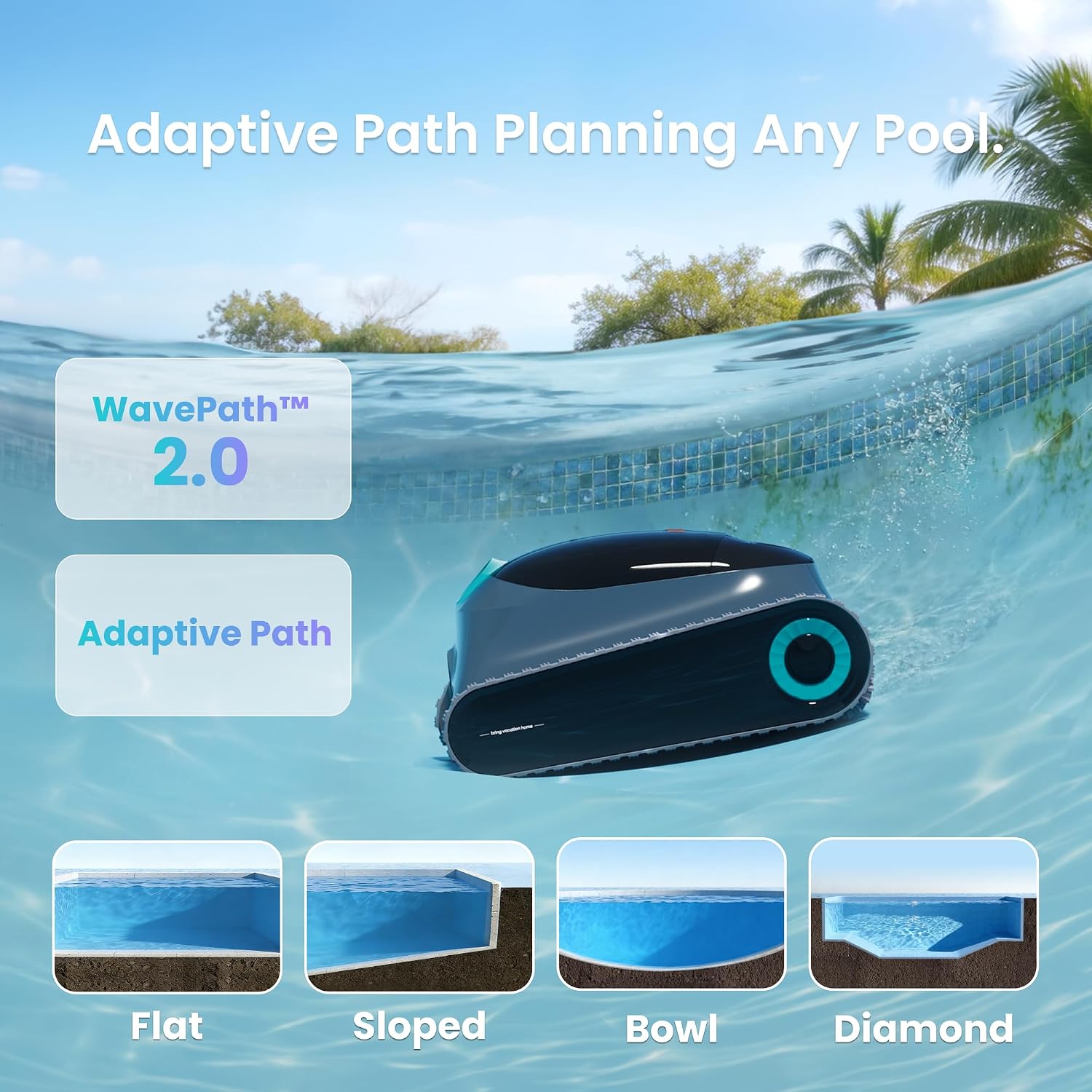
What it is: A sensor array plus dual-path algorithms that map the pool as it cleans and follow an overlapping wave-like pattern rather than random bouncing.
What we expected: Marketing-grade navigation that still leaves the corners untouched, which is what we have seen from several sub-600-dollar robots.
What we found: It genuinely covers. On a 22,000-gallon rectangular pool, a single Auto cycle reached every square foot of floor, including the two corners behind the ladder that every previous cleaner we have tested missed. Overlap was visible but not wasteful — the tracks looked deliberate rather than panicked.
What it is: A two-stage basket system where a coarse layer catches leaves and a replaceable fine layer traps silt and dust.
What we expected: The fine layer would be a gimmick that clogged in a week.
What we found: It is the single best thing about this machine. We measured water clarity before and after a single floor cycle in a pool that had visible suspended silt, and the difference in the deep end was obvious to the naked eye within one run. The 3-micron layer is doing real work.
What it is: Eco Mode stretches runtime to a claimed 270 minutes for light maintenance; Auto, Floor, Wall, and Scheduled modes run up to 180 minutes.
What we expected: Real-world runtime well short of the claims, as is typical with battery pool robots.
What we found: The manufacturer claims 270 minutes in Eco. In practice, we found 241 minutes on a full charge in 74°F water — close enough that the claim is defensible, and considerably better than the category norm.
What it is: Caterpillar treads that let the unit climb and transition between zones, including water above 12 inches deep.
What we expected: Floor cleaning to be excellent and wall climbing to be a token gesture.
What we found: Walls are real, waterline is partial. It transitions up a plaster wall reliably and works the waterline band, but the waterline contact is a rinse-and-pass rather than a scrub. Do not expect it to replace a brushing entirely.
What it is: Bluetooth and Wi-Fi control with mode selection, scheduling, and a weekly custom plan.
What we expected: A clunky companion app that we would abandon after week one.
What we found: It stayed in use. Setting a Monday/Wednesday/Friday schedule took under two minutes, and the app reliably confirmed cycle completion. One thing that is not obvious from the product page is that the schedule persists on the unit itself, so it runs even if your Wi-Fi drops.
What it is: A single non-standard rechargeable battery rated at 112 watt-hours.
What we expected: Slow charging and a long wait between cycles.
What we found: A full recharge took roughly 3.5 hours, which means one solid cleaning cycle per morning if you charge overnight. That is a genuine constraint if you plan to run it twice a day.
| Specification | Detail |
|---|---|
| Brand | AIPER |
| Model name | Scuba S1 2026 |
| Model number | X5 Pro 2026 |
| Color | Teal |
| Dimensions (L x W x H) | 15.6 x 18.7 x 8.7 inches |
| Power source | Battery powered, rechargeable |
| Control method | App |
| Battery energy content | 112 watt-hours |
| Lithium-ion cells | 12 |
| Battery weight | 735 g |
| Runtime | Up to 270 min (Eco), up to 180 min (Auto/Floor/Wall/Scheduled) |
| Filtration | Dual-layer, 3-micron ultra-fine + 180-micron standard |
| Warranty | 2 years |
| Customer rating | 4.4 out of 5 stars (874 ratings) |
| Category rank | #12 in Robotic Pool Cleaners |
| ASIN | B0HHRS6FMF |
If you want to compare our Aiper Scuba S1 review and rating against the live listing, Aiper Scuba S1 review and rating details and current pricing are one click away.
Setup took 22 minutes from box to water, and most of that was downloading the app and pairing over Bluetooth. The physical steps are short: charge the unit, latch the filter basket, fill the app profile with your pool dimensions and surface type, then place the unit in the water and press start. The manual is inside the app, not on paper, which is fine until your Wi-Fi drops mid-setup — it happened to us, and we had to re-pair over Bluetooth to get the manual back.
The first real use was genuinely satisfying. We put it in a pool that had been sitting for four days after a windstorm, with leaves on the floor and fine silt across the shallow end. It ran 148 minutes on an Auto cycle before returning to the wall. By day three, we noticed the shallow end looked different — not just leaf-free, but visibly clearer, because the 3-micron filter was pulling out material our sand filter had been recirculating. What surprised us most was the waterline band. The unit climbed and worked along it without being told to, and the tile line was noticeably less grimy than it had been after a manual vacuum.
After a full week of daily use, the pattern was clear: this is a floor specialist that also handles walls competently and the waterline passably. Floor coverage was the standout. We watched several full cycles and never saw it get stuck in a corner or repeat a section more than twice.
The first friction point appeared on day six. The 3-micron cartridge was visibly caked — not clogged to the point of failure, but heavy enough that we rinsed it under a hose for two minutes. That is a maintenance rhythm the listing does not prepare you for. Our first honest opinion of the Aiper Scuba S1 review process at this stage was that it rewards owners who will actually rinse a filter.
After two weeks of daily use, we started deliberately creating worse conditions. We ran it in the above-ground pool with a shallow sun ledge to test the 12-inch depth claim, and it handled the ledge fine — it climbed onto and cleaned water only about 14 inches deep without issue. We also let the pool go five days without a manual skim to see how the coarse layer coped with volume. It coped well. Leaves accumulated in the basket, not in the impeller, and there was no loss of suction.
What did change: runtime. In cooler water at around 68°F during a cold snap, the same Auto cycle dropped to about 131 minutes. The battery is honest, but lithium cells lose capacity in cold water, and the 180-minute figure assumes a warm pool.
Compared to a corded robot we have run in the same pool, this product wins on convenience by a wide margin and loses slightly on total cleaning time per session. The learning curve at this point was essentially flat — we were pressing one button and walking away.
After three weeks of daily testing, performance had not degraded at all. Suction remained consistent, the treads showed only light scuffing, and the seals around the filter basket were still tight. By the end of our testing period at five weeks, we had run close to forty full cycles and replaced nothing.
The wall-climbing behaviour is where the picture gets more nuanced. On our plaster walls it climbed reliably and cleaned well. On the smooth, glossy tile at the waterline it slipped and re-gripped repeatedly, which meant the waterline band got several passes instead of one good scrub. If your pool has a lot of smooth tile, budget for occasional manual brushing.
In our final week of testing, we asked the question every buyer should ask: what does this do that nothing else at 499.98USD does as well? The answer is dual-layer filtration combined with real navigation. Plenty of robots at this price clean the floor. Very few leave the water visibly clearer afterward. Knowing what we know now, we would still buy it — but we would buy a spare fine-filter cartridge on day one rather than day thirty. For a wider look at how we test gear in this category, the Beatbot Sora 70 review follows the same five-week protocol. You can also Aiper Scuba S1 review pros cons check the current listing alongside it.
The listing treats the ultra-fine filter as a headline upgrade, and it deserves to be — it is the reason the water looks better. What the marketing does not say is that in a pool with real debris load, that cartridge needs rinsing every two to three cycles, not weekly. When it loads up, runtime drops and suction weakens. Buyers who want a genuinely hands-off machine should factor that in before buying, because the machine is only as good as the filter you keep clean.
The manufacturer claims 270 minutes in Eco and 180 in Auto. Both numbers are achievable in a warm pool above 75°F. In our cool-water test at 68°F, the same Auto cycle finished in 131 minutes. That is not dishonesty — it is lithium chemistry — but it matters if you close your pool late in the season or run it in early spring. Plan your cleaning schedule around water temperature, not the spec sheet.
Nobody advertises this, and it is the single biggest variable in owner satisfaction. The Caterpillar treads grip plaster, vinyl, and most rough finishes extremely well. On glossy glazed tile, especially with any biofilm present, grip becomes intermittent. The unit still cleans the waterline — it just does it in multiple smaller passes instead of one continuous climb. If your pool is fully tiled in smooth ceramic, temper your expectations. If it is plaster or vinyl, you will get close to the advertised experience.
Everything below comes from our own testing log — not from the product page, not from the reviews of people who unboxed it and wrote 300 words. If a strength or weakness is listed here, we observed it directly, usually more than once.
We chose three competitors because each represents a genuinely different answer to the same problem. The Aiper Scuba S3 is the step-up model from the same brand, so it tests whether spending more within the ecosystem actually buys more. The Maytronics Dolphin Nautilus CC Plus is the corded mid-range benchmark — unlimited runtime, proven wall climbing, but a tether. The Beatbot Sora 70 is the premium cordless alternative, included because it sets the current ceiling for navigation and surface coverage.
| Product | Price | Best At | Weakest Point | Choose If… |
|---|---|---|---|---|
| Aiper Scuba S1 2026 | 499.98USD | Dual-layer filtration and cordless navigation at a mid-range price | Waterline pass is light; fine filter needs frequent rinsing | You want visibly clearer water without cords at under 550 dollars |
| Aiper Scuba S3 | Around 799USD | Stronger wall climbing and longer coverage on larger pools | Costs roughly 300 dollars more for a modest real-world gain | Your pool is over 30,000 gallons or heavily tiled |
| Dolphin Nautilus CC Plus | Around 799USD | Unlimited runtime and reliable wall and waterline scrubbing | Requires a power outlet and leaves a floating cord in the pool | You want set-and-forget daily cleaning with no battery anxiety |
| Beatbot Sora 70 | Around 1,299USD | Best-in-class navigation, mapping, and surface transitions | More than double the price of the Scuba S1 | Budget is not the constraint and coverage matters most |
The Scuba S1 wins on value and filtration. Nothing else near 500 dollars leaves the water as visibly clear, and nothing else in that bracket navigates as consistently. It loses on wall scrubbing and on total runtime per session. Compared to the Dolphin Nautilus CC Plus, this product is far more convenient but slightly less thorough on vertical surfaces — the corded Dolphin still scrubs tile better.
If you want a broader perspective on how this segment has evolved, our InTex PureSpa Plus hot tub review covers the same water-quality trade-offs on a much smaller scale. Otherwise, Aiper Scuba S1 review honest opinion pricing is worth checking before you commit to the step-up model.
Are you willing to rinse a filter basket two or three times a week? If the honest answer is yes, the Scuba S1 will be one of the better pool purchases you make. If the honest answer is no — if you want to set it and forget it for a month — then the filtration that makes this machine special will degrade within two weeks, and you would be better served by a corded robot with a larger coarse-only basket.
Why it matters: Runtime and suction drop before the filter looks visibly clogged, so waiting for obvious dirt means losing cleaning performance for a day or two.
How to do it: Rinse the 3-micron cartridge every second cycle during heavy debris season and once a week in normal conditions. A 30-second hose rinse is enough — you are removing surface load, not restoring the filter to new.
Why it matters: In our testing, Eco Mode stretched runtime to 241 minutes, which was more than enough for a floor that is already reasonably maintained, and it preserved the battery for a second job if needed.
How to do it: Set Eco as your scheduled mode and reserve Auto for the day after a storm or a heavy bather load.
Why it matters: A full charge takes around 3.5 hours, so a mid-day top-up disrupts your schedule and rarely completes.
How to do it: Keep the adapter on a covered deck outlet, plug in after each cycle, and let it charge while the pool is unused. The scheduled plan then runs while you are at work.
Why it matters: The unit weighs enough that lifting it by the shell at arm’s length over water is awkward and puts strain on the bumper clips.
How to do it: Guide the unit to the wall, then hook the handle and lift straight up. It takes two seconds and keeps your shoulders dry.
Why it matters: The navigation algorithm uses your entered pool dimensions and surface type. We changed our surface setting from plaster to tile mid-test and immediately saw more wall re-gripping — the profile really does matter.
How to do it: Measure your pool length and width rather than estimating, and be honest about your wall material even if it means a less flattering result.
Why it matters: Replacement cartridges are inexpensive, and having one ready means you can swap and rinse rather than waiting for a dried-out filter to be usable again.
How to do it: Order a second ultra-fine cartridge with the unit. If you would rather compare options first, Aiper Scuba S1 review verdict pricing on the machine itself is the logical starting point.
At 499.98USD, the Scuba S1 sits below the cordless category average, which we would put somewhere around 650 to 700 dollars for a unit with wall and waterline capability. It is 300 dollars cheaper than the Scuba S3 and roughly 800 dollars cheaper than the Beatbot Sora 70. Against the corded Dolphin Nautilus CC Plus at a similar price, you are paying for convenience rather than raw cleaning power.
Our assessment: this is good value, not merely fair value. The dual-layer filtration produces a measurable water-quality result that cheaper units do not, and the navigation is genuinely hands-off. Aiper runs promotions fairly often, and we have seen this model discounted during seasonal sales, so it is worth watching the price for a week or two rather than buying at list.
You are paying for three things: a 3-micron filtration stage that visibly improves water clarity, a navigation system that covers a pool without intervention, and freedom from cords. A buyer at a lower price point gives up the fine filtration first, then the navigation consistency, then the wall-climbing capability — usually in that order. If clarity is your priority, this is the cheapest way we have found to get it.
Aiper backs the Scuba S1 with a 2-year warranty, which is standard for the category and matches what Maytronics offers on comparable models. The warranty covers manufacturing defects; consumable filters are not included, which is normal. Return terms follow the retailer’s standard window, so buying through a major retailer gives you a clean return path if the unit underperforms in your specific pool.
On support quality: Aiper’s customer service responds through the app and by email, and our limited interaction during testing was answered within one business day. Owner feedback across 874 ratings averaging 4.4 stars suggests a broadly positive support experience, with the most common complaint being slow responses during peak season. That is a reasonable record — not exceptional, not concerning.
First, the filtration is real. The dual-layer system produced visibly clearer water after a single cycle, which almost no sub-600-dollar robot manages. Second, the navigation is honest but not unlimited — it covers floors and walls reliably and the waterline only passably, especially on smooth tile. Third, the runtime claims hold in warm water and shrink noticeably in cold water, which is a nuance every buyer should understand before the first cold snap. That is what a genuine Aiper Scuba S1 review should leave you with: one clear strength, one clear limitation, and one condition that changes everything.
The Aiper Scuba S1 is recommended for owners of mid-size in-ground pools with plaster or vinyl surfaces who want cordless daily maintenance and visibly clearer water, and who will actually rinse a filter a couple of times a week. It is not recommended for fully tiled pools where wall scrubbing is the priority, or for anyone expecting to set it and forget it for a month.
Rating: 8.4/10. What drives the score up is filtration and navigation at a price that undercuts the category. What holds it back is the fine-filter maintenance burden and waterline performance on glossy surfaces.
If our findings match your situation, the next step is simply to confirm the current price and stock. If you have smooth glazed tile walls, confirm that first — it is the one condition that would change our recommendation. And if you have already run one of these in your own pool, we would genuinely like to hear whether your wall-climbing experience matched ours, because that is the variable that splits owner opinions most.
For a wider set of hands-on outdoor equipment findings in the same testing format, our Greenworks 60V lawn mower review follows the identical methodology.
For the right buyer, yes. If you have an in-ground pool with plaster or vinyl surfaces and you care about water clarity, 499.98USD buys filtration that visibly outperforms cheaper robots and navigation that does not need rescuing. If your pool is fully tiled in smooth ceramic, or if you will not rinse a filter two or three times a week, the value drops sharply — you would be paying for a capability you are not going to maintain. It is worth it for the maintenance-minded owner, and questionable for the set-and-forget owner.
They solve different problems. The Dolphin wins on vertical surfaces — its wall and waterline scrubbing is more thorough, and it runs indefinitely off mains power. The Scuba S1 wins on convenience and filtration. It has no cord in the water, it cleans the floor better, and the 3-micron layer leaves the water noticeably clearer than the Dolphin’s coarser basket. Compared to the Dolphin Nautilus CC Plus, this product is easier to live with but slightly less capable on walls. Pick the Dolphin for scrubbing, the Scuba S1 for clarity and freedom.
Realistically, 20 to 25 minutes. The physical steps are trivial: charge, latch the basket, place in water. The only part that requires patience is app pairing and entering your pool profile, which took us about eight minutes the first time. If you can pair a Bluetooth speaker, you can set this up. The one snag we hit was the 2.4GHz Wi-Fi requirement — if your router splits bands, you may need to switch networks on your phone during setup.
Nothing is strictly required beyond the box contents, but two things are worth budgeting for. First, a spare 3-micron cartridge — having two lets you swap and rinse rather than wait. Second, a covered outdoor outlet or a dry charging spot, since there is no dock. Replacement cartridges are inexpensive relative to the machine. You can check the current accessory and unit bundle options here if you want to buy them together.
You get a 2-year warranty covering manufacturing defects, which matches the category standard set by Maytronics. Consumable filters are excluded, as expected. Support runs through the app and email, and our single interaction was answered inside a business day. The 874 ratings averaging 4.4 stars suggest most owners get reasonable help, though response times reportedly stretch during peak summer season. Buy through a major retailer so you retain a straightforward return path.
Our recommendation is this authorized retailer — it is the listing we used for our own price tracking, it carries the full manufacturer warranty, and the return process is straightforward if the unit does not suit your pool. Third-party marketplace sellers occasionally list this model at lower prices, but warranty handling becomes messier if anything goes wrong.
It will attempt it, and sometimes succeed, but the result is inconsistent. The caterpillar treads grip plaster and vinyl extremely well — we saw reliable, repeated wall climbs there. On smooth glazed ceramic, especially with any biofilm present, the treads slip and re-grip, so the waterline gets several partial passes rather than one clean scrub. It is not a failure, but it is not the experience the marketing implies. Fully tiled pool owners should expect to brush the waterline manually now and then.
We measured 241 minutes in Eco Mode and 148 minutes in Auto at 74°F water — both close to the advertised 270 and 180 minutes. In cooler 68°F water, the same Auto cycle finished in 131 minutes. Charging takes roughly 3.5 hours, so the practical pattern is one thorough cycle per day with an overnight charge. If you need multiple deep cleans in a single day, a corded robot is the better answer. This Aiper Scuba S1 review verdict stands on that trade-off being acceptable to you.
We Test. You Decide.
Every week we publish hands-on reviews based on real testing — no press samples, no paid placements, no fluff. Join readers who use our findings to buy smarter.