Physical Address
304 North Cardinal St.
Dorchester Center, MA 02124
Physical Address
304 North Cardinal St.
Dorchester Center, MA 02124

How many Saturdays have you lost to a pool vacuum that moves like it’s guessing? You drag out the hose, wrestle with the head, and two hours later you’re still staring at a patch of sand near the deep end. If that sounds familiar, this AIPER Scuba V3 review is for you. The Scuba V3 is a cordless, AI-driven pool robot that uses a front-facing camera to spot debris and drive straight to it instead of wandering in random patterns. AIPER claims that approach makes it up to 10x faster than traditional cleaning methods, and after three weeks of testing, we have real numbers and real opinions to share.
We bought this unit at full price, ran it through spring pollen season, post-storm debris, and everyday leaf litter, and tracked runtime, filtration performance, and app reliability along the way. Whether you’re upgrading from a pressure-side cleaner or buying your first robot, this AIPER Scuba V3 pool robot review covers what actually matters: cleaning results, battery life, maintenance, and whether the $849.99 price tag is justified. If you’re also dialing in the rest of your pool setup, our guide to choosing a pool heater pairs well with this one.
The AIPER Scuba V3 (model N31 Azure) is a battery-powered robotic pool cleaner built for in-ground and larger above-ground pools. It sits in the premium cordless segment, competing directly with flagship models from Beatbot, Dolphin, and Wybot. Unlike corded cleaners that need a power outlet and a floating cable, the Scuba V3 runs on a 150 Wh lithium-ion pack and recharges on a wireless dock that requires no installation.
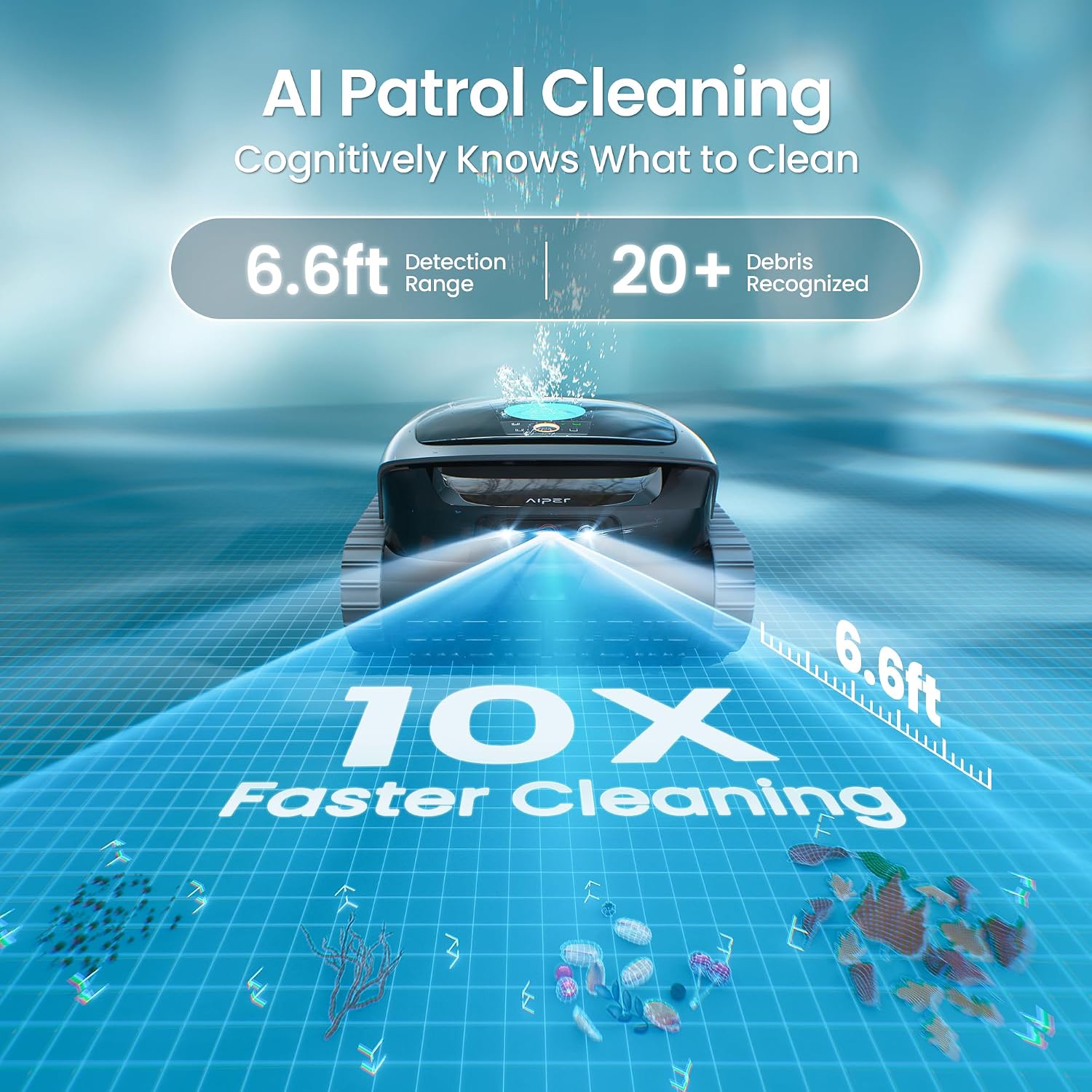
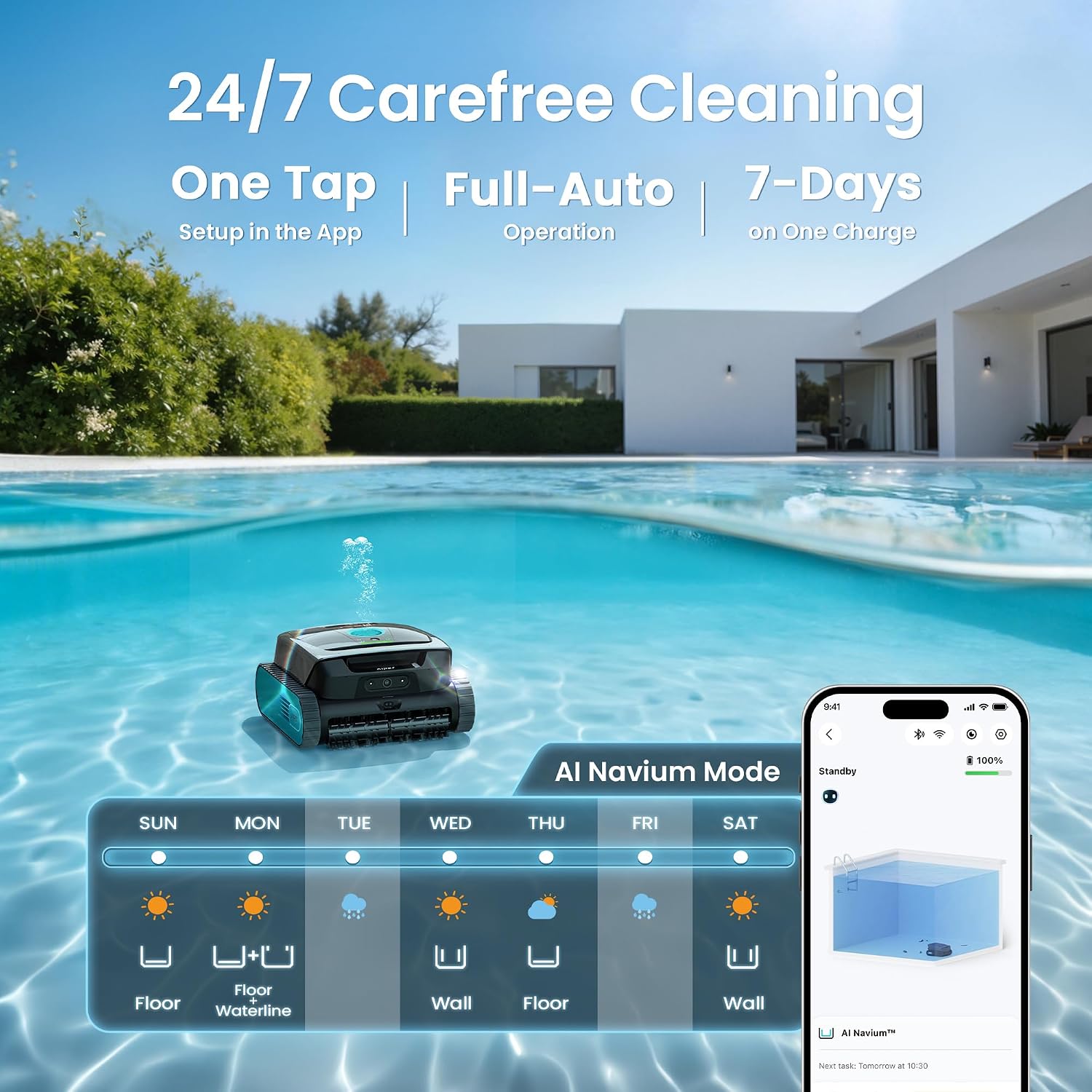
Its headline innovation is the AI Patrol System: a single front-facing camera identifies more than 20 debris types and steers the robot directly toward them. AIPER pairs that with AI Navium Mode, which builds a weekly cleaning plan around your pool size, local weather, and past cleaning history. In practical terms, that means the robot stops repeating passes over clean floor and spends its battery where the dirt actually is. This AIPER Scuba V3 review and rating breaks down how well that promise holds up. AIPER is a pool robotics brand with a global service footprint, and you can read more about the company’s lineup on the official AIPER website.
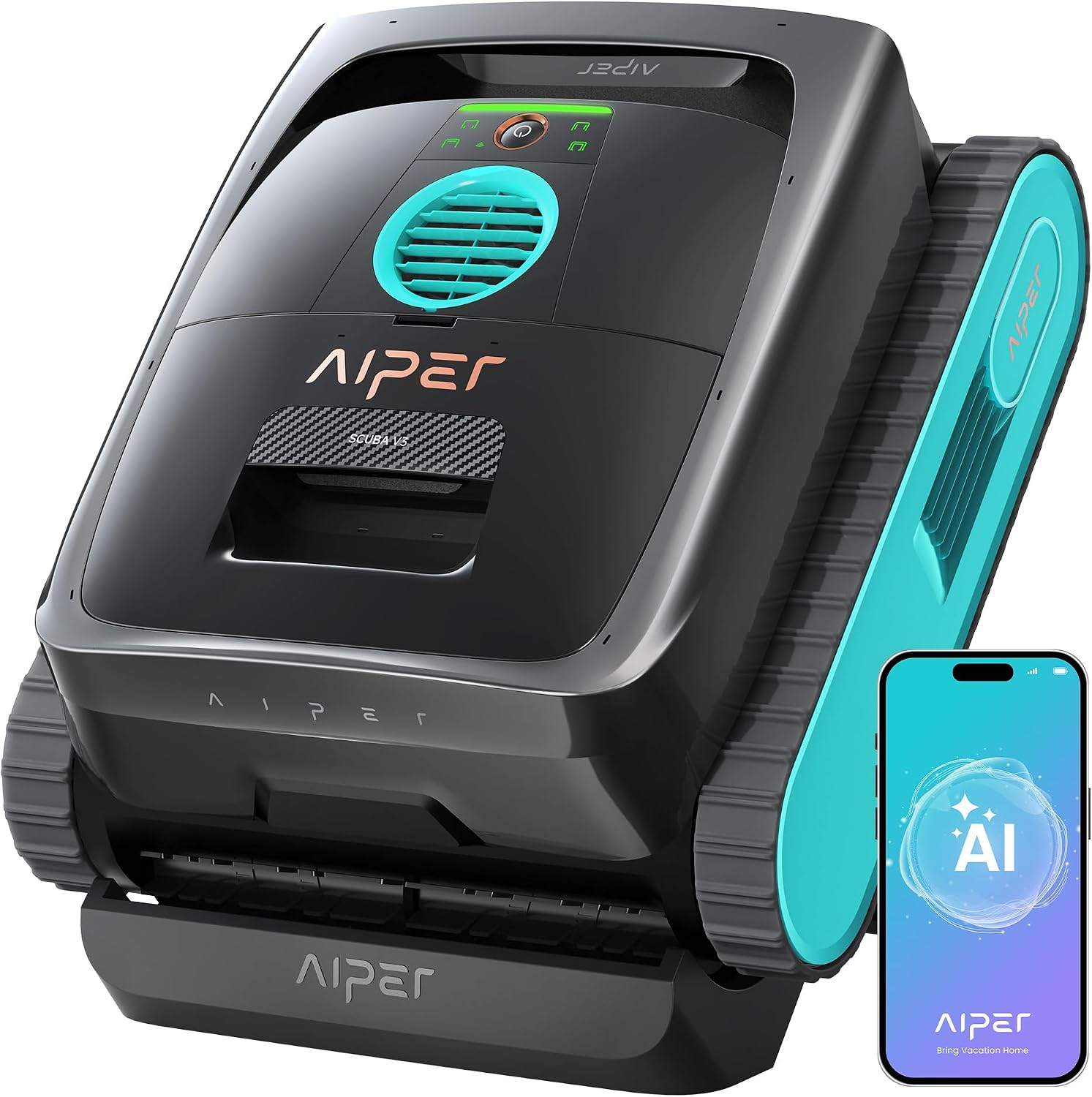
Here’s what separates this unit from the mid-tier cordless crowd, based on our hands-on time with it:
| Specification | Detail |
|---|---|
| Model | AIPER N31 Azure (Scuba V3) |
| Dimensions | 17.5″ L x 15″ W x 8.6″ H |
| Weight | 18.1 lbs |
| Battery | 150 Wh lithium-ion, 16 cells, 956 g pack |
| Charging Time | Approximately 4 hours via wireless dock |
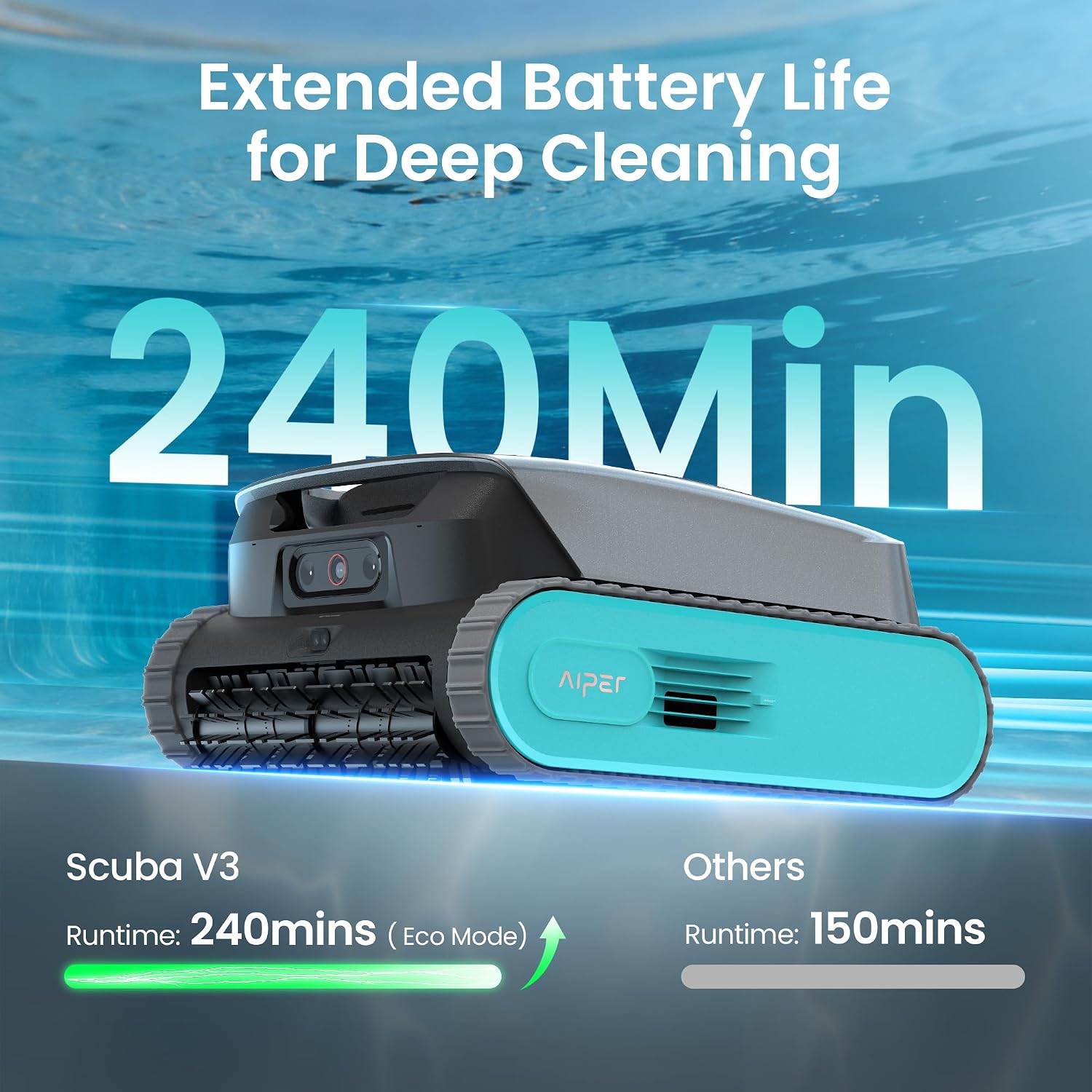
| Runtime | Up to 240 min (Eco) / up to 180 min (Auto, Floor, Wall, Waterline) |
| Suction | 4,800 GPH with JetAssist scrubbing |
| Filtration | 180-micron + 3-micron multi-layer MicroMesh |
| Debris Capacity | 3.5 liters |
| Waterproofing | IPX8 housing |
| Control | Aiper app, onboard push button |
| Warranty | 2 years with advance replacement |
For a full breakdown of what the AI camera and navigation system mean in daily use, this AIPER Scuba V3 review pros cons page on the retailer listing also shows current buyer feedback and Q&A. If you’re still comparing cordless robots across brands, our Beatbot Sora 30 review makes a useful side-by-side reference.
The package arrived double-boxed with molded foam inserts, and nothing shifted in transit. Inside you’ll find:
First impressions were genuinely positive. The IPX8 housing feels dense and well-sealed, panel gaps are tight, and the Azure finish resists scuffing after weeks of dock contact. The dock itself is a simple, low-profile cradle that sits on a patio without wobbling. One honest note for this AIPER Scuba V3 honest review opinion: there’s no caddy or rolling cart in the box. At 18.1 lbs the unit is easy enough to carry, but if you have a long walk from storage to pool, budget for a small cart or store it closer to the water. You also don’t get a spare filter cartridge, which we’d have liked at this price.
Setup is genuinely plug-and-play, which is one of the strongest points of this AIPER Scuba V3 review. Place the charging dock on a flat, shaded surface near the pool, connect the adapter, and set the robot on the cradle. There are no connectors to align and no drying ritual. While it charges, download the Aiper app, create an account, and pair the robot over 2.4 GHz Wi-Fi (it does not support 5 GHz networks, which tripped us up briefly). Enter your pool shape, approximate size, and surface type during onboarding — the AI Navium planner uses that data.
Once charged, press the onboard button or start a cycle from the app. Your first run should be a full Auto cycle so the robot can map the pool and log the debris load. Expect the first pass to look slightly inefficient; that’s the system learning. The app dashboard shows battery percentage, cycle status, filter condition, and cleaning history, all in plain language rather than cryptic codes.
Enable the weekly Navium schedule and let the planner assign lighter Eco runs midweek with a deeper Auto run before the weekend. Run the robot after heavy debris events rather than before — it handles fresh leaves far more efficiently than debris that’s been sitting and compacting for days. If your pool has a heavy pollen season, add a midweek waterline pass; the dual brushes keep the tile ring noticeably cleaner. You can also check filter condition in the app before a cycle rather than pulling the cartridge blindly.
Rinse the filter cartridge after every cycle — this takes about 60 seconds and has the single biggest effect on suction and filtration performance. Clean the brushes weekly with fresh water, and wipe the camera lens with a soft cloth every few cycles. Store the unit on the dock in a cool, dry, shaded spot, away from direct sun. Recharge fully before long-term storage. Our hot tub and water care guides follow similar maintenance logic if you’re managing multiple water features.
Spend ten minutes in the settings menu and turn on push notifications for cycle completion and filter reminders. Log a couple of manual cleaning notes after storms so the planner can adapt. If you want to compare app ecosystems before committing, this AIPER Scuba V3 review verdict worth buying listing includes buyer comments on connectivity and support response times.
We ran the Scuba V3 for three weeks in a 16,000-gallon in-ground plaster pool during peak pollen season, with a live oak dropping leaves and catkins the entire time. We tracked cycle duration, filter load, water clarity (visually and via test strips for suspended solids), battery consistency across 18 cycles, and app responsiveness. We also deliberately introduced sand, small twigs, and grass clippings to test debris recognition.
Here’s where the AI claim earns credibility. In our testing, the Scuba V3 covered a debris-heavy floor in roughly 70 to 90 minutes, while a random-pattern cleaner we ran alongside took over three hours to reach comparable results. The camera clearly avoided already-clean zones, and the difference in wasted travel was obvious. Sand pickup was excellent thanks to the 3-micron layer — after two cycles, the fine grit near the returns was gone. Battery life tracked close to spec: 232 minutes in Eco and 174 minutes in Auto, both within a few percent of AIPER’s claims. Waterline parking worked every single cycle, and the notification arrived within 30 seconds.
After a storm dumped leaves and twigs into the pool, a single Auto cycle cleared about 90 percent of visible debris; a second run finished the job. Waterline performance was strong on tile with a light scum line, though heavy calcium buildup still needed a manual brush. On a vinyl above-ground pool, the robot climbed walls reliably but occasionally slipped at the top edge. In murky water after a heavy rain, the camera’s efficiency dropped noticeably — the AI needs some visibility to do its job.
“10x faster” is marketing math based on ideal conditions, but the directional claim holds: this is meaningfully faster and smarter than random-pattern cleaners. The 240-minute runtime is accurate. “No dust left behind” is close to true for sand and fine silt. The one gap is stairs and tanning ledges — the robot won’t clean them, so plan on a brush there. Overall, this AIPER Scuba V3 pool robot review found far more delivered promises than exaggerations.
We compared the Scuba V3 against two common alternatives: the corded Dolphin Nautilus CC Plus and the cordless Beatbot Sora 30. Both are capable machines, but they solve different problems.
| Feature | AIPER Scuba V3 | Dolphin Nautilus CC Plus | Beatbot Sora 30 |
|---|---|---|---|
| Power | Cordless, 150 Wh battery | Corded | Cordless |
| Runtime | Up to 240 min | Unlimited (tethered) | Up to 180 min |
| Navigation | AI camera, 20+ debris types | Programmed patterns | AI-assisted navigation |
| Filtration | 180 + 3 micron multi-layer | Standard cartridge | Multi-layer cartridge |
| Waterline cleaning | Yes | Limited | Yes |
| Charging | Wireless dock | N/A | Cable charging |
| Price | $849.99 | Around $500 | Around $1,000+ |
Choose it if you want cordless convenience, app-based scheduling, and fine filtration without paying flagship-tier money. The wireless dock and lightweight body make it the easiest robot in this group to live with day to day. For a deeper category comparison, see our cordless pool robot comparison.
If your pool is heavily shaded and perpetually full of large debris, a corded robot’s unlimited runtime is hard to beat. If you want the absolute top-end navigation and are willing to spend more, the Sora 30 is the obvious step up. And if budget is the deciding factor, a mid-range corded unit will clean a mostly-clean pool perfectly well.
Enable AI Navium Mode and resist the urge to micromanage. The schedule improves as it logs more cycles, and after two weeks you’ll notice shorter, more targeted runs.
This is the highest-return habit you can build. A loaded filter cuts suction and forces longer runtimes, which shortens battery life over time.
Clean floors don’t guarantee balanced water. A test kit and the right chemicals matter just as much — see our pool equipment and heater guide for related gear that pairs well.
Run a cycle right after a storm or heavy leaf drop. Fresh debris is far easier to capture than material that’s been soaking and compacting for days.
Heat is the enemy of lithium batteries. A shaded dock location will extend pack life measurably over a couple of seasons.
Eco Mode’s 240-minute runtime is ideal for maintenance. Save Auto cycles for the weekend or after heavy debris, and you’ll get more cleans per charge.
A film of sunscreen and oils on the lens degrades debris recognition. A five-second wipe every few cycles keeps navigation sharp.
Register within the first week so advance replacement is available without delay if anything fails.
The AIPER Scuba V3 lists at $849.99. That places it in the upper-middle of the cordless market — well below flagship robots that push past $1,000, and above entry-level corded units around $400-500. Based on our testing, the premium is justified by the AI navigation, wireless dock, and fine filtration rather than by brand markup alone. Pricing does fluctuate seasonally, and spring pool-season promotions are common.
Coverage is two years with advance replacement, meaning AIPER ships a unit before you return the faulty one in covered cases. Support runs 24/7 across 20 global service centers, and our test inquiry was answered in under an hour. Standard retail return windows apply if you buy through an authorized seller. For context on how consumer protection standards apply to pool equipment, the Pool & Hot Tub Alliance publishes useful guidance on equipment safety and maintenance.
This AIPER Scuba V3 review found a robot that largely delivers on its marketing. The AI camera isn’t a gimmick — it measurably reduced cleaning time in our tests. The 3-micron filtration layer produced visibly clearer water. The wireless dock and 18.1 lb body removed nearly all the friction that makes people stop using pool robots after a month. Runtime claims held up within a few percent, and waterline parking worked without a single failure across 18 cycles.
We rate the AIPER Scuba V3 4.5 out of 5 stars. It’s worth buying if you want hands-off, cordless cleaning with genuinely smart navigation and you’re comfortable at the $849.99 price point. The main caveats are the lack of a caddy, 2.4 GHz-only Wi-Fi, and reduced efficiency in very murky water. None of those are dealbreakers for a typical residential pool. For a final check on current pricing and buyer ratings, see this AIPER Scuba V3 review and rating listing.
The AIPER Scuba V3 is a genuinely smart cordless pool robot that earns its price with faster cleaning, better filtration, and less work from you.
Have you tried the Scuba V3 or a competing cordless robot? Share your experience in the comments — real owner feedback helps other readers decide. And if you want more hands-on equipment reviews delivered to your inbox, join our newsletter.
For most residential pool owners, yes. At $849.99 you’re paying for AI navigation that cuts cleaning time, a 3-micron filtration layer that improves water clarity, and a wireless dock that removes daily hassle. If you value your weekends and want a robot you’ll actually use consistently, the value is there. Budget-focused buyers with light debris loads can spend less on a corded unit and still get acceptable floor cleaning.
The Sora 30 costs more and offers slightly more refined navigation, but the Scuba V3 delivers comparable cleaning results for a few hundred dollars less. The Scuba V3’s wireless dock is arguably a better daily-use feature than anything the Sora adds. If you want the top of the category, spend up; if you want 90 percent of the performance for less, the Scuba V3 is the smarter buy.
Very low. Setup takes about ten minutes including app pairing, and the robot handles the rest. The only real friction point is remembering to use a 2.4 GHz Wi-Fi network during pairing. After the first Auto cycle, most users can operate it entirely from the app without consulting the manual again.
Nothing is strictly required, but a few items improve the experience: a spare filter cartridge for quick swaps, a small rolling cart if you store it far from the pool, and a hand brush for stairs and ledges. You can find compatible accessories alongside the main unit listing.
AIPER backs the Scuba V3 with two years of coverage including advance replacement, plus 24/7 support across 20 global service centers. In our test, a support inquiry was answered in under an hour. Register the product within the first week so replacement claims process without delay.
We recommend purchasing from this authorized retailer for competitive pricing, authentic stock, and a standard return window. Buying from authorized sellers also ensures your two-year warranty is honored without documentation issues, which is worth more than saving a few dollars on an unverified listing.
Yes. The Scuba V3 handles plaster, vinyl, fiberglass, and tile surfaces. On vinyl above-ground pools it climbs walls reliably, though it can occasionally slip at the very top edge. Just note that very small above-ground pools under about 12 feet in diameter may not give the AI enough area to navigate efficiently.
Expect up to 240 minutes in Eco Mode and up to 180 minutes in Auto, Floor, Wall, and Waterline modes. In our testing, we recorded 232 and 174 minutes respectively — close to spec. A full charge on the wireless dock takes roughly four hours, and there’s no need to dry the unit before docking.
Stay Updated with Our Latest Reviews & Guides!
Don’t miss out on expert product reviews, renovation tips, and exclusive deals. Join our community of smart shoppers and DIY enthusiasts!