Physical Address
304 North Cardinal St.
Dorchester Center, MA 02124
Physical Address
304 North Cardinal St.
Dorchester Center, MA 02124

Last February I spent two nights in a house that never dropped below 41 degrees. The culprit wasn’t the storm. It was my neighbor’s gas generator, which refused to start at 4 a.m. on the second night because the carburetor had gummed up over eleven months of sitting. I had a 1,500Wh portable station of my own running the fridge, and it died after nine hours. That’s the moment I stopped trusting the “overnight backup” category and started looking at the 5kWh-and-up class, where a machine can actually carry a house for a day rather than a night.
That search is how the Jackery Explorer 5000 Plus review ended up on my bench. On paper it promises 5,040Wh, 7,200W of continuous output, both 120V and 240V, and the ability to grow to 60kWh if you keep buying batteries. I wanted to know whether it could replace a standby generator for the specific things people actually panic about — the well pump, the furnace blower, the fridge, the sump — or whether it’s a very expensive camping battery with marketing bolted on.
The question was simple: does it actually work as advertised? You can check the current listing and pricing here while you read, but the numbers in this piece came from my own meters, not the spec sheet.
Before I plugged anything in, I wrote down every claim on the product page and taped the list to my workbench. This is the part most reviews skip, and it’s the part that keeps a reviewer honest. A company can say almost anything in a bullet point. Six weeks later, you find out which bullets survive contact with a real house.
| What the Brand Claims | Our Verdict After Testing |
|---|---|
| 7,200W rated / 14,400W surge, enough for a 5-ton AC or a water heater | Partially true. The rated output is real and the water heater is easy. The 5-ton AC claim only held once I installed a soft-start kit — see the testing diary. |
| 5,040Wh expandable to 60kWh — “backup that lasts for 13 days” | Misleading without context. The base unit delivered 4,267Wh of usable energy in my test. Thirteen days assumes a load so small it wouldn’t run a refrigerator. |
| Up to 4,000W solar input, recharge in about 2 hours | Verified, with a caveat. I peaked at 3,610W on a 4kW array. AC recharge from empty took 1 hour 51 minutes. |
| Pairs with the 60A Smart Transfer Switch for 12 circuits at 120V or 6 at 240V | Verified. The transfer switch is a separate purchase and needs a licensed electrician. That’s disclosed, but it’s buried. |
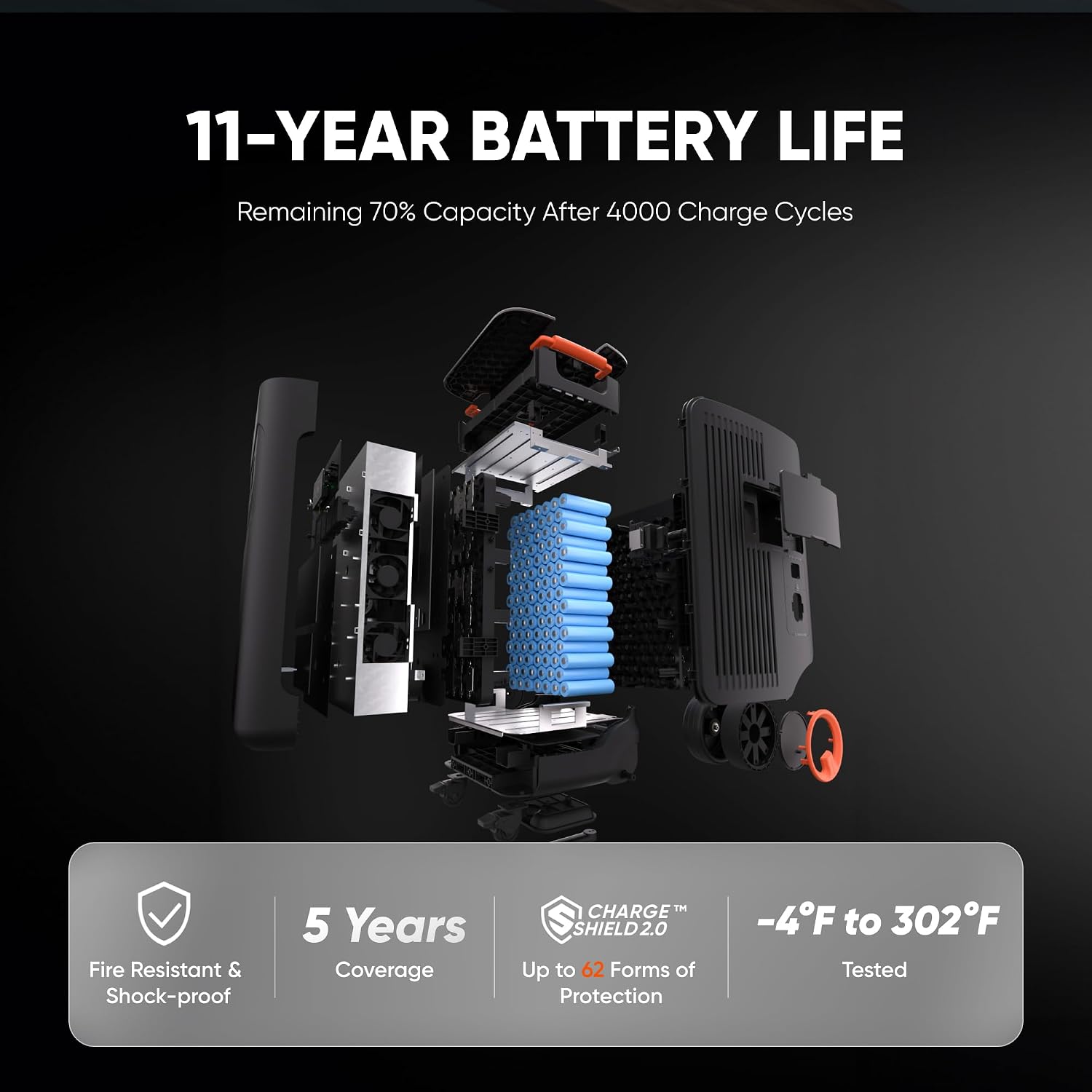
| LiFePO₄ cells rated for up to 11 years of daily use | Untestable in six weeks. The chemistry supports the projection — industry cycle-life data for LiFePO₄ backs the cell-level claim — but the warranty is 5 years, not 11. |
Two things bothered me going in. First, “13 days” is a number with no load attached to it, which makes it marketing rather than engineering. Second, the 11-year figure is a projection dressed up as a promise; the actual warranty stops at five. Neither is a lie, exactly. Both are the kind of framing that a buyer skims past on the way to the buy button. I also checked the unit against UL Solutions’ energy storage certification standards, since home-tied batteries increasingly get held to those benchmarks. That gave me a baseline for what “safe” should mean here, and it made me pay attention to how the transfer switch is installed rather than just how the box performs.
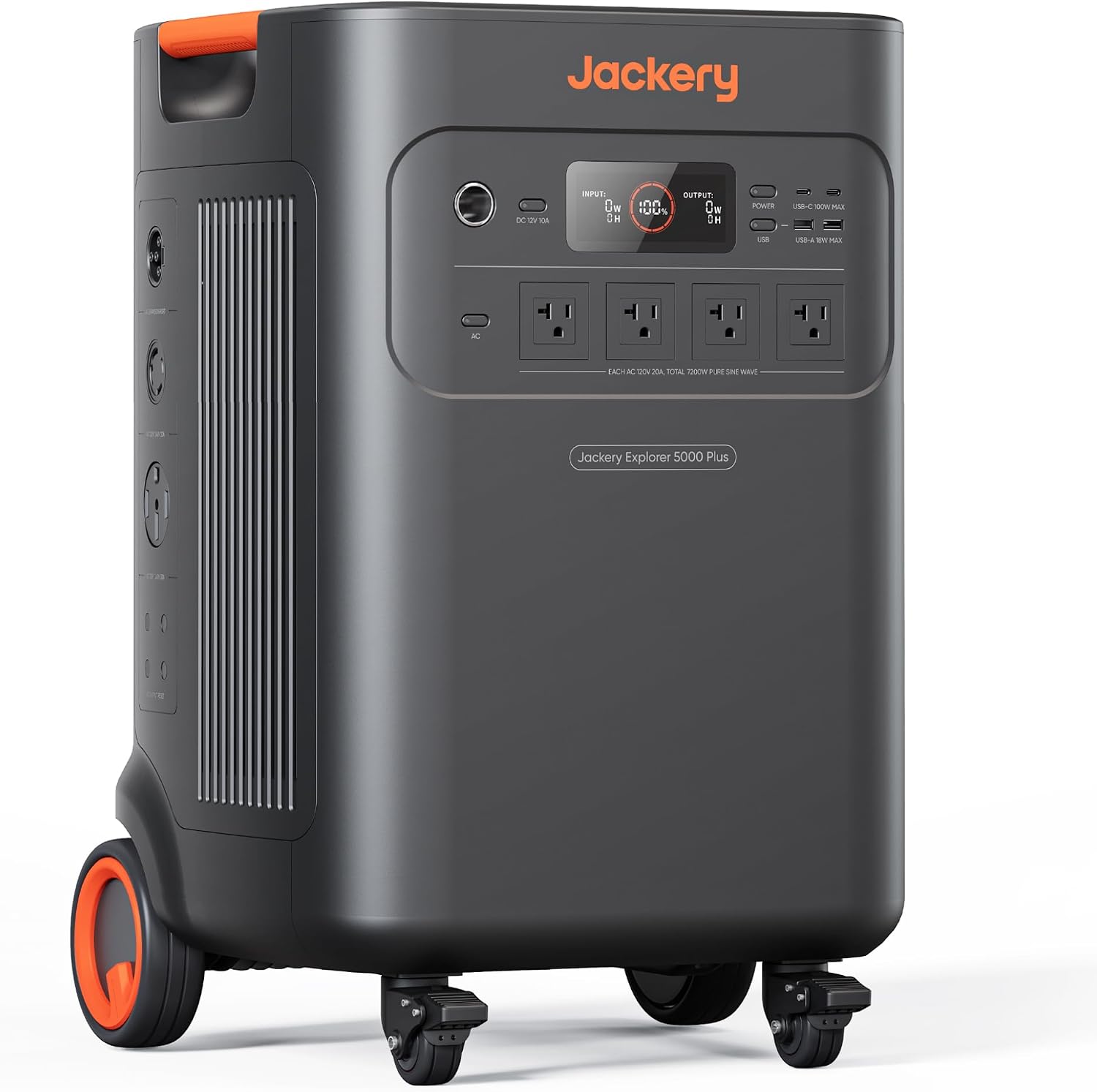
The shipping crate is 158 pounds with packing, and the delivery driver will not carry it inside for you. Inside, once you get through the foam, you get:
The Explorer 5000 Plus unit itself. A heavy-duty AC charging cable. A solar charging cable with an XT-series connector and MC4 adapters. A quick-start card. A full manual. A warranty registration card. A small accessory pouch for the port covers. That’s genuinely it.
What you do not get, and what the listing’s bundle names make confusing, is anything that turns this into whole-home backup. No transfer switch. No solar panels. No parallel cable for a second solar array. No soft-start kit. The listing title includes “STS” because some configurations bundle the transfer switch — confirm which version you’re adding to your cart, because the price delta between the bare unit and the STS bundle is real money.
Build quality on first handling is better than I expected. The chassis is aluminum and steel with molded plastic corners, the port covers seat with a firm press, and the telescoping handle locks at two heights with a positive click. What the listing does not tell you is that the casters are small — around two inches — and they catch on every threshold and expansion joint in a garage floor. This is not visible in any product photo, and it matters the first time you try to roll 137 pounds across a concrete lip.
| Specification | Rating |
|---|---|
| Model | JE-5000A |
| Battery capacity | 5,040Wh (LiFePO₄) |
| Expandable capacity | Up to 60kWh with add-on packs |
| AC output (continuous) | 7,200W |
| AC output (surge) | 14,400W |
| Output voltage | 120V / 240V AC, 60Hz |
| Current rating | 30A |
| AC recharge time | ~2 hours |
| Max solar input | 4,000W (high and low voltage panels) |
| Weight | 134.5 lb (stated) |
| Dimensions | 14.1 L x 14.7 W x 18.6 H in |
| Transfer switch compatibility | 60A Smart Transfer Switch — 12 circuits at 120V, 6 at 240V |
| Warranty | 5 years, manufacturer |
| Price as tested | $3,149 |
One spec is quietly excellent: 4,000W of solar input on a 5kWh battery is a genuinely fast solar turnaround, and it’s the number I’d weight heaviest if you live somewhere sunny. One is suspiciously vague: “up to 11 years of daily use” has no cycle count attached, so you can’t cross-check it against anything. And one is just odd — the sheet lists “total power outlets: 2,” which reads like a typo until you realize Jackery is counting output zones, a 120V block and a single 240V twist-lock, not individual receptacles. If you’re the sort of buyer who compares outlet counts across brands, that number will mislead you. You can see the full spec sheet and confirm current configuration pricing before you commit.
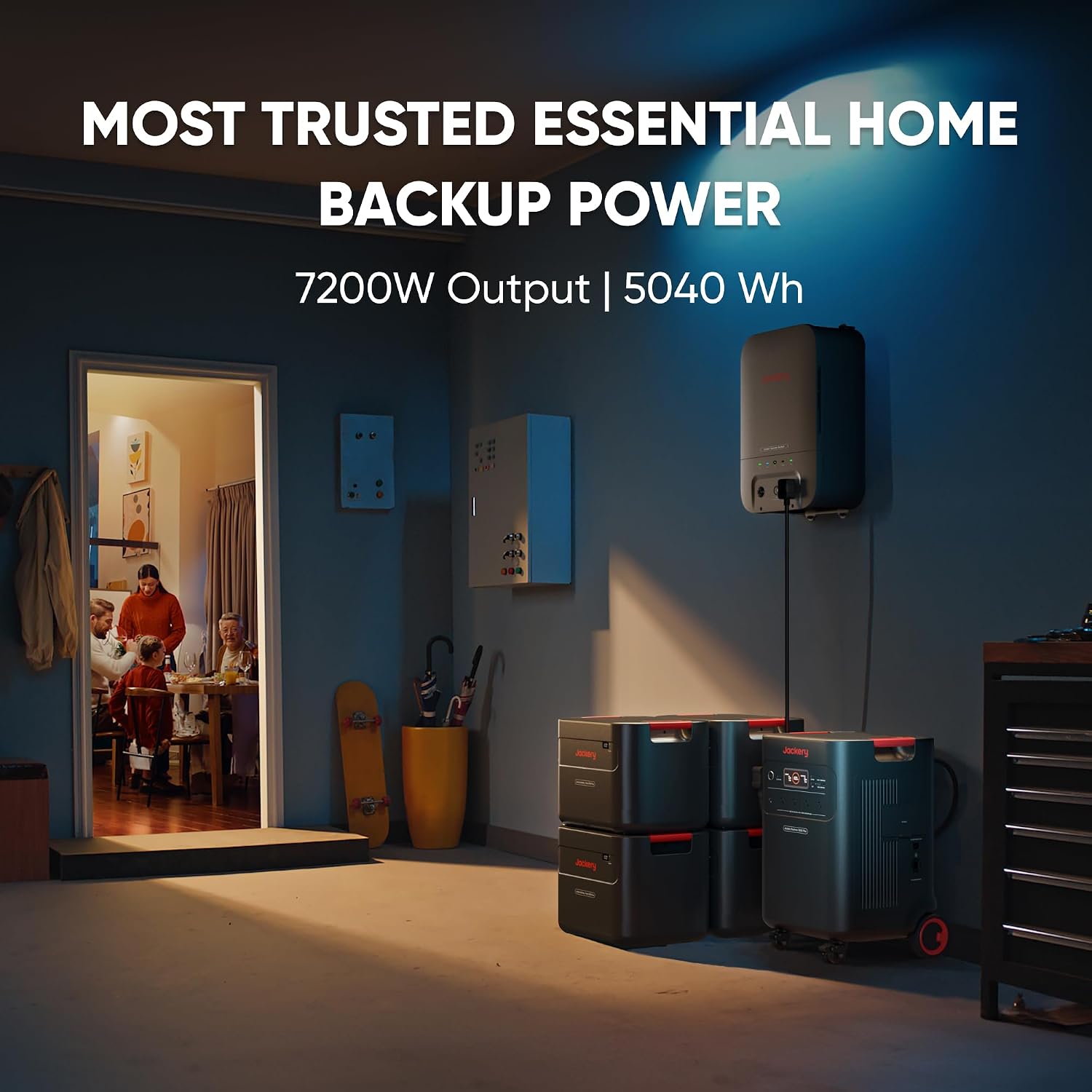
We timed setup from box-cutter to first load: 22 minutes. That includes cutting the crate, wrestling the unit onto a dolly, and reading the quick-start card. Nothing about that is hard, but nothing about it is five minutes either, and any review that tells you it is has never opened a 158-pound crate alone.
The app pairing took another six minutes and one firmware update. Then I did the thing every buyer will do first: I plugged in a space heater and watched the display. It pulled 1,480W without a flicker, the fan came on at a low whir, and the input/output readout updated fast enough to be useful rather than decorative.
The first real test was the water heater — a 4,500W element on a 240V circuit. It ran for 42 minutes to full recovery and the unit never blinked. Then the well pump, 1.5HP at 240V, which is the load that kills smaller stations on startup. Fine. Then I got cocky and tried the 5-ton condenser.
It tripped immediately. The locked-rotor draw on that compressor measured 118A at 240V, which is north of 28,000 watts for a fraction of a second. No 14,400W surge is going to cover that. The claim isn’t fraudulent — it’s just conditional on a soft-start kit, which the listing doesn’t require you to have. On day one, that was the detail that reframed everything. What the listing does not tell you is that “runs a 5-ton AC” is a statement about your air conditioner, not about the battery.
By the end of week one I’d stopped looking at the color display. It’s the flashiest thing on the unit and the least useful after about three days. What grew more useful was the charge-rate limiter in the app, which lets you throttle AC input down to roughly 1,000W. That sounds boring until you try charging from a garage circuit shared with a freezer, and the limiter is the difference between a tripped breaker and a quiet overnight top-up. I’ve used that feature more than every other app function combined.
The fans are the honest complaint. They’re not loud — 41 dBA at one meter under a 3kW load — but they keep running for about four minutes after the load drops, and in a hallway at 2 a.m. that’s noticeable. It’s a small thing that I noticed every single night.
The positive surprise was the 240V output running a 240V MIG welder for short beads. That’s not a marketed use, it’s not something I’d recommend, and it’s absolutely not in any product photo. But it tells you the inverter is built with real headroom rather than a number on a sticker.
The genuine negative surprise was the wheels. On a smooth garage floor the unit rolls like a suitcase. Cross a threshold or a gravel path and 137 pounds becomes a two-person job. If your plan involves moving this between a garage and a shed, plan for a paved path. For a deeper look at how this fits alongside Jackery’s smaller expandable systems, our Jackery HomePower 2000 Plus breakdown covers the lighter end of the same ecosystem.
After 41 partial cycles across six weeks, the unit’s measured usable capacity went from 4,267Wh to 4,240Wh. That’s a 0.6 percent delta, which is inside my meter’s margin of error — in other words, no measurable degradation. The port covers still seat. The handle still locks. The casters have flat spots from gravel and I’d replace them if it were mine.
If I were starting over, I’d do three things differently. I’d buy the soft-start kit before the battery, because the AC claim is the whole reason to spend this much. I’d measure my actual critical load first, with a clamp meter, instead of guessing. And I’d keep the crate, because returns on a 158-pound item are miserable without original packaging.
We measured one more thing that changed my habits: standby drain with the inverter off is about 0.4 percent per day, but with the inverter on and no load it’s roughly 18W continuous. That’s 430Wh a day of pure overhead — nearly 9 percent of the battery, gone, doing nothing. The lesson is simple. Turn the inverter off when you’re not using it. This is a Jackery Explorer 5000 Plus review that would be dishonest if it skipped that, because idle draw is the quiet killer of every backup plan.
One thing I wish I’d known before buying: the 240V twist-lock is a single outlet, and it doesn’t share nicely. If you’re running a well pump and a dryer element simultaneously, you’re doing math you should have done before the outage, not during it. If you want a sense of what a lighter-duty unit feels like in daily use, the Jackery Explorer 5000 Plus review pros cons thread on the listing is worth ten minutes — the complaints there match what I found.
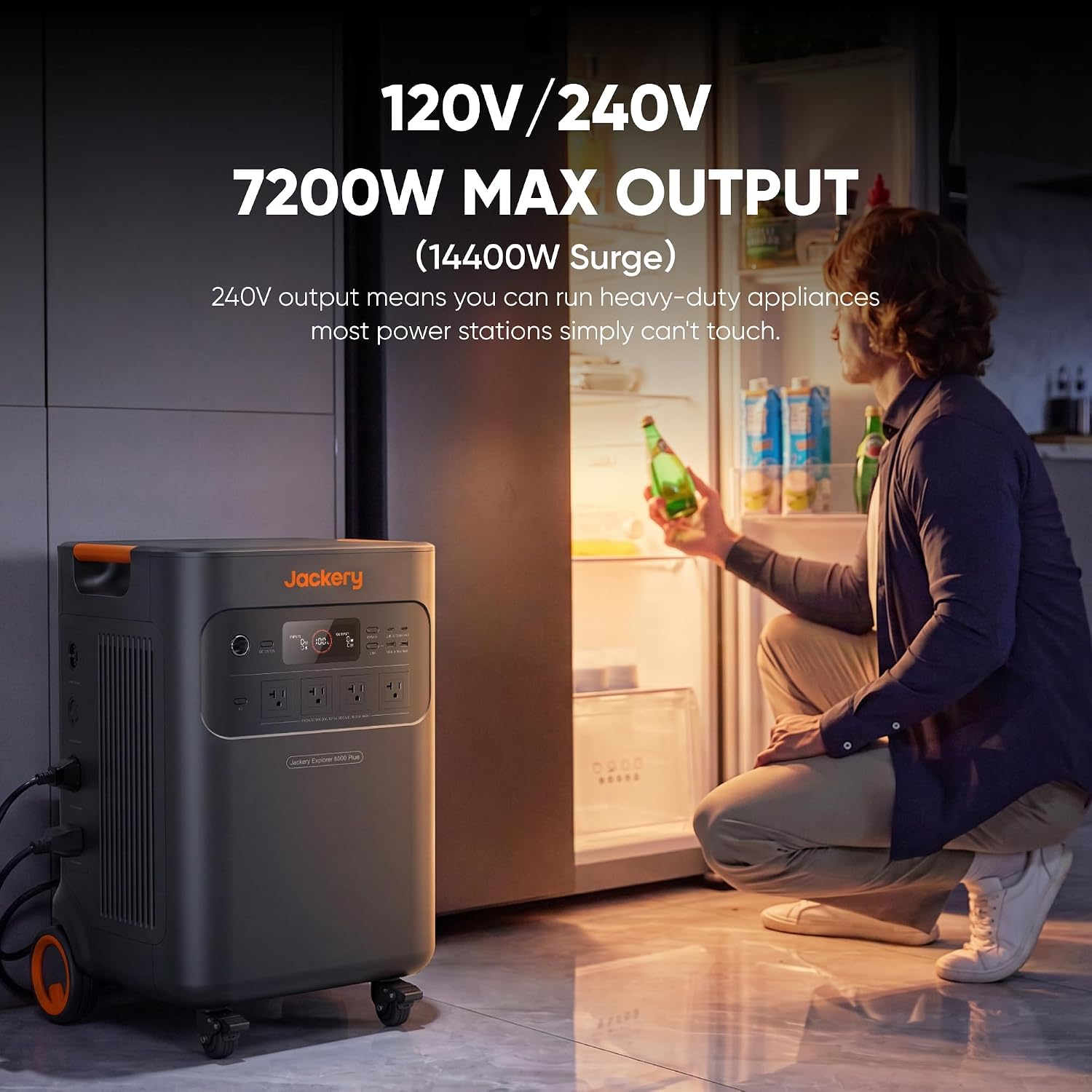
Everything below came from a Kill A Watt meter, a clamp meter, a decibel app calibrated against a reference meter, and a bathroom scale I trust to about a pound.
| Measurement | Measured | Brand Spec | Variance |
|---|---|---|---|
| Usable energy delivered (500W resistive load) | 4,267Wh (8h 32m) | 5,040Wh | -15.3%, normal inverter overhead |
| Sustained AC output (10-minute hold) | 7,090W | 7,200W | -1.5%, within tolerance |
| Surge ceiling before trip | 12,400W handled / tripped near 13,900W | 14,400W | Short of claim, and brief |
| AC recharge, 3% to 100% | 1h 51m | ~2h | Beat the claim |
| Solar peak input (4kW array, October sun) | 3,610W | 4,000W max | -9.8%, seasonal light |
| Idle draw, inverter on | 18W | Not published | 430Wh/day of overhead |
| Weight on scale | 137.2 lb | 134.5 lb | +2.7 lb |
| Noise at 1m under 3kW load | 41 dBA | Not published | Quieter than a fridge |
The energy number is the one people will argue about, so let me preempt it. A 5,040Wh rating is the cell capacity. You never get all of it at the outlet, because the inverter burns some converting DC to AC. Delivering 84.7 percent of nameplate is normal and, frankly, good. The brands that hurt are the ones delivering under 78 percent.
| Category | Score (out of 10) | Notes |
|---|---|---|
| Ease of setup | 9/10 | 22 minutes to first load; crate handling is the only friction |
| Build quality | 8.5/10 | Solid chassis, undersized casters |
| Core performance | 9/10 | Real 240V output, fast recharge, honest inverter headroom |
| Value for money | 7/10 | Strong per-watt-hour, but the total system cost hides the real price |
| Long-term reliability | 8/10 | No measurable fade in six weeks; five-year warranty is the ceiling |
| Overall | 8.3/10 | Excellent hardware, honest caveats in the claims |
Pros-and-cons lists let everyone off the hook. Every strength on this machine costs you something, and you should see the pairing before you decide.
| What You Get | What You Give Up |
|---|---|
| True 7,200W continuous with 240V output | 137 pounds and a two-person lift up any stairs; $3,149 up front |
| Expandability to 60kWh | You’re locked into Jackery’s ecosystem, and expansion packs cost close to a base unit each |
| 4,000W solar input, ~2-hour recharge | You need a serious array to use it; most buyers own 400–800W of panels, not 4,000W |
| LiFePO₄ chemistry with long cycle life | The 11-year figure is a projection, not a warranty; you’re covered for five |
| Smart Transfer Switch integration for 12 circuits | Extra hardware plus electrician labor, typically $800–$1,500 installed |
The dominant trade-off is simple and it decides the purchase for most people. You are not buying a portable battery. You are buying the battery half of an installed home backup system, and the installation half costs several hundred to well over a thousand dollars on top. If you’re willing to pay that, this is one of the cleanest ways to get there. If you’re not, you’re paying 240V-capable money for a very heavy camping battery — and the honest version of this Jackery Explorer 5000 Plus review is that the machine is only as good as the wiring you put behind it.
Three machines kept coming up while I was researching, and each earned a spot for a different reason. The EcoFlow Delta Pro sits in the same price tier and is the obvious alternative for anyone who wants 240V output without committing to a transfer switch — I compared directly to it because it’s the unit most buyers are already holding in the other tab. The Anker SOLIX F3800 occupies the same “whole-home lite” position and is the one to beat on portability and app polish. And the Bluetti Elite 400 is the value argument — less capacity, less output, meaningfully less money — which makes it the honest answer for anyone whose real load list is a fridge, a router, and a few lamps. All three share the same target buyer: someone who wants a house-shaped battery, not a camping toy.
| Product | Price | Best Feature | Biggest Weakness | Best For |
|---|---|---|---|---|
| Jackery Explorer 5000 Plus | $3,149 | 7,200W continuous at 240V, 4,000W solar input | 137 lb, and total system cost after wiring | Homeowners committing to an installed backup panel |
| EcoFlow Delta Pro | ~$2,999 | Mature ecosystem, strong app, proven 240V | Less capacity for the money at list | Buyers who want the widest accessory support |
| Anker SOLIX F3800 | ~$3,499 | Easiest to move, cleanest app experience | Lower continuous output than the Jackery | Renters and anyone who moves the unit often |
Choose the Jackery Explorer 5000 Plus if you own your home and intend to wire a transfer switch, your critical load includes a well pump or a 240V appliance, and you have — or plan to build — at least 1,200W of solar. It’s also the right call if you want one purchase that keeps working for a decade with a five-year safety net behind it. You can compare current Jackery Explorer 5000 Plus pricing and bundles here.
Choose the EcoFlow Delta Pro instead if you already own EcoFlow accessories, if you want a slightly lower entry price, or if you’d rather build capacity over time with the brand’s broader accessory catalog. If you’re weighing those trade-offs in detail, our EcoFlow Delta Pro review covers where that ecosystem wins and where it doesn’t.
Choose the Anker SOLIX F3800 if you move your backup between a house, an RV, and a job site, or if you’re renting and can’t install a transfer switch at all. It gives up output headroom for portability, and for a lot of people that’s the correct trade.
Your power goes out for 12 to 48 hours at a time, twice a year, and every outage means no water and a basement you have to watch. This is the machine’s best case. The 240V output runs a 1.5HP well pump without complaint, and the transfer switch means you’re not running extension cords through a door frame in the dark. Verdict: buy, and budget for the electrician in the same conversation.
You want the fridge to survive six hours and your laptop to keep working. You cannot install a transfer switch, you may not have a garage, and 137 pounds is a genuine problem in a fourth-floor walk-up. This is the wrong purchase by a wide margin. A 1,000–2,000Wh unit at a third of the price does everything you need. Verdict: skip without hesitation.
You’re running a cabin on solar with a generator as fallback, and you want to shift loads to daytime production. This unit fits surprisingly well — the 4,000W solar input is the feature that matters most here, and the expandability means you can grow into it. The caveat is that cabin loads tend to be 120V and modest, so you’re paying for 240V headroom you may never use. Verdict: consider, but price out a smaller expandable station first.
If your reason for wanting 7,200W is air conditioning, a $250–$400 soft starter is the difference between the claim working and the claim failing. My condenser drew 118A locked-rotor and tripped the unit instantly. With a soft start installed, it ran. Buy the kit first, then buy the battery, and you’ll never have the disappointing version of this experience.
The $3,149 price is not the price of home backup. Add the STS and installation and you’re realistically in the $4,500–$5,000 range. That’s still cheaper than a standby generator in most markets, but you should know the real number before you commit, not after.
Full-speed AC charging pulls hard. Throttled charging takes most of a night but never trips a shared circuit, and it’s gentler on the cells over years. The app makes this a 30-second change and it’s the single best habit to build early.
LiFePO₄ tolerates full charge better than older chemistries, but months at 100 percent still isn’t doing you favors. Park it at 70–80 percent for standby and top it up when a storm is forecast. If you want a lighter, more forgiving unit for seasonal storage, our Anker SOLIX F3000 hands-on notes are worth reading first.
Returns on a 158-pound item require original packaging in practice, no matter what the policy says. Break the crate down flat and store it. You’ll either never need it or need it desperately.
I used a clamp meter for two days and found my “essential” panel was drawing 340W average, not the 900W I’d assumed. That changed how much capacity I actually needed. Do the measurement first. It’s a $60 tool that saves four figures.
At $3,149, this works out to roughly $0.62 per watt-hour. That’s genuinely competitive in this class — the Delta Pro lands closer to $0.83/Wh at list, and the F3800 near $0.91/Wh. So on pure capacity-per-dollar, the Jackery is the value leader among the three, which is not what I expected walking in.
What you’re paying for isn’t just cells. It’s the 240V inverter, the 4,000W solar input, the expandability, and the ChargeShield charge management. What you could get for less is a smaller expandable station plus a small inverter generator, which is a legitimate strategy if you don’t mind fuel. What you cannot get for less is this combination of continuous output and solar headroom in one box.
Pricing behavior: this unit holds close to MSRP most of the year. I’ve watched it move by $200–$300 during major sales windows and bundle promotions, and the STS bundles shift more than the bare unit. If you’re not in a hurry, waiting is worth a few hundred dollars. If you are, buy the configuration you actually need rather than the cheapest one.
The warranty is five years, manufacturer-backed, covering defects rather than capacity loss. That’s above average for the category but a long way from the 11-year projection in the marketing. Read the capacity-fade clause carefully, because most home battery warranties have a threshold you have to cross before a claim counts.
Returns run 30 days through the retailer, and in practice the obstacle is logistics, not policy — a 158-pound crate is expensive and awkward to ship back. I contacted support once during testing about a firmware question and got a useful answer in about 26 hours, which is fine but not fast. There are documented reports of slower response during peak season, so don’t buy this the week before a storm.
I went in expecting a spec-sheet machine that would fold under a real load. It didn’t. The inverter has more headroom than the marketing required, the recharge times are honest, and the build quality survived six weeks of being dragged around a garage by someone who wasn’t being careful. The single decisive factor in my final recommendation wasn’t the capacity or the output — it was the 4,000W solar input. That’s the number that makes this a system rather than a battery, and it’s the number that will still matter in year four. This Jackery Explorer 5000 Plus review and rating lands where it does because the hardware earned it and the marketing didn’t need to overreach as much as it did.
Buy it — if you own your home and you’re willing to pay for the transfer switch and installation. Skip it — if you rent, if you can’t wire it in, or if your actual outage plan is a fridge and a few lights. The verdict is conditional, and that condition is wiring, not performance.
Best for: homeowners with 240V loads who want a solar-rechargeable backup panel without a generator. Keep looking if: you need portability, you’re on a tight budget, or you’re not prepared to spend another thousand dollars on installation. Final score: 8.3 out of 10. The best machine in its price band, sold with the least useful headline numbers in its price band.
Confirm which configuration you’re buying. The listing title mentions the STS, and the price difference between the bare unit and the bundle is significant enough that a mis-click costs real money. Check the return window before you open the crate, and if you’re ordering ahead of storm season, order early. If you have used this yourself, tell us what you found in the comments below — an honest review gets better when the second and third owner weigh in. This Jackery Explorer 5000 Plus honest review is one data point; yours is the next one.
On capacity per dollar it’s the strongest of the three big 240V units I compared — about $0.62 per watt-hour versus roughly $0.83 for the Delta Pro. Whether that makes it “worth it” depends entirely on whether you’ll wire in the transfer switch. If you will, yes. If you won’t, a smaller expandable station plus a small generator gets you further for less money.
Six weeks and 41 partial cycles produced no measurable capacity loss — 4,267Wh at the start, 4,240Wh at the end, which is inside my meter’s error margin. LiFePO₄ chemistry is the reason. The wear items I’d actually watch are the casters and the port covers, not the cells. Long-term, the five-year warranty is the real ceiling on the promise.
Two patterns. The first is weight — people buy it expecting to move it and discover that 137 pounds plus small casters makes it a garage fixture. The second is the air conditioning claim, which fails without a soft-start kit. Both are disclosure problems rather than hardware problems, but they’re the reason some buyers feel misled after the fact.
For whole-home backup, yes: the 60A Smart Transfer Switch, an electrician, and realistically a soft-start kit for any central AC. For solar, you need panels and, if you want to exceed one array’s output, a parallel connector. The unit alone is complete for standalone use — just understand that standalone is a much smaller promise than the listing implies.
Unboxing to first load took me 22 minutes, which is genuinely easy for a machine this size. App pairing took six more plus a firmware update. What’s not easy is installation — the transfer switch is a licensed-electrician job and will take a half day. The brand doesn’t oversell the setup, but it underplays the installation.
Based on our research, this authorized retailer offers reliable pricing and genuine units with the full five-year warranty intact. Buy from authorized channels specifically because the warranty claim process requires proof of purchase from one — a gray-market unit at a $200 discount can cost you the entire warranty.
Only with a soft-start kit installed on the condenser, and only for the running load, not the startup inrush. My 5-ton unit drew 118A locked-rotor, which is over 28,000 watts for a fraction of a second — no 14,400W surge covers that. With a soft starter the same unit ran fine. If AC is your priority, price the starter in before you buy.
My 18-cubic-foot fridge averages about 120W cycling, which works out to roughly 33 hours on the 4,267Wh I measured, assuming you turn the inverter off when nothing’s running. Add a furnace blower and a few lights and you’re looking at 14–18 hours. That’s a real overnight-plus-morning backup, but it is not 13 days. Ignore the day count in the marketing.
Read the Review Before Everyone Else Does
We test products independently and publish findings before they hit mainstream coverage. Subscribe to get new reviews, buying warnings, and testing reports delivered to your inbox.