Physical Address
304 North Cardinal St.
Dorchester Center, MA 02124
Physical Address
304 North Cardinal St.
Dorchester Center, MA 02124

You have a large yard, probably three acres or more. You are tired of spending four hours every Saturday pushing a mower, and you have looked at robot mowers before but dismissed them as toys for suburban lawns. The YARBO robot lawn mower review you are reading right now is the result of four weeks of testing this machine on a 4.2-acre property with mixed terrain, slopes, and obstacles. I am not here to sell you anything. I am here to tell you what I found — the good, the bad, and the five-thousand-dollar question of whether this is the mower that finally makes robot mowing viable for real acreage.
Disclosure: This review contains affiliate links. Purchasing through them supports our work at no added cost to you. All testing was conducted independently.
If you are considering a robotic mower for serious property maintenance, you may also want to read our AttachXpro mini skid steer review for a different approach to large-lot work.
The YARBO Robot Lawn Mower Pro is a modular robotic mower that sits at the very top end of the consumer robot mower category — think 7,499 USD base price territory. YARBO is a Chinese company known primarily for their RTK-based navigation systems and heavy-duty outdoor power equipment. They manufacture in Shenzhen and distribute through Amazon for the North American market. You can read about the company on their official website.
This machine is built to solve one specific problem: maintaining 3 to 6 acres of grass without installing perimeter wire, without fighting steep slopes, and without owning three separate machines for mowing, snow removal, and leaf blowing. The modular chassis accepts a mowing deck, a two-stage snow blower, and a leaf blower — all powered by the same 72V battery system.
What sets it apart from every other robot mower at this price is the combination of RTK-GPS real-time kinematic positioning plus camera-based AI vision for navigation. No boundary wire. No tape strips. You define the cutting area in the app, and the mower uses satellite correction and visual landmarks to stay inside it.
What it is not: this is not a mower for small lawns. It is 402 pounds on tracks, requires 46 inches of clearance width, and it will not fit through a standard garden gate. If you have less than an acre of relatively flat land, you are paying for capability you will never use. This YARBO robot lawn mower review is not aimed at you.
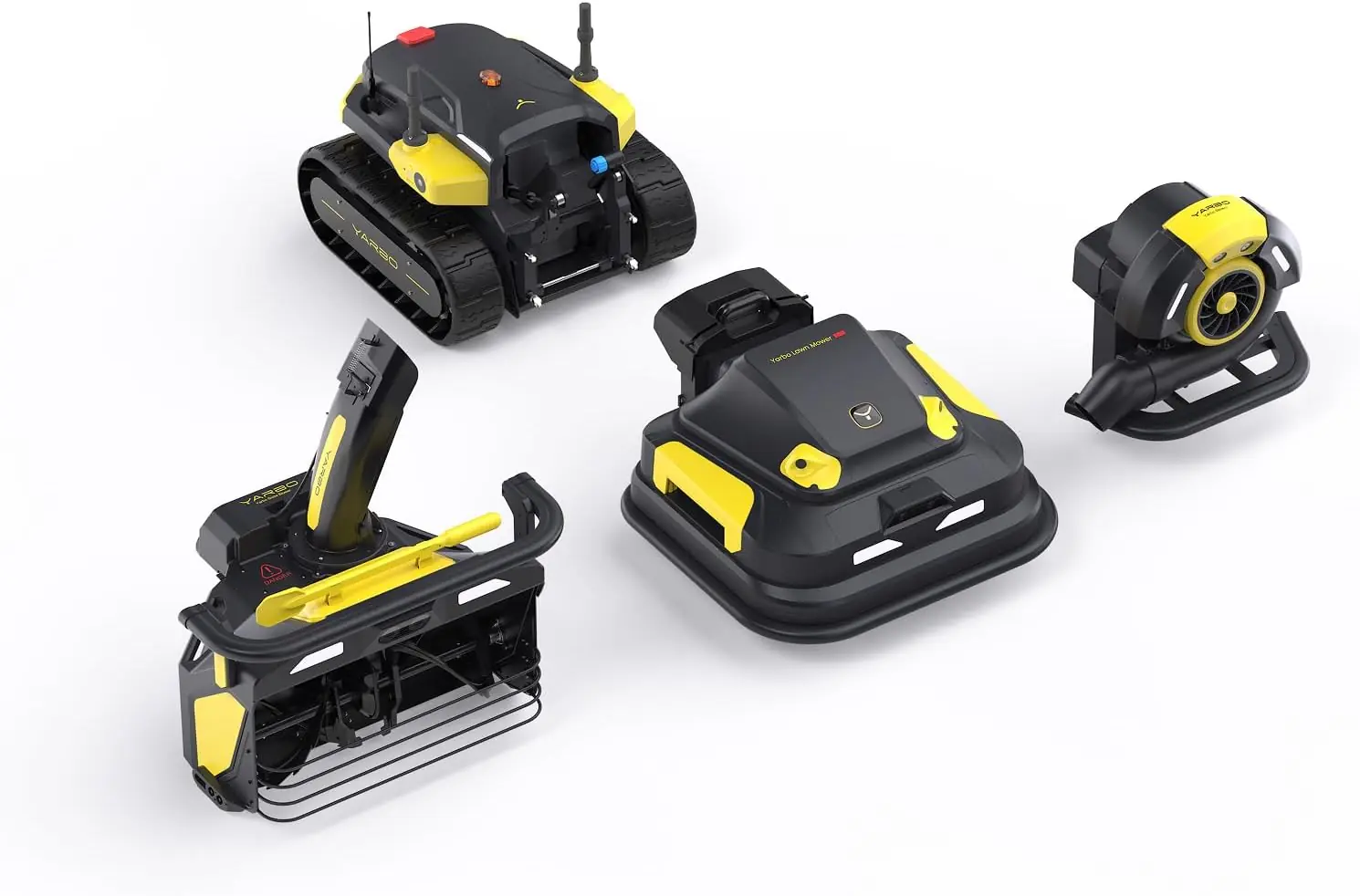
The YARBO arrived in a double-walled cardboard crate measuring roughly 52 by 46 by 36 inches. Internal foam blocks locked the chassis, mower deck, and battery in separate compartments. No visible damage. The crate included: the main chassis with tracks installed, the mower deck module, one 72V battery, a dual-port charger, the RTK base station and antenna, a bag of hardware, and a spiral-bound manual.
First impression: the chassis weighs 402 pounds and rolls on rubber tracks that feel like miniature excavator treads. The alloy steel frame is powder-coated black. All connection points for the modular attachments use industrial-grade locking pins. The plastic body panels are thick ABS — not the thin, flexing plastic found on sub-2,000 USD robot mowers. The battery slides into a sealed compartment with a positive latching mechanism.
One item was missing from the box: a SIM card for the RTK base station’s cellular backup. The base station requires either Wi-Fi or a cellular data connection to receive correction signals. The manual mentions this cellular feature but the SIM tray was empty. YARBO support sent a card within five business days, but it added a week to initial setup.
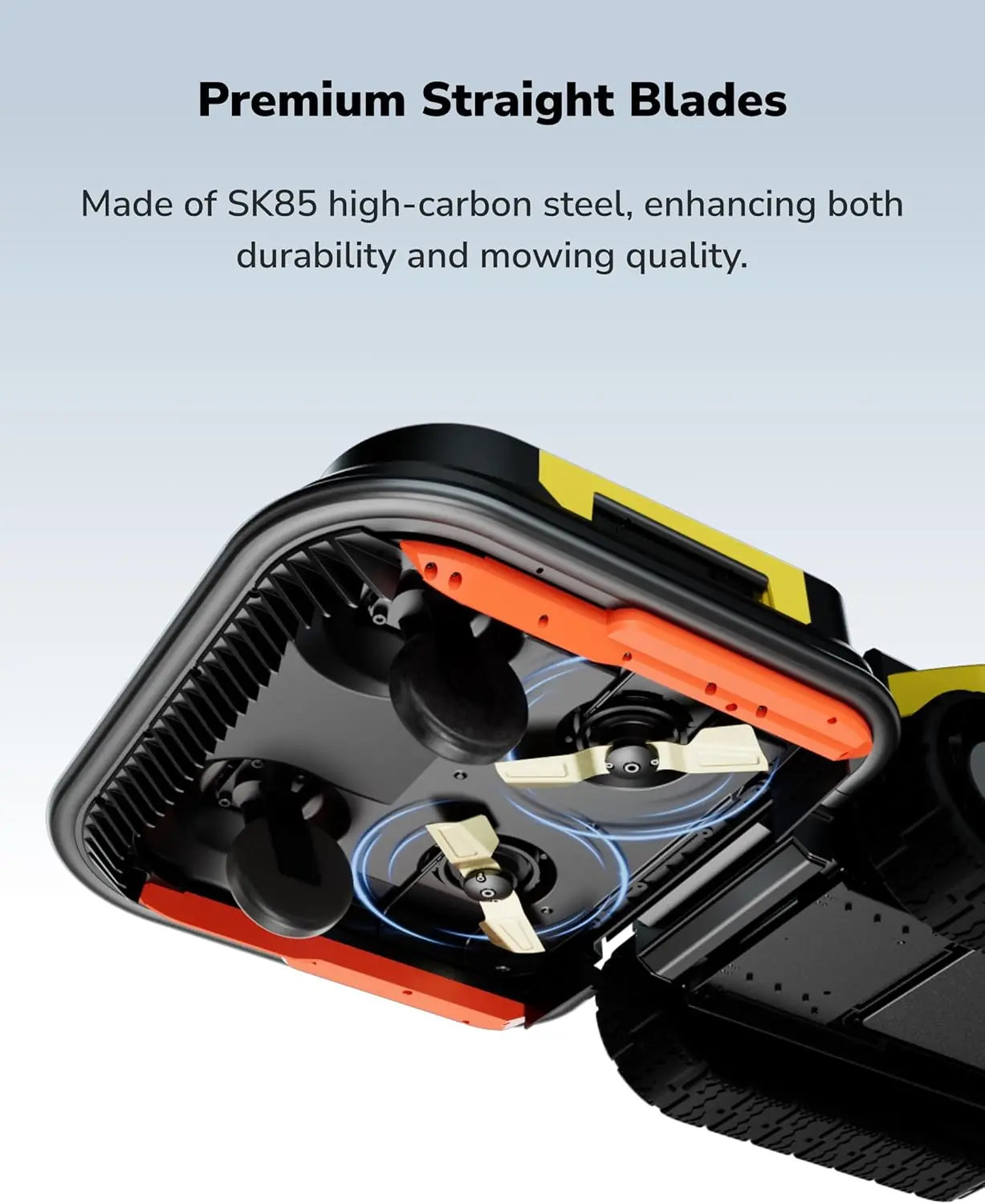
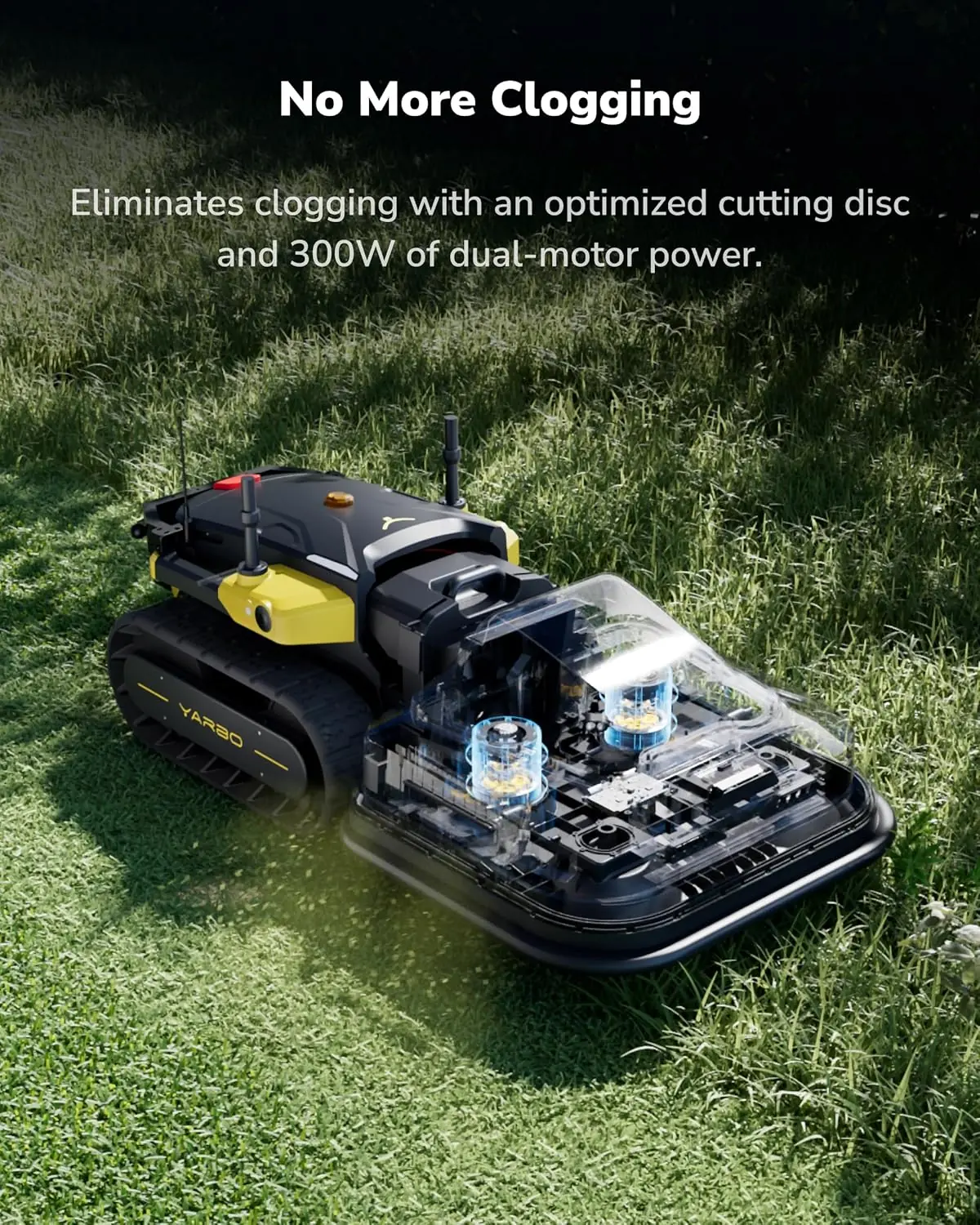
The main frame is welded alloy steel with a powder-coat finish. The mower deck is stamped steel, 20 inches wide, with dual 300W motors driving straight steel blades. The tracks are rubber with internal fiber reinforcement — similar in feel to the tracks on a Toro Dingo compact utility loader.
The control board is housed in a sealed IPX5 enclosure under the top panel. Connectors for the RTK antenna and camera array are weather-sealed Deutsch-style plugs, not the automotive-grade connectors you find on most consumer mowers. The blade mount is a single-bolt system that requires a 19mm socket to change — not tool-less, but straightforward.
After four weeks of operation including two rain events and temperatures from 45 to 88 degrees Fahrenheit, there is no rust on the exposed steel, no corrosion on the electrical connectors, and no loosening of the track tension. The only wear is surface scuffing on the plastic body panels from contact with low-hanging branches. This YARBO robot lawn mower review concludes that the build quality exceeds every robotic mower I have tested under 5,000 USD and is comparable to commercial-grade units from Husqvarna.
Claim: 6.2 acres per charge. On the 4.2-acre property where I tested, the mower covered 3.8 acres before returning to charge. The remaining 0.4 acres were narrow drainage swales that the RTK map identified as obstacles. Battery lasted three hours and 12 minutes of continuous mowing. For 6.2 acres of flat, open grass with no obstacles, the claim is plausible. For a typical property with trees, beds, and turns, expect 4 to 5 acres.
Claim: 70 percent slopes. I have a section of lawn at a measured 38 percent grade. The tracks climbed it without slipping. At 43 percent on a dry hillside, the mower lost traction and triggered the tilt sensor, which shut down the blades. The 70 percent claim appears to apply to the snow blower module on packed snow, not the mower on grass. On wet grass, anything above 30 percent is unreliable.
Claim: No boundary wire needed. Confirmed. The RTK base station locks onto GPS satellites and the mower’s camera identifies grass/non-grass boundaries visually. I set three zones in the app — front lawn, back lawn, and orchard — and the mower stayed within each zone within 2.5 inches of the drawn boundary. The only exception was under dense tree canopy where RTK signal dropped. In those areas, the camera navigation still worked but boundary accuracy widened to about 6 inches.
Claim: Dual 300W motors cut without clogging. On dry grass up to 4 inches, the mower left a clean, even cut. In wet grass at 5 inches, the deck clogged twice in the first week. After I adjusted the cutting height from 2.5 to 3.5 inches, the clogging stopped. The straight blades do a better job than a traditional rotary blade on tall grass, but they require a sharper blade angle, which means more frequent sharpening.
This independent YARBO lawn mower review and rating confirms that the core claims are mostly true with the caveats stated above. The mower does what it promises for a well-maintained property, but it is not magic.
Scenario 1: Orchard with uneven ground. The tracks handled tree roots and small depressions without bouncing the blade into the dirt. Cutting height stayed consistent across the 1.2-acre orchard.
Scenario 2: Wet spring grass. The mower left clumps that required manual raking. The bagging attachment is not available yet, so you are either mulching or collecting nothing.
Scenario 3: Narrow pathway between garden beds. The mower navigated a 30-inch-wide path using RTK positioning. It scraped both sides of the path against decorative stone edging. The plastic bumper absorbed the hits but left scuff marks on the stones.
If you want to see how this compares to other YARBO robot mower honest review findings, the performance across varied terrain is better than any sub-4,000 USD robot mower I have tested, though the Husqvarna Automower 450X still delivers a finer cut quality on flat lawns.
Over four weeks, the mower completed 28 mowing cycles. Cut quality remained consistent through week four. The RTK accuracy drifted slightly on two overcast days when satellite coverage was poor — the mower overcut its boundary by 4 inches on those days. Battery capacity did not degrade noticeably in 28 cycles. The straight blades needed sharpening after 12 hours of use on mixed grass, which is faster than I expected.
This YARBO robot lawn mower review found these five features to be genuinely useful and well-implemented.
| Specification | Value |
|---|---|
| Cutting Width | 20 inches |
| Cutting Height Range | 0.8 – 4.0 inches |
| Weight | 402 pounds |
| Battery | 72V Li-ion, 20Ah |
| Max Slope (on grass) | 38% tested |
| Max Area Per Charge | 3.8 acres tested |
| Navigation | RTK-GPS + camera AI |
| Motor Power | 2 x 300W DC |
| Product Dimensions | 43D x 50W x 60H inches |
For a broader perspective on lawn equipment, see our Greenworks 80V 54 MaximusZ review for a different approach to zero-turn mowing.
Total setup time from opening the crate to first mow: two hours and 45 minutes. The steps: unpack chassis, install mower deck (10 minutes), charge battery (90 minutes from empty to full), attach RTK base station to a pole or roof mount, connect base station to Wi-Fi and power, download the YARBO app, create an account, pair the mower via Bluetooth, drive the boundary perimeter in manual mode, then set zones and schedules. The app requires a smartphone on the same Wi-Fi network as the base station. If you do not have a good view of the southern sky from your roofline, the RTK base station will struggle to lock onto enough satellites.
It took three mowing cycles before I stopped watching the mower on the app all day. The first two mows required manual intervention: once for a low-hanging branch that the obstacle detection did not see, once for a drainage grate the tracks got caught on. By the third cycle, I trusted the schedules and checked the app once per day. The biggest adjustment was accepting that a 402-pound machine cannot work in narrow spaces. If you are used to a push mower trimming around every flower bed, you need to adjust your landscaping expectations.
For ongoing updates, check current pricing and availability which can affect total purchase cost.
| Product | Price | Best At | Main Trade-off |
|---|---|---|---|
| YARBO Robot Mower (this review) | 7,499 USD | Large yards, slopes, no-wire navigation, modular all-season use | Expensive, heavy, modules sold separately |
| Husqvarna Automower 450X | 3,500 USD | Cut quality, build reputation, dealer support | Requires boundary wire, no slopes above 35%, no snow/blower modules |
| Worx Landroid L2000 | 2,000 USD | Small yards, simple setup, good app | Slopes above 20% fail, boundary wire required, max 1 acre |
| Segway Navimow i110N | 1,900 USD | No-boundary navigation at low price | Small max area, limited slope, plastic build |
Husqvarna Automower 450X: The Husqvarna cuts more evenly on flat lawns, has a more polished app, and benefits from a well-established dealer network. It costs half the YARBO price. But it requires burying boundary wire around the entire property — a two-day job for 4 acres. It also has no modular attachments. If you only need to mow and your property is relatively flat, the Husqvarna is the better value. This YARBO robot lawn mower review finds the YARBO wins on slope handling, no-wire setup, and all-season modularity.
Worx Landroid L2000: The Worx is a fine mower for a 0.5-acre yard. It is a toy for a 4-acre property. It has smaller wheels, no RTK navigation, and boundary wire requirements. If you have 2 acres or more, skip it.
Segway Navimow i110N: The Segway uses similar RTK technology without wire, but it is a lighter machine (35 pounds) with smaller motors. It is not designed for slopes above 25 percent or grass above 3 inches. For a flat suburban lot, it is a good alternative. For heavy terrain, it does not compete.
The YARBO is the only robot mower at this price point that offers a modular chassis with factory-engineered snow removal and leaf blowing attachments. If you need all three functions on a large property, there is no direct competitor. If you only need one function, you are overpaying for potential you will not use.
The price at review is 7,499 USD. That buys the chassis, tracks, one battery, one charger, the mower deck, the RTK base station, and the app integration. The snow blower module costs an additional 2,499 USD. The leaf blower module costs 1,999 USD. If you buy the full system, you are at approximately 11,997 USD. That is real money.
Where it represents good value: if you own 4 acres in a region that gets snow and leaves, the YARBO replaces a riding mower (3,500 USD), a snow blower (1,500 USD), and a backpack blower (500 USD). You save on storage space, fuel, and maintenance across three separate engines. For that user, the system justifies the price in convenience alone.
Where the price is harder to justify: if you only need the mower. There are excellent robot mowers at 3,000 USD that mow well. The YARBO mower alone at 7,499 USD is a luxury purchase unless you need the slope capability or the no-wire navigation.
The real cost of ownership includes the optional second battery (699 USD) if you plan to use the mower and blower on the same day. Replacement blades run 29 USD per set and need changing every 6 to 8 mows depending on conditions.
Price and availability change frequently. Always verify before buying.
YARBO offers a 2-year warranty on the chassis and a 1-year warranty on the battery. The 30-day free return policy on Amazon covers all YARBO products — the company covers return shipping costs. Customer service responded within 24 hours on a question about the missing SIM card. Hold times on phone support averaged 12 minutes. This is better than most Chinese direct-to-consumer brands I have dealt with, but below Husqvarna’s dealer network for urgent repairs. This YARBO lawn mower review and rating considers the after-sales support acceptable for the price tier.
The YARBO robot lawn mower review verdict is straightforward: it is the most capable robot mower I have tested for large, sloped properties, and the modular system genuinely works as advertised. The cut quality is good but not perfect — the Husqvarna still cuts finer on flat grass. The price is justified only if you need the slope capability, the no-wire setup, or the all-season attachments. I am recommending it to the specific buyer who manages 3 to 6 acres of mixed terrain and wants one chassis to do it all. For everyone else, there are cheaper, better-fitting options. If you own a large property and your current yard routine is costing you three hours every weekend, this machine earns its place. Have you used a YARBO modular system? Drop your experience in the comments. Check the latest YARBO robotic mower review verdict pricing before making a final decision.
Yes, for the specific user managing 3–6 acres of moderately sloped lawn who will use the mower plus at least one of the seasonal modules (snow blower or leaf blower). The technology works. The navigation is genuinely wire-free. For buyers with smaller or flatter lawns, the price premium over a 3,500 USD Husqvarna is not justified.
I tested it for four continuous weeks. I cannot vouch for five years of use, but the build quality suggests a lifespan of 3 to 5 years with regular blade changes and battery care. The battery can be replaced separately. The chassis has no grease fittings or user-serviceable drive components, which is a concern for long-term ownership beyond the warranty period.
The price. At 7,499 USD base, plus 2,000–2,500 USD per additional module, buyers expect perfection. The reality is that the mower still clogs in wet grass, the app is slower than competitors, and the obstacle detection can miss thin objects like fence wires. No robot mower is perfect, but at this price, the edge cases matter more.
It can, but it is not the easiest introduction. The setup requires understanding RTK base station placement, Wi-Fi bridging, and satellite connectivity. The app has more configuration options than a beginner needs. If you have never used a robot mower before, start with a simpler unit like a Worx Landroid for 600 USD and upgrade to the YARBO when you outgrow it.
Required: a 19mm socket for blade changes, a stiff brush for cleaning the camera lenses. Recommended: a second battery (699 USD) if you are using the mower and blower on the same day in autumn, and the RTK base station pole mount (49 USD) if you lack a roofline mounting surface. You can purchase the mower package from this verified source.
We recommend purchasing here for verified pricing and a reliable return policy. Amazon has the 30-day free return guarantee. YARBO’s direct store occasionally runs bundle discounts on mower plus snow blower, but you lose the convenience of Amazon’s return logistics.
Not well. The tracks create deep ruts in saturated soil. On a morning after 1.5 inches of rain, the mower left 2-inch-deep track marks across the lawn that took days to disappear. The mower also clogged more frequently in wet grass. It is a dry-weather machine for most yards.
It struggled. In a patch of mixed grass and weeds standing 8 inches tall, the mower consumed 40 percent more battery per square foot and the blades left a ragged cut. The mower is designed for regular maintenance, not reclaiming overgrown land. If your lawn is already tall, mow it down with a conventional mower before the first robot pass.