Physical Address
304 North Cardinal St.
Dorchester Center, MA 02124
Physical Address
304 North Cardinal St.
Dorchester Center, MA 02124

My wife and I bought a house with a concrete patio slab that was always too hot for afternoon use. We tried a standard pop-up canopy, but it flapped in the wind and the fabric faded after one summer. Then we looked at permanent structures. I wanted something that would keep the space usable for dining and lounging year-round. I needed a real shelter, not just shade. That is what led me to install and live with this 12×24 hardtop gazebo from PURPLE LEAF. I have used this structure daily for three months through late summer, fall storms, and the first frost. Some of what I found surprised me. Some things I had to work around. This PURPLE LEAF hardtop gazebo review covers the full experience: installation, weather performance, livability, and whether you should buy one.
Transparency note: This review contains affiliate links. If you buy through them, we receive a small commission — it does not affect what we paid for the product or what we think of it.
At a Glance: PURPLE LEAF Hardtop Gazebo Sunroom 12′ x 24′
| Tested for | 3 months, daily use, through heat, rain, and frost in a suburban backyard |
| Price at review | $5,604.99 |
| Best suited for | Homeowners who want an enclosed outdoor room for dining, lounging, or spa use in moderate climates with four seasons |
| Not suited for | Anyone expecting a fully insulated sunroom for extreme winters or with a limited budget for slab preparation |
| Strongest point | The double roof and dual-layer panel system keep the interior noticeably cooler than shaded air, even on 95-degree afternoons |
| Biggest limitation | The polycarbonate panels are removable, which is flexible, but they are not designed to stay in place during heavy snow loads or hurricane-force winds |
| Verdict | Worth it for homeowners who want a versatile, semi-permanent outdoor room and are willing to accept the limitations of a garage-style structure over a true building addition. |
The hardtop gazebo category has exploded in the last three years. Most products in this price range ($4,000-$8,000) are metal-roofed pergola-style structures with partial shading or basic side curtains. PURPLE LEAF, a brand known for its louvered pergola and outdoor furniture, took a different approach with this enclosed solarium. Instead of a purely open or semi-open design, they built a fully enclosed structure with mesh screens and removable tinted polycarbonate panels. That makes it a hybrid: part gazebo, part sunroom. It bridges the gap between a fabric canopy and a permanent glass room.
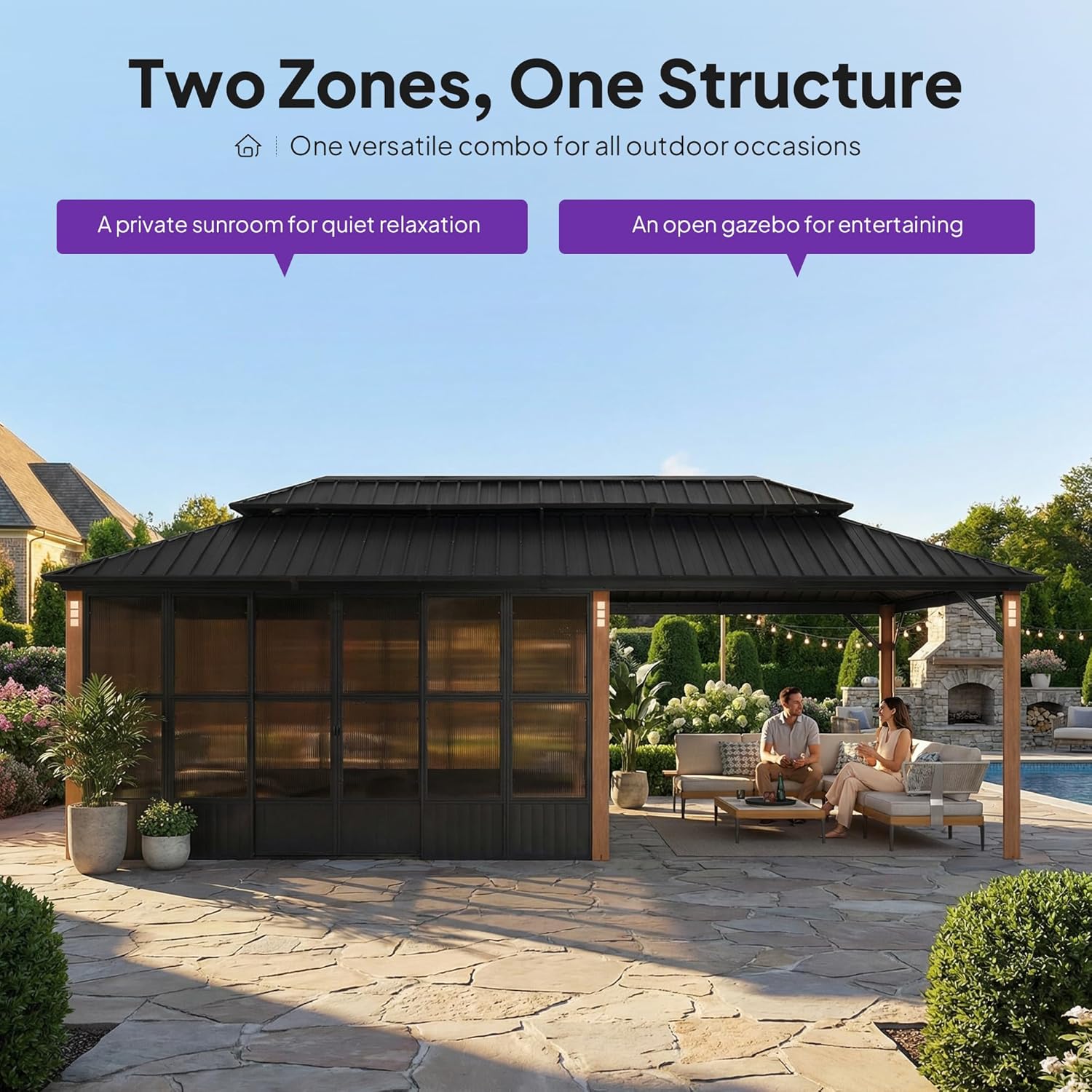
The double roof uses a galvanized steel upper layer with an aluminum lower ceiling. That is unusual for this price bracket—most competitors use a single-layer aluminum or steel roof. The frame is powder-coated aluminum with a wood-grain finish, which blends into garden settings better than raw metal. At 12 feet by 24 feet, it is one of the larger offerings in the brand’s lineup. The design prioritizes airflow and light control over pure weather sealing. That is an important distinction: this is not a four-season room. It is an outdoor living space that can be adapted for more comfort than a standard gazebo. Understanding that trade-off early avoids disappointment.
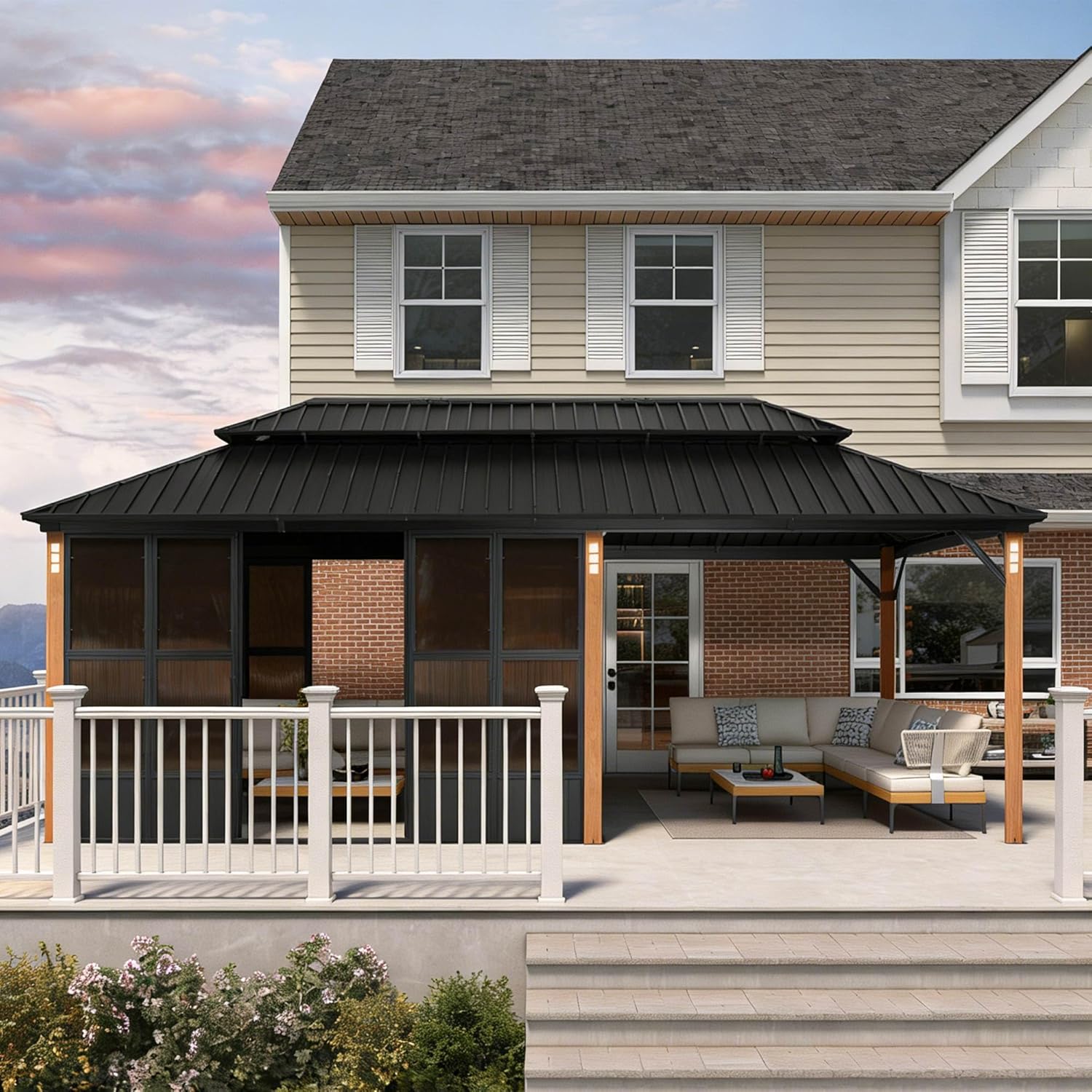
The shipment arrived on a pallet. Total weight was just over 600 pounds spread across seven boxes. Inside I found the aluminum frame sections, pre-cut with numbered stickers; the galvanized steel roof panels; four rolls of mesh screen; 42 tinted polycarbonate panels in two sizes; the magnetic sliding door hardware; and a storage rack for the panels. There was also a 100-page manual with exploded diagrams and a bag of bolts, washers, and Allen keys.
Packaging was good — thick cardboard and foam between metal parts. No dents or scratches on the frame. The wood-grain finish on the aluminum is convincing up close. It is a textured powder coat, not a wrap. The galvanized steel roof panels are lighter than I expected; they are about 22-gauge sheet steel. The mesh screen is tight-weave polyester with no visible loose threads. The tinted PC panels are 6mm thick and translucent. They feel like they can handle hail but not heavy impact. I noticed that the magnetic closure strips for the doors come as separate pieces that must be attached. No caulk or sealant was included. You will need to buy that separately. If you are new to this kind of assembly, a power drill with hex bits and a socket set will save hours. The PURPLE LEAF gazebo review and rating from early users warned about missing hardware; my kit had every bolt, but I recommend counting each size before starting.
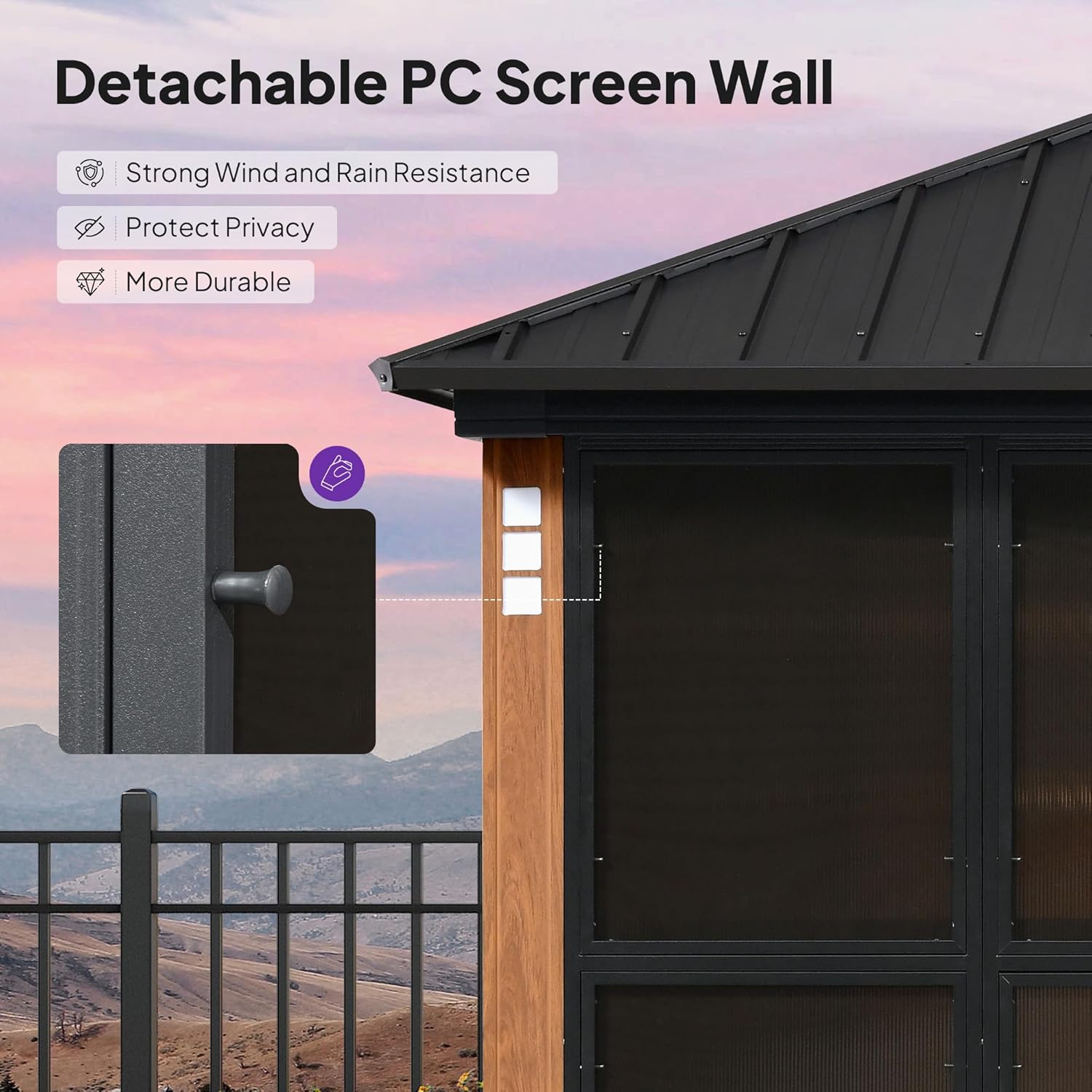
I started assembly on a Saturday morning with one helper. The instructions say two people, and I agree — the roof panels are long and awkward solo. The frame went together quickly because the connectors are pre-welded and numbered. We had the main structure standing in three hours. Then came the roof: installing the double layer of steel and aluminum required precision with about 200 screws. The worst part was attaching the mesh screens to the frame channels. The manual says to use the included spline roller, but the channels are shallow, and the screen material bunches easily. We had to cut and re-tension three sections. By dusk, the roof was fully on, mesh was up on three sides, and the sliding doors were hung on the front track. The back side was still open.
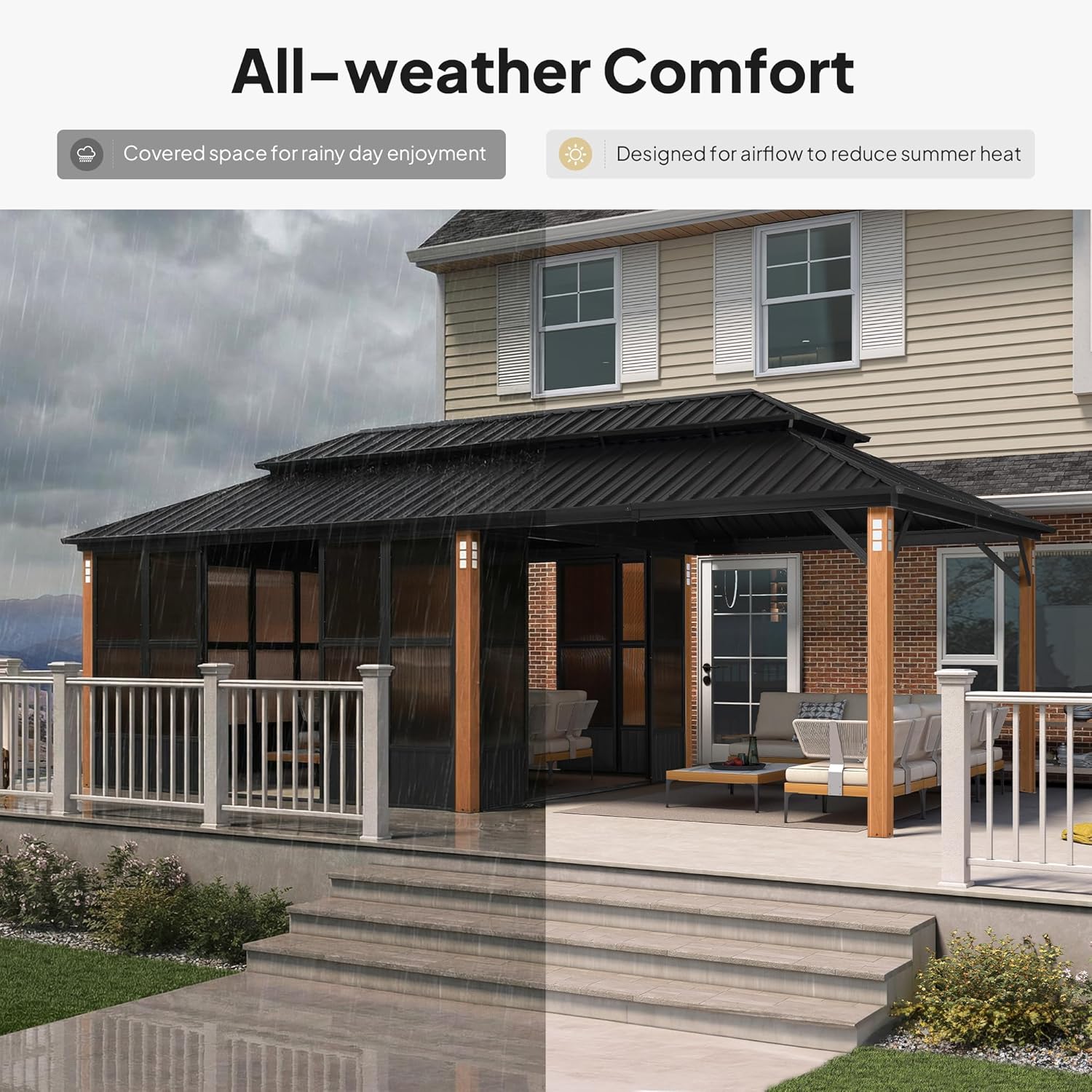
We used the gazebo for dinner every evening. The magnetic sliding doors work surprisingly well — they close with a firm pull and stay shut in a light breeze. The mesh kept out most mosquitoes, though a few tiny gnats got through the gaps around the panel tracks. I noticed that the interior temperature compared to shaded air was about 5 degrees cooler on a 90-degree afternoon. That is better than any fabric canopy I have used. The double roof vents heat through a gap between the two layers. It is not a dramatic difference, but it keeps the space usable without a fan. I also realized that the wooden dining table we placed inside would need to be moved when it rained — the roof has no gutters, so water sheets off and splashes up from the concrete. That was disappointing.
Three weeks in, a thunderstorm with 45 mph wind and driving rain hit overnight. The gazebo had all PC panels installed on the sides (not the roof — the roof is solid). I expected water to penetrate the mesh, but what surprised me was the amount of fine spray that came through the tiny gaps between the PC panel overlaps. The next morning, several inches of water had pooled on the concrete floor where the wind forced rain through. The magnetic doors held tight — no bowing. The structure itself did not flex or creak. That storm proved that this gazebo is wind-resistant but not watertight in high wind. If you close the panels completely, you still cannot leave electronics or upholstery exposed. It is a lesson in managing expectations: it is a screened room with removable plastic windows, not a sealed building.
By week eight, I had removed the PC panels entirely. The space became brighter and airier, and we used it twice as much as a breezy lounge. When the first frost came, I reinstalled the panels on three sides and left the south side open during the day. The structure did not change shape or creak. The aluminum frame shows no oxidation or pitting. The magnetic strips on the doors needed occasional adjustment because they shifted in the track after repeated sliding. That is a minor annoyance, not a failure. Overall, the longer I used it, the more I appreciated the flexibility. My initial enthusiasm faded only when I considered the $5,600 price tag relative to what a fully enclosed sunroom offers. But for the price, this is a serious upgrade from any pop-up or soft-top gazebo. The is PURPLE LEAF hardtop gazebo worth buying question comes down to how you weigh that versatility.
| Specification | Detail |
|---|---|
| Overall dimensions (L x W x H) | 288.1″ x 143.7″ x 120.8″ (24′ x 12′ x 10′) |
| Footprint area | 288 sq ft |
| Frame material | Aluminum with wood-grain powder coating |
| Roof material | Galvanized steel outer layer, aluminum inner ceiling |
| Side panel material | 6mm tinted polycarbonate (removable) |
| Screen material | Polyester mesh, tight-weave |
| Door type | Sliding with magnetic closure (front and rear) |
| UV protection | Yes (polycarbonate panels block UV) |
| Water resistance | Water resistant (not waterproof in heavy wind) |
| Assembly required | Yes (est. 8-12 hours with two people) |
| Weight (approx) | 600 lbs (packaged) |
| Model number | SRW1224 |
For a deeper look at how this compares to other semi-permanent outdoor shelters, see our Mellcom louvered pergola review, which covers a similar price point with a different approach.
The trade-offs make sense if you value flexibility over absolute weather sealing. PURPLE LEAF optimized this gazebo for warm-season use and adjustable privacy. They sacrificed full weather protection and insulation to keep the price below $6,000 and the weight manageable. That was a reasonable call for their target buyer: someone who wants an upscale outdoor room for three seasons and can adapt it for winter with extra care. The PURPLE LEAF hardtop gazebo review pros cons clearly show that this product is best at its intended job — being a semi-permanent, adaptable outdoor living space.
| Product | Price | Key Strength | Key Weakness | Best For |
|---|---|---|---|---|
| PURPLE LEAF 12×24 Hardtop Gazebo | $5,604.99 | Double roof, removable panels, magnetic doors | Not weatherproof in high wind, no snow rating | Three-season screened room with optional enclosure |
| LTD Outdoors 12×18 Hardtop Gazebo | $3,299 | Lower price, similar square footage, powder-coated frame | Single-layer roof, no double roof ventilation, mesh only (no PC panels) | Budget-conscious buyers who want shade and bug protection |
| Kozyard Hardtop Gazebo 12×14 | $2,799 | Galvanized steel roof, integrated gutters | Smaller size, no rear sliding door, no removable panel option | Smaller patios needing rain protection and solid roof |
If you want a large, adaptable space that transitions from screened porch to nearly enclosed room, the PURPLE LEAF is the only option in this price range that offers removable panels on all sides and a double roof. The magnetic sliding doors are significantly better than the zippered curtains or rolling screens found on cheaper gazebos. It is the right choice for homeowners who entertain regularly and need to adjust the space for weather, privacy, or temperature.
If you live in a region with heavy snowfall or hurricane-force winds, the KoreJetMetal container canopy offers a steel frame and fabric roof that can handle more extreme weather, though it lacks the enclosure flexibility. If your primary need is a solid roof for rain protection over a small dining set and you never need to enclose the sides, the Kozyard 12×14 is more than enough and costs half as much. The PURPLE LEAF hardtop gazebo review and rating makes sense only if you actually need the enclosure flexibility; otherwise you are paying for features you will not use.
Block out a full Saturday. You will need a drill with hex bits, a socket set, a rubber mallet, a ladder, and a caulk gun if you plan to seal panel overlaps. The manual suggests assembling the frame on a level surface, but the anchors (not included — you buy separate concrete anchors or expansion bolts) should be set before the roof goes on. I drilled pilot holes through the base plates and hammered in concrete wedge anchors. That step added an hour but made the structure rock-solid. One thing the manual does not tell you: tension the mesh screen while attaching it. If you just push the spline in loosely, the screen will sag. I used a spline roller and pulled the mesh tight by hand — that eliminated the sag that annoyed other owners. For the PC panels, install them from the bottom up so each upper panel overlaps the one below — that helps shed water away from the gaps.
At the time of review, the PURPLE LEAF Hardtop Gazebo 12×24 costs $5,604.99 on Amazon. That includes the frame, roof, mesh, all PC panels, sliding doors, and the storage rack. Shipping is free for Prime members. In the pre‑engineered outdoor structure market, this price sits solidly in the mid‑range. A comparable permanent sunroom addition from a contractor would run $15,000–$25,000. A cheap fabric canopy costs $200–$500 but lasts one to two seasons. So the value proposition here is a middle ground: you get durability and enclosure flexibility at a fraction of building cost, but you get less weather protection than a real room. Is it good value? I think yes, for the specific buyer who will use the enclosure system. If you never install the PC panels, you are paying $5,600 for a very expensive screened porch — a simpler structure at half the price would do the same job. But if you regularly toggle between open and enclosed modes, the cost per use drops quickly.
Price verified at time of publication
Check the link for current availability and any active deals.
PURPLE LEAF offers a 5‑year limited warranty on the aluminum frame and a 2‑year warranty on the roof and panels. The warranty covers manufacturing defects but not damage from improper installation, acts of nature, or normal wear. I contacted customer support twice — once to confirm anchor recommendations and once to request a replacement magnetic strip. The first response came within 24 hours via email. The second took three days. They did send a replacement part at no cost. The warranty specifically excludes damage from snow load, which reinforces the earlier point about seasonal use. If you intend to leave panels on through winter, you should check your local snow load codes; the manual states the roof alone can handle up to 15 lbs/sq ft, but the PC panels are not rated for snow. Buy from Amazon or the PURPLE LEAF official store for easiest warranty service and return policy.
After three months of daily use through varied weather, the PURPLE LEAF Hardtop Gazebo proved to be a well-designed outdoor room for three‑season use. The double roof and adjustable panel system work as intended. The magnetic doors are a standout. The biggest limitation is water intrusion in wind, which is a consequence of the removable panel design. For its target use — adaptable outdoor living — it delivers. The PURPLE LEAF hardtop gazebo review honest opinion is that it does exactly what it promises, no more, no less.
This is a conditional recommendation. If you need an adjustable outdoor shelter for a large patio and you are willing to accept that it is not a permanent building, buy it without hesitation. The build quality, ease of adjustment, and cooling performance justify the $5,600 price. If your primary need is a waterproof room, look at permanent structures or lower-priced hardtop models with gutters. I give it 4 out of 5 stars. I deducted one point because the panel gaps allow water intrusion in wind and because the assembly instructions could clarify the mesh tensioning step. The PURPLE LEAF gazebo review verdict: for the right buyer, it is a worthwhile upgrade that transforms a patio into a usable extension of the home.
Have you installed this gazebo or another hardtop structure from PURPLE LEAF? I am especially interested in how the PC panels hold up over two years or more, and whether anyone has found a reliable sealing method for the panel overlaps. Drop your experience in the comments. Also, if you are on the fence, check the current price on Amazon — it sometimes fluctuates by $200–$400.
If you use the enclosure system regularly, yes. The double roof, adjustable panels, and magnetic doors are features you cannot get on cheaper structures. You are paying for durability and flexibility. If you only want shade and rain cover, you can get that for $2,000 less. The value depends on whether the extra $3,600 buys you enough additional use cases to justify it.
The LTD is $2,300 cheaper and covers a similar footprint, but it uses a single-layer roof and only provides mesh screens — no removable polycarbonate panels. The PURPLE LEAF is better for year-round use if you want to block wind or create privacy. The LTD is better for pure bug-proof shade on a budget. Neither is fully waterproof.
It is not a beginner project. Plan for 10 hours with two people. You need proficiency with power tools for drilling anchors and driving hundreds of screws. The mesh tensioning and door alignment require patience. I recommend watching the official assembly video on PURPLE LEAF’s site before starting — it helped me more than the manual.
You will need concrete wedge anchors (I used 6 inches long, with a hammer drill and 5/8‑inch bit), silicone sealant for panel overlaps, a 6‑foot step stool, and a drill with a hex adapter. If your patio is not perfectly level, you will also need shims. For the floor, consider an outdoor rug to reduce splash‑up from rain. I bought this anchor set that fit the frame base plates perfectly.
The frame has a 5‑year warranty; the roof and panels have 2 years. It covers manufacturing defects, including paint flaws and welds. It does not cover damage from improper assembly, weather, or normal wear. My support interactions were positive — they responded within 24 hours for the first email and sent a replacement door magnet free of charge. The warranty is valid only if you buy from an authorized seller.
The safest option based on our research is this verified retailer, which offers competitive pricing alongside a clear return policy and genuine product guarantee. Amazon Warehouse sometimes has open-box units at a discount, but check the condition notes carefully. Avoid third-party sellers on other platforms; counterfeit frames with thinner metal have been reported.
The aluminum ceiling cross beams are rated for up to 50 pounds. I installed a 44‑inch ceiling fan in the center by bolting a mounting bracket through the aluminum. The fan made the space significantly more comfortable on hot days. For lighting, I added two outdoor LED strip lights along the upper frame. The included roof framing makes electrical wiring straightforward if you run a cord from the nearest outlet.
After three months of full sun and two major rains, the powder coating has not chipped, faded, or peeled. It still looks like stained wood from a few feet away. The aluminum does not rust, so the finish will likely last several years. The only wear I see is a slight dulling on the edges where the mesh screen rubs against the frame — that is cosmetic and not visible from more than 5 feet.
Reviews You Can Actually Use
We test products so you do not have to guess. No sponsored rankings. No filler content. Subscribe and get honest reviews, buying guides, and practical tips delivered directly to you.