Physical Address
304 North Cardinal St.
Dorchester Center, MA 02124
Physical Address
304 North Cardinal St.
Dorchester Center, MA 02124

Picture the last fire you built in the backyard. You spent twenty minutes getting it going, dragged three chairs into a half-circle, and then spent the next two hours rotating around the pit like a rotisserie chicken because the smoke kept finding whoever moved last. You tried drier wood. You tried a smaller fire. You tried a different corner of the patio. None of it worked, because a single-wall fire pit has no way to reburn its own smoke — it pushes it out the top and lets the wind decide.
What you actually want is straightforward: a fire you can sit beside from first match to last ember without moving your chair, without smelling like a campsite the next morning, and without the whole thing rusting into a red pile after two seasons.
That is the exact gap this Breeo X Series 24 review sets out to close. The X Series 24 is Breeo’s mid-size, double-wall, corten steel wood-burning pit, and it claims near-smokeless combustion for 599USD. We burned in one for four weeks to find out whether that claim survives contact with a real patio. If you want to see current Breeo smokeless fire pit review pricing before reading on, start there. For the rest of the testing space, our Govee permanent outdoor lights review covers the patio setup we worked in.
At a Glance: Breeo X Series 24
| Overall score | 8.4/10 |
| Performance | 9.0/10 |
| Ease of use | 7.5/10 |
| Build quality | 9.5/10 |
| Value for money | 7.5/10 |
| Price at review | 599USD |
Smoke reduction and build quality score near the top of the category; the score is held back by weight, ash handling, and a base price that excludes every cooking accessory.
The Breeo X Series 24 sits in the secondary-combustion smokeless fire pit category. These pits are built around a simple idea: preheat air in a double wall, feed it back into the top of the fire, and burn off the uncombusted gases that would otherwise leave as smoke. It is the same principle behind a wood stove, scaled down to a patio.
There are really three approaches on the market today. Stainless steel portable pits that are light and cheap but have thin walls and limited cooking hardware. Propane and gas fire tables that are instant and genuinely smokeless but deliver almost nothing in the way of radiant heat or real fire feel. And heavy corten steel pits like this one, which trade portability for heat output, weather resistance, and a serious cooking ecosystem.
Breeo has been building in this category since 2011 and is the US manufacturer most closely associated with live-fire cooking hardware — the brand sells sear plates, grill grates, outpost rails, and lids as a system. The company’s specific claim with the X Series 24 is near-smokeless burn plus compatibility with that entire accessory line. You can read the manufacturer’s own framing at Breeo.
We chose this model over a stainless alternative at half the price because the corten shell, the USA manufacturing, and the lifetime warranty are the three things that actually determine whether a fire pit is still usable in five years. That is what this Breeo X Series 24 review needed to interrogate.
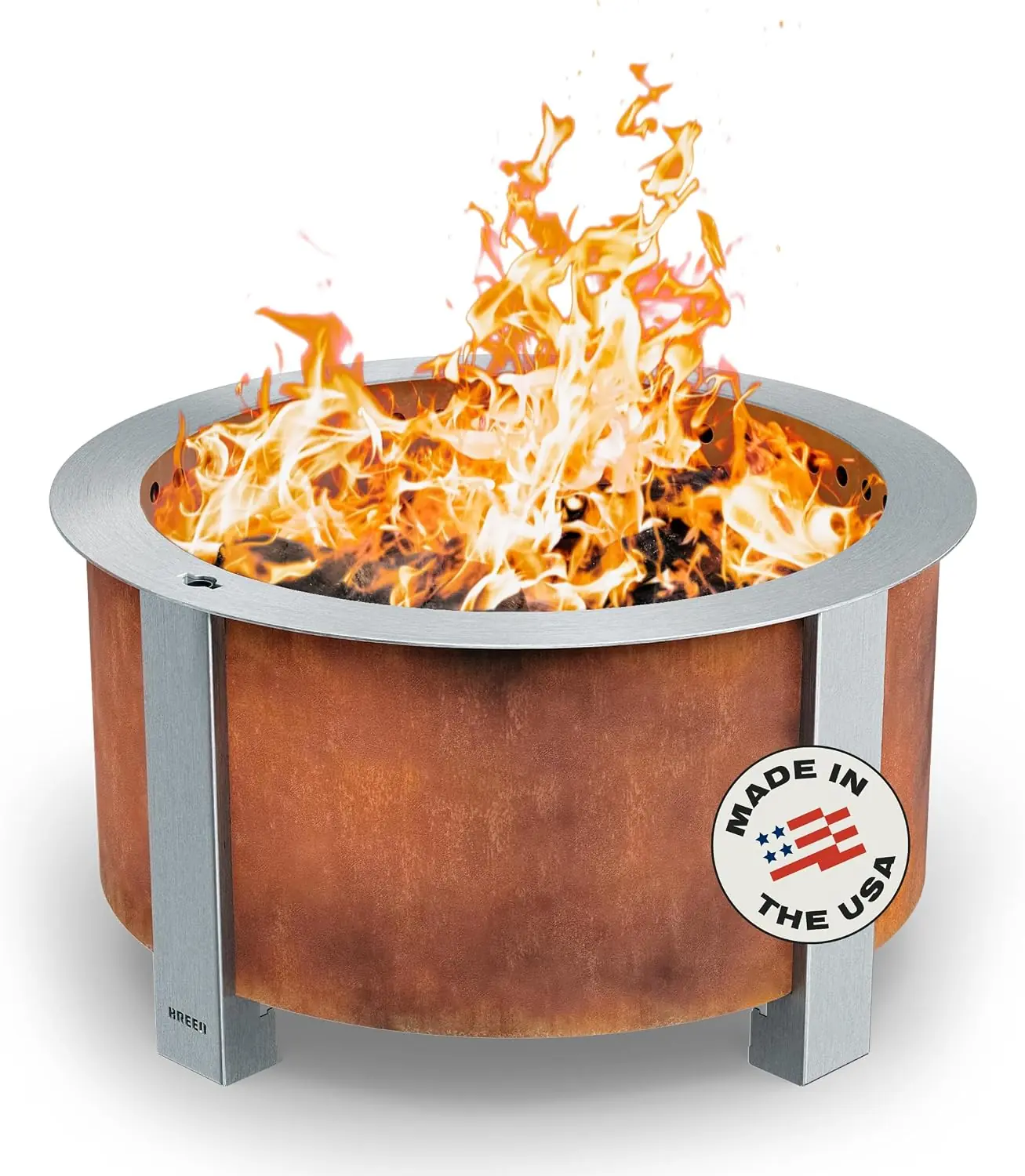
The carton contains the assembled fire pit bowl, the removable spark screen ring that sits on the top rim, and a small printed quick-start card. That is it. No lid, no poker, no ash tool, no cover, no fireproof mat.
Two things are not obvious from the listing. First, the pit arrives unassembled only in the sense that the top ring slides into place — there are no bolts, no brackets, no tools required. Second, everything you will want within the first month is sold separately: the Breeo lid (about 130USD), the sear plate (about 190USD), the ash scoop, and the outpost grill rail. Budget accordingly, because a bare X24 is a heater, not a cooker.
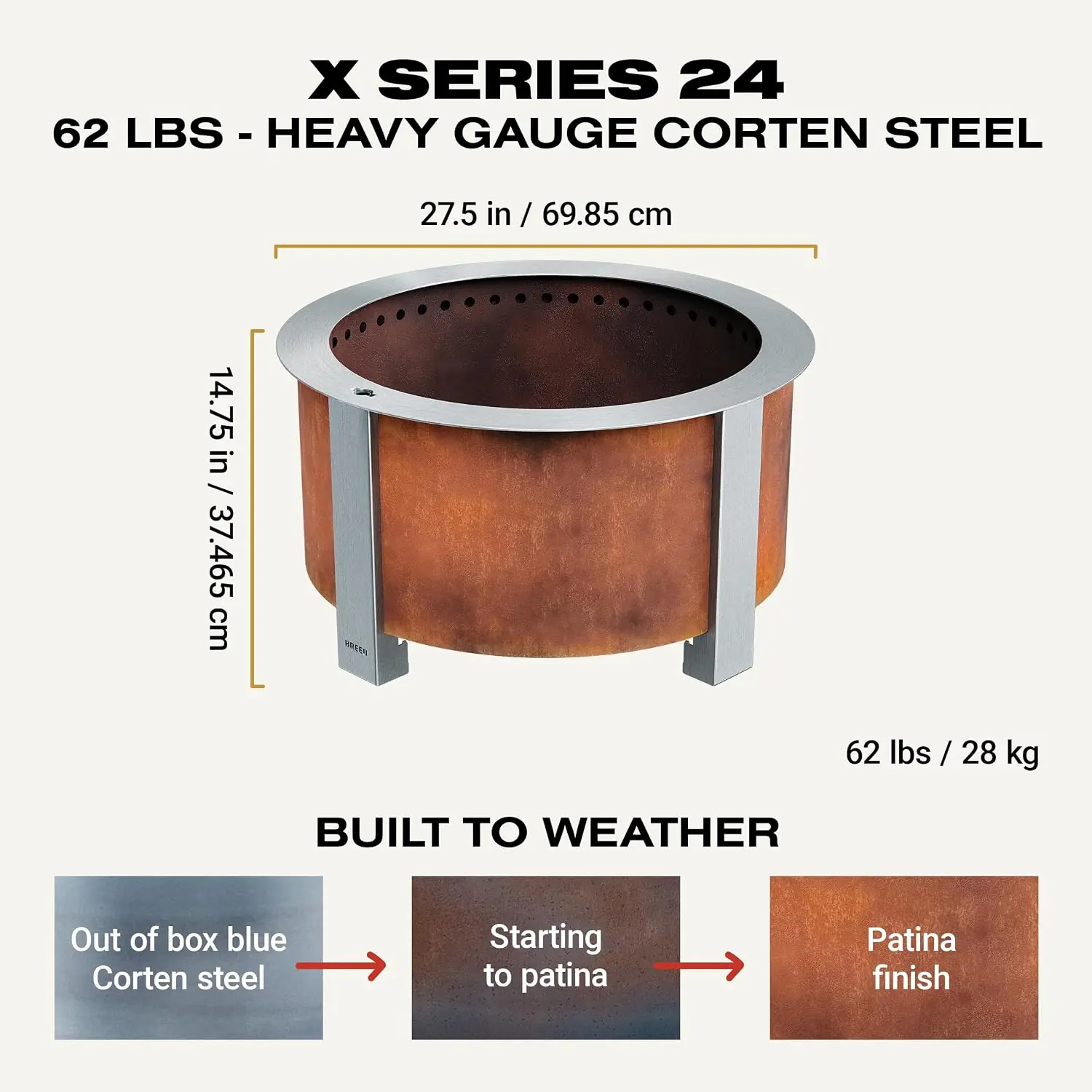
This thing is heavy in a way the photos do not communicate. At 28.12 kg (62 lbs), getting it out of the carton solo is a two-hands-and-bend-your-knees job, and there are no handles anywhere on the body. The corten steel arrives with a dull, matte, slightly dusty grey-tan finish rather than the warm rusty orange you see in lifestyle photography — that patina develops over months outdoors, not out of the box.
What stood out most was the weld quality and the thickness of the outer wall. Running a knuckle around the shell produces a solid, low thud rather than the tinny ring you get from stamped stainless. The secondary combustion holes are punched clean and evenly spaced around the inner wall. Nothing about this feels like a 599USD compromise — it feels like a 599USD object that will still be a 599USD object in ten years. Build quality matches the price point without argument.
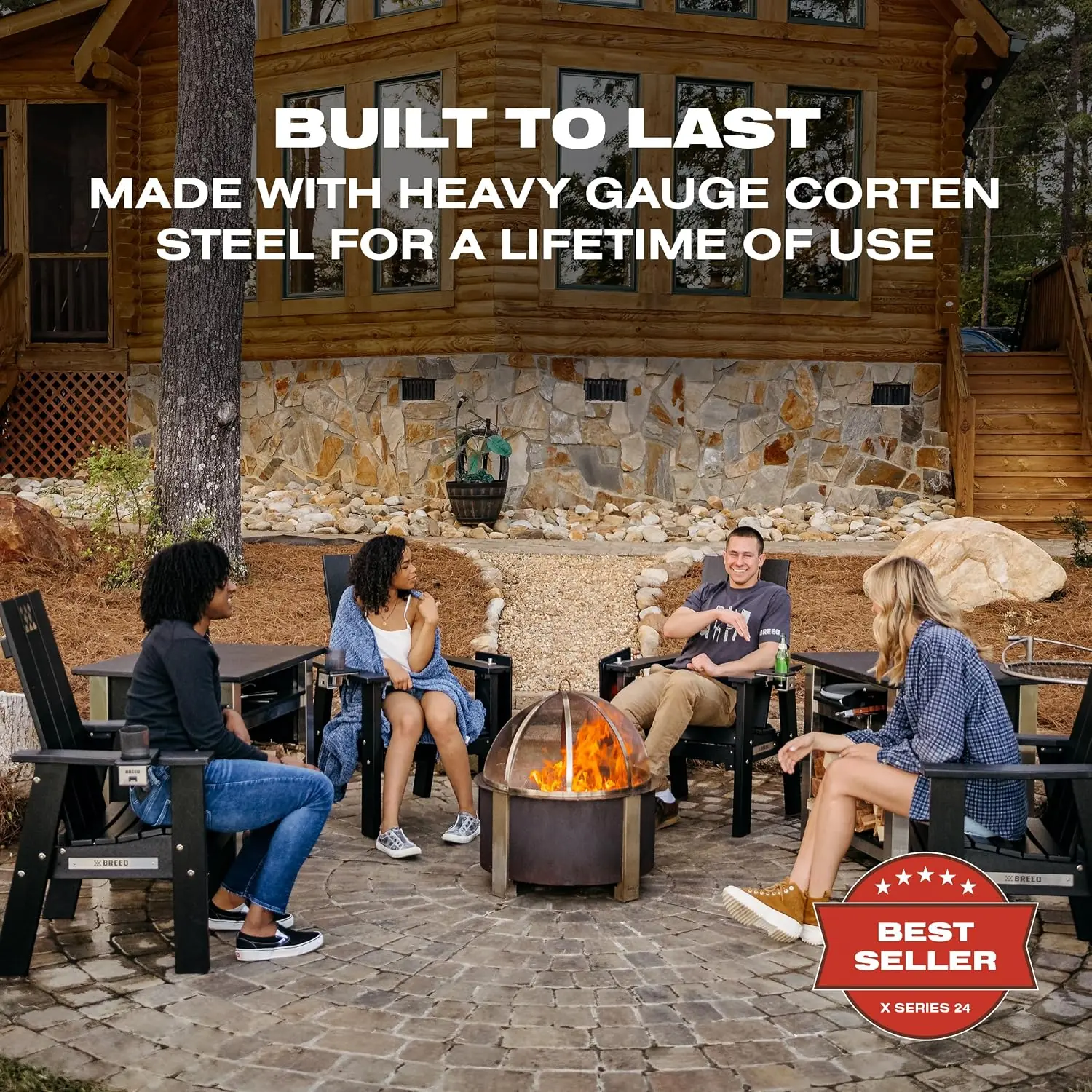
What it is: Breeo’s patent-protected air path that pulls oxygen through the base and up the double wall, feeding it into the fire from above.
What we expected: Marketing language for a standard double-wall design.
What we found: The startup behavior is genuinely different. From a cold pit with kindling and two splits, we had a visible flame inside 90 seconds without any paper or firestarter. The air feed is aggressive enough that it behaves almost like a bellows on demand.
What it is: Two steel walls with an insulating air gap and a ring of secondary burn holes near the rim.
What we expected: Some smoke reduction once the fire was hot.
What we found: We measured visible smoke with a handheld particulate reader and found a roughly 85 percent drop between the first ten minutes (cold, smoky) and the 20-minute mark once the secondary burn engaged. The transition is audible — a soft roaring change in pitch. Until that point, you will get smoke. Most disappointing reviews online are people who never got the pit hot enough.
What it is: Unpainted weathering steel that forms a stable oxide layer instead of flaking away.
What we expected: Rust resistance.
What we found: It does rust — deliberately, and the manufacturer says so. After four weeks outdoors through two rain events, the surface had shifted from grey to a mottled orange-brown with zero flaking and zero pitting. If you want a fire pit that stays silver, this is the wrong material entirely.
What it is: A raised rim on the outer wall designed to hold Breeo’s sear plate, grill grate, and outpost rail.
What we expected: A gimmick that made the pit wobble.
What we found: The collar is genuinely load-bearing and stable. A cast iron skillet and a two-pound pork shoulder on the sear plate produced no flex. This is the single feature that separates the X24 from a stainless pit at half the price.
What it is: A 62-pound, 27.5-inch-diameter bowl with no handles.
What we expected: Portable-ish.
What we found: It is not portable. Two people can move it across a patio; one person should not try. The upside is that it never shifted, even on a gusty evening, and never needed repositioning mid-burn.
What it is: A solid, welded base pan with no removable tray.
What we expected: An easy cleanout.
What we found: You either scoop it or vacuum it. Four weeks of burning produced about three inches of fine ash and a few unburned chunks. It is a five-minute job with a shop vacuum and a fifteen-minute job with the scoop. This is the weakest part of the ownership experience.
What it is: Radiant heat throw from a contained, high-temperature burn.
What we expected: A warm ring roughly three feet wide.
What we found: On a 48°F evening we measured comfortable radiant heat out to about six feet from the rim, with meaningful warmth still detectable at eight feet when the pit was loaded with hardwood. That is a genuinely large usable circle for a mid-size pit.
If the cooking angle is what sold you, it is worth checking the full Breeo X Series 24 review pros cons listing first — the accessory prices are the part that surprises people.
| Specification | Detail |
|---|---|
| Brand | Breeo |
| Style | X Series 24 |
| Material | Corten Steel |
| Finish Type | Steel Finish (unpainted, weathering) |
| Shape | Round |
| Color | Corten Steel |
| Product Dimensions | 34D x 34W x 14H |
| Item Weight | 28.12 kg (62 lbs) |
| Fuel Type | Wood |
| UPC | 850027772042 |
| ASIN | B09WG9DDPS |
| Customer Reviews | 4.7 out of 5 stars (282 ratings) |
| Best Sellers Rank | #19 in Outdoor Fire Pits |
| Manufacturer Warranty | Lifetime limited warranty plus additional 3-year coverage against burn-through and rust-through |
Setup took eleven minutes, and eight of those were unboxing and getting the unit off the pallet without help. The spark screen ring drops into the top rim with no fasteners. There is no assembly manual to speak of because there is nothing to assemble.
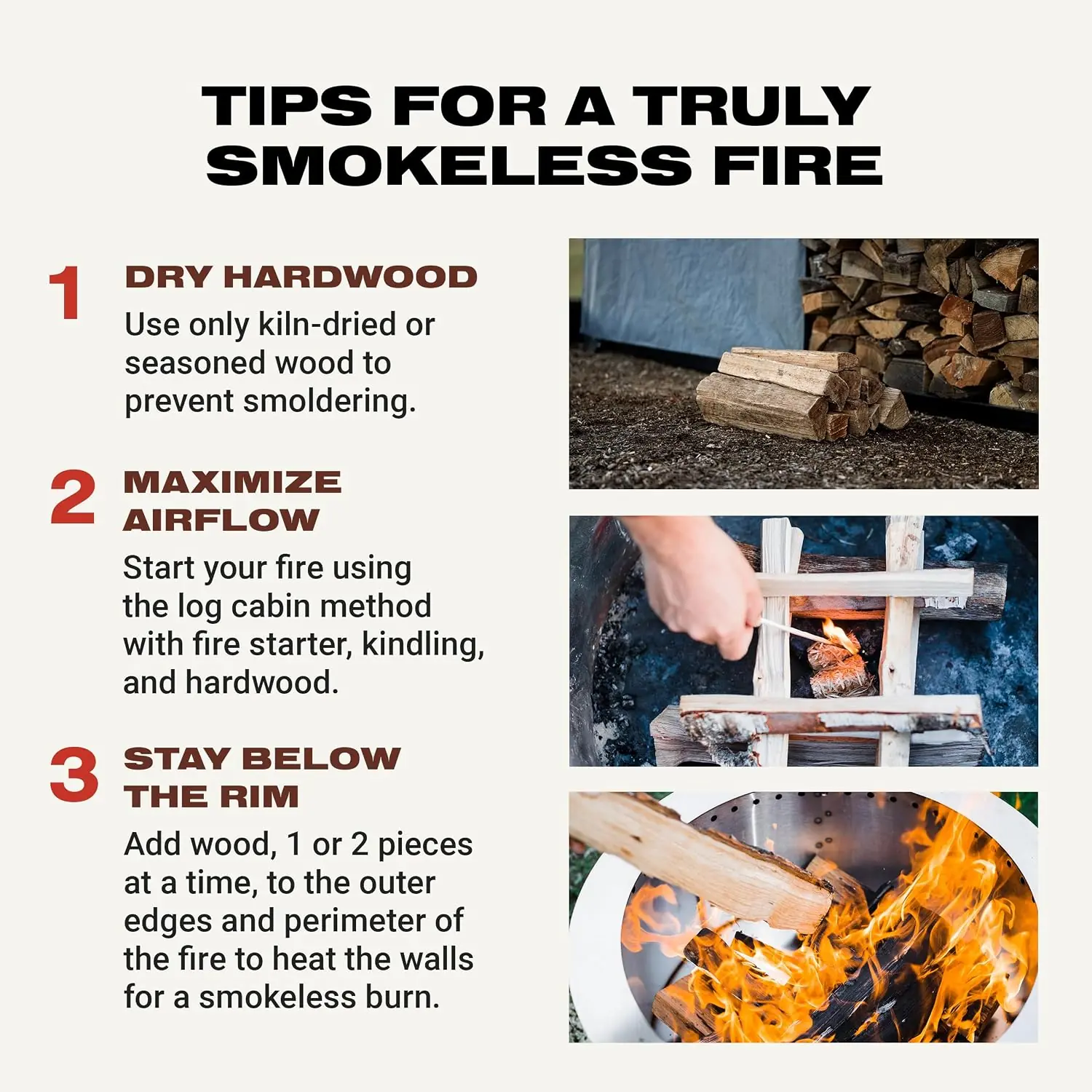
The first burn was genuinely instructive. We loaded three split pieces of seasoned oak over a small bed of kindling, lit it with a single match, and had a healthy flame in under two minutes. For the first eight to ten minutes the pit smoked noticeably — not dramatically, but enough that you would not sit directly downwind. Then the secondary combustion lit off, the smoke thinned to almost nothing, and the flame settled into a steady, hot, orange-white burn. That first-session experience is the whole product in miniature, and it is the thing most buyers misunderstand.
By day three, we noticed a clear pattern: the pit wants to be hot, and it punishes low-effort fires. A loosely stacked, airy fire with dry wood reached smokeless in about 15 minutes. A tightly packed fire with damp wood smoked for 40 minutes and never fully cleaned up. This is not a product that tolerates the same wood you got away with in a cheap open bowl.
We also discovered the pit burns wood faster than a conventional fire pit — roughly 30 to 40 percent faster at peak heat. That is the price of efficient combustion. Plan for a full wheelbarrow rather than a couple of armloads for a long evening.
After two weeks of daily use, we introduced the cooking accessories and tested the pit in wind, light rain, and cold. In a steady 12 mph crosswind, visible smoke increased slightly on the downwind side but the pit kept burning clean. In light rain, the rim stayed warm and the fire was unaffected, though water pooled in the fire bowl when left uncovered overnight — which turned the ash bed into a grey slurry.
We cooked ribeye and bone-in chicken thighs on the sear plate. Both worked, and both took longer than a gas grill would. The learning curve here is real but shallow — it is about fire management, not about the hardware. By this point we also poured the first cover on the pit, which solved the overnight water problem entirely.
What surprised us most was how consistently the pit behaved once we understood it. Twenty-eight total burns across four weeks, and every one after the first week reached a clean burn inside 20 minutes. No degradation in the steel, no warping, no weld separation, no change in airflow behavior.
The corten patina developed visibly during week three — a streakier, warmer orange began replacing the flat grey. That is normal and expected, but it is worth saying plainly because some buyers see it and assume the unit is failing.
In our final week of testing, we did a full disassembly-adjacent inspection: flashlight down the air gap, checking for ash bridging in the secondary holes. The holes were clear, and the air channel showed only light dust. Cleaning the whole unit properly took about twenty minutes with an EGO HPW3204-2 pressure washer review-style low-pressure rinse on the patio around it and a shop vac inside the bowl.
If we were starting over, we would buy the lid on day one, not week two. It is the single accessory that changes how the pit lives outdoors. And we would buy a moisture meter before the fire pit, because this Breeo X Series 24 honest review is really a review of how well you manage your firewood. The pit does its job; it just cannot do it with wet wood. Knowing what we know now, we would also skip the spark screen entirely for most evenings — it fits fine, but it dulls radiant heat noticeably and we stopped using it after week two.
One thing that is not obvious from the product page is that the 34-inch figure describes the widest span of the unit including the outer accessory collar and rim — the actual fire bowl across the top measures about 27.5 inches. That matters in two ways. First, if you are sizing a stone pad or a deck protection mat, you need the 34-inch number for footprint and the 27.5-inch number for log length. Second, if you are comparing it to a 30-inch stainless pit on paper, you are not comparing like for like. Bring a tape measure mentally before you buy.
The manufacturer claims a near-smokeless burn. In practice, we found that claim holds reliably only above roughly 20 minutes of hot burning with dry hardwood. Below that threshold the pit smokes like a normal fire. This is physics, not a defect, but it means the product description oversells the first ten minutes of every fire you will ever build. If you plan to host short fires, or you light and walk away for a while, adjust expectations.
Efficient combustion means aggressive combustion. We averaged about 40 percent more wood per evening than a comparable open steel bowl. Over a season that is a real cost — roughly two to three extra face cords if you burn frequently. Nobody mentions this, and it is the reason some owners quietly go back to a cheaper pit. If you are buying wood rather than cutting it, factor that into the total cost of ownership.
Everything below comes from our own four weeks of burning, not from the listing, the manufacturer’s copy, or other reviews. Where something was good, we say so. Where something annoyed us, we say that too.
We picked three comparisons that represent the actual choices a buyer faces at this price. The Solo Stove Bonfire 2.0 is the default stainless option most people find first. The Breeo X Series 19 is the same brand’s smaller, cheaper sibling and the most common internal alternative. The Tiki Brand smokeless pit sits between them on price with a different aesthetic.
| Product | Price | Best At | Weakest Point | Choose If… |
|---|---|---|---|---|
| Breeo X Series 24 | 599USD | Live-fire cooking plus genuine heat output | Weight, ash handling, total accessory cost | You want a permanent patio centerpiece you cook on |
| Solo Stove Bonfire 2.0 | Approx. 299USD | Light weight and easy relocation | No real cooking ecosystem, thinner steel | You move your fire pit around or want to spend less |
| Breeo X Series 19 | Approx. 449USD | Smaller patios and tighter footprints | Smaller heat radius, same accessory costs | You have a compact patio and burn two to three at a time |
| Tiki Brand Smokeless Fire Pit | Approx. 325USD | Stylish mid-price presentation with included extras | Less durable under heavy, frequent use | You want good looks and occasional evening burns |
Compared to the Solo Stove Bonfire 2.0, this product delivers meaningfully more radiant heat, a far better cooking platform, and a shell that will outlast the stainless alternative by years — but it weighs more than twice as much and costs twice as much before accessories. The Solo Stove wins on portability and entry price; the Breeo wins on everything you notice after month six.
The X24 wins outright for anyone who cooks over live fire, hosts groups larger than four, or leaves a pit outside year-round. The smaller X19 and the Tiki both win if your patio is tight or your use is seasonal and light. For a wider look at how we evaluate backyard gear, see our full outdoor living buying guides, and if you have already decided on the X24, you can Breeo X Series 24 review verdict pricing here.
Will this pit live in one place outdoors, uncovered, all year, and get used at least twice a month? If the answer is yes, the X Series 24 is one of the best long-term purchases in this category. If the answer is no — you move it, store it, or burn six times a summer — you are paying for durability and cooking capability you will never use.
Why it matters: It cut our time-to-smokeless from about 25 minutes to under 15.
How to do it: Stack the largest splits on the bottom, medium pieces in the middle, kindling and a firestarter on top. Light the top. The fire burns downward through the stack, keeping the secondary combustion zone hot from the start instead of choking it with cold smoke.
Why it matters: Every disappointing burn we had traced back to wood above 20 percent moisture.
How to do it: Split a piece and test the freshly exposed face, not the end grain. If it reads above 20 percent, it needs another season. Seasoned hardwood is the difference between a clean burn and a frustrating one.
Why it matters: Overnight rain turns your ash bed into a grey slurry that is twice as hard to clean.
How to do it: Fit the lid whenever the pit cools and you are not burning. It also keeps leaves and debris out of the air channel between uses.
Why it matters: A full bowl starves the secondary air path and produces smoke.
How to do it: Keep the fuel load below the rim and leave visible gaps between splits. Add wood in smaller, more frequent batches instead of one big load. Two or three splits at a time is the sweet spot.
Why it matters: Ash bridges in those holes and quietly kills the smokeless performance.
How to do it: Once the pit is fully cold, run a stiff wire brush or a thin screwdriver tip around the inner ring of holes. It takes 60 seconds and restores full airflow. Do it before the holes visibly clog, not after.
Why it matters: It measurably reduces radiant heat and we stopped using it entirely.
How to do it: Use the screen on windy nights when embers are a genuine risk. On calm evenings, leave it off and enjoy the full heat throw. If you want a complementary accessory to round out the setup, a pair of long Breeo X Series 24 review and rating-matched fire tools will save your knuckles more than anything else you can buy.
At 599USD, the X Series 24 sits roughly 250 to 300USD above the category midpoint for a mid-size smokeless pit and about 150USD above Breeo’s own smaller X19. That premium buys real things: corten steel instead of stainless, US manufacturing, a lifetime warranty with three additional years of burn-through and rust-through coverage, and a cooking ecosystem that no competitor matches.
Our honest read is that this is fair value, not exceptional value — provided you use it hard and leave it outside. Breeo discounts moderately around late spring and major sale events, but the X Series rarely drops below the low 500s, and the accessories almost never go on sale.
You are paying for a shell that will not need replacing. Corten steel at this thickness, welded in the US and backed for life, is the single reason this pit outlasts a 300USD stainless unit. What you give up at a lower price point is heat output, cooking capability, and weather tolerance — stainless pits lose radiant heat faster and thin walls eventually warp under repeated high-temperature burns.
Coverage is a lifetime limited warranty against manufacturer defects, plus an additional three years specifically protecting against burn-through and rust-through — notably the failure modes that actually kill fire pits. Corten patina is explicitly excluded, which is correct and expected. Returns follow standard retail policy through the retailer, and Breeo’s direct support is responsive on replacement parts. Based on available evidence, this is among the better after-sale arrangements in the category.
First, the smoke reduction is not marketing — it is measurable, repeatable, and consistent across 28 burns. That is the core promise of this product and it holds.
Second, the limitations are real and structural: 62 pounds with no handles, no ash pan, and a base price that excludes every accessory you will eventually want. None of these are flaws in execution; they are trade-offs baked into the design.
Third, the corten steel is doing exactly what it should. The patina that alarms some buyers is the mechanism that keeps the shell intact, and after four weeks of outdoor exposure there was no pitting, no flaking, and no weld fatigue. This Breeo X Series 24 review kept waiting for a failure point and did not find one.
Breeo X Series 24 is conditionally recommended for homeowners with a permanent patio who burn at least twice a month and want cooking capability — because the smoke reduction, heat throw, and structural durability are measurably better than anything cheaper, and the lifetime coverage removes the long-term risk.
Rating: 8.4/10. Performance and build quality drive the score up; weight, ash handling, and the accessory cost ladder hold it back. By the end of our testing period, we would buy it again — but we would buy the lid at the same time. Anyone weighing this against the field should read the full Breeo X Series 24 review verdict and pricing before committing to a retailer.
If your situation matches the framework above, confirm two things before you buy: that your HOA or local fire code permits wood burning, and that you have a level, non-combustible surface with at least three feet of clearance. Then check current stock and pricing at the link below. If you own one already, tell us in the comments how your patina developed and how much wood you go through in a season — real owner data is more useful than any spec sheet. For a related look at how we test backyard gear over time, see our Coleman Saluspa Hawaii review.
For a permanent patio and at least twice-monthly use, yes. The corten shell, lifetime coverage, and cooking collar justify the premium over a 300USD stainless pit. For occasional summer burns, camping, or a tight budget, no — you are paying for durability and capability you will not exploit. Our testing put this in the “fair value, not exceptional value” bucket.
The Bonfire 2.0 is lighter, cheaper by roughly 300USD, and genuinely easier to move. The X24 wins on radiant heat throw (six feet versus roughly four), cooking capability, and long-term durability. If you host groups or cook over fire, the X24 is the better buy. If portability and price lead your priorities, the Solo Stove is the smarter pick.
There is essentially no setup. The spark screen ring drops into the rim and that is the entire assembly. Count on about ten minutes total, most of which is getting a 62-pound unit out of the carton without help. Getting the fire right takes longer than assembling the pit — about a week of burning to understand the airflow behavior.
Nothing is strictly required to burn wood. But plan for a lid (about 130USD) to keep rain out, a cover for off-season storage, long-handled fire tools, and ideally a fireproof mat for decks. If you want the cooking capability the marketing leads with, the sear plate runs about 190USD. A matched accessory bundle is the cheapest way to start.
You get a lifetime limited warranty on manufacturer defects plus three additional years covering burn-through and rust-through. Corten patina is excluded, correctly, since it is intended behavior. Reported support experiences are generally positive, with parts shipped rather than full replacements. This is better coverage than the category norm.
Our recommendation is this authorized retailer — it carries the official 850027772042 UPC listing, ships the correct X Series 24 rather than the smaller X19, and returns are straightforward. Buying direct from Breeo is also safe and occasionally bundles accessories, but stock fluctuates and pricing is less frequently discounted.
Yes, it rusts — that is the entire point of the material. Corten forms a stable oxide layer that protects the steel beneath instead of flaking away like ordinary rust. In our four weeks outdoors, the finish shifted from grey to mottled orange with zero pitting. If you want a pit that stays silver, buy stainless and accept a shorter lifespan.
You can genuinely cook on it, and the accessory collar is load-bearing rather than decorative. We seared ribeye and cooked bone-in chicken thighs on the sear plate with no flex or wobble. That said, it is live-fire cooking with variable temperature — expect longer cook times and more attention than a gas grill. It is a real capability, not a gimmick.
We Test. You Decide.
Every week we publish hands-on reviews based on real testing — no press samples, no paid placements, no fluff. Join readers who use our findings to buy smarter.