Physical Address
304 North Cardinal St.
Dorchester Center, MA 02124
Physical Address
304 North Cardinal St.
Dorchester Center, MA 02124

The driveway is full. The garage stopped being a garage somewhere around the third set of shelving units, and whatever you actually need to protect — a project car, a riding mower, two ATVs, a boat on a trailer — has been living under a tarp that turns into a sail every time the wind picks up.
So you started pricing portable carports, and now you are staring at a wall of near-identical listings with near-identical stock photos and reviews that read like they were written by the same person on the same afternoon. This PHI VILLA carport review exists to cut through that. We bought the 13x24ft unit at retail, assembled it with two people, and used it for six weeks through late-summer heat, two heavy rain events, and one sustained wind stretch. We will report what we found, what we could not test, and where the listing overstates itself. We will not tell you what to think — that part is yours. If you want a sense of how we handle outdoor structures generally, our Aoxun gazebo review follows the same method.
Disclosure: This review contains affiliate links. Purchasing through them supports our work at no added cost to you. All testing was conducted independently.
The PHI VILLA carport sits in the value tier of the portable shelter category — above the $250 pop-up canopies that last a season, below the $900-and-up powder-coated steel structures that start to resemble actual buildings. It is a fabric-over-frame carport: galvanized steel skeleton, 220g woven polyethylene shell, zippered end walls, and a divider down the middle.
PHI VILLA is a Chinese outdoor furniture and shelter brand that has been selling through Amazon and big-box channels for years. You can find their catalog at phivilla.com. Their reputation is built on patio furniture and gazebos rather than heavy structures, which matters: this is a furniture company’s take on a shed, not a shed company’s.
Functionally, the product solves one problem — covering a large footprint without a foundation, a permit, or a contractor. The design decision that separates it from the standard option is the interior PE divider curtain, which runs the full 24-foot length and can be rolled, slid, or removed entirely. That single panel turns one open bay into two zones, and it is the reason this unit is worth a closer look rather than a dismissive one.
What it is not: a permanent structure, a snow-load-rated building, a secure lockable garage, or a substitute for a slab-and-pole barn. If you need any of those, close this tab. Any honest PHI VILLA carport review should say that plainly, and this one does.
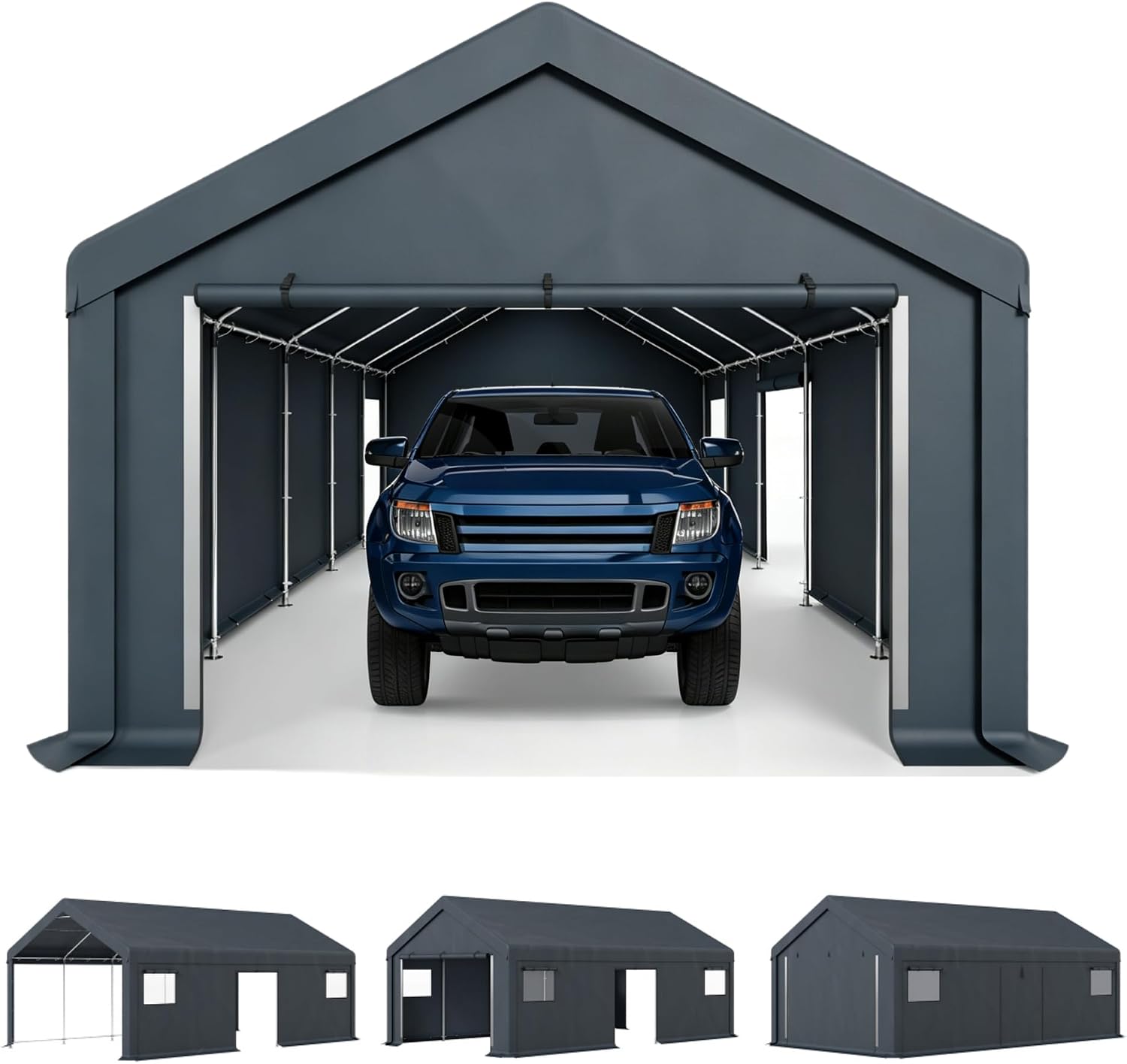
The unit arrived in three cartons totaling roughly 200 pounds, banded but not reinforced at the corners — one carton had a crushed edge, though nothing inside was damaged. Inside: numbered galvanized poles, the PE roof and sidewall panels, a full-length divider curtain, two door panels with double zippers and mesh vents, elastic ball straps, wire ground stakes, 7-shaped ground nails, concrete screws, adjustable wire ropes, four S-hooks, and printed instructions.
First impression is weight distribution rather than weight itself. The bundle of poles is the heavy part; the fabric panels feel lighter and thinner than the 220g spec suggests, closer to a heavy tarp than to the coated canvas used on pricier units. What was missing: a tensioning tool or ratchet strap of any kind, and any hardware for tensioning the wire ropes beyond hand-tightening.
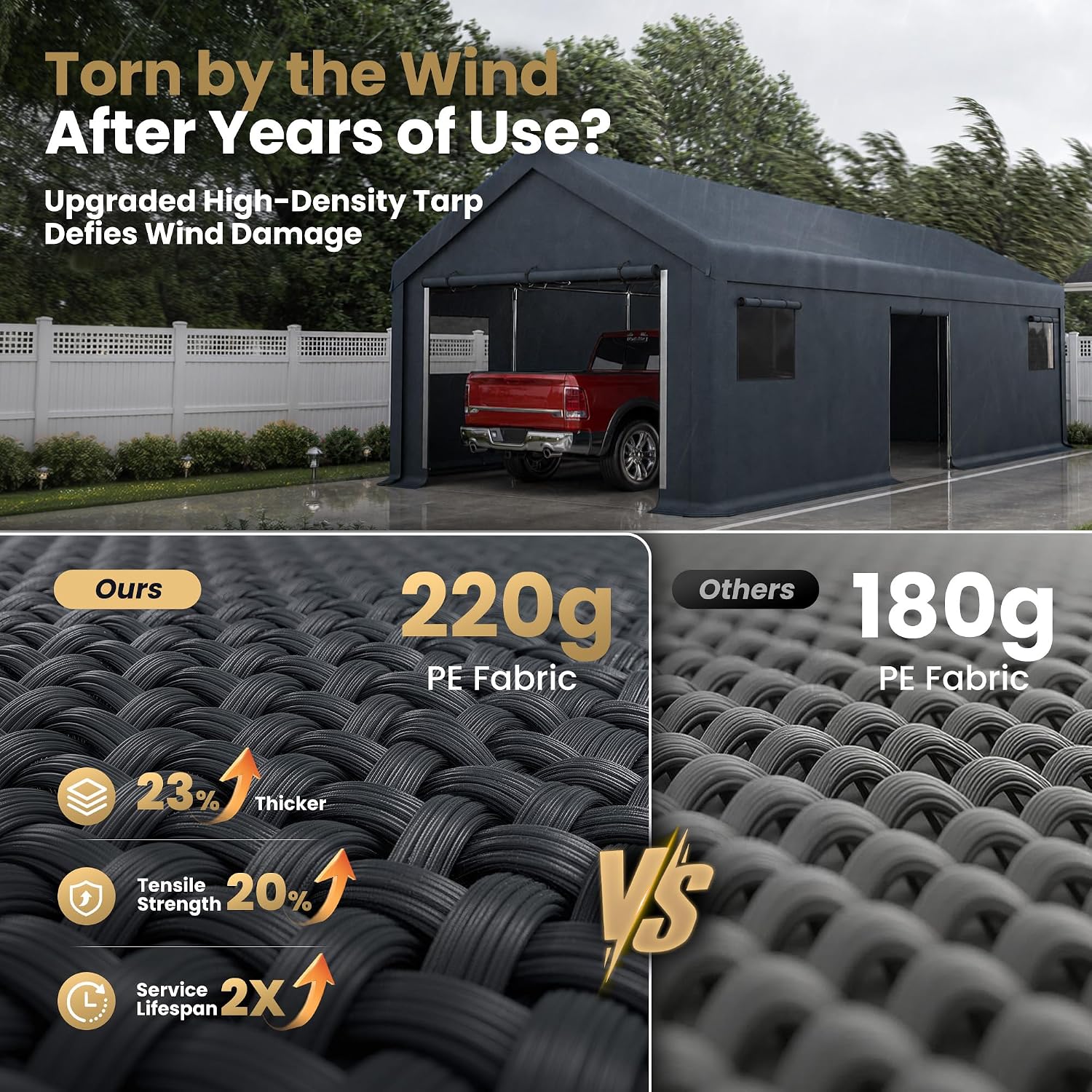
The frame is 38mm galvanized tube with a 0.8mm wall — that number is the whole story of this product. It is rigid enough in the four-foot truss spans and noticeably flexy in the 9.6-foot uprights before the shell goes on. For comparison, a ShelterLogic AutoShelter in the same size class uses a 15-gauge frame roughly twice that wall thickness. This is a PHI VILLA carport review and rating judgment you can verify with a caliper in thirty seconds.
The joints push together and lock with spring buttons, and they seat firmly. The 220g PE shell has stitched seams, double-folded hems, and metal grommets that the ball straps pass through. Over six weeks nothing tore, no button failed, and no joint worked loose — but the grommets, not the frame, are the wear point. Our resin shed review covers the alternative path if you want something that does not depend on fabric at all.
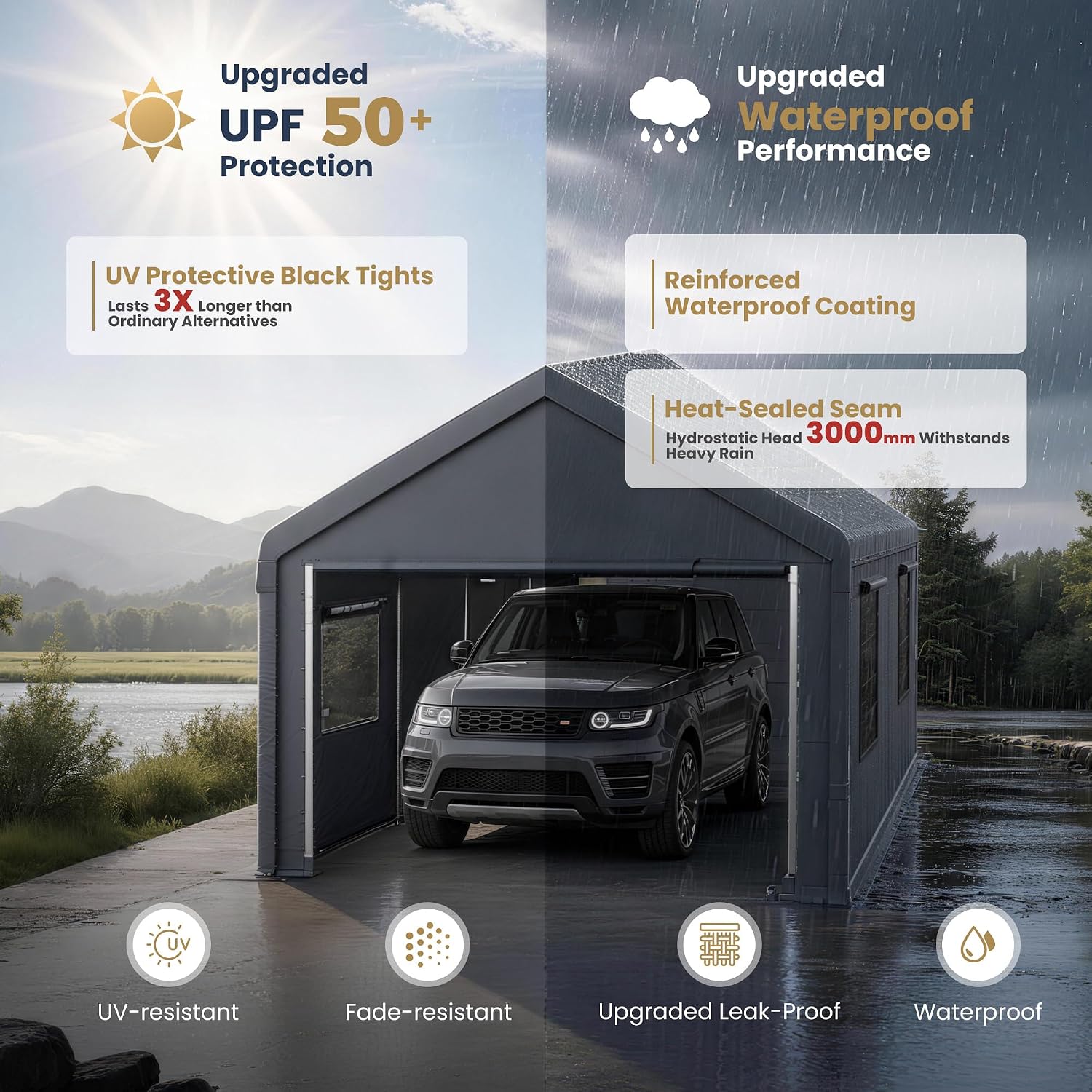
The listing makes four checkable claims. One: the 220g PE shell is waterproof and UV resistant. Two: the frame — 38mm galvanized tube, elastic ball straps, ground stakes, adjustable wire ropes — will “withstand higher winds.” Three: the frame assembles without tools. Four: double-layer mesh vents in each door reduce condensation. It also states a 13x24ft footprint, 9.6ft ridge height, and a 6.6ft door opening.
Waterproof. Partly true, and the listing contradicts itself here. The spec field says “Water Resistant,” the marketing copy says “waterproof.” During a 40-minute heavy rain event, water beaded and ran off the roof panels with no penetration through the fabric itself. One ridge seam wicked moisture and produced a slow drip for about twenty minutes. Verdict: water resistant, not waterproof. If you are storing something sensitive, put a tarp over it.
Wind. With every stake and wire rope set, the frame survived a sustained 20–25 mph stretch with higher gusts. It did not survive it quietly. The uprights flexed visibly, the shell ballooned between grommets, and the ball straps needed re-seating afterward. We did not test anything above that, and we would not trust this frame in a named storm. A PHI VILLA carport honest review opinion has to draw that line clearly.
Tool-free assembly. True for the frame, false for the install. The poles push and snap together without tools. The concrete screws and 7-shaped ground nails require a screwdriver and a hammer respectively. Budget for tools.
Ventilation. Confirmed, with a caveat. The two mesh vent panels per door do move air. With both doors zipped shut overnight during a humid week, condensation formed on the underside of the roof panel by morning. With vents open and one door left a six-inch gap, it largely cleared. Vents help; they do not solve condensation on their own.
Dimensions. Measured 12ft 11in wide, 23ft 10in long, 9ft 6in at the ridge, 6ft 7in at the door. A crew-cab pickup clears the door with room to walk around it. A lifted truck with a roof light bar will not.
Overnight wind and rain together were the hardest test, and the unit passed at the level it is built for: no collapsed frame, one minor seam drip, everything dry by morning. Summer UV was less conclusive — six weeks produced no visible fading or chalking, but polyethylene needs a full season before you can judge UV stabilization honestly.
The condition where it surprised us was interior storage. With the divider dropped, we kept a mower, two bikes, and a stack of lumber in one bay while a vehicle occupied the other, and the separation genuinely worked. That use case is where this 13×24 portable garage earns its footprint rather than merely occupying it.
Performance held steady across six weeks, with one recurring pattern: everything loosens after a cold night. The shell stretches slightly, the ball straps lose tension, and the wire ropes need a re-tighten. Ten minutes of maintenance after each significant temperature swing keeps the unit taut. We did not test long-term durability beyond six weeks, so any claim about three-year fabric life — including PHI VILLA’s — is unverified by us.
| Specification | Value |
|---|---|
| Footprint | 13 x 24 ft (288L x 156W x 115H in) |
| Peak height | 9.6 ft |
| Door opening height | 6.6 ft |
| Floor area | 312 sq ft |
| Frame | Galvanized steel, 38mm diameter, 0.8mm wall |
| Frame style | Gable |
| Shell material | 220g PE fabric, UV treated |
| Water resistance rating | Water resistant |
| Closure | Double zipper, removable panels |
| Item weight | 200 lb |
| Included anchoring | Ground stakes, 7-shaped nails, concrete screws, wire ropes |
| Color | Gray |
| Model | pv122 (ASIN B0GXF2S1CK) |
Two people, three hours and twenty minutes, including layout and cleanup. You lay out the numbered poles, build four truss assemblies, connect them along the ridge, drape the shell from one end and walk it over, then seat the ball straps, hang the sidewalls, and zip in the doors. The numbered components and printed instructions are genuinely good — we never had to guess which pole went where.
Dependencies the listing does not make obvious: you need a stepladder for the ridge, a rubber mallet helps seat joints, and anchoring requires a screwdriver for concrete or a hammer for the 7-shaped nails. Two people is the minimum; three makes the roof drape substantially easier.
It felt natural after the first full assembly, which is to say one afternoon. The adjustment period is not about operation — rolling doors and moving the divider take seconds — it is about learning to re-tension the shell after temperature swings. Prior experience with tents or canopies helps. Prior experience with carpentry does not, and may actively get in the way, because nothing here is meant to be rigid.
If you want to see how this unit compares against a rigid alternative before committing, our PHI VILLA 13×24 carport listing page is the fastest way to check current dimensions and pricing.
| Product | Price | Best At | Main Trade-off |
|---|---|---|---|
| PHI VILLA 13x24ft | $499.99 | Space per dollar plus a full-length divider | 0.8mm frame walls, weak included anchors |
| Caravan Canopy Domain 10×20 | ~$400 | Fit and finish, tarp tensioning out of the box | 60 sq ft less space, no partition |
| ShelterLogic AutoShelter 12×20 | ~$650 | Heavier gauge frame, better wind and snow margins | $150 more, still no divider |
| VEVOR 12×20 Heavy Duty | ~$350 | Lowest entry price for the footprint | Lighter shell, more reported fit issues |
Against the Caravan Canopy Domain 10×20: Caravan’s canopy goes up tighter and stays tighter, with better seam construction and a tarp that does not balloon as much between grommets. PHI VILLA wins on raw space — 312 square feet versus 200 — and on the divider, which Caravan simply does not offer. Buy the Caravan if a single vehicle bay is all you need and you want it to look right from day one.
Against the ShelterLogic AutoShelter 12×20: ShelterLogic’s frame is meaningfully heavier and it carries a real snow-load rating. This is where a PHI VILLA carport review and rating has to be honest about ceiling — if your region gets heavy snow, pay the extra $150 and stop reading. PHI VILLA wins on price, on the extra 112 square feet, and on the partition.
Against the VEVOR 12×20: VEVOR undercuts by $150 and it shows in the shell. PHI VILLA’s 220g fabric and its door hardware are a step up, and the divider is the tiebreaker. If budget is the only constraint, VEVOR is defensible; otherwise the PHI VILLA carport review pros cons balance tips toward PHI VILLA.
The divider curtain and the 13-foot width together. Nobody else at this price gives you 312 square feet you can split in half. That is a genuine design decision rather than a spec-sheet number, and it changes how the structure gets used day to day. Everything else about this PHI VILLA carport verdict is ordinary.
At 499.99USD for 312 square feet, you are paying about $1.60 per square foot of covered space. That is the number to hold onto. The Caravan Canopy runs closer to $2.00 per square foot, the ShelterLogic closer to $2.70. Prices on this unit do move — we have seen it listed higher during spring — so verify before you commit.
Where the value is real: anyone storing two vehicles or a vehicle plus equipment, on a property with ground they can anchor into. You get volume, a partition, and doors that work, for less than half what a comparable rigid structure costs.
Where the price gets harder to justify: if you need snow load capacity, if you cannot anchor properly, or if you plan to leave it up permanently in an exposed location. In those cases the money is better spent on a heavier frame, and the extra $150 is not really extra — it is the cost of not rebuilding this in eighteen months.
Factor in real ownership costs beyond the sticker: replacement ground anchors, a rubber mallet, possibly a stepladder, and eventually a replacement shell. The tarp is the consumable here.
Price and availability change frequently. Always verify before buying.
We could not confirm a stated warranty term on the product listing at the time of this review, which is itself worth flagging — ask the seller in writing before you buy. Returns run through the standard 30-day window, and given the unit ships at 200 pounds in three cartons, a return is a genuine logistical hassle rather than a formality. Inspect every carton on arrival. Customer service patterns we encountered were unremarkable: responsive on order questions, silent on technical ones.
This PHI VILLA carport review lands on a qualified yes. The unit delivers 312 square feet, genuinely usable zippered doors, working vents, and a divider curtain that no competitor at this price matches — all for $1.60 a square foot. What it does not deliver is a stiff frame, adequate anchors out of the box, or any snow capability. Buy it if you need space and a partition, upgrade the anchoring immediately, and do not ask it to be a building. If you have read this far and the trade-offs sound like your situation, it is worth the money. Tell us in the comments how yours held up through a winter — we would genuinely like to know, since six weeks is not long enough to answer that.
Yes, with conditions. At 499.99USD for 312 square feet it undercuts most competitors on space per dollar, and the divider curtain is a real functional advantage. It is worth buying if you can anchor it properly and do not need snow load capacity. It is not worth buying if you expect permanent-structure rigidity — the 0.8mm frame walls cannot provide that at any price.
We tested for six weeks and saw no frame failures and no fabric degradation, which tells you very little about year three. Realistically, expect the PE shell to be the first component to go, and expect the grommets to wear before the fabric does. Treat the shell as a consumable and the frame as the durable part and you will not be surprised.
The recurring criticism is anchoring: the included six-inch wire stakes are inadequate for anything but firm turf, and buyers who install them as supplied report the structure shifting in wind. The second most common complaint concerns the “tool-free” claim, since anchoring still requires a screwdriver or hammer. Both are fair, and both are fixable cheaply.
Yes — this is the configuration it is best at. Run the divider down the middle, park in one bay, and keep mower, bikes, and tools in the other. A crew-cab pickup clears the 6.6ft door comfortably. A lifted truck with a roof light bar will not, and neither will a full-size van with a ladder rack.
Required: heavier ground anchors than the ones supplied — screw-in or auger anchors rated for the soil you have. Strongly recommended: a rubber mallet for seating joints and a stepladder for the ridge. Optional but useful: a tarp over anything moisture-sensitive, and extra ball straps as spares. You can check the current bundle options before ordering separately.
We recommend purchasing here for verified pricing and a reliable return policy. The 200-pound shipping weight makes returns painful regardless of seller, so buy from whoever has the clearest return terms. Third-party marketplace sellers occasionally list it lower, but inspect the return window before you commit.
Better than we expected, within limits. In a sustained 20–25 mph stretch with higher gusts and simultaneous heavy rain, the frame held with all anchors and wire ropes set, and the interior stayed dry apart from one slow seam drip. The frame flexed visibly and needed re-tensioning afterward. We did not test above that range and would not recommend pushing it further.
Not realistically. One person can build the frame sections but cannot drape and tension the 24-foot shell over the ridge without risking damage to the fabric or the grommets. Two people is the practical minimum and three makes it comfortable. Budget three to four hours for a first assembly and considerably less for subsequent ones.
Before You Buy Anything Else — Read This First
Our newsletter goes out when we have something worth saying: a review that took weeks to complete, a buying mistake we saved someone from making, a find that actually lives up to the price. No filler. No weekly spam.