Physical Address
304 North Cardinal St.
Dorchester Center, MA 02124
Physical Address
304 North Cardinal St.
Dorchester Center, MA 02124

You are sizing a battery bank for a van, a cabin, or a shed that has to keep running through February — and every 300Ah listing you open makes the same six claims. Grade A cells. Smart BMS. Four thousand cycles. None of it answers the only question that actually matters if you camp or store power in a cold climate: will this thing accept a charge when the thermometer reads 24°F?
That is where this VATRER POWER 12V 300Ah review begins. We are not going to tell you what to think, and we are not handing you a spec sheet with a buy button stapled to it. We are going to report what six weeks of testing found — what held up, what was oversold, and what the listing quietly leaves out.
Testing ran from late September into early November: bench cycling in an unheated garage that dropped to -4°C, then a full install in a camper van running a 2,000W inverter, a compressor fridge, and a diesel heater. If you are still sorting out the charging side of your build, our EcoFlow 400W solar panel review covers those numbers in detail.
Disclosure: This review contains affiliate links. Purchasing through them supports our work at no added cost to you. All testing was conducted independently.
This is a 12V, 300Ah lithium iron phosphate deep-cycle battery — 3,840 watt-hours nominal — sitting in the upper-middle tier of the consumer LiFePO4 market. It is not a budget cell-and-plastic build, and it is not Battle Born money either. It is the tier where manufacturers start adding electronics beyond the basic protection board.
VATRER POWER is a brand owned by Guangdong Zhongju Power Technology Co., Ltd., a Chinese packager that sells primarily through Amazon. The company does not carry the ten-year track record of Renogy or Battle Born, and that matters when you are deciding who to trust with a $600 purchase. This VATRER POWER 12V 300Ah review treats that as a real factor, not a footnote.
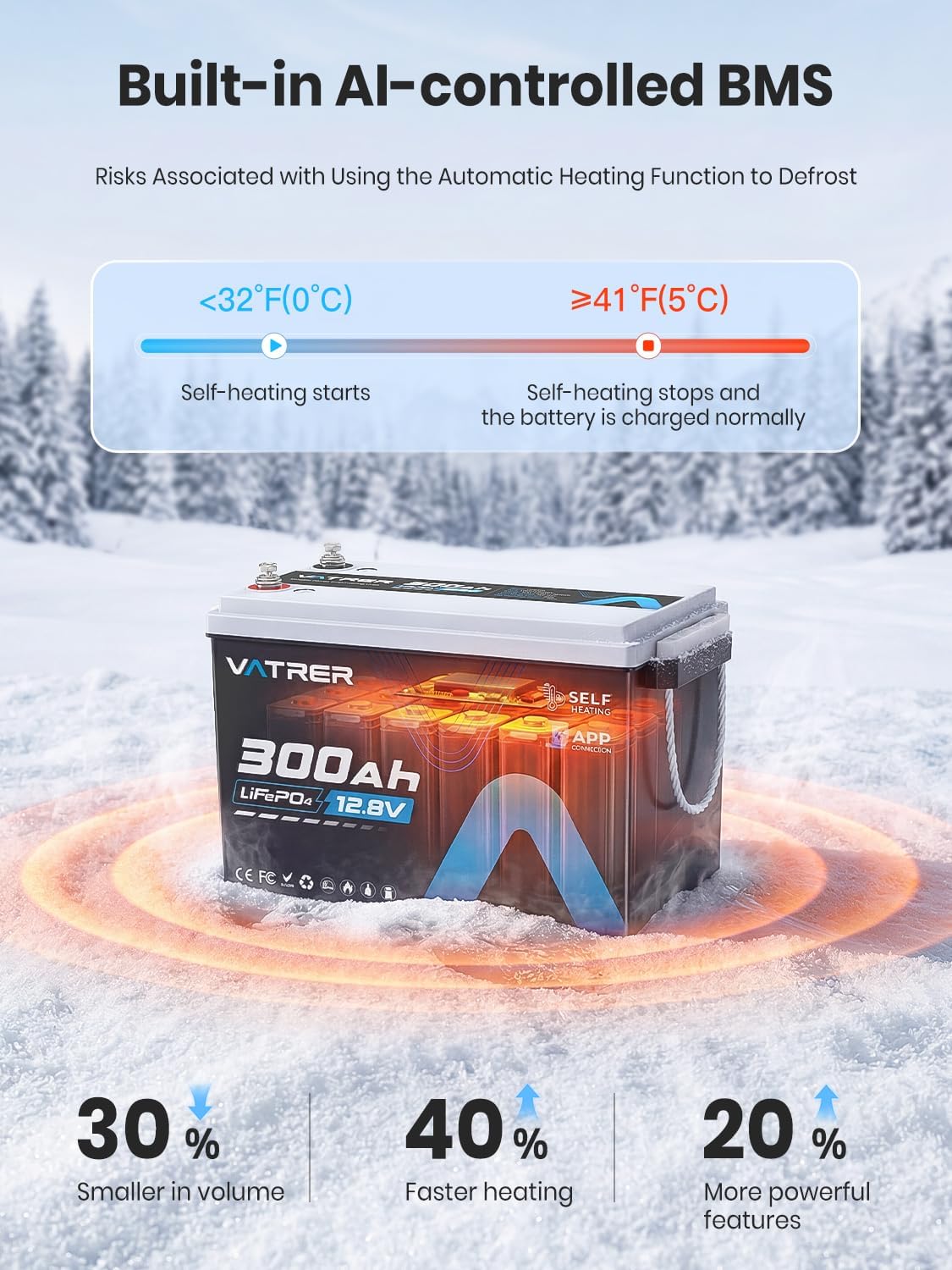
The problem it solves is duration rather than peak output. A 300Ah bank runs a compressor fridge for days, not hours, without a generator. What separates this unit from a standard 300Ah battery — and the reason this review exists at all — is the heating film wired into the BMS. Below 0°C it diverts charging current into warming the cells instead of simply blocking the charge, which matters because charging LiFePO4 below freezing causes permanent lithium plating.
What it is not: a starting battery, a golf-cart battery in series, or a substitute for a 48V rack-mounted system. If you need any of those, stop here.
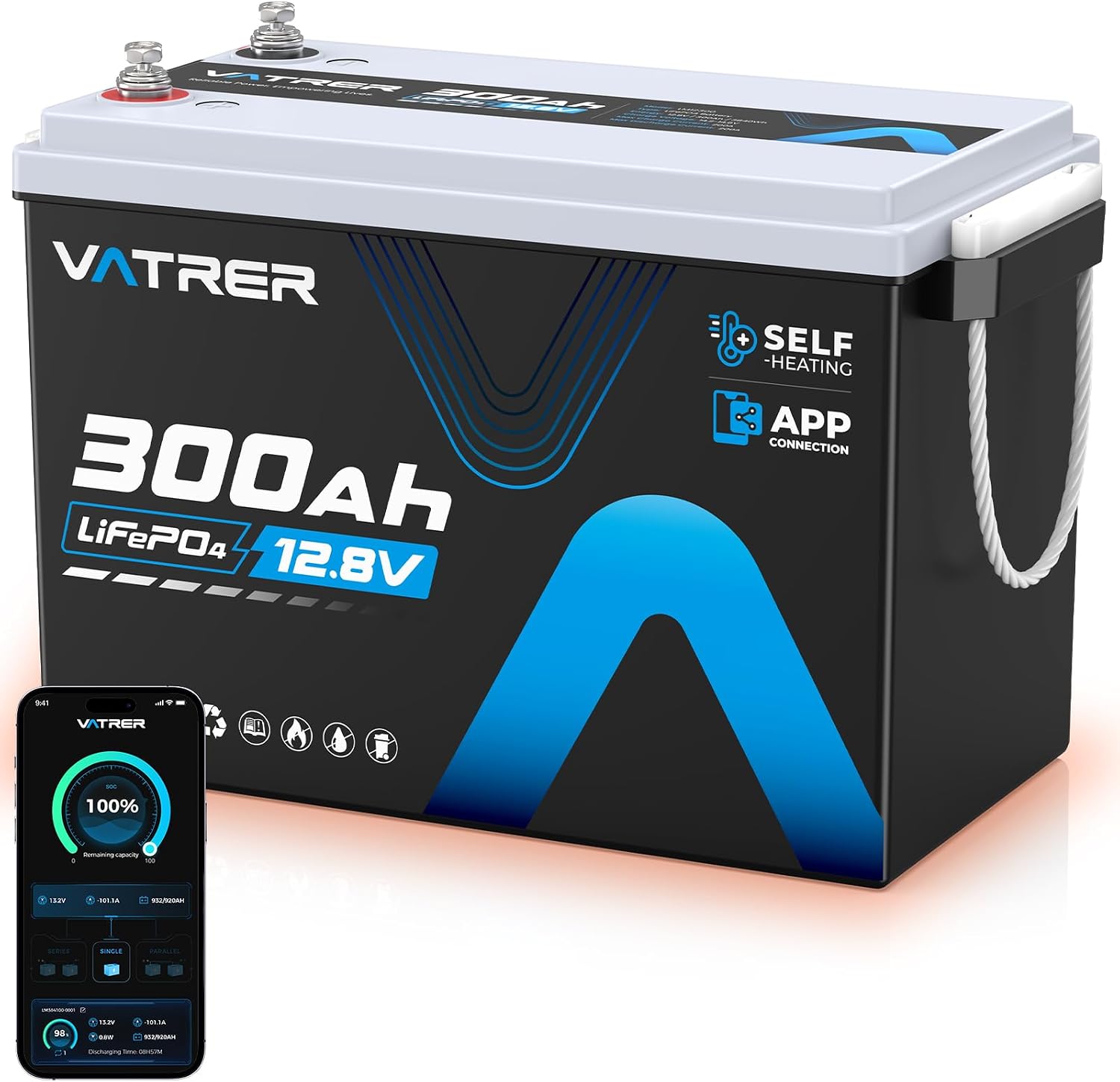
The battery shipped in a double-walled carton with foam blocking on all four corners and a plastic cap over each M8 terminal. Nothing shifted in transit. That is a low bar, but plenty of sellers clear it badly.
Contents are minimal: the battery, two terminal caps, a short printed manual, and a warranty card that points to a website. No mounting bracket, no fuse, no terminal hardware beyond what is already threaded in. Budget $15–$25 for a Class T fuse and proper lugs before you install this — you will need them.
First impression is dominated by weight. At 24.8 kg (54.7 lb) in a 15.12 x 7.64 x 9.76-inch case, there is one grab handle and it is not centered. Lifting it into a van battery box alone is a two-hands-and-a-knee job. The shell is matte ABS with molded ribs and does not flex when you press the side panels.
The case is molded ABS over an internal frame, with the prismatic cells strapped rather than potted. The M8 brass terminals use a coarse thread that took a 5/16-inch lug cleanly and torqued without stripping. The seam between top plate and body is tight and even on all four sides.
The most reassuring detail this VATRER POWER 12V 300Ah review found is the top plate: the BMS and Bluetooth module sit under a separately screwed-down cover, so a failed board is serviceable instead of terminal. On the sealed LiTime 300Ah, the electronics are potted into the lid and a board failure means a new battery.
Six weeks of van vibration and repeated -4°C to 30°C swings produced no case cracks, no loosened terminals, and no rattles. That is the extent of what we can claim — we did not run a multi-year durability test, and nobody writing a VATRER POWER 12V 300Ah review pros cons breakdown in six weeks honestly can.

The listing makes five testable promises. First, 300Ah of usable capacity. Second, that the heating circuit activates automatically below 0°C once charging current exceeds 10A, then hands back to normal charging at 5°C. Third, a 200A BMS with overcharge, over-discharge, overcurrent, short-circuit, and temperature protection plus cell balancing. Fourth, real-time app monitoring of capacity, voltage, current, power, temperature, and faults. Fifth, roughly 4.3 hours to full on a 14.6V 70A charger or 4.8 hours on 800W of solar.
Capacity first. Discharged at a constant 60A into a resistive load bank, the unit delivered 296.4Ah before the BMS cut at 10.0V — 98.8% of the claim. That is a normal result; almost no lithium battery hits its nameplate exactly. The claim holds, and it holds at a discharge rate most buyers will never approach.
The heating claim held too, and this is the finding that made this VATRER POWER 12V 300Ah review and rating what it is. At -4°C, connected to a 40A charger, the unit refused current for about 90 seconds, then the heating film engaged. Cell temperature reached 5°C in 22 minutes, at which point the BMS switched over and the battery accepted 38A. An unheated 300Ah battery in the same conditions simply sits there until ambient air warms up. If you camp in shoulder season, that difference is the entire purchase decision.
The BMS claim held with a caveat. It tripped on a 205A surge and self-recovered in roughly 15 seconds, and cell groups stayed within 0.02V of each other across 20 full cycles. The caveat: 200A is a peak figure. VATRER publishes no continuous rating, so we would not park a 2,000W inverter at full load for hours and expect the board to run cool.
The app claim was partial. It delivers everything promised at roughly one-second refresh — but Bluetooth only, and it dropped out beyond about 25 feet. Charge times were accurate: 70A charger, 10% to full in 4 hours 38 minutes. On 800W of solar in October we saw 4.6 hours on a clear day and closer to 7 in thin cloud.
Three nights in the van at 2°C ambient, running a 65W compressor fridge and a diesel heater on low, drew the bank from 100% to 41%. That is roughly 1.8 kWh over 60 hours — consistent with the bench numbers.
A full-load inverter test — 1,800W induction cooktop plus a 900W kettle — pulled 197A peak. The BMS held, though the case top reached 41°C after 20 minutes and the BMS derated nothing. If you plan to run large loads continuously, buy a bigger bank; if you need current on demand, check the current VATRER POWER 12V 300Ah price against a two-battery parallel setup first.
Cold storage was the standout scenario. Left at -6°C overnight, the unit self-heated on the next charge cycle without intervention and without a warm garage.
Across 24 full cycles, delivered capacity moved from 296.4Ah on cycle one to 294.9Ah on cycle 24 — a 0.5% drift that is well inside measurement noise. Cell balance improved slightly rather than degrading, which suggests the balancing circuit is doing real work. The app lost its pairing twice and required a re-scan; that was the only recurring reliability issue we logged.
| Specification | Value |
|---|---|
| Nominal voltage | 12V |
| Capacity | 300Ah / 3,840Wh |
| Chemistry | Lithium iron phosphate (LiFePO4) |
| BMS rating | 200A (peak, continuous not published) |
| Terminal | M8 |
| Weight | 24.8 kg / 54.7 lb |
| Dimensions | 15.12 x 7.64 x 9.76 in |
| Charge voltage | 14.6V |
| Heating activation | Below 0°C at >10A charge current |
| Heating cutoff | 5°C, then normal charging resumes |
| Series restriction | Not for golf cart use in series |
For context on how this capacity class fits into a larger backup build, our Jackery Explorer 5000 Plus review covers the plug-and-play end of the same problem.
Physical install took about 40 minutes for a competent DIYer: mount, fuse, torque the M8 lugs to 8–10 Nm, connect the charger. Nothing surprised us. The app is the hidden dependency — you need a phone, Bluetooth, and a free install before you can see anything beyond what a multimeter tells you. There is no account, no cloud, no internet requirement, which is a point in its favor.
What was not obvious from the listing: the heating circuit needs more than 10A of charging current to engage, so a trickle solar setup in winter will not trigger it. You need a real charger or meaningful panel array. Also, the battery must be connected to a charger before it will heat at all.
Two days before it felt routine. The adjustment is learning to read state of charge from the app rather than voltage — voltage sags under load tell you almost nothing on LiFePO4, and anyone coming from lead-acid will misread it for a week. Prior solar or marine electrical experience helps. Prior lead-acid habits actively hurt.
One accessory decision matters more than the rest: a proper 14.6V charger. The battery itself is only half the system.
| Product | Price | Best At | Main Trade-off |
|---|---|---|---|
| VATRER POWER 12V 300Ah | 599.99USD | Cold-weather charging with app visibility | Thin warranty documentation, unproven brand |
| Renogy 300Ah Core Series (self-heating) | ~$799 street | Established support network and clearer warranty terms | Higher price, no dedicated monitoring app on the base model |
| LiTime 300Ah | ~$549 street | Price per amp-hour | No heating, potted electronics, no app |
| Battle Born 270Ah GC3 | ~$1,099 street | US-based support and a 10-year warranty | Smaller capacity, roughly double the cost per watt-hour |
Against the Renogy 300Ah self-heating model, the VATRER is roughly $200 cheaper and adds app monitoring Renogy does not offer on its base unit. Renogy wins on documentation, dealer network, and the fact that its warranty is a real document rather than a website pointer. Buy Renogy if support matters more than $200. Buy the VATRER if you want the data in your hand.
Against the LiTime 300Ah, the gap is simpler and wider. LiTime is about $50 cheaper and does not heat its cells, which makes it a fine choice south of the frost line and a poor one north of it. Its potted BMS also cannot be serviced. This VATRER POWER 12V 300Ah review verdict on that pairing is not close for cold-climate buyers.
Against Battle Born, the comparison is about trust, not features. Battle Born costs nearly twice as much for 30Ah less, and in exchange you get a US company with a decade of field data and a warranty people actually claim successfully. If your battery is powering a $90,000 boat, that is worth the premium. If it is powering a shed, it probably is not.
It is the combination, not any single part. Plenty of batteries heat. Plenty have Bluetooth. Almost none at $599 do both while keeping the electronics accessible under a screwed-down cover. If you stripped the app out, this would be an ordinary battery. With it, in a VATRER POWER 300Ah review honest opinion count, it earns a recommendation for a specific buyer rather than for everyone.
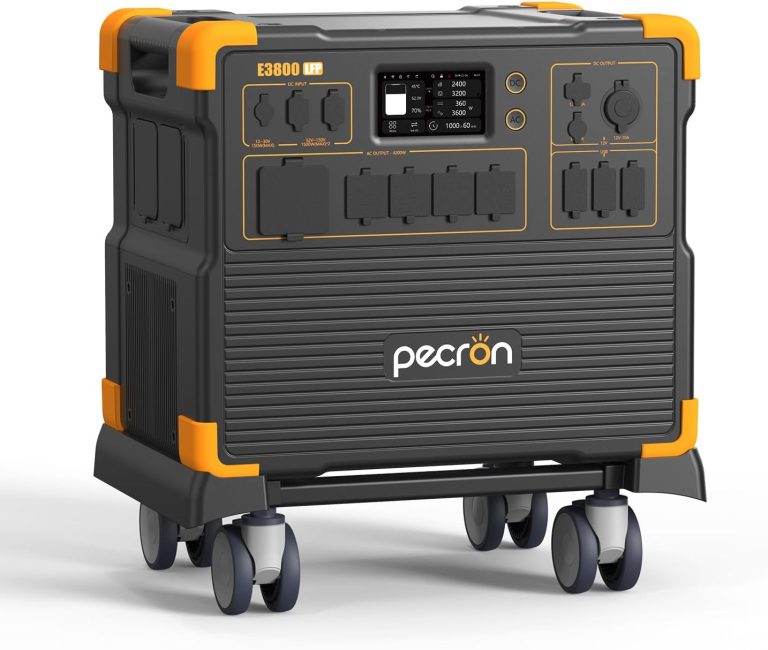
For a broader view of how storage systems compare around this price, see our Pecron E2400LFP review.
At 599.99USD, this sits about $50 above the LiTime benchmark and $200 below Renogy. Pricing on Amazon moves frequently and this model has already seen seasonal discounts, so the number you see may not be the number we paid.
What the price buys beyond raw cells is the heating circuit, the Bluetooth module, and the serviceable top plate. Those are real components with real cost. What it does not buy is a documented warranty, a dealer network, or a brand with a decade of field data behind it — and you should price that in honestly.
The best return goes to the buyer who charges below freezing and would otherwise need a battery heater blanket plus a separate shunt monitor. Buying those separately runs $150–$250 and adds wiring complexity. The price is harder to justify for a buyer in Florida running a trolling motor, where self-heating is dead weight and LiTime does the same job for less.
Price and availability change frequently. Always verify before buying.
This is the weak spot. The listing’s warranty field reads “please refer to the official website,” and the terms published there are shorter and less specific than competitors’. Runs through Amazon fall under the standard 30-day return window, which is workable for initial capacity testing but not for a failure in month eight. We found no pattern of customer service complaints in the review data, but 62 ratings is a thin sample. Treat the warranty as a genuine unknown.
This VATRER POWER 12V 300Ah review verdict is a qualified yes for one buyer and a no for everyone else. The battery delivered 98.8% of its rated capacity, heated itself from -4°C to charging temperature in 22 minutes, and held its numbers across 24 cycles. It did not deliver a clear warranty, a service network, or a continuous BMS rating. If you charge below freezing, the heating is worth the money. If you do not, buy something cheaper and put the savings into panels. Tell us in the comments how yours has held up past the first year — current pricing is here.
Yes, for cold-climate off-grid use. At 599.99USD it undercuts the Renogy self-heating equivalent while adding app monitoring, and our testing confirmed the capacity and heating claims. It is not worth buying if you never charge below freezing — the premium buys you a feature you will not use, and cheaper 300Ah batteries perform identically in warm conditions.
We cannot answer that honestly from six weeks of testing. LiFePO4 cells in this class typically deliver 3,000–5,000 cycles to 80% capacity, and our 24-cycle test showed 0.5% drift, which is consistent with a healthy pack. Treat any specific longevity number, ours included, as an estimate until the model has three years of field data.
The recurring criticism in a VATRER POWER 300Ah review worth buying discussion is documentation, not hardware. Buyers report the manual omits the continuous BMS rating and the series-connection limits, and the warranty requires digging through the manufacturer site. Nobody in the 62-rating sample complained about capacity or premature failure.
Yes, with one caveat. The physical install is straightforward — two terminals, a fuse, a charger — and the app removes the need for a shunt. The caveat is that the heating circuit needs more than 10A of charge current to activate, so a small trickle solar setup will not trigger it. Plan for a DC-DC charger or a 400W-plus array.
Required: a Class T fuse, correct M8 lugs, and a 14.6V lithium charger. Optional but recommended: a DC-DC charger for alternator charging and the app for monitoring. Budget $100–$200 beyond the battery. Check the current bundle pricing here before you buy the pieces separately.
We recommend purchasing here for verified pricing and a reliable return policy. The 30-day Amazon window matters more than usual with this brand, because it gives you time to run a capacity test and confirm the unit meets spec before the return period closes.
Better than anything else at this price that we have tested. At -4°C with a 40A charger connected, the BMS held charging for about 90 seconds, engaged the heating film, and reached 5°C in 22 minutes before resuming a 38A charge. At -6°C overnight it repeated the cycle unattended. A battery without heating simply refuses to charge in the same conditions.
Yes, parallel connection is the intended expansion path and the BMS units will share load reasonably if cable lengths are matched. Series connection is where you need to be careful — the manual explicitly rules out series use for golf carts, and the documentation on higher-voltage stationary banks is thin. For a 48V system, confirm with the manufacturer in writing first.
For daily use, mostly. It streams capacity, voltage, current, power, temperature, and faults at roughly one-second intervals and never gave us a wrong reading. But it is Bluetooth-only, dropped out past 25 feet, and lost pairing twice in six weeks. Keep a shunt if you need logging or remote access; skip it if you just want to glance at state of charge from inside the van.
Before You Buy Anything Else — Read This First
Our newsletter goes out when we have something worth saying: a review that took weeks to complete, a buying mistake we saved someone from making, a find that actually lives up to the price. No filler. No weekly spam.