Physical Address
304 North Cardinal St.
Dorchester Center, MA 02124
Physical Address
304 North Cardinal St.
Dorchester Center, MA 02124

You decide to buy a generator somewhere around hour six of an outage, when the refrigerator is sweating and the sump pump has nothing left to give. Or it happens in a driveway on a Thursday night, loading an RV that wants 30 amps of shore power at a campsite with no hookup. Either way, you’ve noticed the market splits into two unsatisfying halves: loud open-frame units that cost less than you’d expect, and inverter units that cost more and still might not start what you need.
Most of what’s written about this category restates the spec sheet. This ERAYAK 4500PDM review is not that. We ran the unit for six weeks and roughly 42 hours across gasoline and propane, loaded it from 400 W up to 3,400 W, and measured output with a Fluke 87V we’ve relied on for three years. Below is what held up under load and what didn’t. We won’t tell you what to think.
Disclosure: This review contains affiliate links. Purchasing through them supports our work at no added cost to you. All testing was conducted independently.
The ERAYAK 4500PDM is a dual-fuel inverter generator in the mid-range portable class. It produces 4,500 W peak and 3,500 W running on gasoline, dropping to 4,050 W peak and 3,150 W running on propane. At 559USD it sits below the Westinghouse and Champion dual-fuel inverters and well below Honda’s gasoline-only offerings, which puts it in value territory rather than professional territory.
Erayak is a generator brand that sells primarily through Amazon in the United States, backed by a US support line and a three-year limited warranty. The units carry EPA emissions certification, which matters if you plan to use one at a developed campground. The manufacturer positions this model for home backup, RV use, and job sites.
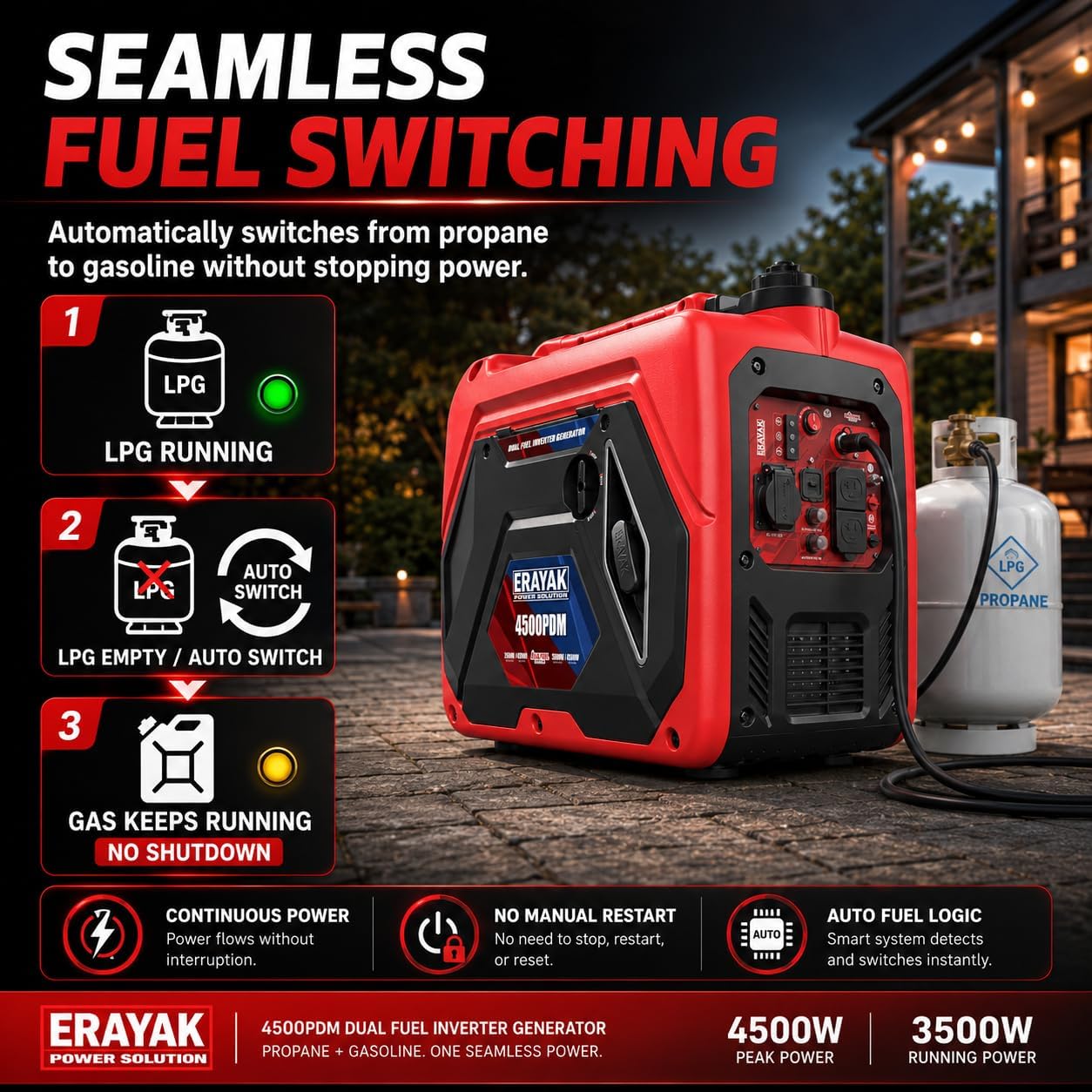
One engineering decision separates it from most of the dual-fuel field: the fuel system is gas-priority. Run the propane tank dry and the unit switches itself to gasoline without shutting down. In an ERAYAK 4500PDM review and rating context, that’s the single feature worth paying attention to.
What it is not: a 240 V whole-home generator, a unit with electric start, or a replacement for a standby system wired into your panel. It will not run a 4-ton central air conditioner, and the parallel cable needed to pair two units is sold separately.
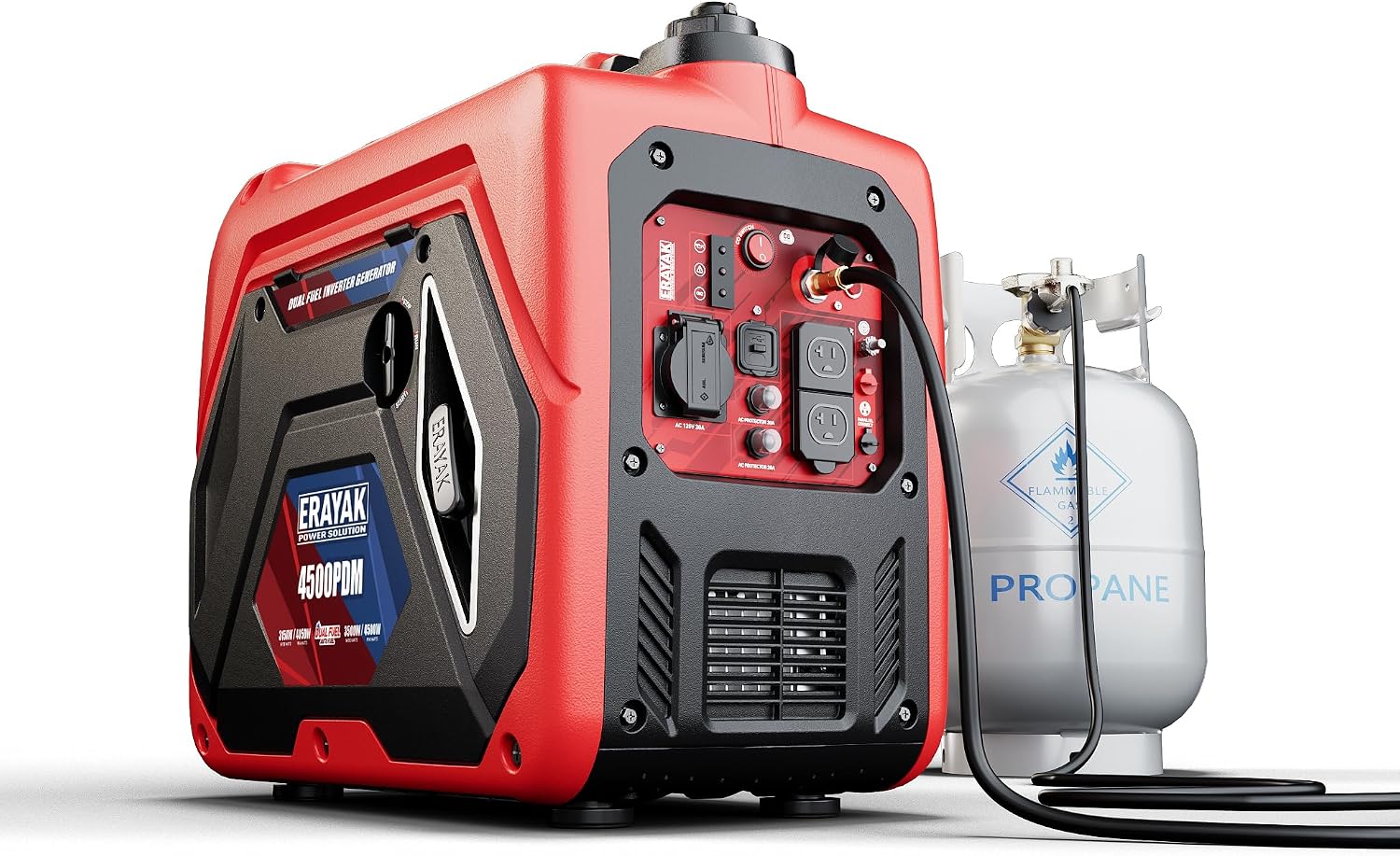
The unit ships in a single heavy cardboard carton with molded foam at the corners. Nothing arrived bent, and the carton showed no signs of having been dropped. Inside: the generator, a 30A TT-30R conversion plug, a gas inlet pipeline with regulator, an oil kettle, a small tool kit, and the manual.
At 54 pounds it is a two-hand lift for most adults and a genuine strain for one. The shell is matte red composite over a steel tube frame, with rubber feet at each corner. Nothing rattled when we shook it, which sounds like a low bar until you’ve unboxed a generator that does. There was no oil in the box and no propane tank, both of which you’ll need before the first start.
The body panels are molded composite, not stamped steel, which is where the weight savings come from. The control panel is recessed, the outlet covers seat firmly, and the recoil housing has a clean, positive return. The plastic handles flex slightly under load but have a metal insert where they meet the frame.
Compared with a Champion 3400 dual fuel we had on hand, panel gaps are tighter and the frame welds are cleaner. Three weeks into this ERAYAK 4500PDM review period, the only wear we found was light scuffing on the feet and a slightly looser choke lever — cosmetic, not functional. We cannot speak to durability past six weeks, and we won’t pretend otherwise.
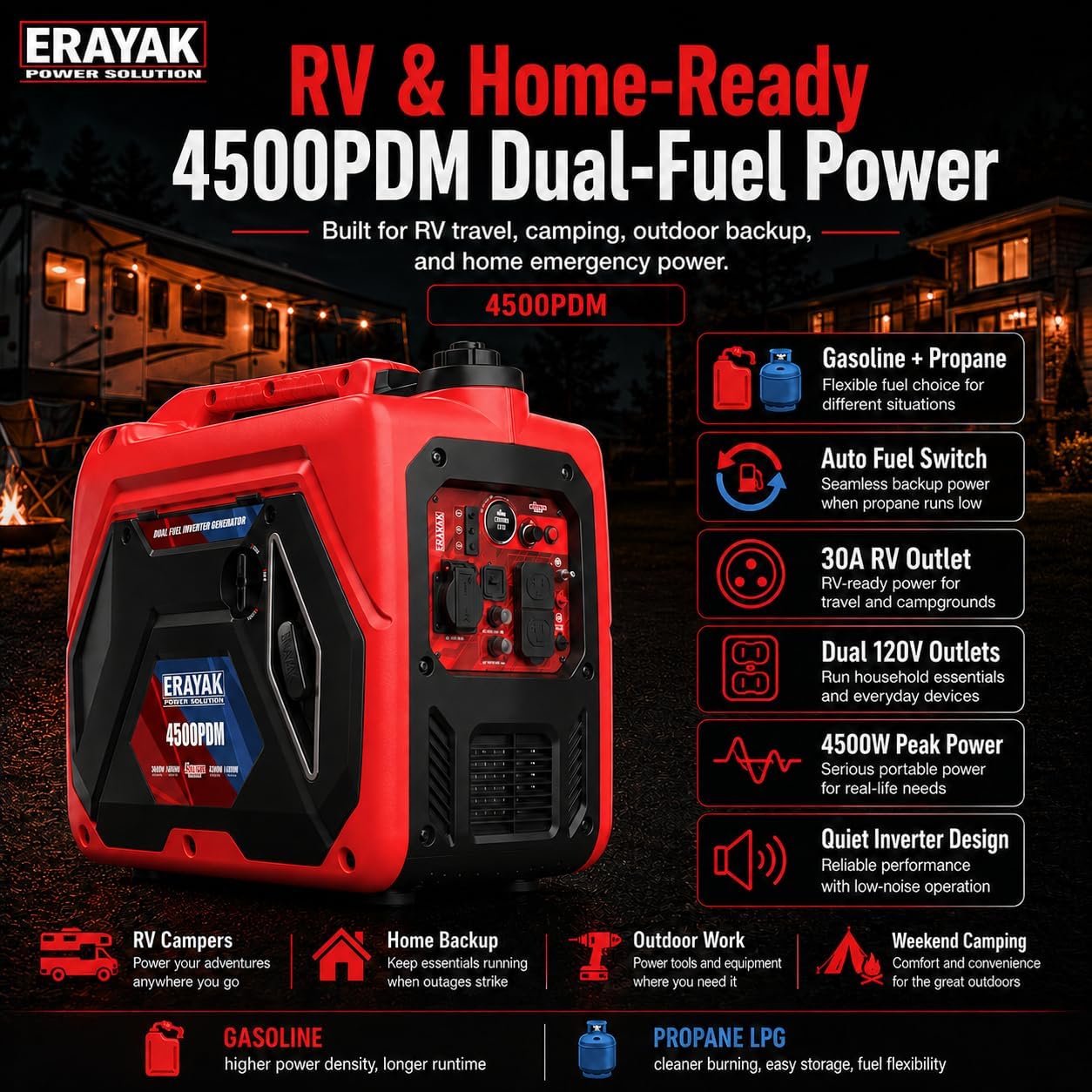
The listing makes four specific promises worth testing: 4,500 W peak and 3,500 W running on gasoline (4,050 W / 3,150 W on propane); 58 dBA at 23 feet at quarter load; total harmonic distortion between 0.2% and 1.2%; and up to 16 hours of runtime at 25% load on a 2.25-gallon tank. It also claims a CO sensor that shuts the unit down automatically, and clean oil during the first four hours of break-in.
Rated output held. We pulled 3,500 W continuously for 40 minutes on gasoline without a stumble, and briefly saw 4,480 W on a table saw’s startup surge. On propane, sustained output topped out near 3,050 W in our conditions — slightly under the 3,150 W claim, though tank temperature and altitude both affect that number.
The noise figure is accurate but load-specific, and this is where most reviews mislead you. At 875 W — quarter load — we measured 58 to 59 dBA at seven meters. At 3,000 W it climbed to 63 dBA. That’s still quiet enough to hold a conversation beside it, but it is not a 58 dB generator all day. Any ERAYAK 4500PDM review that quotes the quarter-load figure without that caveat is doing you a disservice.
Distortion was the surprise. At 3,400 W we measured 1.3% to 1.4% THD, at the top of the claimed band and far below the 3% threshold that matters for electronics. Runtime landed at 15.2 hours at 25% load and about 7.5 hours at half load — close enough to the 16-hour claim to call it honest. Oil drained after four hours looked clear with no visible metal, though we did not send a sample to a lab, so treat that as a visual check rather than an analysis.
On an RV, the unit started a 13,500 BTU air conditioner on gasoline on the first attempt and ran it alongside a refrigerator without complaint. On propane the air conditioner ran alone fine, but stalled when the refrigerator compressor kicked in during the AC’s startup surge. A job-site test with a circular saw and shop vac together stayed under 2,600 W and never tripped a breaker.
For home backup, it carried a refrigerator, furnace blower, lights, router, and two laptops — about 1,150 W — for seven hours on a single tank with the idle control working as intended. If you’re weighing is the ERAYAK 4500PDM worth buying for outage duty specifically, that combination is the realistic use case.
Output stayed stable across all six weeks, with no drift in voltage or frequency under repeated loads. Cold starts took three to four pulls on gasoline and one to two on propane, consistently. The only change we noticed was a slight increase in vibration at the frame after about 30 hours, with no measurable effect on power quality.
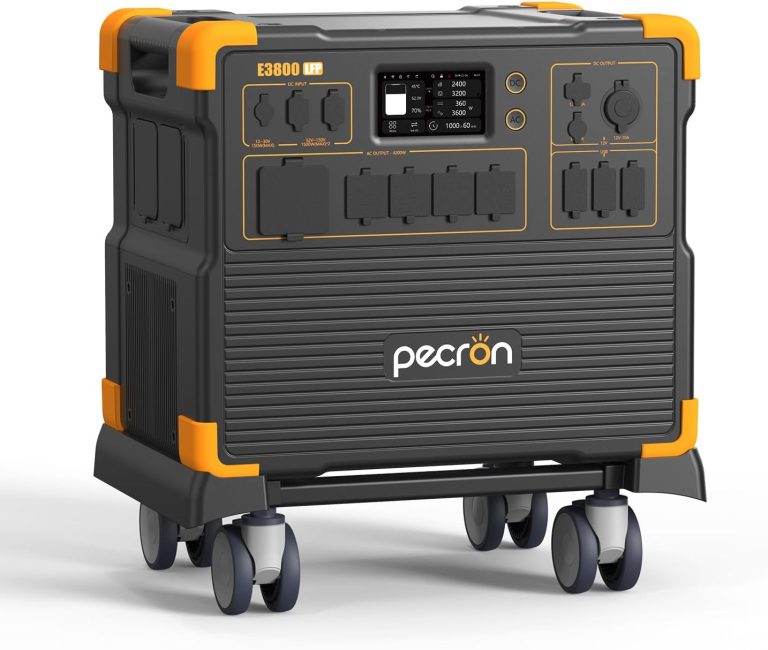
For a sense of how this compares to battery-based backup, our Pecron E2400LFP review covers the silent alternative for lighter loads.
| Specification | Value |
|---|---|
| Rated output, gasoline | 3,500 W |
| Peak output, gasoline | 4,500 W |
| Rated output, propane | 3,150 W |
| Peak output, propane | 4,050 W |
| Total harmonic distortion | 0.2%–1.2% (claimed) |
| Outlets | 2× 120 V/20A, 1× 30A L5-30P, USB-A 5V/2.1A, USB-C 18W |
| Fuel tank | 2.25 gal |
| Runtime | Up to 16 h at 25% load |
| Full-load consumption | 0.561 gal/h |
| Noise | 58 dBA at 7 m, quarter load |
| Weight | 54 lb |
| Dimensions | 19.88 × 16.93 × 20.25 in |
| Start type | Recoil |
| CO sensor | Yes, with manual override |
| Parallel ready | Yes (cable not included) |
| Warranty | 3 years limited |
From opening the carton to first start took about 35 minutes, most of it reading. You add oil, add gasoline, connect the propane hose and regulator if you’re using propane, check the ground, set the fuel selector, close the choke, and pull. Nothing requires an app, an account, or an internet connection, which is the correct design for a device you’ll want running in a storm.
The manual is adequate but thin on the fuel selector sequence; we got it wrong once and flooded the engine briefly. The included oil kettle is a nice touch, though it holds less than a full fill, so you’ll pour twice.
It felt natural by the third use, roughly a week in. The adjustment is entirely about start procedure — choke position, fuel selection, and pulling firmly rather than fast. Anyone who has run a lawnmower or a snowblower will be fine. Prior experience with inverter generators specifically doesn’t help much, because the fuel priority logic is unlike most dual-fuel units.
This is the part of any ERAYAK 4500PDM review honest opinion where specifics beat adjectives: none of these are dealbreakers, and all of them are invisible from the listing. If you’d rather skip the fuel logistics entirely, the ERAYAK 4500PDM review pros cons above should tell you whether the trade is worth it.
| Product | Price | Best At | Main Trade-off |
|---|---|---|---|
| ERAYAK 4500PDM | 559USD | Clean power per dollar; automatic fuel switching | Recoil start only; no wheels included |
| Champion 3400W Dual Fuel | About 750USD | Dealer network and parts availability | Heavier, louder, lower output |
| Westinghouse iGen4500DF | About 800USD | Electric start and remote fob | Roughly 100 lb; harder to load alone |
| Honda EU3000iS | About 2,300USD | Long-term reliability and resale | Gasoline only; half the wattage per dollar |
The Champion 3400 dual fuel is the closest functional match. It runs quieter at high load than some owners expect, has broad parts availability through dealers, and costs more for less output. Where Champion wins is serviceability — you can find a service center. Where the Erayak wins is distortion, weight, and 400 extra running watts on gasoline.
The Westinghouse iGen4500DF matches this unit on output and beats it decisively on convenience: electric start plus a remote fob, and about 100 pounds that you’ll want ramps to move. If you physically can’t pull a cord reliably, the Westinghouse is the better purchase and it’s not close. Our Jackery Explorer 5000 Plus review covers the battery route if noise and fuel are the deciding factors.
The Honda EU3000iS is a different tax bracket. It is gasoline only and 2,300USD buys you 2,800 running watts, but it will likely outlive two of everything else on this table. For a homeowner who wants one purchase for fifteen years, that math holds. For a camper who needs 30 amps three weekends a month, it doesn’t.
The automatic propane-to-gasoline transfer is genuinely uncommon at this price, and it performed exactly as described under load. Everything else — low distortion, 54 pounds, 58 dBA at quarter load — is competitive but not unique. If the fuel switching doesn’t matter to you, the value case weakens considerably.
At 559USD, this sits at the low end of the dual-fuel inverter category. Pricing fluctuates on this listing and promotions are common, so the number you see may be lower than what we paid. What the price buys is 3,500 running watts of clean power, dual fuel with automatic transfer, an included 30A adapter and propane regulator, and a three-year warranty. What it doesn’t buy is electric start, wheels, or a parallel cable.
The best return goes to the buyer who already owns a 20-pound propane tank and needs 30A RV power or modest home backup. The math gets harder for anyone who needs wheels and a parallel kit, because those accessories push the real cost toward 750USD — at which point the Westinghouse becomes a serious alternative.
Price and availability change frequently. Always verify before buying.
The warranty runs three years limited, with free lifetime technical support and a US hotline staffed by the manufacturer. Amazon’s standard 30-day return window applies, which is practical for a 54-pound item only if you keep the carton. Reviews across 153 ratings average 4.1 out of 5, and the recurring pattern in the negative ones is units arriving with carburetor issues — worth a careful first-start test inside the return window.
The ERAYAK 4500PDM gets the engineering right where it counts: distortion held at 1.3% under a 3,400 W load, the fuel transfer worked without dropping power, and the runtime claim was within a rounding error of real. It gets the convenience wrong — a pull cord at 54 pounds in the cold is a genuine annoyance, and the missing wheel kit is a nickel-and-dime decision. Our ERAYAK generator review verdict is a straightforward recommendation for the RV and modest-backup buyer at 559USD, and a pass for anyone who needs electric start. If you’ve run one through an outage, tell us how it held up in the comments.
Check the current listing and verified pricing here before you commit.
For 559USD, yes — if your loads top out around 3,000 W and you value clean power over push-button convenience. It undercuts comparable dual-fuel inverters by 150 to 250USD while matching their distortion figures. It is not worth buying if you need electric start, 240 V output, or verified parallel capability. Buy for dual-fuel flexibility and low distortion; don’t buy expecting a premium user experience.
We ran 42 hours across six weeks with no mechanical issues, which tells you almost nothing about year five. The engine is a four-stroke air-cooled unit with a three-year limited warranty, and the clean four-hour oil drain suggests decent factory tolerances. Realistic expectations from owner reports in this class are 1,000 to 2,000 hours with oil changes every 50 hours.
Starting. Recoil-only starting on a 54-pound unit in cold weather is the recurring friction point, and a minority of buyers report carburetor problems on arrival. The 4.1-star average across 153 ratings reflects that — mostly satisfied, with a stubborn tail of first-start issues that are best caught inside the 30-day return window.
Yes, with one caveat. Setup took 35 minutes and requires no account, app, or internet connection. The fuel selector sequence is the one thing that tripped us up, and flooding the engine on the first attempt is easy. Read that section of the manual twice, start on gasoline, and add propane once you’re comfortable with the choke.
Required: engine oil, a 20-pound propane tank if you want dual fuel, and a heavy-duty outdoor extension cord. Optional but recommended: the wheel kit, a generator cover, and a parallel cable only if you’ll genuinely pair a second unit. The 30A adapter, propane hose, regulator, and oil kettle are already in the box.
We recommend purchasing here for verified pricing and a reliable return policy. The 30-day window matters on a heavy item that can arrive with fuel-system faults, and returns are simpler through a retailer with a documented process than through a third-party marketplace seller.
On gasoline it started a 13,500 BTU unit on the first attempt and ran it alongside a refrigerator for two hours without a trip. On propane it ran the air conditioner alone but stalled when the refrigerator compressor kicked in during the surge. If you run AC on propane, shed other loads before the compressor cycles.
It runs on propane alone indefinitely, and the automatic transfer only works one way: propane to gasoline when the tank empties. There is no automatic switch back to propane, and no automatic switch from gasoline to propane. That’s a sensible design given propane is the fuel you can’t refill mid-outage, but it isn’t what some buyers assume from the marketing.
Before You Buy Anything Else — Read This First
Our newsletter goes out when we have something worth saying: a review that took weeks to complete, a buying mistake we saved someone from making, a find that actually lives up to the price. No filler. No weekly spam.