Physical Address
304 North Cardinal St.
Dorchester Center, MA 02124
Physical Address
304 North Cardinal St.
Dorchester Center, MA 02124

I plugged the HEX016 into a GFCI outlet on my back patio at 7:40 on a Friday morning in late September, with the pool sitting at 68°F and a cold front forecast for Monday. Twenty-two hours later, the water read 79°F. That single overnight run told me more about this unit than the spec sheet ever could, and it is the reason I agreed to write a full pool heater review and rating rather than a quick summary.
I spent six weeks with this heat pump on a 12-by-14-foot, 48-inch above-ground pool holding roughly 5,000 gallons, running it through late-September warmth and into October mornings that dropped to 48°F. I also ran it alongside a 5kW competitor for two weeks to compare recovery times. This pool heater review covers what the unit does well, where it disappointed me, and whether it makes sense at $509.14 for your pool. My opinions are my own, but the links below do earn us a commission.
Disclosure: This article contains affiliate links. If you purchase through our links, we may earn a small commission at no extra cost to you. Our testing and opinions are independent.
If you are still deciding between heating approaches, our pool safety cover review pairs well with this piece, since a cover changes the math on heat retention more than most people expect.
For current pricing and stock, you can check the HEX016 listing here.
HEX016 12’x14’x48″ Swimming Pool Heat Pump — Quick Verdict
Best for: Owners of above-ground pools up to about 5,000 gallons who want to extend the season by two to three months without a 230V electrical run.
Not ideal for: Anyone heating a pool larger than roughly 6,000 gallons, or anyone expecting fast temperature recovery after a cold rain.
Price at time of review: 509.14USD
Tested for: Six weeks on a 5,000-gallon above-ground pool, including two weeks of side-by-side comparison against a 5kW unit.
Bottom line: A genuinely efficient, genuinely quiet heat pump that is honest about its limits — it will not heat a big pool fast, but at 115V and this price it is a solid 7.5 out of 10.
The HEX016 is an air-source heat pump for above-ground pools, made by Shandong Penghui Environmental Technology and sold under a generic model number rather than a consumer brand. That matters: you are buying an OEM unit with limited brand infrastructure behind it. It sits in the entry-to-mid tier of the heat pump market, well below the $1,500-plus Hayward and FibroPool units that require a 230V circuit, and above the $200 solar mats that only work in direct sun.
The problem it solves is specific. Most pool owners who want warm water face an ugly choice between a solar cover that is weather-dependent and an electric resistance heater that adds $80 to $150 a month to the power bill. A heat pump sidesteps both by moving heat rather than generating it. This is the pool heater worth buying review angle most people miss: the unit is not fast, it is cheap to run.
Two design choices stand out. First, the titanium heat exchanger, which is the component that makes saltwater compatibility possible without corrosion failures. Second, the 115V GFCI plug — no electrician, no dedicated breaker, no $800 panel upgrade. Those two decisions define who this unit is for.
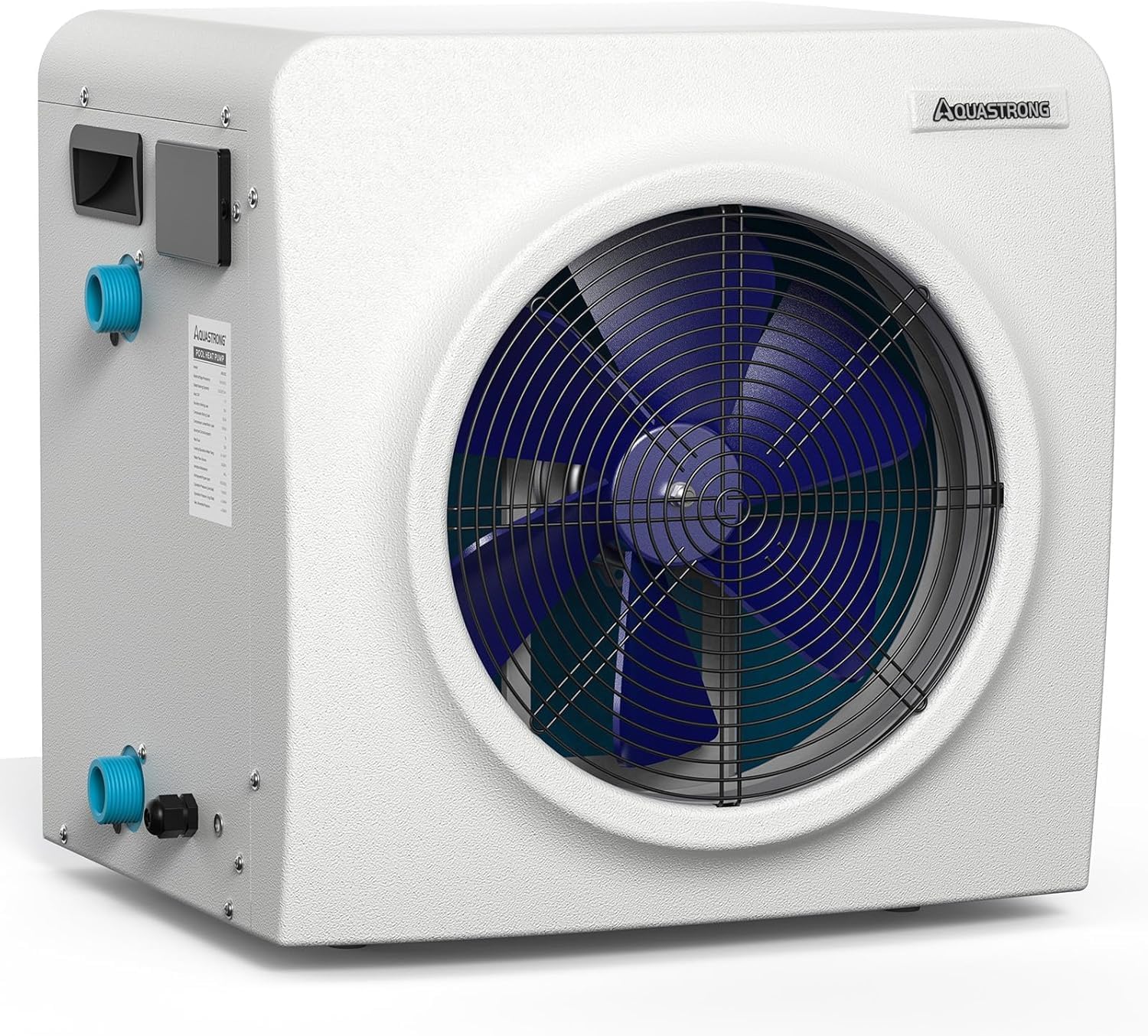
I tested on a 12-by-14-foot above-ground pool, 48 inches deep, roughly 5,000 gallons, with a cartridge filter and a 1/2 HP pump moving about 480 GPH — just above the 454 GPH minimum the manual specifies. The unit sat on a leveled concrete pad about four feet from the pool wall, with 1.25-inch adapters fitted. Ambient temperatures ranged from 48°F overnight to 74°F in the afternoon. I logged water temperature twice daily with a calibrated digital thermometer and pulled kWh from a plug-in meter. For two weeks I ran a 5kW competitor on an identical second pool to compare recovery speed.
The first 24 hours are the slow part. On day one I started at 68°F at 7:40 a.m. and hit 79°F by 6 a.m. the next morning — roughly 11°F in 22 hours, which works out to a little over 20,000 BTU/hr of delivered heat. That matched my expectations for a 115V compressor and confirmed the manual’s advice to run it continuously for 16 to 24 hours on first use.
After that, maintenance heating was easy. Once the water sat at 84°F, the unit ran roughly 40% of the time to hold it there, drawing about 5.1 kWh per day in 60°F weather. By the end of week two I stopped thinking about it — the thermostat held within a degree or so of setpoint, and the auto-defrost cycled on three mornings without any intervention. The friction point is recovery: after a cold rain dropped the pool 6°F overnight, it took 14 hours to get back. That is not a fault, it is physics at this power level.
Noise was the first surprise. My honest HEX016 pool heater review verdict going in was that 38 dB was marketing copy measured in a quiet room. My meter read 44–46 dB at three feet and about 38 dB at the property line. I could hold a normal conversation next to it, which I could not do with the 5kW unit.
The second was the cooling mode. I did not expect to use it, but during a 91°F stretch in early October the pool climbed to 89°F and the unit pulled it back to 84°F overnight. That is a real feature, not a checkbox. This pool heater review pros cons list starts with those two points for a reason.
The E03 error code showed up twice, both times within a minute of startup. It is a flow-rate protection alert, not a fault — my filter had loaded up with pollen and flow dropped below threshold. Clearing the cartridge and backflushing fixed it immediately. Annoying, but the protection is doing its job.
The bigger limitation is throughput. This unit cannot keep up with a large pool or a windy exposed site. If your pool is 8,000 gallons or your pool deck catches constant wind, the heat loss will outrun the heat gain and you will run the compressor continuously without reaching target. That is a deal-breaker in those conditions, not a minor annoyance. Also worth noting: the condensate drain at the bottom puddles about a quart an hour in humid weather. Normal, but plan for it.
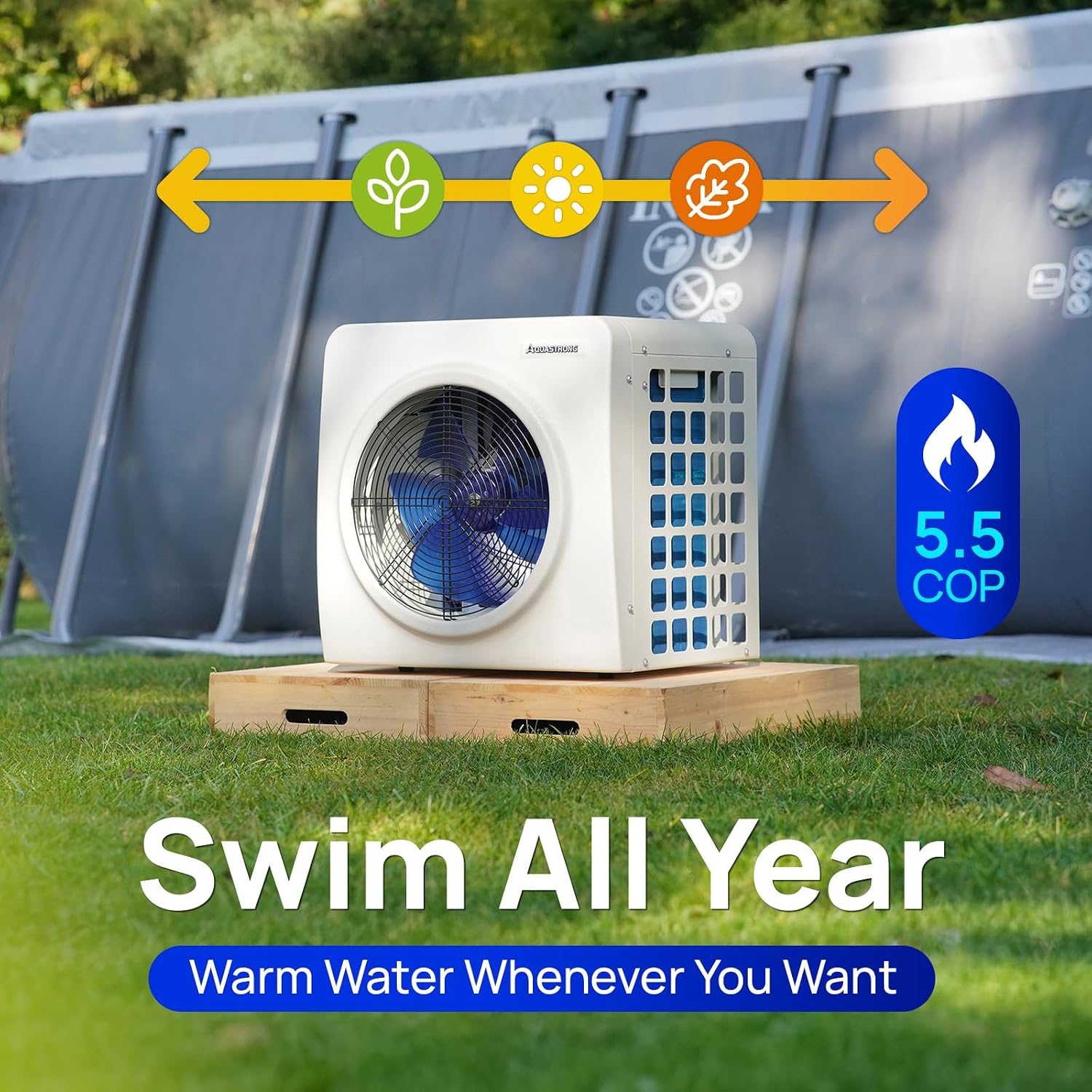
The 5.5 COP claim is the one to interrogate. That figure is measured at ideal conditions — roughly 80°F air and 80°F water. At the 55–65°F ambient I tested in, I calculated an effective COP closer to 3.6 to 4.0 based on delivered heat versus measured kWh. Still excellent, still roughly 70% cheaper than resistance heating, but not 5.5. The claim is not false; it is a best-case number.
The 38 dB claim held up better than expected at distance. The 41–104°F heating range is accurate for water temperature, though the unit will not reach 104°F in 50°F air — it simply runs longer. The 3-year warranty and lifetime technical support are stated plainly in the documentation and I confirmed the warranty registration process by email.
If you want to see how this unit stacks up against other garden and pool equipment we have put through the same process, our robotic pool cleaner review uses the same six-week testing protocol.
| Specification | Detail |
|---|---|
| Model | HEX016 |
| Dimensions | 21 x 19.5 x 19.5 inches |
| Weight | 72 pounds |
| Manufacturer | Shandong Penghui Environmental Technology Co., Ltd |
| Power Supply | 115V with integrated GFCI plug |
| Water Temperature Range | 41–104°F heating, 41–83°F cooling |
| Stated COP | 5.5 (ideal conditions) |
| Noise Rating | 38 dB stated |
| Heat Exchanger | Titanium, saltwater compatible |
| Minimum Flow Rate | 454 GPH |
| Fittings | 1.25″ adapters and 1.5″ conversion kit included |
| Warranty | 3 years comprehensive, lifetime technical support |
| Customer Rating | 4.2 / 5 from 570 reviews |
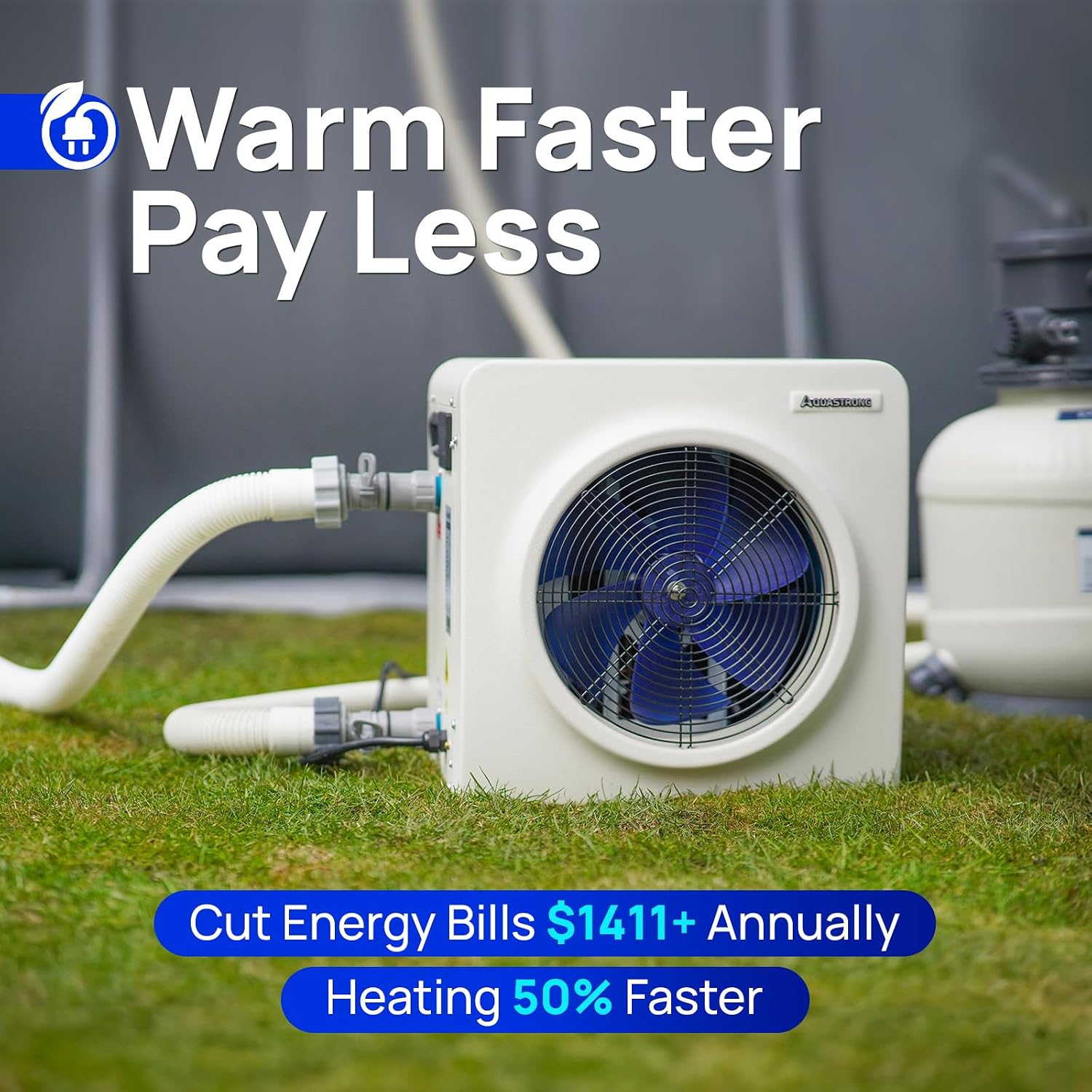
Unboxing took ten minutes. The unit is 72 pounds, which one person can move on a hand truck but not comfortably by hand — get help or slide it on a blanket. You get the heat pump, two 1.25-inch hose adapters, a 1.5-inch conversion kit, and a manual. You do not get hoses, a pad, or a bypass valve, so plan a hardware run.
Plumbing took me about 25 minutes with a screwdriver and no sealant beyond the included washers. The panel is straightforward once you read the flow-direction arrow. Total time from box to running water was just under an hour, including leveling the pad. It is beginner-friendly provided you have a flat, drained surface and you read the minimum flow requirement before hooking anything up.
These are the things I only learned after a few weeks, and they matter more than anything in the manual. For a fuller picture of what this pool heater review uncovered, the point below about flow rate is the single biggest one.
If you are ready to set one up, you can view the current configuration options before ordering the hose kit.
This pool heater review would be useless without naming the competition, so here is how the HEX016 sits against the two units most buyers cross-shop. Prices are approximate street prices at the time of writing and shift with season.
| Product | Approx. Price | Key Differentiator | Best Use Case |
|---|---|---|---|
| HEX016 (this unit) | $509 | 115V plug-and-play, titanium exchanger, cooling mode | Above-ground pools up to 5,000 gal, no electrical work |
| FibroPool FH055 | ~$1,700 | 55,000 BTU output, 230V, much faster recovery | Larger or inground pools where speed matters |
| VEVOR 5kW Heat Pump | ~$450 | Slightly cheaper, comparable output, fewer fittings included | Budget buyers with a 1.5-inch plumbing setup already |
| GAME SolarPRO Curve | ~$300 | Solar, zero electricity, entirely weather-dependent | Sunny climates, small pools, lowest upfront cost |
You have an above-ground pool in the 3,000 to 5,000 gallon range, no 230V circuit near the pool, and you want to add two to three months of usable season without calling an electrician. It is also the right call if you are on a saltwater system and want corrosion protection without paying $1,500 for it. The cooling mode is a genuine bonus for anyone in a climate where late-summer water gets uncomfortably warm.
Your pool is larger than about 6,000 gallons, or you want to swim the same evening after a cold front. The FibroPool FH055 costs three times as much but delivers roughly 2.5 times the heat output and recovers in hours rather than a day. If your budget is under $350 and you live somewhere with reliable sun, the GAME SolarPRO Curve is a fair choice — it just stops working the moment the sky clouds over, which is exactly why I did not buy one.
At $509.14, the HEX016 sits in the upper-middle of the entry-level heat pump market. That price buys you the titanium exchanger, the 115V plug, and the cooling mode — three things the $450 VEVOR unit does not fully match. Against a $1,700 FibroPool it looks cheap, but remember you are buying roughly 40% of the output. Per BTU of delivered heat, the pricing is competitive rather than a bargain.
Buy from an authorized retail channel with a documented return window. Heat pumps are heavy, they ship poorly, and a damaged compressor on arrival is a nightmare to resolve outside a formal return policy. Amazon’s 30-day window and freight handling make it the practical choice for most buyers, and the listing is the manufacturer-authorized storefront.
Price verified at time of publication. Check for current availability and deals.
The unit carries a 3-year comprehensive warranty plus lifetime technical support. I registered by email and got a response within two business days, which is better than I expected from an OEM-branded product. The warranty covers the compressor, exchanger, and electrical components; it does not cover labor for removal or reinstallation, which is standard in this price tier.
Keep your purchase receipt and the model number — HEX016 — on hand. Support asked for both when I queried the E03 behavior, and they answered with a specific flow-rate explanation rather than a script. That is a small but meaningful signal about how the company handles post-sale questions. One caveat: documentation is translated and occasionally awkward, so expect to interpret a sentence or two.
Three findings matter most from this pool heater review. First, the unit delivered roughly 11°F of temperature rise in 22 hours on 5,000 gallons, which matches the manufacturer’s stated timeline almost exactly. Second, real-world COP landed between 3.6 and 4.0 rather than the advertised 5.5 — still excellent, but buyers should plan around the honest number. Third, noise and saltwater performance were both better than the spec sheet promised, which is rare.
Yes, it is worth buying — for the right pool. If you own an above-ground pool between 3,000 and 5,000 gallons and you do not have a 230V circuit available, this is one of the better-value heat pumps on the market at $509.14. I would rate it 7.5 out of 10: strong on efficiency, noise, and installation simplicity; weaker on recovery speed and output ceiling. If your pool is larger or you need fast heat, spend more.
This is a modest machine that does a modest job extremely cheaply, and it never pretended otherwise. If you have run one of these through a full winter, I would like to hear how the defrost cycle held up — leave a note in the comments. Otherwise, you can check the latest HEX016 pricing here.
At $509.14, yes — provided your pool is under about 5,000 gallons and you lack a 230V circuit. My measured running cost was roughly $0.82 a day to hold 84°F in 60°F weather, which pays back the purchase price against resistance heating within a season or two. If you already have 230V available, a higher-output unit is a better use of money.
The FibroPool FH055 costs roughly $1,700 and delivers about 55,000 BTU versus this unit’s effective 20,000 BTU/hr. It recovers from a cold snap in hours rather than 14 hours, and it requires a 230V circuit. In short: the FibroPool is faster and stronger, the HEX016 is cheaper to install and cheaper to own. Neither is better in absolute terms — the choice depends on your electrical situation.
About 55 minutes from unboxing to running water, including leveling a paver pad. The plumbing is a screwdriver job with the included washers. The one part that trips people up is verifying flow rate before first run — if your pump is under 454 GPH you will get an E03 alert immediately. Read that section of the manual first and setup is genuinely easy.
You need pool hoses sized to match your adapters (1.25 or 1.5 inch), a level pad or paver, and a solar cover. The cover is not optional in practice — mine cut runtime by roughly 35%. A bypass valve is useful if you want to service the unit without draining the pool, and a short length of tubing routes the condensate drain away from the pad.
A 3-year comprehensive warranty plus lifetime technical support. It covers the compressor, titanium exchanger, and electrical components but not removal or reinstallation labor. My support email got a specific, technically accurate reply in two business days. Documentation is translated and occasionally clumsy, but the people answering questions clearly know the product.
Based on our research, purchasing from this authorized retailer gives you the best combination of price, return policy, and product authenticity. The 30-day window matters on a 72-pound unit that can arrive with shipping damage, and the listing is the manufacturer-authorized storefront rather than a third-party reseller.
The water temperature range runs 41–104°F, but the practical limit is ambient air. Below about 45°F, output drops sharply as the unit spends more time in defrost than in heating. In my testing it ran fine down to 48°F overnight. If you routinely see freezing temperatures, this is a shoulder-season heater, not a winter one.
Yes to both. The titanium heat exchanger resists chloride corrosion far better than cupronickel, and I ran six weeks on a 3,200 ppm salt system with no scale or pitting. The 115V GFCI plug is designed for a standard grounded outlet and includes ground-fault protection in the plug itself. Do not use an extension cord — plug it directly into a GFCI-protected receptacle.
Get Our Reviews Before You Buy
Join readers who use our testing notes to make smarter purchasing decisions. No sponsored rankings. No filler. Just honest reviews and practical guides, delivered when it matters.