Physical Address
304 North Cardinal St.
Dorchester Center, MA 02124
Physical Address
304 North Cardinal St.
Dorchester Center, MA 02124

Three autumns in a row, I ended a backyard gathering with my jacket smelling like a campfire and my eyes still stinging an hour after everyone had gone home. The fire pit in the middle of the yard was a ninety-dollar steel bowl from a hardware store, and it did exactly what cheap fire bowls do: it burned wood, it threw sparks at ankle height, and it pushed smoke into whichever chair happened to be downwind.
After the third October in a row, I stopped blaming the yard. I ordered the 27-inch Yukon in the Amazon Exclusive bundle, and I started keeping notes. What follows is my Solo Stove Yukon review, built from roughly five months of use — two or three fires a week through fall and winter, plus a handful of spring cookouts with eight or nine people crowded around it.
I’ve tried to write this as a Solo Stove Yukon review honest opinion rather than a spec sheet. Everything below comes from use, not from the product page.
Disclosure: Some links in this article are affiliate links. We may earn a commission if you buy through them. This does not influence our findings or recommendations.
The short answer on the Solo Stove Yukon (27-inch Amazon Exclusive Bundle)
| Tested for | About five months, 40+ fires, mixed hardwood and softwood, in a suburban backyard with a prevailing crosswind. Also used for three charcoal-free cookouts on a grill grate. |
| Best suited to | Someone with a permanent or semi-permanent backyard spot who regularly hosts six or more people and is tired of dodging smoke. |
| Not suited to | Anyone who wants a fire pit they can genuinely carry to a campsite, or who wants heat output comparable to a patio heater. |
| Price at review | 689.99USD |
| Would I buy it again | Yes, but I’d buy it in September rather than November, and I’d skip the lid-and-shelter upsell and put that money toward a proper fitted cover. |
Full reasoning below. Or check the current price here if you have already decided.
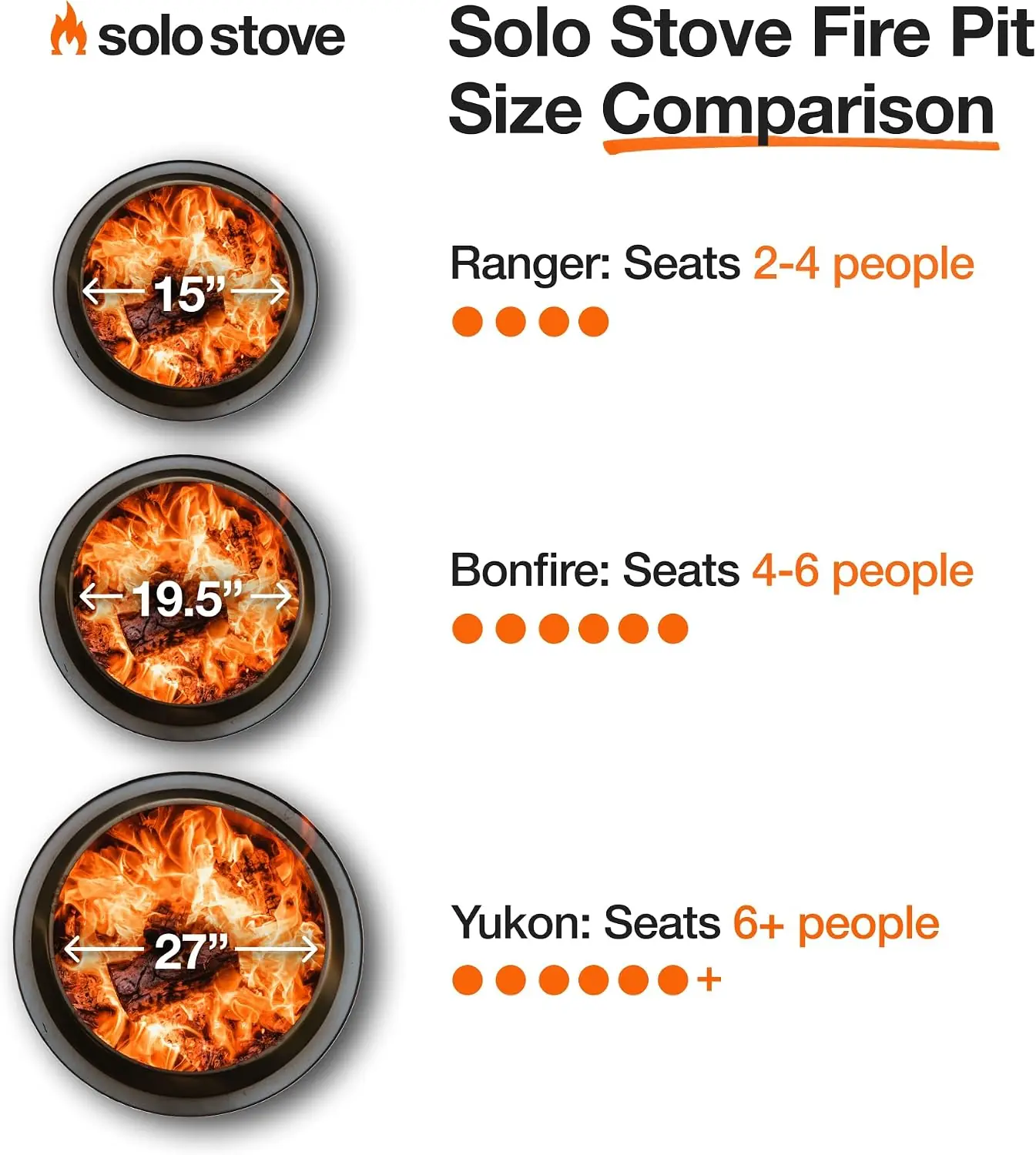
The Yukon is a wood-burning fire pit. That is the whole category. You put split logs in it, you light them, and it burns. It is not a gas appliance, it does not run on pellets, and it has no ignition system, fan, or electronics of any kind. The 27-inch diameter makes it the largest pit Solo Stove sells, sized for six people or more around the rim.
What it is not matters just as much. It is not a grill, even though Solo Stove sells a grilltop for it. It is not a patio heater — the heat goes sideways into shins and faces, not down onto a floor. It is not a permanent masonry fireplace, and it is not a good match for someone who wants a fire they can start by turning a knob and walk away from. It is also not, despite the marketing language, something you casually carry to a beach.
Solo Stove has been building these since around 2010 out of Texas, and the brand’s whole identity is the double-wall airflow design. If you want the manufacturer’s own explanation of how that works, Solo Stove publishes it here. The short version: air enters the bottom vents, gets heated between two layers of steel, and re-enters above the fire to burn off the particles that would otherwise leave as smoke.
In market terms, this sits at the premium end. You can buy a functioning wood fire pit for eighty dollars. You are paying for the burn behavior, the stainless construction, and — in this bundle — the accessories that normally cost extra. This is the second natural place to evaluate whether Is Solo Stove Yukon worth buying comes down to budget or to the smoke problem, because those are two very different questions.
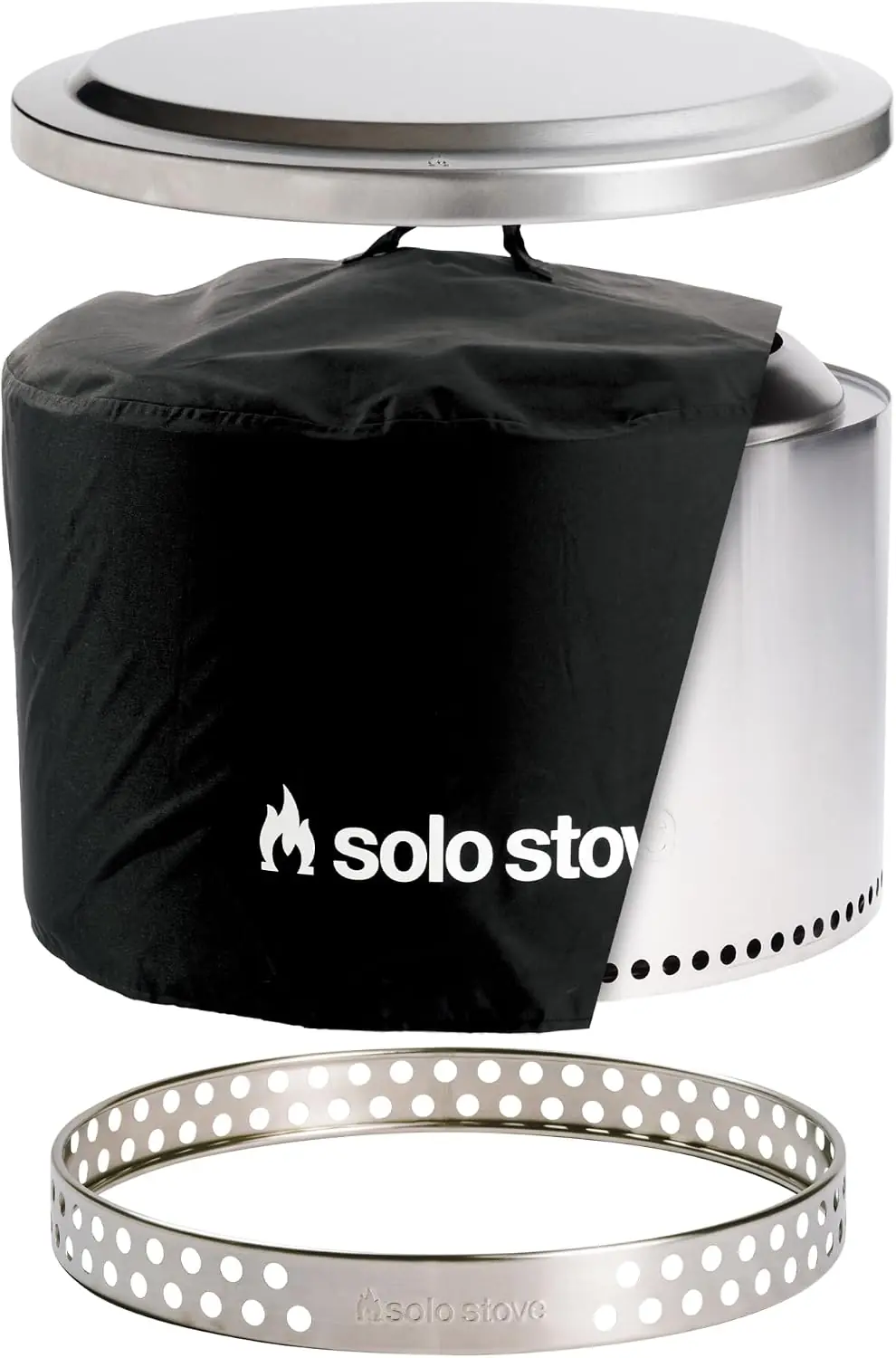
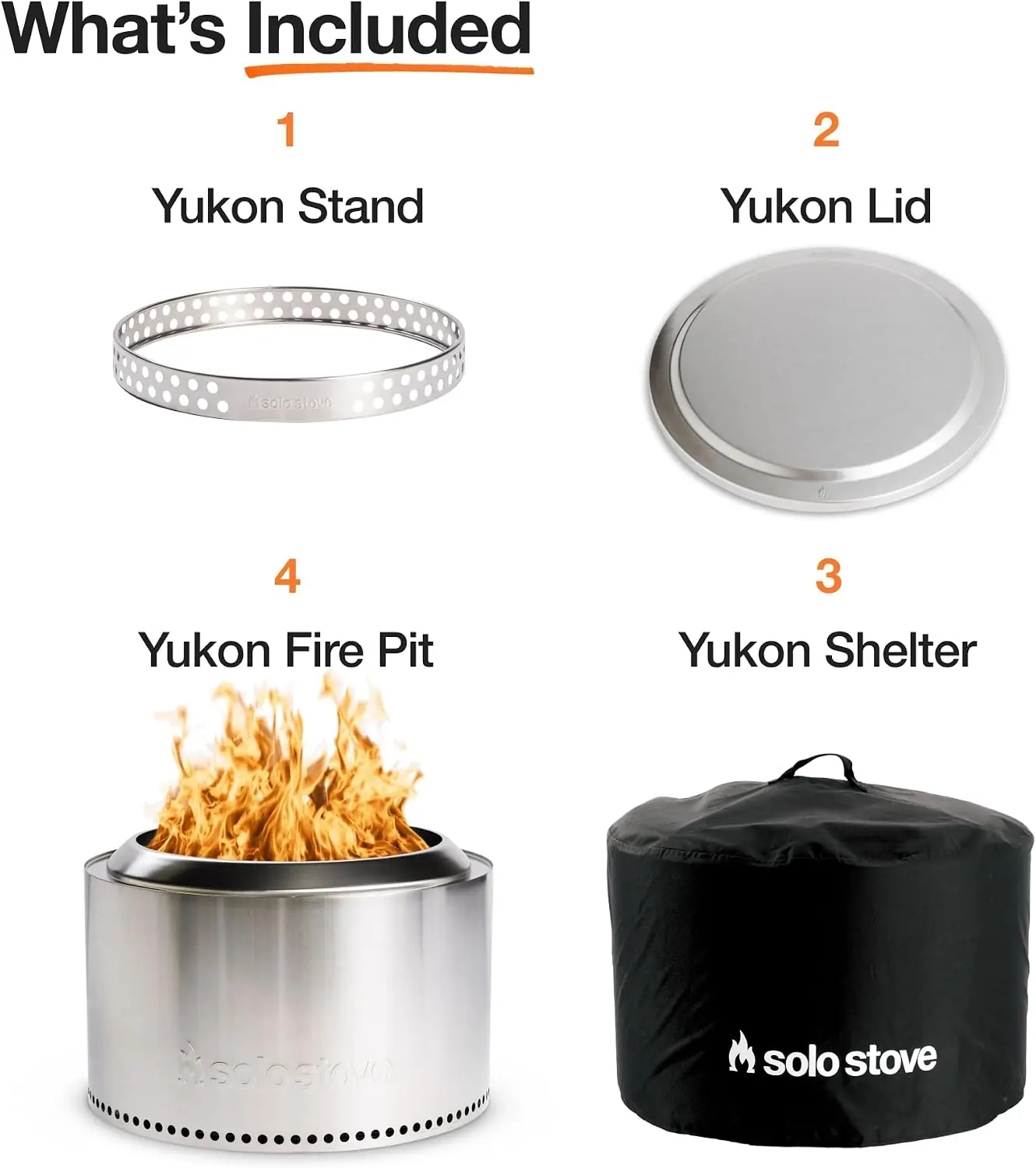
The Amazon Exclusive bundle includes the Yukon 2.0 fire pit itself, a base plate, a removable ash pan, a lid, a stand, and a weather-resistant shelter. That is a complete setup. Nothing in the list is a throwaway filler item — the stand, the lid, and the ash pan are all things you would otherwise buy separately, and together they’d run you well over a hundred dollars at retail.
What is absent: a cover that actually keeps rain out of the interior. The included shelter is a lightweight fabric wrap, and after one wet week I found standing water in the bottom of the pit. I now use a rigid lid and tip the whole unit slightly. That is the one gap in an otherwise complete package.
Packaging quality is good without being wasteful. Each component is nested and separated, and the finish on the stainless arrived unmarked. The first thing I noticed lifting it out was the weight — the pit alone is listed at just over 43 pounds, though the shipping weight on the product data reads 26.76 kg (about 59 pounds). I’m treating that larger figure as the packed shipping weight rather than what you’ll be lifting at the fire ring, since the boxed bundle felt noticeably heavier than the unit does assembled.
Fit and finish held up to inspection. The double wall meets cleanly at the rim, the base plate seats without wobble, and the ash pan slides out with one hand. The only thing I’d flag before purchase: budget for a proper fitted cover if the pit will live outside year-round.
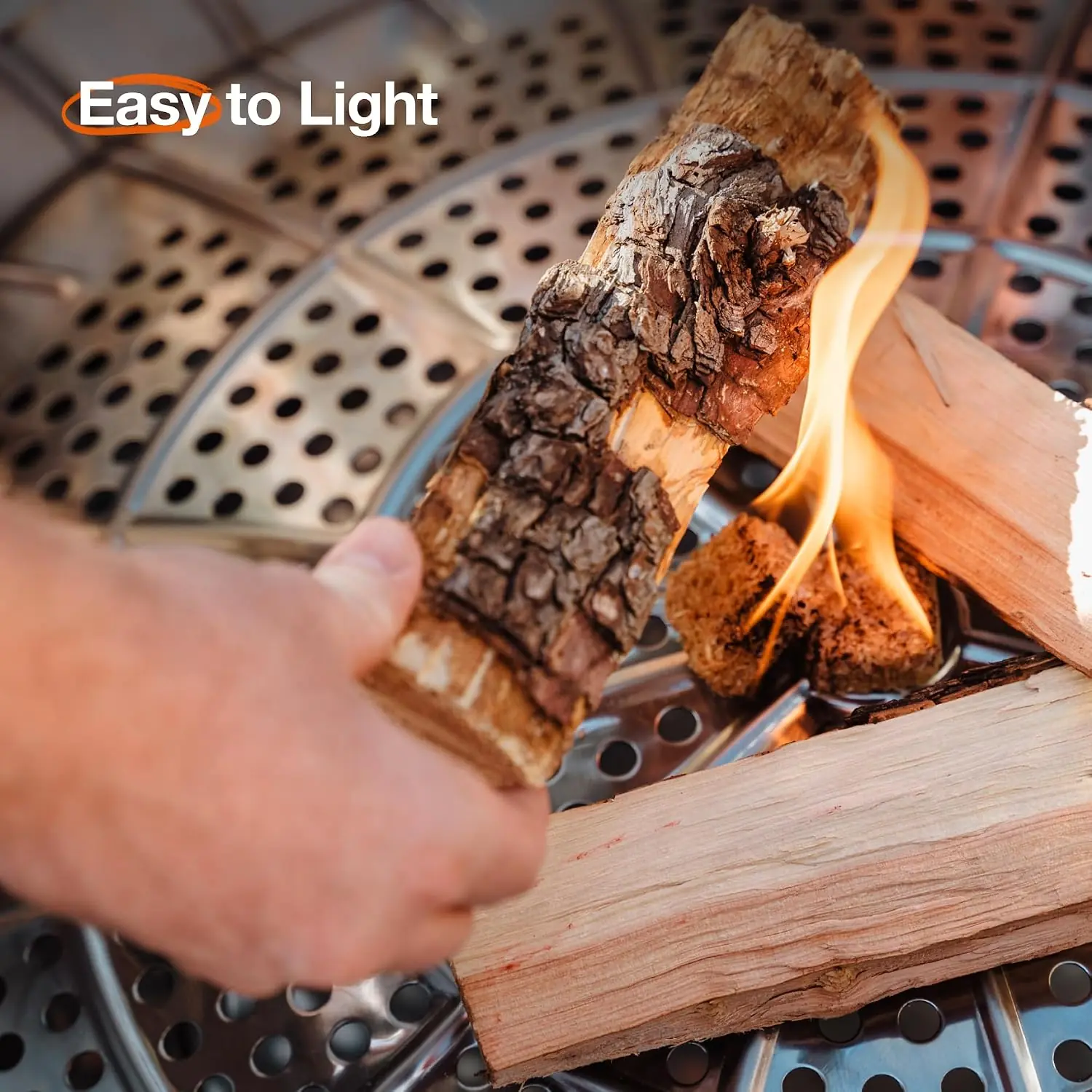
There was no assembly. You lift the pit out of the box, flip the ring at the top, set it on the stand, and you’re done — call it five minutes including unpacking, and most of that is cardboard. The documentation is a single folded sheet covering lighting and cleaning, and it’s adequate rather than thorough. If you have used any wood fire pit before, nothing here is new. If you haven’t, the sheet won’t tell you much about fuel sizing, which matters more than anything else.
There is one, and it’s shorter than I expected. Getting a fire lit takes no skill. Getting a clean fire takes about three attempts. The variables are wood moisture and fuel size — dry, split, wrist-thick pieces work; damp or oversized logs don’t. I’d estimate a complete beginner gets a genuinely low-smoke burn on the second or third fire, roughly a week of evening use. The pit rewards good fuel and punishes wet wood, which is a reasonable thing for it to do. By the end of the first week I had a working answer to Is Solo Stove Yukon worth buying, which I did not expect that fast.
The very first burn did not go perfectly. I loaded it the same way I’d loaded my old steel bowl — a mound of mixed wood, lit from the bottom — and it smoked steadily for about twelve minutes. Then it cleaned up. Somewhere around the ten- to fifteen-minute mark the secondary burn kicked in, the visible plume thinned to almost nothing, and the fire got noticeably hotter. That pattern has held ever since. The first ten minutes of any burn are a normal fire; after that it becomes something different. Nobody told me that, and it’s the single most useful thing to know before your first light.
For context on the backyard side of this, I’ve also written about outdoor lighting that survives real weather, which pairs with a fire pit more often than people admit.
Fuel management improved more than anything else. I learned to build a small, hot bed of coals first rather than trying to light a full load, and that cut the smoky phase from twelve minutes to about five. I also learned the pit’s actual capacity — three or four split logs is a good evening fire; six is a bonfire that you’ll feel on your face from ten feet away. Learning to stop feeding it was the real skill. Efficiency improved too; I’m using noticeably less wood per evening than I did in month one, for the same amount of heat.
The airflow behavior has been completely consistent. Same fuel, same weather, same result, every time — I never once had a burn that smoked badly for no reason. The ash pan is the other quiet winner. Lifting the base plate and sliding the pan out takes thirty seconds, and I’ve never once had to shovel ash out of the firebox. The stand has not marked the patio. The rim has not warped, the base plate has not seized, and the seams are still tight.
First, this is a people-warmer, not a space heater. Almost all the heat leaves at an angle, so if you’re sitting three feet away you’re warm and if you’re eleven feet away you’re cold. Second, you cannot use it as a slow evening fire unless you’re willing to keep feeding it — the design burns hot and fast, and a single load lasts maybe forty-five minutes to an hour. Third, and this one cost me a burn, the base plate sits low enough that fine ash collects around the bottom vents over time. If you don’t clear those vents every few weeks, airflow drops and the smoke comes back. That’s not in the manual.
No structural issues. The stainless has taken on a gold-to-blue heat tint on the upper rim, which is cosmetic and expected on 304 steel. The high-heat ceramic coating on the lower body has held up with no flaking. The weather shelter that came in the bundle has faded and stiffened after a season outdoors — that’s the one component I’d genuinely call disposable. Everything else looks like it has years left.
| Specification | Detail |
|---|---|
| Brand / Model | Solo Stove — BUNDLE-ESS-SSYUK-27-2.0-AMZ |
| Diameter | 27 inches (listed dimensions 28D x 28W x 19H) |
| Material | 304 stainless steel, polished finish, high-heat ceramic coating |
| Fuel type | Wood only |
| Listed item weight | 26.76 kg (approx. 59 lb); Solo Stove lists the pit itself at just over 43 lb |
| Shape / style | Round, modern |
| In the box | Fire pit, base plate, removable ash pan, lid, stand, weather-resistant shelter |
| Ideal group size | 6+ people |
| What We Evaluated | Score | One-Line Note |
|---|---|---|
| Ease of setup | 5/5 | Five minutes from box to lit fire, zero tools, zero hardware. |
| Build quality | 5/5 | Seams tight, no rust after a wet season, only cosmetic heat tint. |
| Day-to-day usability | 4/5 | Ash pan is excellent, but it needs feeding every 45–60 minutes. |
| Performance vs. claims | 4/5 | Smoke reduction is real and dramatic; “smokeless” and “portable” are not. |
| Value for money | 4/5 | Fair for the bundle, expensive if you only burn a few times a year. |
| Heat reach and distribution | 3/5 | Warm and comfortable at three feet, useless at twelve. |
| Overall | 4.2/5 | A genuinely better fire pit that solves one problem extremely well and is honest about little else. |
The overall number lands where it does because the core engineering delivers exactly what it promises and the accessories make the package feel complete. What holds it back is the marketing wrapping: a pit this heavy is not portable, and a fire this hot is not a low-effort evening burn. Buy it for the smoke fix, not for the lifestyle copy.
Three products come up in every conversation about this pit. Prices shift often, so treat the figures below as approximate rather than current.
| Product | Price | Strongest At | Weakest At | Best For |
|---|---|---|---|---|
| Solo Stove Yukon (27″, Amazon Exclusive Bundle) | 689.99USD | Largest seating circle, complete bundle, fastest cleanup | Weight, heat reach, single burn duration | Hosts with six or more people and a fixed backyard spot |
| Breeo X Series 24 | roughly $550–$700 depending on configuration | Heavier-gauge steel, made in the USA, sear-plate cooking system | Costs climb fast with accessories; heavier still | Buyers who want a permanent, cook-capable centerpiece |
| Solo Stove Bonfire 2.0 | roughly $350–$450 | Same airflow design at a lower price and 10 fewer pounds | 19.5-inch diameter limits the crowd to four or five | Smaller yards, couples, and first-time buyers testing the concept |
| Tiki Brand 30″ Smokeless Fire Pit | roughly $400–$500 | Widest diameter for the money, easy retail availability | Less efficient secondary burn; more smoke in practice | Budget-minded buyers who want the size without the premium |
If your problem is a crowd, this is the one to pick. The 27-inch rim genuinely seats eight adults without anyone kneeling, and the smoke reduction scales with diameter — a bigger fire with more consistent secondary burn puts less smoke into more people’s faces. The bundle also matters more than it looks: the ash pan alone changes the ownership experience, and on the Breeo side you’re paying extra for a comparable setup. After five months, the Solo Stove Yukon bundle review verdict rests mostly on the fact that this is a complete, well-integrated system, not a pit plus a wishlist.
Buy the Bonfire 2.0 instead if your typical group is four people or fewer. It costs several hundred dollars less, weighs considerably less, and uses the identical airflow design — you are giving up diameter and nothing else that matters at that scale. Buy the Breeo X24 instead if you want to cook over the fire regularly and you care about American manufacturing and thicker steel; its sear plate system is a better cooking platform than the Yukon grilltop, and I’d say so even having bought the Solo Stove. For our full comparison notes on that pit, see our Breeo X Series 24 review. And if you want to stay under $500, the Tiki 30 is a reasonable compromise — just go in expecting more visible smoke than the Solo Stove design produces.
The right buyer here is a specific person: you own your home or have a long-term lease, you have a patio or a gravel pad where a 28-inch steel ring can live permanently, and you host people at least twice a month during the warmer half of the year. You are not especially price-sensitive at the $700 level, but you are sensitive to annoyance — and smoke in your face, ash on your hands, and a fire that takes twenty minutes to clean up are the three annoyances you are buying your way out of. You have burned wood before and you know what dry fuel looks like. You want something that works the same way every time and doesn’t require you to learn a hobby.
The wrong buyer is the person who pictured themselves loading this into a truck bed for weekend camping trips. It is too heavy for that, it needs to cool before it moves, and loose ash travels. Also skip it if your main goal is warmth on a cold patio — a propane heater does that job better for less money. Buy the Bonfire 2.0 if your gatherings are small, and buy a Breeo if cooking over the fire is the point rather than a bonus. And if you burn fewer than eight times a year, a $150 fire bowl and a bag of dry hardwood will serve you well enough that the upgrade is hard to justify.
At 689.99USD, this is not a cheap fire pit and it is not trying to be. For context, a bare Yukon 2.0 typically sells in the $500–$600 range depending on season, so the bundle premium buys you the lid, the stand, the ash pan, and the shelter — accessories that individually total well over $150. Viewed that way, the bundle is the better buy than the standalone pit. Viewed against the category, you’re paying a premium over a Tiki or a generic stainless bowl for airflow engineering that actually works, and paying roughly the same as a comparable Breeo configuration.
The value question is really a frequency question. If you light it forty times a year, the cost per evening lands in the price of a decent bottle of wine, and the smoke problem it solves is worth that to almost anyone who has hosted around a conventional pit. If you light it six times a year, you are paying a premium for a problem you don’t really have.
Buy from a retailer that is an authorized Solo Stove dealer. The warranty only applies to units sold by authorized retailers, and third-party marketplace sellers offering a suspiciously low price are the most common source of both counterfeit units and warranty headaches. Amazon has the advantage of a clear return window, which matters on a product this size — you want the option to send it back after your first couple of burns if the smoke behavior doesn’t match the claim. It matched for me.
Price and availability change. Check current figures before deciding.
Solo Stove covers every genuine product sold by an authorized retailer against manufacturing defects. Defective units are replaced or refunded as store credit. Normal wear — and the manufacturer specifically calls out misuse — falls outside that. In practice, that means heat discoloration and a faded shelter are on you, while a failed weld or a seized ash pan would not be. I have not had to file a claim, so I can’t speak to how quickly they process one. The Amazon return window is the more useful protection in the first month, and it’s the reason I’d buy there rather than from a smaller dealer with a stricter policy.
If smoke in your face has genuinely ruined outdoor evenings, yes — this is the most effective fix I’ve used, and it works consistently enough that I stopped thinking about it. If you’re buying it because it looks good in photos, no. The premium buys behavior, not aesthetics, and cheaper stainless pits look nearly identical sitting cold on a patio.
Breeo uses thicker steel, is made in the US, and has a better cooking system with its sear plate. The Yukon is lighter, cheaper to fully outfit, and has an easier ash-removal setup. For pure fire performance they’re close enough that most people couldn’t tell them apart. If cooking over the fire is a real priority, buy the Breeo. If seating a crowd matters more, buy the Yukon.
Five minutes, and most of that is cardboard. There is no assembly — you flip the ring at the top, set the pit on the stand, and you’re finished. The honest caveat is that “setup” and “first successful burn” are different things. Budget fifteen minutes for the first fire to reach its clean-burning phase, and expect to spend a week learning what fuel sizing works for you.
Nothing is strictly required — the bundle is complete. In practice, you’ll want two things. First, a rigid lid or proper fitted cover, because the included shelter doesn’t keep rain out. Second, a supply of dry, split hardwood; the pit’s performance depends on fuel moisture more than on anything else. If you’re considering the standalone pit instead of the bundle, check the Solo Stove Yukon bundle pricing first — the accessory math usually favors the bundle.
None structural. After a wet season outdoors I have no rust, no warping, and no seized parts. The rim has taken on gold and blue heat tint, which is normal for 304 stainless and purely cosmetic. The only component showing real wear is the included weather shelter, which has stiffened and faded. One maintenance note: clear ash from the bottom vents every few weeks or airflow drops and smoke returns.
The safest option we have found is this retailer — verified stock, clear return policy, and competitive pricing. The warranty only covers units from authorized sellers, which is the main reason to avoid third-party marketplace listings, no matter how much you save. Buy where you can return it after two or three burns if the smoke behavior disappoints.
No, and any review claiming otherwise hasn’t used one in wind. There’s a visible plume for the first ten to fifteen minutes while the fire establishes, and the secondary burn takes over after that. Once it engages, smoke drops to something close to nothing — but a gusty crosswind will still push what’s left toward someone. Dry wood is the deciding variable. Wet fuel defeats the design entirely.
Yes, with caveats. Solo Stove sells a grilltop insert for the Yukon, and I’ve cooked sausages and foil-wrapped vegetables over coals with reasonable results. It is not a grill and it never will be — there’s no lid, no grate height adjustment, and the fire runs hot. Treat cooking as a bonus for casual evenings, not as a reason to buy. For real fire cooking, the Breeo cooking system is the better tool.
The consistency. I expected the smoke reduction to work sometimes and fade when the wind picked up or the wood was marginal. Instead, the same input produced the same result for five straight months, and I stopped thinking about where to sit — which was the whole point. The thirty-second ash cleanup is the quieter reason I stopped resenting the maintenance. Neither of those is exciting, and both are why I’d buy it again. For more on the outdoor setup around it, our testing approach explains how long we run these before writing.
Buy it if you host regularly, have a permanent outdoor spot, and smoke has genuinely been a problem you’ve tried and failed to solve with a cheap pit. Don’t buy it if your household is four people or fewer, if you want to move it around, or if you expect warmth at any distance. The Bonfire 2.0 handles the small-group case for a lot less money. As for the full Solo Stove Yukon review and rating, the honest summary is that this pit does one thing unusually well and is marketed as though it does four. Buy it for the one thing.
I’m curious whether the vent-clogging issue I ran into is universal or a quirk of how much softwood I burned early on. If you own one, tell me in the comments what your burn times look like and whether you’ve had to clean the bottom vents. If you’re ready to buy, the Amazon Exclusive bundle is here.
Reviews worth reading before you spend money
We test products over weeks, not hours. No sponsored rankings. No affiliate-first conclusions. Join readers who use our work to make better decisions.