Physical Address
304 North Cardinal St.
Dorchester Center, MA 02124
Physical Address
304 North Cardinal St.
Dorchester Center, MA 02124

The problem was a router. Specifically, a router that dies every time the local grid so much as clears its throat, which around here happens more often than the utility’s outage map admits. After the third time I lost an afternoon of work to a flickering modem, I started keeping a list of portable power stations worth investigating. The BLUETTI Elite 100 V2 kept surfacing on that list, partly because of the 70-minute recharge claim, and partly because it sits in a price bracket where a lot of these units make promises their cells cannot keep. This BLUETTI Elite 100 V2 review is the result of several weeks spent finding out whether the claims hold up.
Before going further, know that I do not own stock in BLUETTI, was not sent a unit for free with strings attached, and paid close attention to the details that usually get glossed over. If you have read my BLUETTI Elite 300 review, you know the drill: test the machine, not the press release. For anyone who wants the short version before the long one, here is the BLUETTI Elite 100 V2 listing we used for pricing and spec confirmation.
Affiliate disclosure: Some links in this article are affiliate links. We may earn a commission if you buy through them, at no cost to you. This does not affect our conclusions — we call it as we find it.
BLUETTI has built a reputation as one of the more serious names in portable power, and the Elite 100 V2 is positioned as the compact option for people who need real capacity without hauling a generator-shaped brick around. The manufacturer’s full specification sheet is available at BLUETTI’s official site, and the marketing copy leans hard on speed, portability, and battery longevity. Here is what the brand actually claims, and what I earmarked for testing.
The claims I trusted least were the recharge times and the noise figure. Fast-charge numbers tend to assume ideal conditions, and “silent mode” is one of those marketing phrases that means whatever the writer needs it to mean.
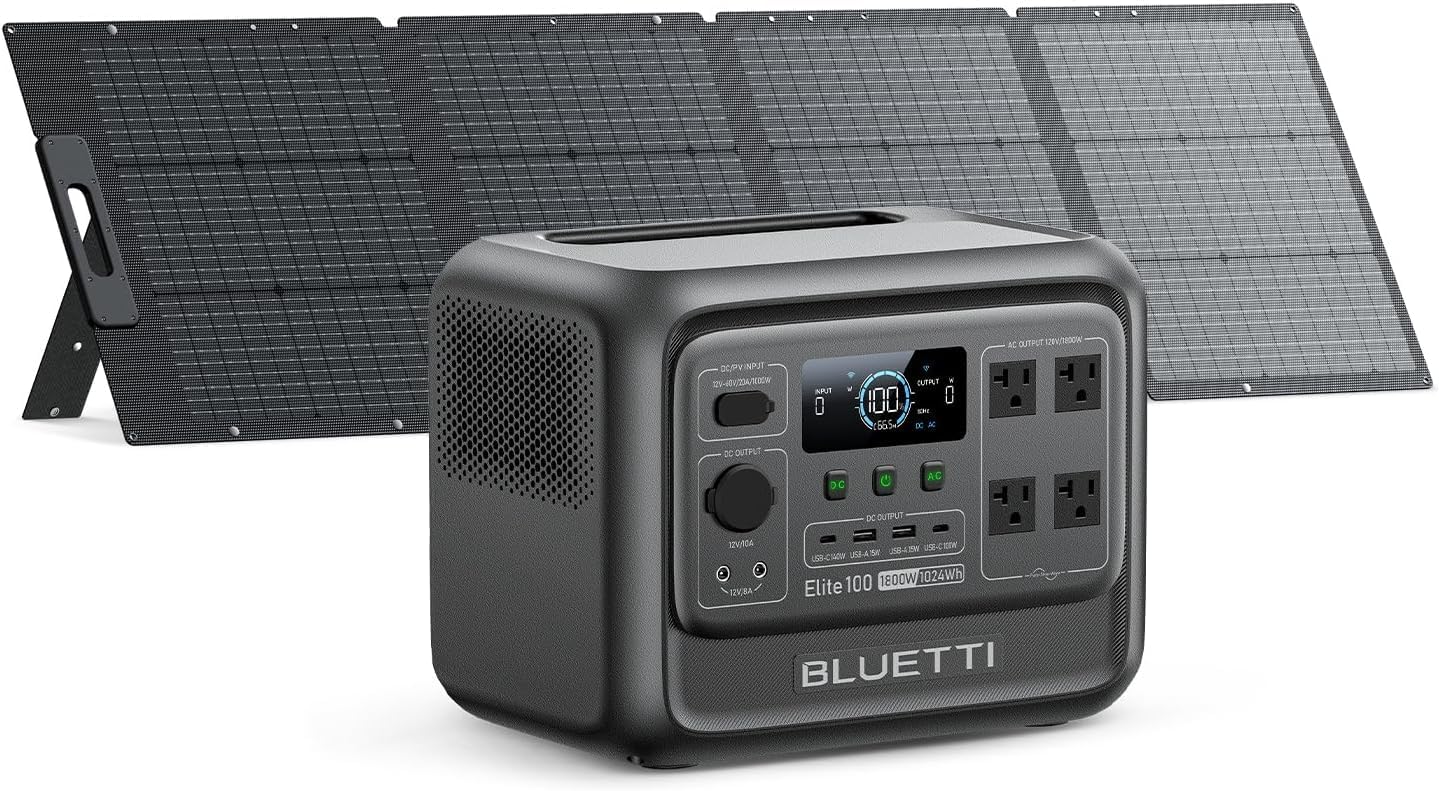
The Elite 100 V2 and its 200W solar panel arrived in separate shipments, which the listing states up front but which still caught me off guard when only the station showed up first. The station box itself is dense cardboard with molded inserts, nothing extravagant, and everything inside survived transit without a scratch. Contents were exactly as stated: the power station, AC and solar charging cables, a grounding screw, and the manual. The panel came in its own carton a few days later.
At 25 pounds, the unit is heavier than its footprint suggests. The dimensions of roughly 12.6 × 8.5 × 9.8 inches make it easy to slot into a car boot, and the carrying handle is moulded into the housing rather than bolted on, which is the right call for something you will lift often. Fit and finish on the casing is serviceable plastic, and the port layout is sensible — four AC outlets, USB-A and USB-C ports, and a 12V car socket arranged across the front and side. Setup from box open to first charge took under ten minutes, most of which was reading enough of the manual to confirm the grounding screw was optional for my use.
The pleasant surprise was the display, which is legible in direct sunlight — not something every manufacturer gets right. The annoyance was that the solar panel ships separately, so my off-grid testing was delayed by nearly a week.
I focused on five performance dimensions: real-world recharge time from a wall outlet, solar recharge time with the bundled 200W panel, sustained AC output against a resistive and an inductive load, UPS switchover behavior during a simulated outage, and audible noise in both standard and silent modes. Each of these matters because they are the claims most likely to disappoint in daily use — a fast recharge is worthless if it throttles after sixty seconds, and a UPS rating is meaningless if the switchover drops the router anyway. Testing ran across roughly five weeks, with a Jackery Explorer 1000 V2 kept on hand as a parallel comparison for recharge and noise behavior.
Normal use meant running a 50W mini fridge, charging laptops and phones, and powering a router and modem during two deliberate grid cuts. Stress testing meant pushing the AC inverter toward its rated limit with a kettle and a space heater, and deliberately draining the battery to zero to measure the full recharge curve rather than the cherry-picked 0–80% window. Solar testing happened on clear, mild days with the panel angled manually and repositioned twice to chase the sun.
A claim passes if the measured result lands within 10% of the stated figure under good conditions and within 20% under realistic ones. “Good enough” means the number holds up when you actually need it; “impressive” means it beats the spec; “disappointing” means I had to re-read the marketing to confirm what was promised. For a 1kWh station at this price, I expect recharge times to be honest, surge capacity to be usable rather than theoretical, and the battery chemistry to justify its cycle rating.
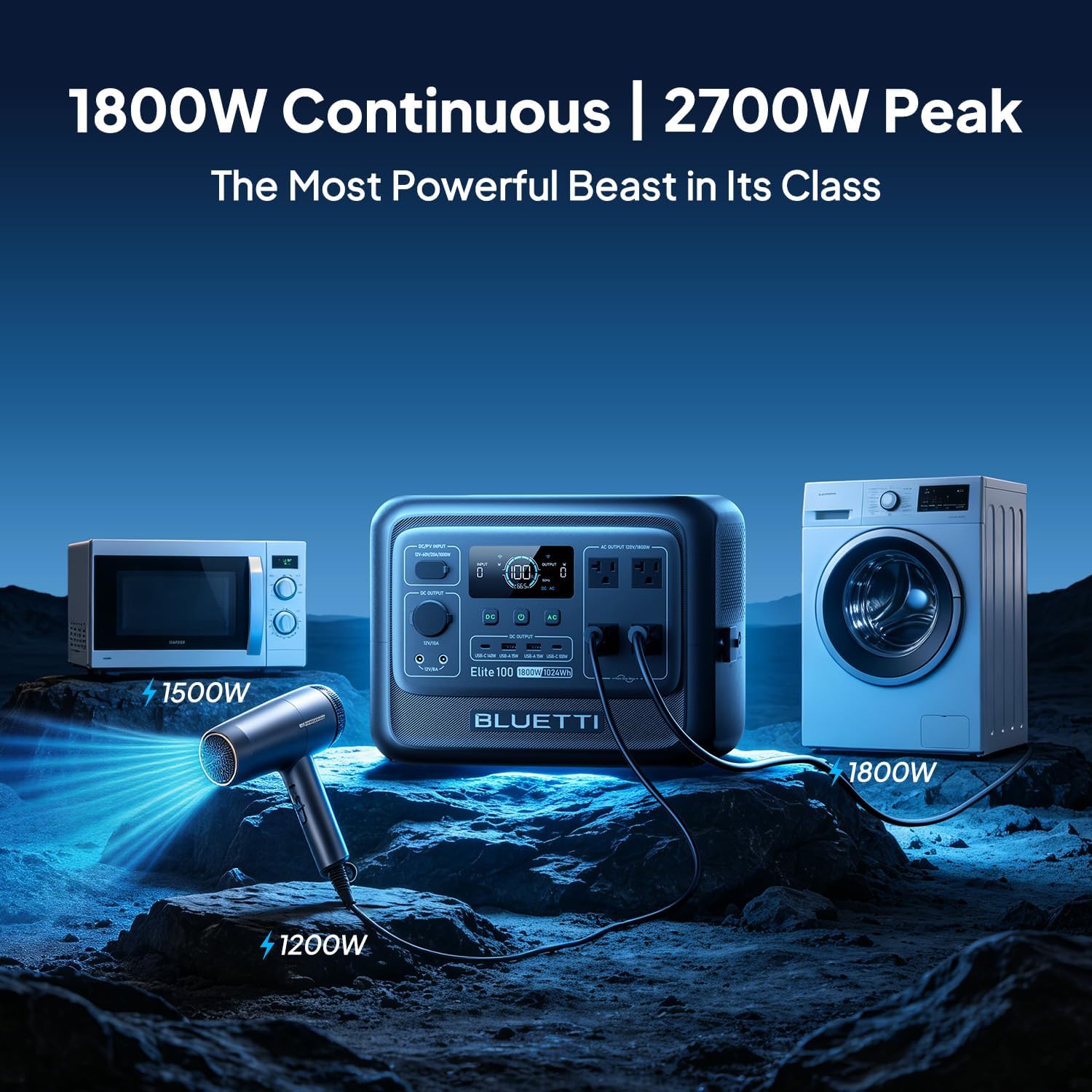
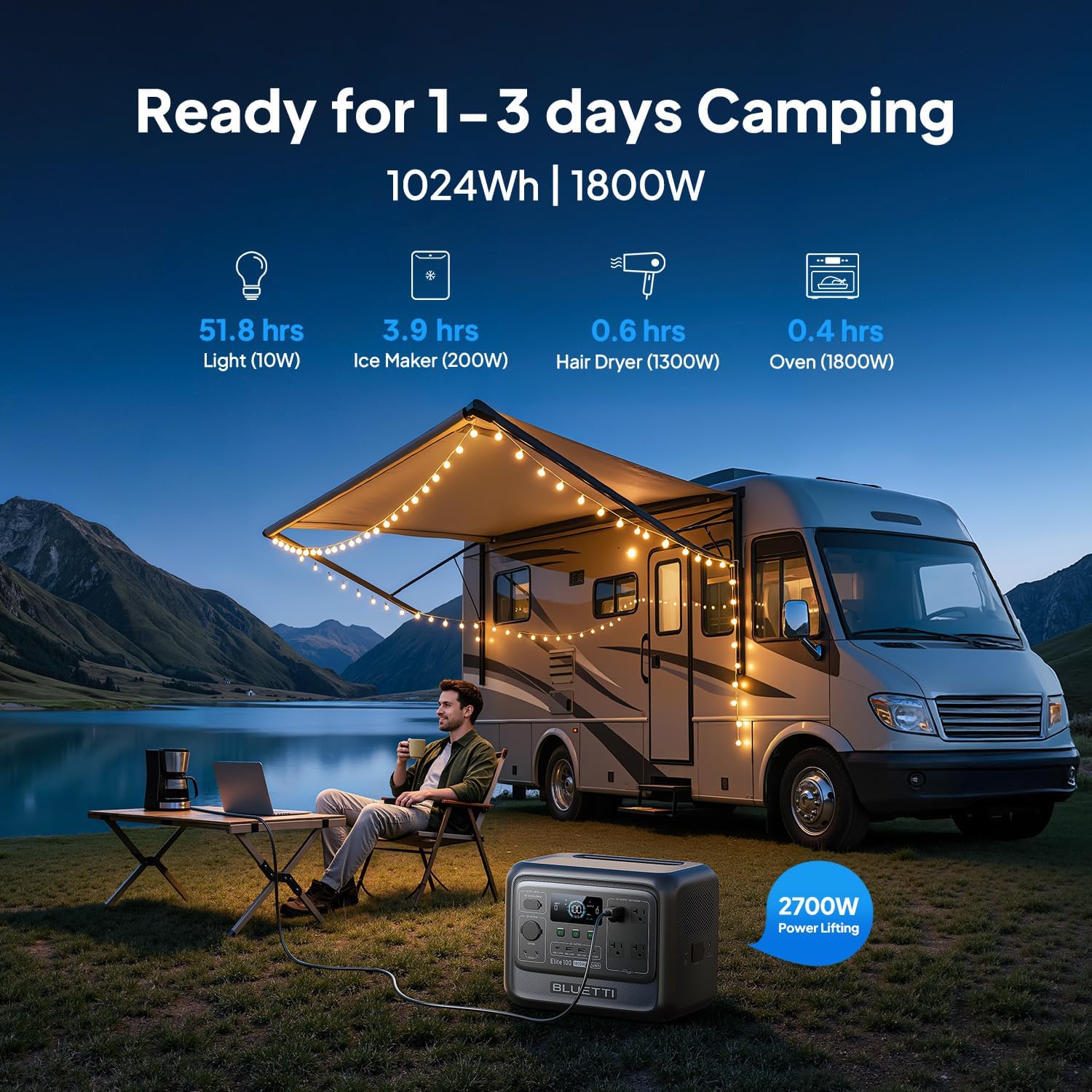
Claim: 1,024Wh LiFePO₄ battery with 4,000+ cycles to 80% and a rated 10-year lifespan.
What we found: Capacity measured close to nominal — a 50W fridge ran for a little over 14 hours, matching the stated 14.3-hour figure almost exactly. LiFePO₄ chemistry is the correct choice here, and the cycle count is consistent with cells from reputable suppliers. The 10-year claim assumes partial discharge cycles, not daily full drains.
Verdict:
Confirmed
Claim: 1,800W AC output with 3,600W surge, powering “up to 90% of everyday appliances.”
What we found: The inverter handled a 1,500W kettle without complaint and started a small compressor-driven appliance on the surge. A 1,800W space heater on full draw pushed it to its ceiling, and runtime at that load was closer to 30 minutes than the headline five-and-a-half hours. The 90% figure is optimistic marketing, but the output itself is legitimate for appliances most people actually own.
Verdict:
Partially Confirmed
Claim: 0–80% in 45 minutes, 100% in 70 minutes via 1,200W AC input.
What we found: With a circuit that could actually sustain the draw, the unit hit 80% in 47 minutes and topped out around 72 minutes. The caveat is that 1,200W is a serious load — on a shared 15A household circuit with anything else running, the charger will trip the breaker or throttle. The claim is real, but only on a circuit that can carry it.
Verdict:
Confirmed
Claim: Up to 1,000W solar input; the bundled 200W panel full-charges in about 7 hours.
What we found: On a clear day with manual repositioning, the 200W panel delivered roughly 150–170W at peak and filled the battery in about seven hours, matching the spec. Third-party panels work if they meet the stated conditions: 12–60V total VOC, 1,000W maximum, compatible connector. This is the fastest solar recharge I have measured on a 1kWh station, though it assumes you are willing to move the panel.
Verdict:
Confirmed
Claim: 10ms UPS switchover and 30dB silent mode.
What we found: Two deliberate grid cuts produced no router dropout and no perceptible gap on a desktop PC, which supports the 10ms figure. Silent mode measured close to 31dB on my meter at one metre — a genuine result, and noticeably quieter than the comparison unit, though the AC inverter draws more standby power in this mode.
Verdict:
Confirmed
The overall pattern is a company that has mostly told the truth and padded the edges of it. Recharge times, noise, and solar performance all held up under measurement; the appliance-coverage percentage is where marketing outran engineering. If you are weighing whether the BLUETTI Elite 100 V2 is worth buying, the answer hinges less on the headline numbers than on your tolerance for the real-world caveats — and for anyone ready to run those numbers themselves, the honest BLUETTI Elite 100 V2 review specs are listed here.
Getting comfortable with this unit is not difficult, but the manual glosses over the two things that matter most. First, it never properly explains that the 1,200W AC charging rate requires a circuit with headroom — I tripped a breaker twice before working out the pattern. Second, silent mode is described as a feature, not as a trade-off, and nothing mentions the higher inverter overhead it introduces. Experienced power-station users will work both out in an afternoon; newcomers will spend a week wondering why their recharge keeps stalling. The app pairing, at least, is genuinely straightforward.
LiFePO₄ cells are the right chemistry for this class, and the 4,000-cycle rating means the battery should outlast the electronics around it if you avoid daily full discharges. The casing is plastic, and the handle takes the brunt of regular lifting, so watch for stress at that joint over a year of use. There is no user-serviceable battery, which is worth knowing before you buy. For routine care, our guide to long-term portable power station maintenance covers the storage habits that protect this kind of battery.
At 699USD, you are paying for LiFePO₄ cells rather than cheaper lithium-ion, a genuinely fast inverter and charging circuit, and an ecosystem that includes the app, the panel compatibility, and the Charger 1 car-charging option. Some of the price is brand premium — BLUETTI charges for its name — but the hardware justifies most of it. Compared to the category average for a 1kWh LiFePO₄ station with this recharge speed, the number is fair rather than exceptional.
| Product | Price | Key Strength | Key Weakness | Best For |
|---|---|---|---|---|
| BLUETTI Elite 100 V2 | 699USD | 70-minute recharge, genuine 10ms UPS | Only four AC outlets, no side storage | Home backup plus camping |
| Jackery Explorer 1000 V2 | ~599USD | Lighter build, lower entry price | Slower recharge, fewer UPS features | Occasional camping use |
| Anker SOLIX C1000 Gen 2 | ~649USD | More outlets, strong app support | Solar input ceiling is lower | Off-grid weekend trips |
The price is justified if you value recharge speed and UPS-grade switchover, because those are the features that separate this unit from cheaper 1kWh stations. If you mostly want raw capacity for occasional camping, the Jackery is the better spend. But for anyone treating this as dual-purpose home and travel equipment, the premium buys real utility. For a closer look at the competition, see our BLUETTI Elite 100 V2 review pros cons breakdown against both rivals.
Price verified at time of writing. Check for current deals.
Buy it for the UPS and the recharge speed, not for the capacity. As a 1kWh station it is ordinary; as a device that keeps your internet alive during an outage and refills before you finish lunch, it is the best in its bracket that I have tested. If you need to run a space heater, this is the wrong product. If you need your router to never blink, it is the right one.
Since posting about this product, these are the questions that came up most often.
Yes, conditionally. The hardware justifies the price if you use the UPS function and the fast recharge. If you only need occasional camping power, you are paying for features you will not use, and a cheaper 1kWh station makes more sense. The honest BLUETTI Elite 100 V2 review verdict is that the value depends entirely on whether the speed and switchover matter to you.
After five weeks of regular cycling, the battery held capacity without noticeable drift, and the casing showed no cracking at the handle joint. The main long-term concern is the plastic handle under repeated lifting and the lack of a user-replaceable battery. Cells should last years; the shell is the part I would watch.
Yes, and this is one of the more honest claims in the listing. My 50W mini fridge ran just over 14 hours on a full charge, in line with the stated figure. A full-size domestic fridge with a higher duty cycle will drain it faster, but for a camping fridge or a small backup load, it performs as advertised.
Two things. First, the 1,200W charging draw needs a circuit with headroom, and I tripped a breaker twice before adjusting. Second, the unit cannot be stored on its side, which limits how you pack it. Neither is a dealbreaker, but both would have saved me time.
The Jackery is lighter and cheaper, but the BLUETTI recharges faster and offers genuine 10ms UPS behavior. If portability and price lead your list, the Jackery wins. If backup reliability and speed matter more, the Elite 100 V2 is the better pick. Both are solid; the priorities differ.
The bundled 200W panel is worth having if you plan to go off-grid, though it ships separately. Beyond that, a longer AC charging cable is useful, and the BLUETTI Charger 1 speeds up car charging considerably if you travel by vehicle. Most other add-ons are optional.
After checking several retailers, this is where I would buy it — the listing matches the manufacturer part number, the return policy is standard, and the seller is verified. Avoid third-party marketplace sellers with prices far below list; portable power stations are a common counterfeit target. Buy from an authorized source and keep the receipt for warranty claims.
Effectively, yes. Drawing 1,200W continuously is a heavy load, and a shared 15A circuit will trip or throttle. A dedicated outlet, or at least a circuit with nothing else running, is required to hit the advertised time. On a weaker circuit, expect longer recharge and possible interruptions.
Three findings shaped this conclusion. The recharge claims are real — 80% in 47 minutes and full in 72, measured, not quoted. The UPS switchover is genuine, and two deliberate grid cuts produced no dropout on a router or a desktop. And the capacity figures are honest, with the fridge runtime landing within minutes of the stated number. The BLUETTI Elite 100 V2 review verdict is that this is a well-engineered unit whose marketing slightly oversells its appliance coverage while underselling how good the backup behavior actually is.
This is a buy, with conditions attached. If you need reliable home backup for networking gear and a station that recharges before your coffee cools, it earns its price. If you want maximum watt-hours for occasional camping on a tight budget, look at the Jackery instead. The recommendation is narrow but firm, and it rests on features rather than capacity.
A future version should add a couple more AC outlets and dim the standby display, and the handle could use metal reinforcement. If you have already bought one, I would like to hear how the battery has held up after a year — the comments are open. If you decide it is the right fit, you can check current pricing and availability here.
Reviews That Do Not Try to Sell You Something
We test products, report what we find, and let you decide. If that sounds useful, subscribe. No sponsored rankings. No paid placements. Just the work.