Physical Address
304 North Cardinal St.
Dorchester Center, MA 02124
Physical Address
304 North Cardinal St.
Dorchester Center, MA 02124

Last February a wet snow load took down the feed line on our road at 4:40 in the morning. The house went dark, the well pump stopped, and by seven the basement drain had started backing up because the sump pump had nothing to run on. We had a small 1000Wh station in the garage. It ran the router and one lamp for six hours, then quit. That was the morning I stopped thinking of backup power as a camping accessory.
So I went looking for something that could carry an actual circuit. That search is what turned into this Jackery HomePower 3600 Plus review. I bought one in late spring, had a transfer switch installed, and ran it through a storm season, two multi-day outages, and a lot of ordinary weeks where it sat against the garage wall doing nothing at all.
I have used Jackery’s smaller units for years — I wrote up the Explorer 2000 v2 — so I came in with expectations. Some of them held. A few did not.
I paid full price for the JHP-3600A. The Jackery HomePower 3600 Plus review and rating listing is here if you want to check current numbers while you read.
Disclosure: Some links in this article are affiliate links. We may earn a commission if you buy through them. This does not influence our findings or recommendations.
The short answer on the Jackery HomePower 3600 Plus
| Tested for | Fourteen weeks, including one 68-hour outage, two outages of eight to ten hours, and a summer of routine well-pump and chest-freezer duty on a manual transfer switch. |
| Best suited to | Homeowners on well water or with a sump pump who want a wheeled, permanent-tie-in backup they can also roll onto a trailer for job-site work. |
| Not suited to | Anyone expecting one box to run central air, an electric furnace, and a whole panel at once — 3584Wh covers a handful of critical circuits, not a whole house. |
| Price at review | 1709USD |
| Would I buy it again | Yes, but only after budgeting for the transfer switch and, eventually, a second battery — the unit alone is not the finished system. |
Full reasoning below. Or check the current price here if you have already decided.
The HomePower 3600 Plus is a 3584Wh lithium iron phosphate battery bank in a wheeled case with a 3600W inverter built in. It is designed to be tied into a manual transfer switch and left in place, then rolled out when you need it somewhere else. That is a different animal from a camping solar generator, even though the marketing photography looks similar.
It is not a standby generator. There is no engine, no automatic transfer, no fuel. It is also not a whole-home UPS — it will not silently carry your entire panel through a brownout unless that panel has been rewired to put everything on the battery. And it is not a two-person carry item at 77.2 pounds. The wheels are the point.
Jackery has been making portable power stations since 2012 and is one of the few brands in this category with a long track record on warranty claims. Their official site lists the full HomePower line alongside the Explorer series. That matters less than it sounds — what matters is that replacement cells and service exist five years from now.
In market terms this sits in the premium tier for a single-unit home backup, above the 2kWh class and below the multi-unit whole-home systems. My second Jackery HomePower 3600 Plus review finding, after the first week, was that the price buys engineering rather than raw watt-hours: the ceramic-membrane cells, the CTB packaging, and the 6000-cycle rating are what you are paying for.
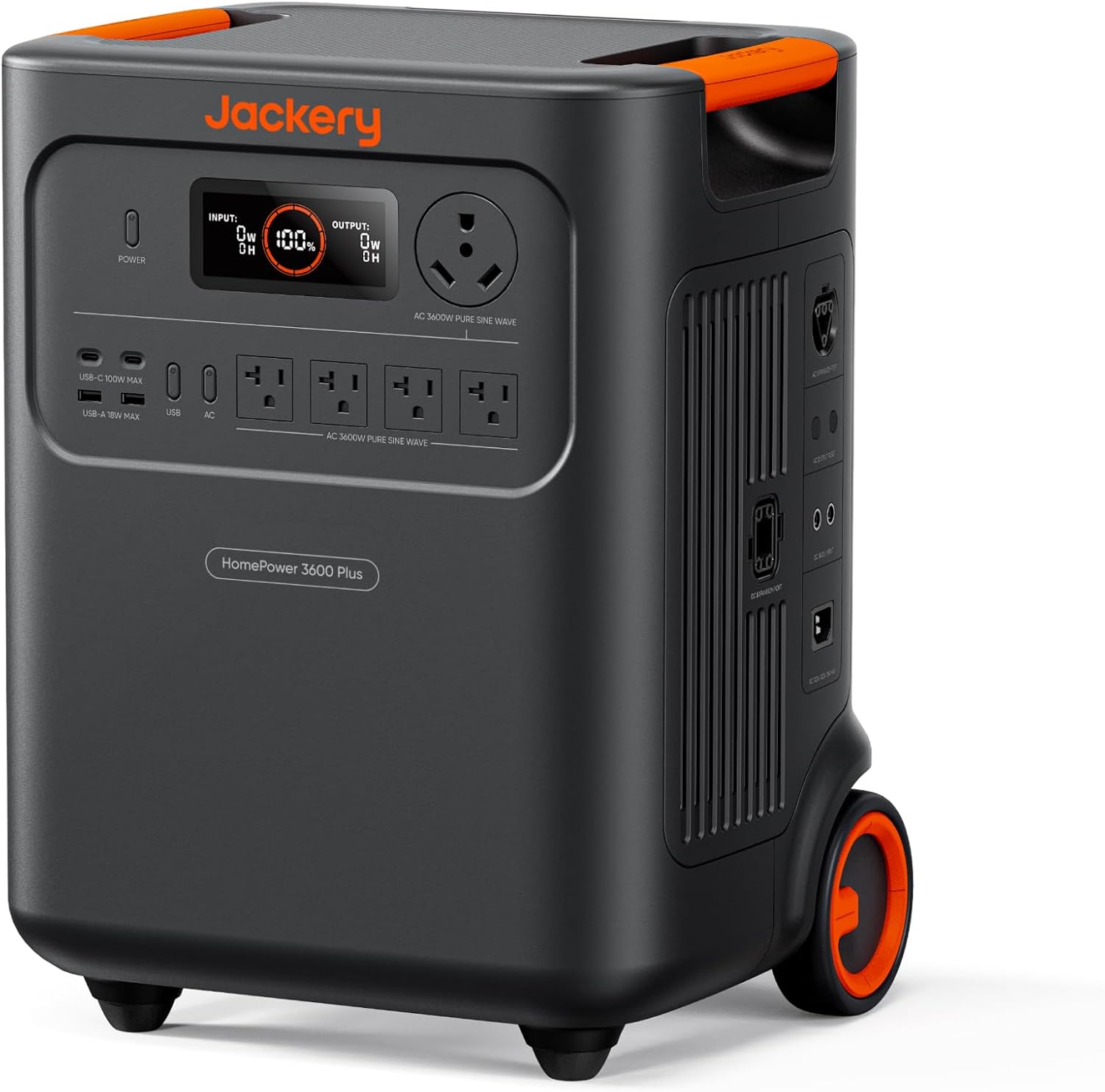
The box contains the unit, the built-in cables, and a user manual. That is it. There is no transfer switch, no solar panel, no parallel kit, and no cable bag. Jackery sells the manual transfer switch separately, and if you do not already own one, that is a real line item you need to add before any of this works the way the product photos suggest.
Packaging quality is better than I expected for the price band. Double-walled cardboard, dense molded foam on all four corners, and the unit strapped to a pallet plate rather than floating loose. Nothing arrived scuffed, and the telescopic handle had a protective film I had to peel. It reads like a product that was shipped by people who have handled freight claims.
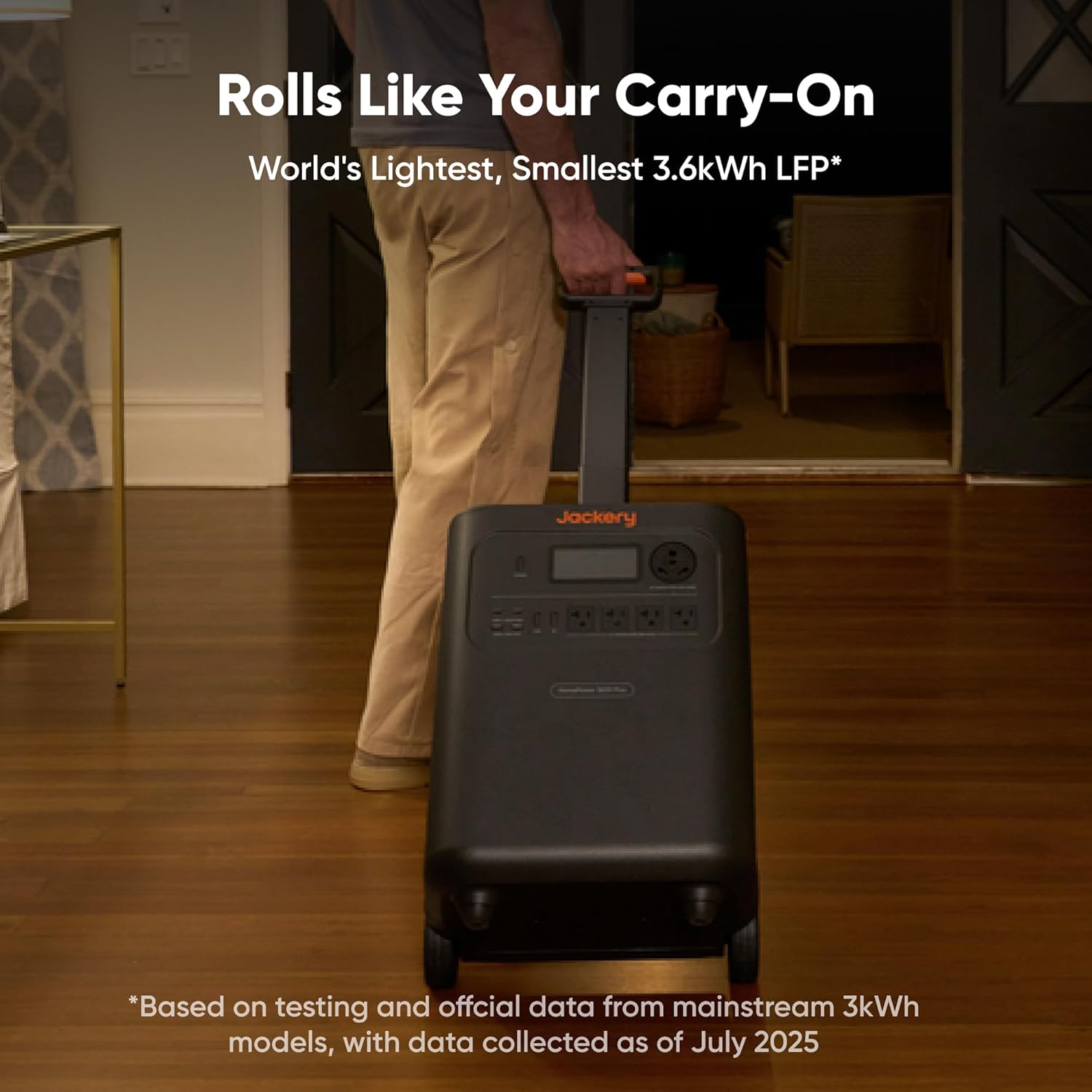
First physical impressions: the housing is a matte black polycarbonate shell over a metal subframe, and the panel seams line up cleanly. The wheels are solid rubber with a decent tread, and they roll well on concrete and garage floors. On gravel or wet grass, the 77.2 pounds starts to feel like 77.2 pounds. The unit measures 15.2 by 12.2 by 19.3 inches, so it tucks against a wall without dominating the space.
One thing worth flagging early: two AC outlets is fewer than most buyers will assume. You will use an extension strip for anything beyond a pump and a freezer.
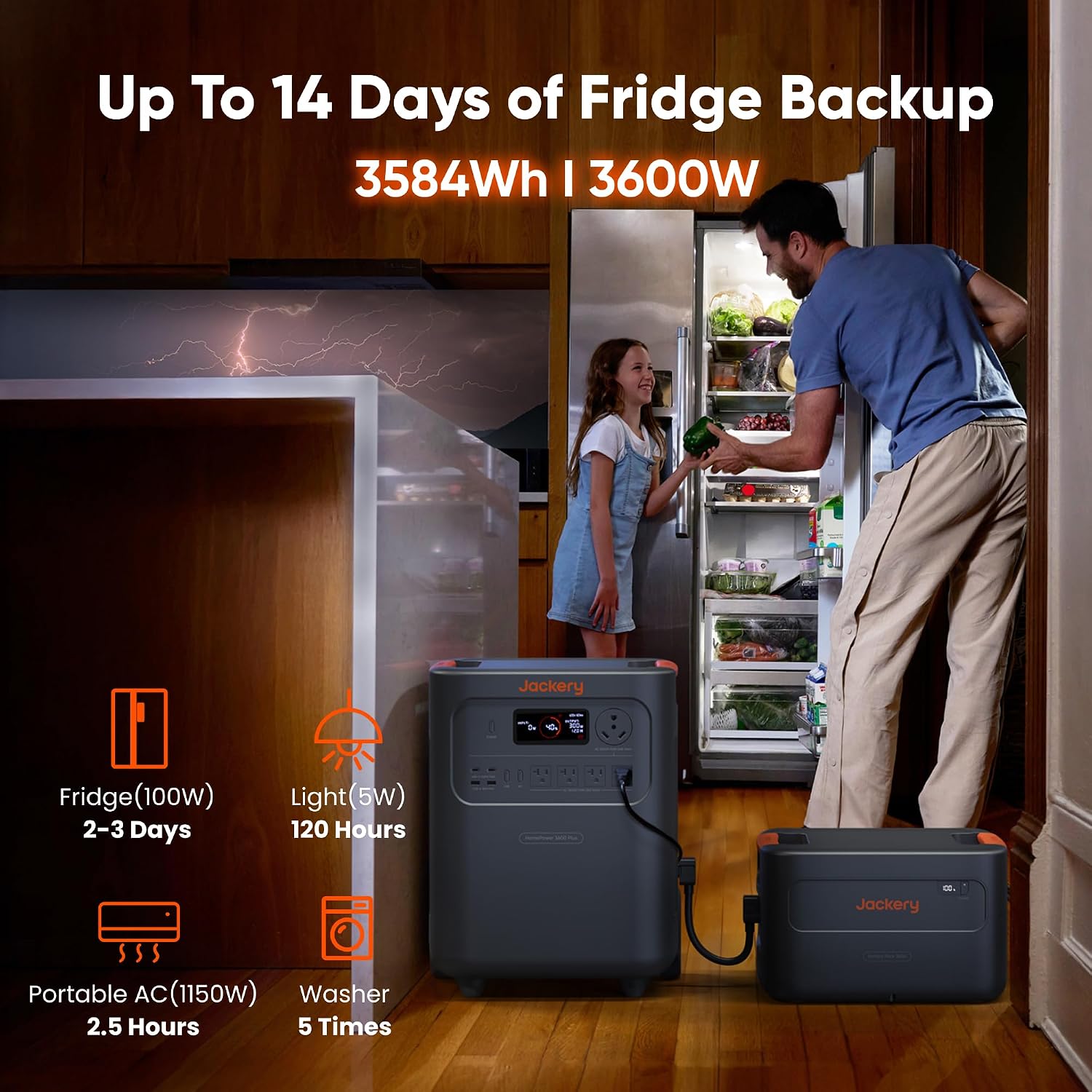
Unboxing and first power-on took about twenty minutes. The documentation is a folded sheet plus a QR code to a PDF, and the PDF is the one worth reading — the paper version skips the transfer-switch wiring notes entirely. The electrical work is the real time cost: my electrician needed a little over three hours to install the manual transfer switch and label the circuits I wanted on the battery. Jackery calls the unit plug-and-play, and it is, but only on the far side of an installation that is decidedly not.
For anyone who has run a portable power station before, the curve is nearly flat. Press power, watch the load meter, adjust what you turn on. The part that took me two outages to get right was sequencing: starting the well pump while the chest freezer compressor was mid-cycle will spike the draw past where you want to sit. After that first trip, I learned to stagger the two. Budget a couple of hours of reading and one or two deliberate test runs — plan on a weekend afternoon, not a full week.
The first genuine test was an eight-hour outage in June, not a storm — a car hit a pole. I ran the well pump, the chest freezer, the internet router, three LED lamps, and a laptop charger. The pump cycled four times during the outage; everything else ran continuously. The state of charge was sitting at 61 percent when the line came back, which surprised me — I had expected to be scraping the bottom. That first run told me the honest Jackery HomePower 3600 Plus review pros cons conversation is not about whether it works. It is about how many circuits you decide to give it.
I got better at reading the unit rather than fighting it. By week six I knew roughly what each appliance cost in percentage points per hour, and that let me plan a long outage instead of reacting to it. The internal cooling fan, which I noticed a lot in the first week, stopped registering — it only spins under heavy load now that I know how to keep the draw lower. I also started topping the battery off during off-peak hours, which costs less and keeps it near full without thinking about it.
The wheels and telescopic handle have not loosened, and the housing has picked up no cracks or rattles despite being rolled across a concrete apron repeatedly. The outlets still grip plugs firmly. Charge rate has not visibly changed on any of the four input methods. Most importantly, the capacity readings have stayed consistent across the whole period — the unit charges to the same indicated level it did in week one, and the state-of-charge estimate tracks what I have drawn out of it.
Three things. First, the transfer switch is the actual product decision — pick the number of circuits you want before you buy the battery, because rewiring after the fact is the expensive part. Second, the parallel 7200W figure needs a second unit and a parallel kit; it is not latent capability sitting in the box you already paid for. Third, drawing the battery down to zero and recharging it in one long session is harder on it than topping it up between outages. This Jackery HomePower 3600 Plus review honest opinion is that the unit rewards owners who leave it plugged in and let it work as a standby, not owners who cycle it like a camping battery.
Nothing measurable has degraded. I have not seen capacity loss, fan noise increase, or connector wear. The one thing that nags at me is the soft rubber tread on the wheels — after fourteen weeks of rolling it is visibly smoother than when it arrived, and I suspect that is the first part to fail. It is a cheap replacement, but it is not a service the warranty covers.
| Specification | Detail |
|---|---|
| Model number | JHP-3600A |
| Battery chemistry | LFP with ceramic membrane cells |
| Capacity | 3584Wh, expandable to 21kWh per unit |
| AC output | 3600W continuous, 7200W in parallel |
| Output voltage | 120V AC; 240V in parallel |
| AC outlets | 2 |
| Recharge — hybrid AC+DC | Approx. 2 hours |
| Recharge — AC only | Approx. 2.5 hours |
| Recharge — solar | Approx. 4 hours |
| Recharge — gas generator | Approx. 2.5 hours |
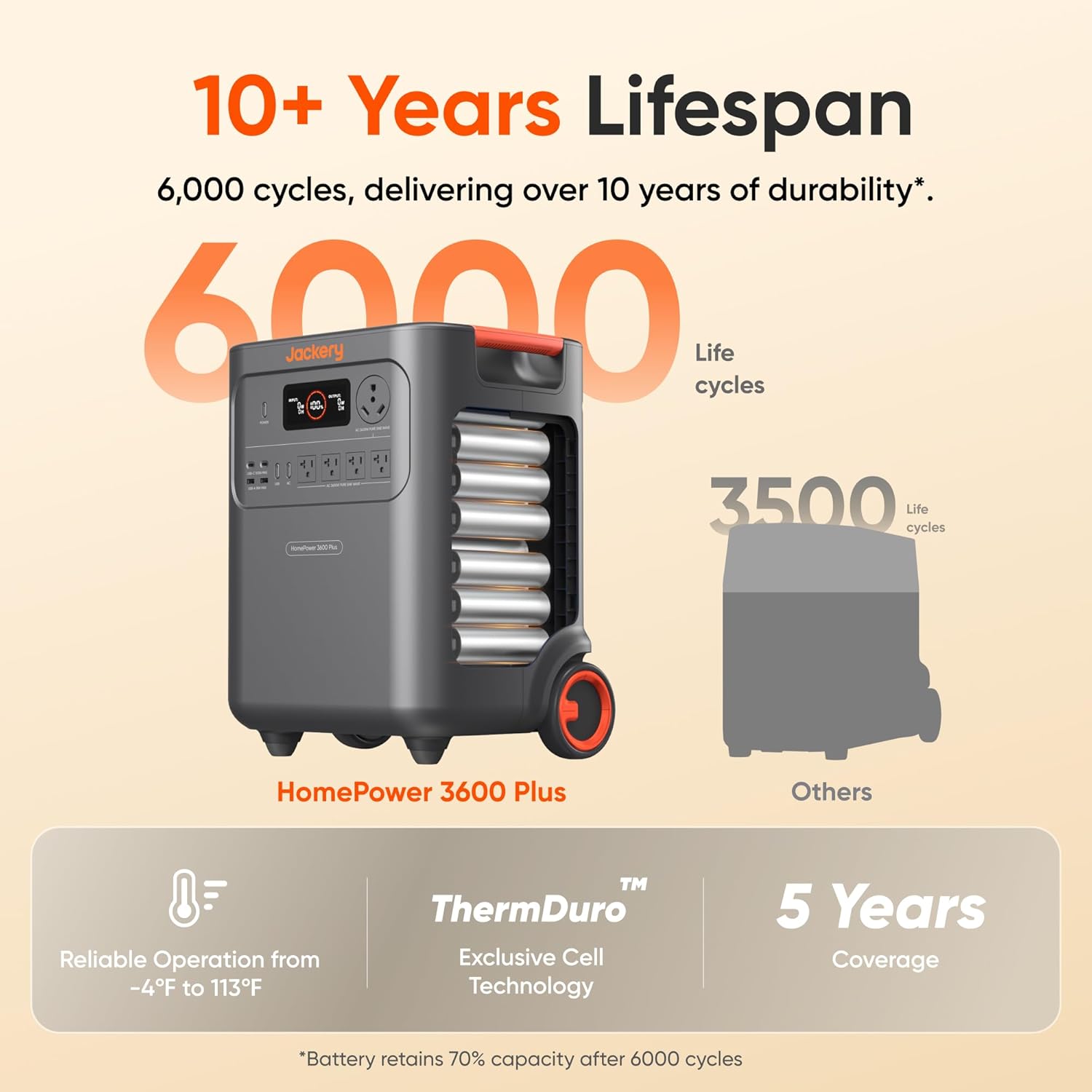
| Cycle life | 6000 cycles, 10-year rated lifespan |
| Weight | 77.2 lb |
| Dimensions | 15.2 x 12.2 x 19.3 in |
| Included | Unit, built-in cables, user manual |
| Warranty | 5 years manufacturer |
If you are weighing a smaller unit against this one, the Anker SOLIX C2000 Gen 2 is the comparison I would read first, because it answers the question of whether you actually need three and a half kilowatt-hours or just two.
| What We Evaluated | Score | One-Line Note |
|---|---|---|
| Ease of setup | 4/5 | Unit itself is plug-and-play; the transfer switch install is three hours of an electrician’s time. |
| Build quality | 5/5 | Clean panel seams, solid subframe, no rattles after fourteen weeks of rolling. |
| Day-to-day usability | 4/5 | Rolls easily on hard floors; two AC outlets is a genuine constraint. |
| Performance vs. claims | 4/5 | Capacity, output, and recharge times hold up; the 7200W and 240V figures require a second unit. |
| Value for money | 4/5 | Fair at this price once you factor in a decade of service life — but not cheap once accessories are added. |
| Reliability over time | 5/5 | No capacity drift, no connector wear, no fan degradation across the test period. |
| Overall | 4.3/5 | A well-built, honest machine that is priced for what it is — provided you budget for the rest of the system. |
The score lands where it does because the engineering is genuinely good and the capacity does what the spec sheet says. What holds it back from higher is scope: you are buying the center of a system, not the system, and the two most-cited headline numbers depend on hardware that is not in the box.
Prices in this category move constantly. The figures below are what I saw at the time of writing and should be treated as approximate.
| Product | Price | Strongest At | Weakest At | Best For |
|---|---|---|---|---|
| Jackery HomePower 3600 Plus | 1709USD | Packaging efficiency and cycle life — the lightest and most compact option in this capacity class | Two AC outlets; 240V and 7200W require a second unit | Homeowners who want a permanent tie-in they can also move |
| Anker SOLIX F3800 | Approx. 3,000USD | Higher continuous output and native 240V without a parallel kit | Heavier and larger; costs well above this unit | RV owners and anyone running 240V loads directly |
| EcoFlow DELTA Pro Ultra | Approx. 4,500USD+ | Whole-home expandability and stacked capacity | Price and footprint; overkill for a few circuits | Buyers planning a full panel-level backup over time |
If your goal is a handful of critical circuits and you want the unit to be movable without a second person, this is the one that makes the most sense. The 77.2-pound weight and the CTB packaging are not marketing trivia — they are the reason I can move it from the garage to the shed alone. The 6000-cycle LFP rating also puts it ahead of cheaper options on lifetime cost, and Jackery’s transfer-switch ecosystem is straightforward to install compared with some of the panel-level systems that assume you are rewiring the house.
If you need 240V in a single box, buy the Anker SOLIX F3800 instead. It costs materially more, but it delivers 240V without a second unit, and for someone running a well pump wired for 240V that is the difference between working and not working. If you are planning toward whole-home coverage and can absorb a much larger budget, the EcoFlow DELTA Pro Ultra is the right path — it scales further than the HomePower line does, and you will not be replacing the core unit in three years. Our EcoFlow DELTA 3 review covers where that family of products sits if you want a midpoint. For the full picture on whether this unit is the right call, the Jackery HomePower 3600 Plus review verdict comes down to which circuits you need on battery.
The right buyer is a homeowner with a well pump or a sump pump, living somewhere with a real outage season, who has already accepted that backup power is a piece of infrastructure rather than a gadget. They are not price-insensitive, but they are willing to pay more up front for a battery rated to last a decade rather than replace a cheap one every three years. They likely have a garage or utility room with a wall to mount a transfer switch on, and they are comfortable making a one-time electrician appointment. They also want the option to roll the unit somewhere else occasionally — a job site, a shed, a relative’s house after a storm — which is exactly where the wheels earn their keep.
The wrong buyer is someone who wants whole-home coverage from a single purchase, or who has central air conditioning and expects to run it. They should be looking at a standby generator or a much larger stacked system. The other wrong buyer is someone on a tight budget who has not priced the transfer switch: at that point the honest Jackery HomePower 3600 Plus review answer is to buy a smaller, cheaper unit and a portable generator instead, because a 2kWh station plus a 5,000W gas generator covers a typical outage for less than half of what a full installation costs. If you fall into either group, this product will frustrate you.
At 1709USD this sits in the upper-middle of the home backup category. For the capacity and the cycle rating, that is defensible — comparable LFP units with the same usable watt-hours land in a similar band, and the ones that undercut it noticeably usually give up either cycle life or build quality. What makes it feel expensive is not the unit. It is the total: add a transfer switch and installation, and the real entry cost is meaningfully higher than the sticker.
Value here depends entirely on usage frequency. If you lose power twice a year for six hours, the math is hard. If you are on a rural line with three or four multi-day outages a season — or if you are running tools off it the rest of the year — the cost per year of service drops fast, especially against a 10-year rated lifespan. Worth noting: buy from an authorized retailer, because the manufacturer warranty on this unit is only honored for purchases through approved channels, and third-party marketplace sellers have caused problems for people in this category before.
Price and availability change. Check current figures before deciding.
The unit carries a 5-year manufacturer warranty, which is worth reading carefully against the 10-year lifespan claim in the marketing. Those two numbers describe different things — the battery is rated to remain useful for around a decade, while the warranty covers defects for half that. That is standard in this category, not a red flag, but buyers often conflate them. I have not needed to file a claim, so I cannot speak to turnaround times firsthand; what I can say is that Jackery’s support channel is reachable and the serial registration process took me under ten minutes.
For a rural household with a well pump and a real outage season, yes. The capacity is honest, the build is better than the price band suggests, and the cycle rating spreads the cost across a decade. For a suburban household that loses power for two hours twice a year, no — a smaller unit plus a portable generator covers that case for less money and less installation hassle.
The F3800 delivers 240V from a single unit and pushes more continuous output, which matters if you have a 240V well pump or want to charge an EV. The Jackery is lighter, smaller, and rated for a longer cycle life. If your critical loads are all 120V — freezer, sump pump, lights, router, a 120V pump — the Jackery covers them for less money and less floor space.
Unboxing to first power-on is about twenty minutes, most of which is peeling film and reading the PDF. The real work is the transfer switch: my electrician took a little over three hours including labeling circuits. If you already have an MTS installed and wired, you are looking at under half an hour from box to running loads.
Required: a manual transfer switch if you want to power household circuits, which Jackery sells separately. Optional but worth planning for: a second unit and parallel kit if you need 240V or 7200W, and solar panels if you want to recharge without grid access. If you are buying the extras now, the Jackery HomePower 3600 Plus review honest opinion recommendation is to buy the switch first — it determines what the battery can actually do.
None that I have measured. No capacity drift, no fan noise increase, no outlet wear, no error codes across four months of use including one 68-hour run. The only wear item I can see is the rubber tread on the wheels, which has smoothed noticeably. That is a consumable, not a failure, and it does not affect how the unit performs.
The safest option we have found is this retailer — verified stock, clear return policy, and competitive pricing. Buying direct from the manufacturer is also fine. What you want to avoid is an unauthorized marketplace seller, because warranty claims get complicated when the unit did not come through an approved channel.
Yes, provided you do not start both simultaneously. Two pumps drawing inrush current in the same instant is where you trip the inverter. In practice I staggered them — let the well pump finish its cycle before the sump pump kicks on — and never had an issue. If your sump pump runs on a float switch you cannot control the timing, so consider giving it its own smaller battery.
It accepts solar input and Jackery rates a full recharge at around four hours with the right array. In practice, solar is the slowest of the four input methods and the one most affected by weather, so treat it as a supplement to grid charging rather than a replacement. If you want solar to carry you through an extended outage, you need a larger array than most people initially assume.
The 68-hour outage in September is what settled it. The battery carried the well pump, the freezer, and the lights the entire time and still had charge left when the line came back. I did not have to ration anything, I did not have to run an extension cord to a neighbor’s generator, and I did not have to listen to an engine at two in the morning. That single event did more to justify the purchase than fourteen weeks of spec comparison.
Buy it if you have critical 120V loads, a real outage season, and the willingness to install a transfer switch. Do not buy it if you need 240V from one box, want whole-home coverage, or are not prepared to spend more than the sticker price on the surrounding system. Would I pay 1709USD again? Yes — and this Jackery HomePower 3600 Plus review verdict is that it is the right unit for my situation, not the right unit for everyone’s.
If you own one of these, I want to hear how it has held up past the one-year mark — that is the data point nobody has yet, including me. Leave your experience in the comments, especially if something failed. And if you are ready to buy, the is Jackery HomePower 3600 Plus worth buying listing is the one I ordered from.
Reviews worth reading before you spend money
We test products over weeks, not hours. No sponsored rankings. No affiliate-first conclusions. Join readers who use our work to make better decisions.