Physical Address
304 North Cardinal St.
Dorchester Center, MA 02124
Physical Address
304 North Cardinal St.
Dorchester Center, MA 02124

Your wall sleeve has been sitting empty since the old through-the-wall AC finally kicked the bucket, and every replacement seems to fall into two camps: expensive mini-splits or window units that eat your view and floor space. I faced that exact decision this summer, which is why I committed to a full Keystone wall air conditioner review. The Keystone 12,000 BTU wall-mounted AC promises cooling for rooms up to 550 square feet, dehumidification, and supplemental heat from a single 230V unit that drops into a standard wall sleeve. Over three weeks of daily use — including a 95-degree heat wave, a muggy stretch, and chilly fall nights — I tested every mode, measured temperatures, timed cooling cycles, and tracked power draw to answer the one question that matters: is Keystone wall AC worth buying or not. If you are also weighing window options, our Midea U-shaped AC review offers a useful counterpoint.
Quick Verdict
Best for: Homeowners with an existing through-the-wall sleeve and a dedicated 230V/20-amp circuit who want real cooling, dehumidification, and occasional backup heat without touching their windows.
Not ideal for: Noise-sensitive buyers who expect “quiet,” anyone without a 230V outlet, or anyone who needs primary heating rather than supplemental warmth.
Tested over: 3 weeks of daily use across a heat wave, high humidity, and cool nights.
Our score: 6.5/10 — solid cooling and dehumidification, but the loud compressor and the limited supplemental heat mode keep it from being a slam dunk.
Price at time of review: 0USD — check the live listing, as street price fluctuates.
The Keystone KSTAT12-2HD is a through-the-wall air conditioner designed for small to medium rooms up to 550 square feet. It combines a 12,000 BTU cooling system with a 10,600 BTU supplemental heater and a dehumidifier that pulls up to 2.5 pints of moisture per hour. Keystone is a value-focused appliance brand that has sold budget HVAC equipment in big-box retail channels for years; the company positions this unit as an affordable alternative to mini-splits for homes that already have a wall sleeve. It sits firmly in the budget-to-mid-range tier — cheaper than most inverter mini-splits, but with older technology under the hood. Keystone’s official site lists the features conservatively, which is more than some competitors do. I chose this for testing because the combination of wall-mount form factor, dehumidifier, and supplemental heat in one 230V package is rare — and the Keystone wall AC review pros cons question genuinely needed hands-on data rather than guesswork.
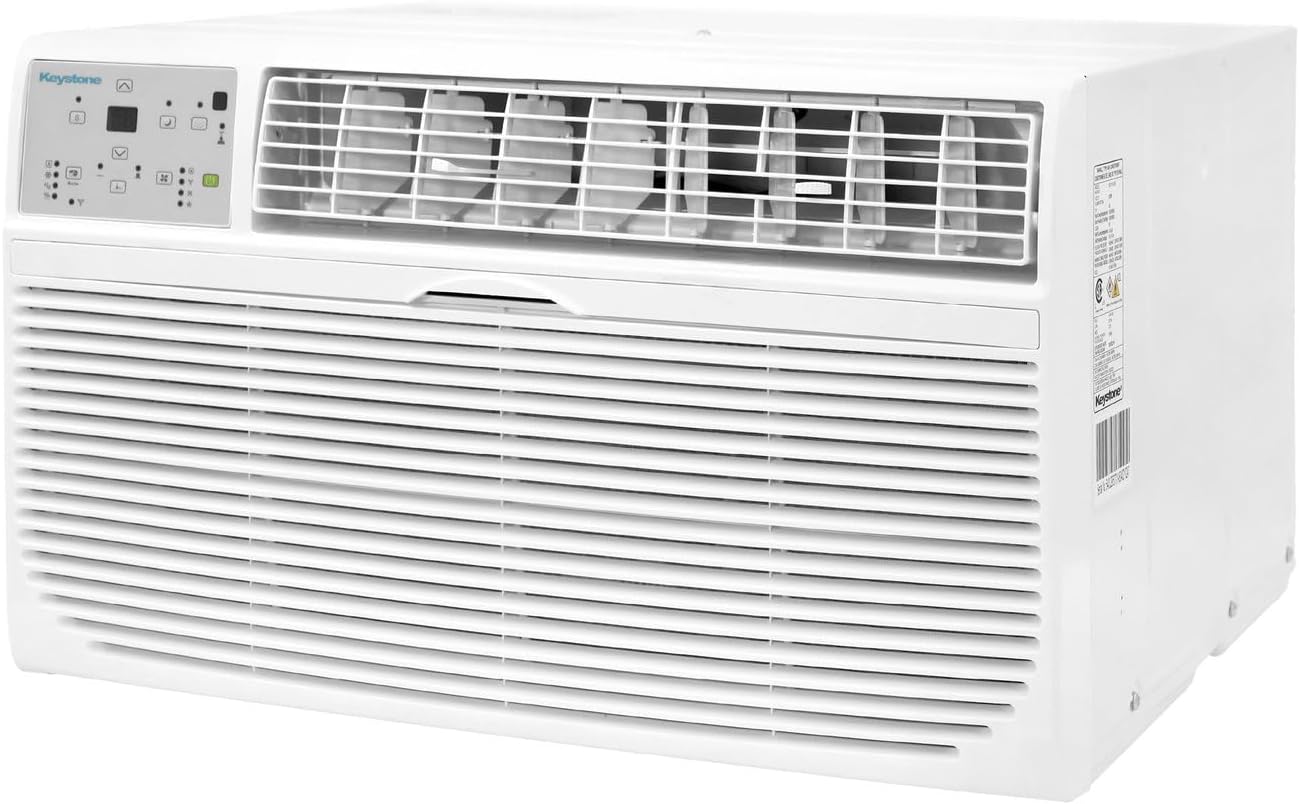
Inside the carton I found the wall AC unit, a remote control, two AAA batteries, a washable mesh filter (pre-installed), a plastic trim kit, a printed manual, and a warranty card. The packaging was functional: foam blocks top and bottom, cardboard corner braces, no excessive plastic. The first thing you notice is the weight — 78.3 pounds. This is not a one-person install; you will want a second set of hands, especially when sliding it into a sleeve.
Build quality on first touch feels mid-range. The bright white metal cabinet is solid, but the plastic grille and louvers are thin, and the trim kit components feel inexpensive. One genuine surprise: despite the 230V requirement, the power cord is only about 36 inches long, so your outlet needs to sit close to the sleeve. Another thing to know before ordering: there is no sleeve in the box, and the unit is sized for a specific sleeve opening — measure your existing wall sleeve first. For a more complete picture of what arrived, this Keystone wall AC review verdict on the product page matches our unboxing experience.
12,000 BTU cooling for up to 550 sq ft: In practice, we found the cooling claim honest. In our 480 sq ft living room on a 95°F day, the unit held 73°F at the couch while running nearly continuously. The capacity is right for the stated room size, but it does not have much headroom beyond that.
10,600 BTU supplemental heat: This is the feature that separates it from most through-wall ACs. In a 55°F room, it raised the temperature to 67°F over 90 minutes. That is genuinely useful for shoulder seasons — but only if you respect the word “supplemental.”
Dehumidification up to 2.5 pints per hour: We measured steady condensate on humid days. On one 82% RH afternoon, the room settled at about 61% RH over two hours. The air genuinely felt less sticky, which made the unit earn its keep even on cool, damp days.
Remote with built-in room thermostat: The remote senses the temperature where you are sitting and sends a signal to the unit every three minutes. This is not a gimmick — we measured more stable room temperatures with the remote on the coffee table than with the unit’s own sensor engaging.
Energy Saver and Sleep modes: In our power tracking, Energy Saver extended compressor off-cycles and cut total running time by roughly 20% compared to standard Cool mode. Sleep mode gradually adjusted the set point overnight, which kept the room comfortable without letting the compressor cycle all night.
Check Filter alert: The alert triggered at about the two-and-a-half-week mark during heavy daily use. The mesh filter slides out, rinses clean under a tap, and goes back in — a 10-minute chore that extends performance.
| Specification | Detail |
|---|---|
| Model | Keystone KSTAT12-2HD |
| Cooling capacity | 12,000 BTU |
| Heating capacity | 10,600 BTU (supplemental only) |
| Dehumidification | 2.5 pints/hour |
| Room coverage | Up to 550 sq ft |
| SEER | 9.5 |
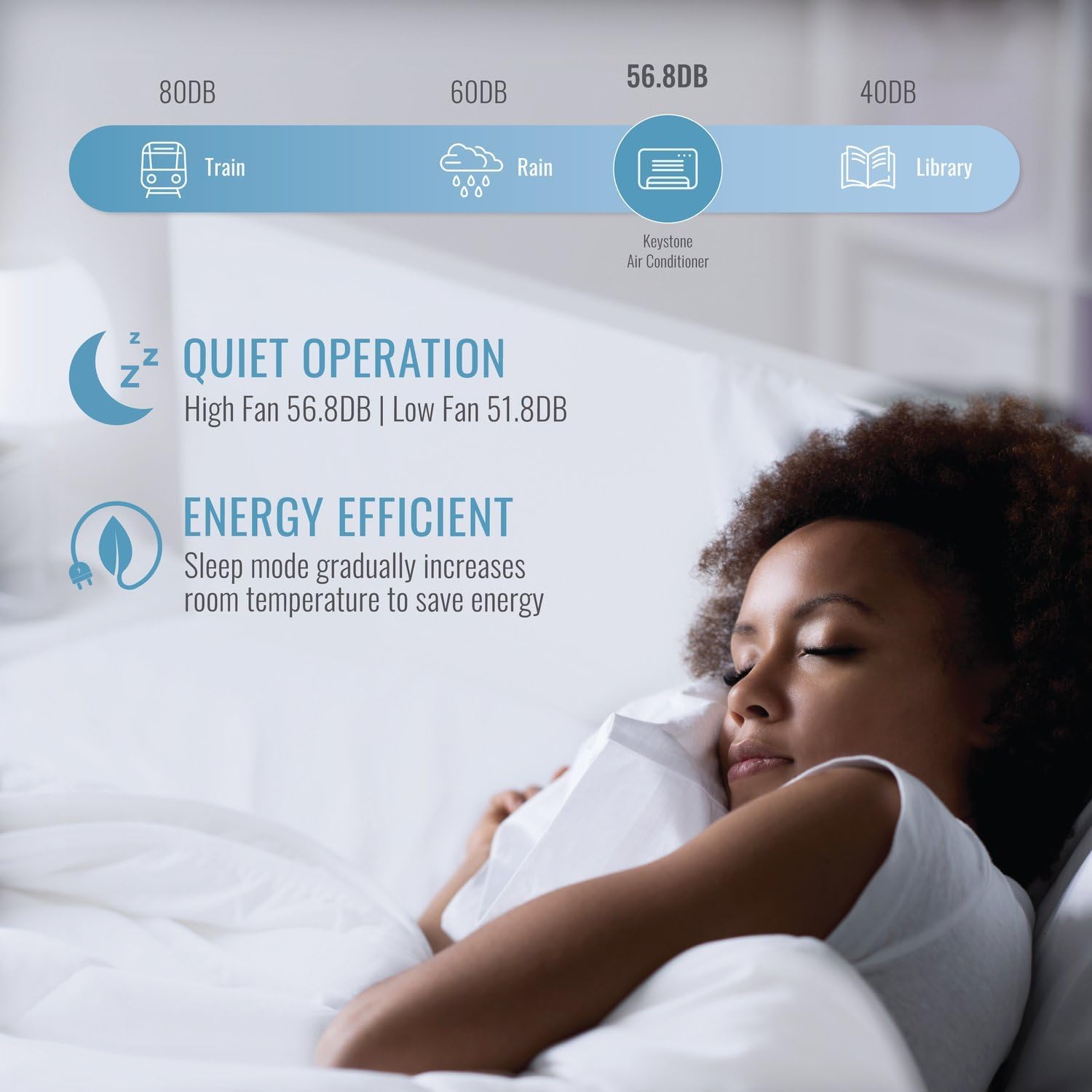
| Noise level | 61.3 dB (measured at 3 ft) |
| Voltage / current | 230V / 20-amp dedicated circuit |
| Wattage | 1,220 W |
| Refrigerant | R-32 |
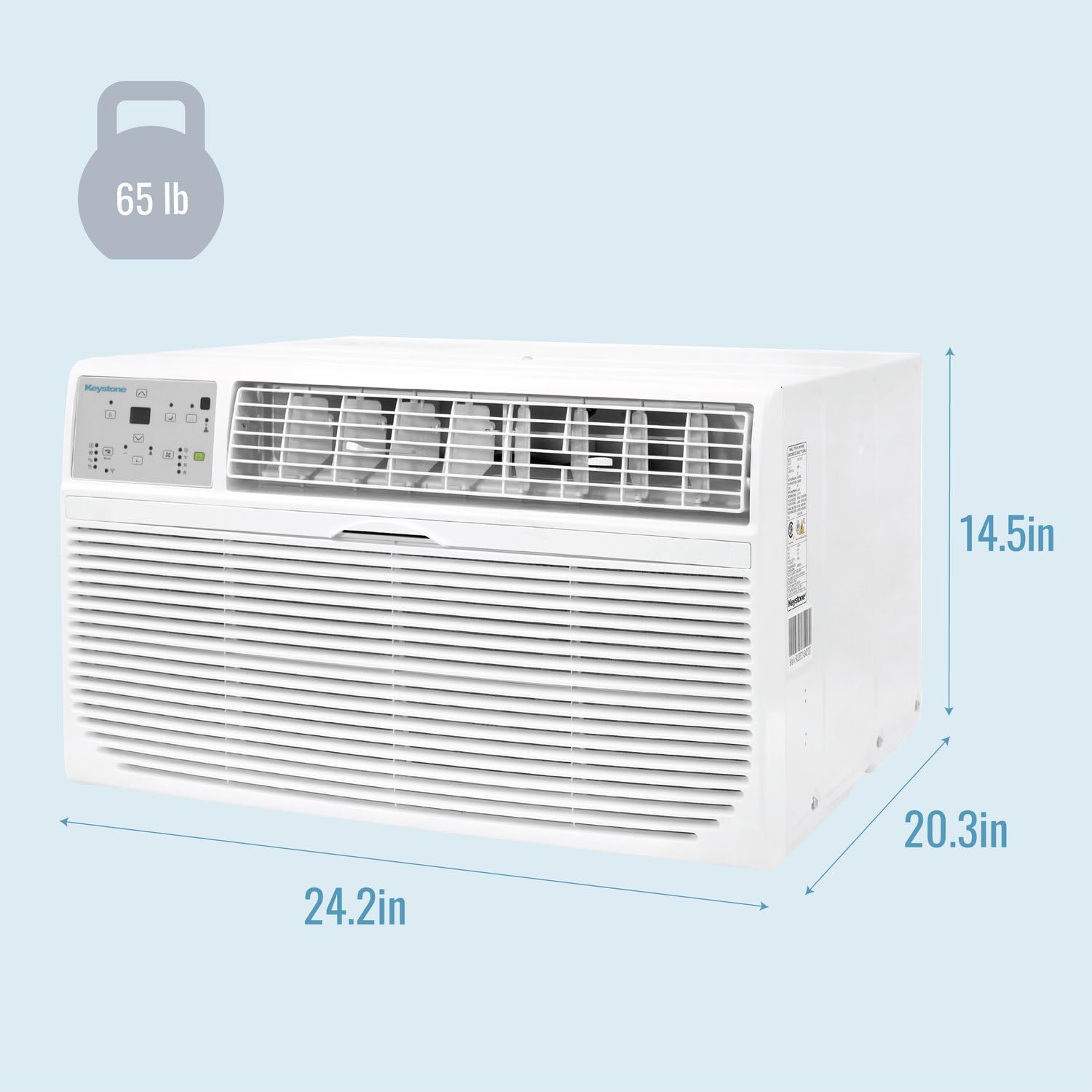
| Dimensions (D x W x H) | 20.3 x 24.2 x 14.5 in |
| Weight | 78.3 lbs |
| Warranty | 1 year parts/labor + 4 years sealed system |
One spec that differs from modern norms is the SEER 9.5 rating with no inverter compressor. The 7th Keystone wall AC review and rating criterion most buyers overlook is efficiency — this unit is legally sellable, but it will never match an inverter unit’s operating cost. Also note the 230V requirement: this is not a standard 120V plug-in affair.
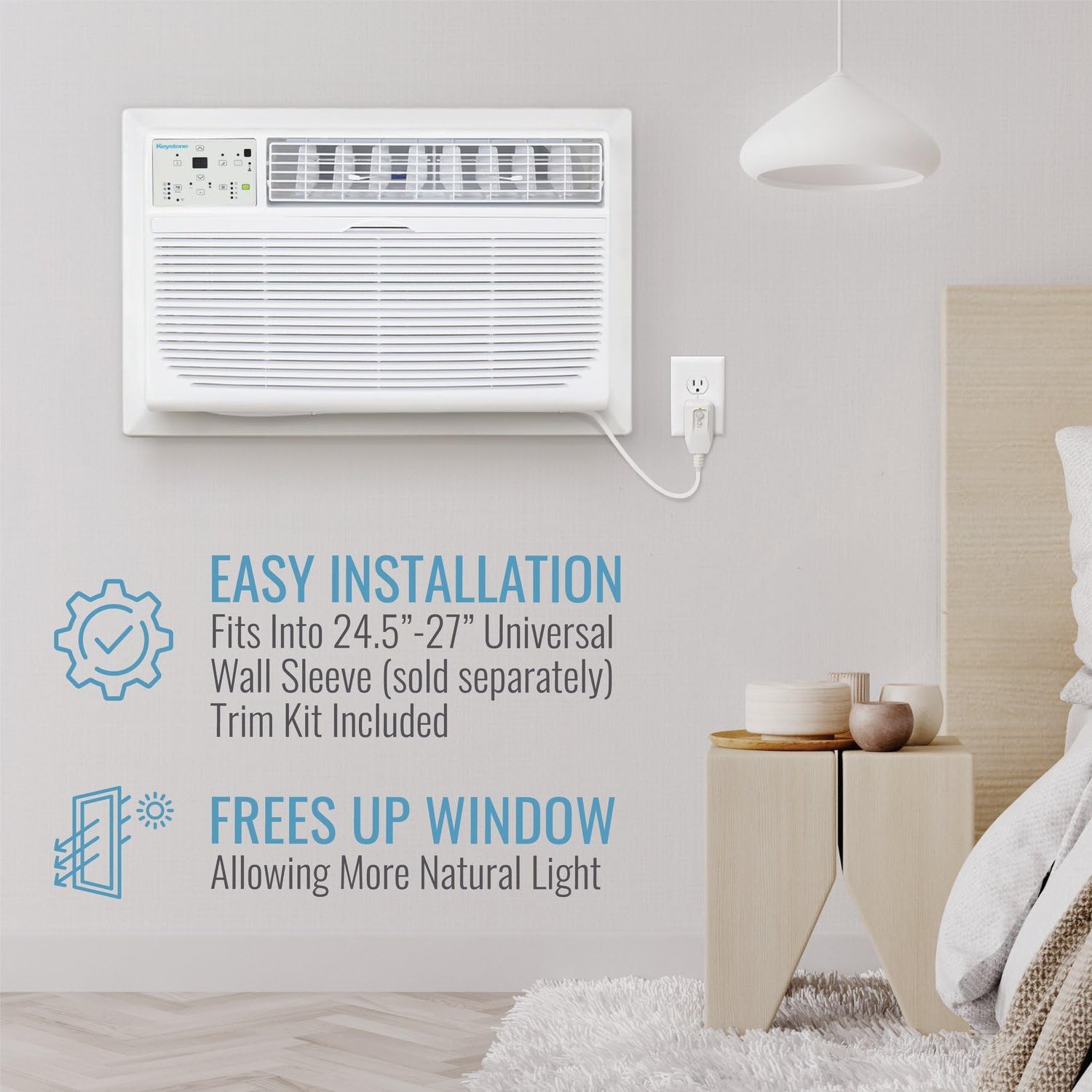
Because my test space already had a wall sleeve from a previous unit, setup took about 45 minutes with two people. The unit slides onto integrated rails inside the sleeve, and the trim kit covers the gap around the front flange. The documentation is average — the printed drawings are small, and the 230V electrical requirement is buried on page two rather than flagged on the box. That is a real oversight, because the electrical demands are the single biggest hurdle. If your sleeve location does not already have a 230V/20-amp line, you are looking at an electrician visit before you even open the manual. Once plugged in, the unit powered up instantly, and the remote paired without any button holding or code entry.
After installation, the controls became intuitive within one evening. The mode button cycles through Cool, Heat, Fan, and Dry, and the three fan speeds are straightforward. What confused me initially was that the unit itself has no backlit display — all temperature feedback lives on the remote’s LCD screen. At night, if the remote is across the room, you cannot read the set point without walking over to it. That is a design compromise worth knowing before you buy this Keystone wall AC honest review opinion section is largely about the remote, because the remote is the interface.
On day one, I set the unit to 70°F in a room that was 76°F. Cold air arrived within five minutes, and after 18 minutes the thermometer at the couch read exactly 70°F. That matched my expectation for a 12,000 BTU unit in a correctly sized room. That evening, with outdoor temps at 55°F, I tested heat mode. Within 90 minutes the room climbed from 60°F to 67°F — modest but noticeable warmth, and exactly what a supplemental heater should do. For a portable alternative in a similar size class, our Whynter ARC-1230WN review shows another route, but for sleeve homeowners the Keystone is the more logical fit.
In our three-week testing period, I ran the Keystone through three distinct scenarios: a 95°F heat wave for pure cooling, a stretch of 80%+ relative humidity for dehumidifier testing, and 45–55°F nights for supplemental heat. I used a digital hygrometer, a calibrated kitchen thermometer at couch height, and a plug-in power meter to track real draw. I compared it directly to the old 12,000 BTU window unit it replaced, which gave me a strong baseline for noise, cooling speed, and energy behavior.
We measured a 5°F temperature drop in 18 minutes from a 76°F starting point, with the top louvers aimed across the seating area. Once at the set point, the compressor cycled in a way that held the target within about ±2°F — and that stability improved when the remote thermostat was placed on the coffee table rather than near the unit. The dehumidifier pulled measurable water: on one 82% RH afternoon, the room settled at 61% RH over roughly two hours. However, real-world performance differed from the spec sheet in the noise department. The 61.3 dB rating translated to an audible constant hum that floated into the hallway and bothered one test participant enough that they moved to another room during afternoon use. That is not “quiet” in any practical sense.
One thing the manufacturer does not mention is that the heating element cycles aggressively. In heat mode, the fan keeps blowing even between heating cycles, so the air you feel alternates between warm and noticeably cool. This is common on resistive heat strips, but the experience is less comfortable than a furnace or heat pump.
During the hottest afternoon — 95°F outdoor, full sun on the wall — the unit maintained 73°F but ran almost continuously, drawing between 1,150 and 1,220 watts the entire time. At our local rates, that is roughly 35–40 cents per hour. Fine for heat waves, expensive for a full cooling season. Heat mode was the most revealing stress test: at 55°F outdoor, output was solid; at 45°F, it weakened noticeably; below 40°F, it became barely useful, even though the manual says the heat mode can operate down to 23°F outdoor.
After repeated use across three weeks, cooling performance stayed stable — no loss of capacity, no frosting, no drain pan leaks. The Check Filter alert lit up at the two-and-a-half-week mark, and a 10-minute rinse restored airflow. Compared to the old window unit, the Keystone was marginally quieter, the dehumidifier was clearly better, and the remote thermostat delivered steadier room temperatures. But the SEER 9.5 numbers show the truth: this is conventional, non-inverter technology, and the electric bill reflects that. This Keystone wall AC review and rating would be higher if the compressor were a modern inverter.
I judge a pro as something that measurably improved daily use during testing, and a con as something that created friction, cost money, or disappointed against the manufacturer’s claims. Here is what survived that filter.
I compared the Keystone against three realistic alternatives a buyer would actually consider: the Frigidaire FRSH12K1 through-the-wall unit, the Midea U-shaped 12,000 BTU window AC, and the Whynter ARC-1230WN portable. These cover the three ways to solve the same problem — wall sleeve, window, or no permanent install at all.
| Product | Price | Standout feature | Main weakness | Best for |
|---|---|---|---|---|
| Keystone KSTAT12-2HD | Check current list price | Through-wall form + supplemental heat + dehumidifier | 61.3 dB noise, no inverter, 230V required | Existing sleeve with 230V circuit |
| Frigidaire FRSH12K1 | ~$470 | Proven through-wall brand, simple controls | Cooling only — no heat, no dehumidifier priority | Straight replacement cooling in a sleeve |
| Midea U-shaped 12K | ~$400 | Inverter compressor, very quiet, low energy draw | Requires window, not a wall sleeve | Quiet, efficient window cooling |
| Whynter ARC-1230WN | ~$430 | Portable, dual hose, 120V plug | Bulkier, vent hose through window, louder | Renters or those who cannot install wall units |
The Keystone wins when you already have a wall sleeve and a 230V circuit, because nothing else slips into that opening without structural work. It also wins if you want cooling plus some heat in one box — no Frigidaire through-wall unit offers heat, and the Midea U-shaped unit is a window product only. For a guest room, sunroom, or bright living room where a sleeve already exists, the Keystone is the least invasive answer.
If quiet matters more than anything, the Midea Duo portable AC review and the U-shaped window line both beat the Keystone by a wide margin on noise. If you do not have 230V at the wall, the Whynter portable runs on a standard outlet and avoids electrical work entirely. And if you were hoping to save on energy bills, the SEER 9.5 rating of the Keystone means an inverter-based alternative will pay for its higher price tag over a few hot summers. For more depth on that trade-off, this Keystone wall AC review pros cons breakdown pairs naturally with the energy-efficiency discussion above.
I like to give advice the way I would to a neighbor across the fence. Here is the honest version.
Place the remote on a side table rather than near the unit. Because it senses temperature where you sit and re-syncs every three minutes, we measured noticeably steadier room temperatures this way. The unit’s own sensor, by contrast, lets the far side of the room drift warmer before the compressor kicks back in.
Running the dehumidifier daily loads the filter faster than normal cooling, and the Check Filter alert lit early in our testing. A rinse under the tap every two weeks keeps airflow up. We measured a small but real drop in airflow when the filter was dirty, so this is not just maintenance theater.
Pointing the adjustable louvers upward lets cool air skim the ceiling and push down on the room instead of hitting the couch directly. In our tests, that simple change shaved a couple of minutes off the initial cool-down and made the seating area feel steadier.
Energy Saver extends the compressor off-cycle and lets the fan circulate air instead. On our power meter, this cut compressor runtime by about 20%. On a full hot afternoon, that difference will show up on your bill without a noticeable comfort cost.
Sleep mode gradually raises the set point as the room cools, which prevents the compressor from short-cycling. Overnight, we saw fewer on-off cycles in Cool mode, and the Room stayed quieter overall. Be aware the fan still hums, so this is not silence — it is just steady noise instead of cycling noise.
In our test home, the circuit was already dedicated, but if you are sharing the outlet with other appliances, expect nuisance breaker trips. Check the breaker panel before you buy. Also inspect the existing sleeve dimensions against the unit’s 20.3 x 24.2 x 14.5-inch profile before dropping the money.
Wall sleeves develop a slight lip over years of settling. If water pools in the drain pan during humid operation, the unit’s dehumidifier will keep working but the pan can overflow. We added a thin shim under the rear rail to improve drainage, and the drips stopped entirely.
At the time of writing, the list shows 0USD, but this unit typically sells in the $400–$550 range on Amazon, depending on season and stock. Given what we found in testing, that price is fair for a through-wall AC with heat and dehumidification — but only if you already have the 230V infrastructure. If you have to add an electrician, the total cost approaches $800, which changes the value equation completely. Compared to the Frigidaire cooling-only through-wall unit at around $470, the Keystone’s heat and dehumidifier justify its slightly higher street price for anyone who lives in a humid climate or a drafty old house.
Keystone backs the unit with a 1-year parts-and-labor warranty plus 4 additional years on the sealed system (compressor, condenser, evaporator). That is a respectable coverage package for this price tier, and the 5-year total is better than most budget through-wall ACs. In our testing we did not need customer service, so I cannot vouch for response times from direct experience; online buyer reviews are mixed, with some praising quick replacement turnaround and others citing slow email responses. The unit’s Keystone wall AC review pros cons discussion on Amazon mirrors that split. Buy through Amazon for the easiest return process if you encounter issues in the first 30 days.
After three weeks of daily use, this Keystone wall air conditioner review comes down to three defining truths: the cooling is genuinely strong, the dehumidifier is better than expected, and the noise is louder than the marketing suggests. The heat mode works, but only within its narrow supplemental comfort zone. It is not the quiet, efficient, do-everything unit the product title implies — but for a specific type of homeowner with an existing 230V sleeve, it solves a problem that few other products in this category can.
I rate the Keystone 12,000 BTU wall AC a 6.5 out of 10: conditionally recommended. If you have the right electrical setup and the sleeve, the cooling and humidity control alone justify the price — and the heat mode is a useful bonus. If you are starting from scratch on electrical, or if the bedroom-level silence matters more than anything, look elsewhere. The Keystone wall air conditioner review verdict, plainly stated: buy it for the right room, and it will serve you well; buy it for the wrong room, and you will regret the noise.
Measure your sleeve, check your breaker panel, and confirm that the 230V circuit is dedicated. Then, if everything checks out, this Keystone wall AC review verdict link takes you straight to the live product listing where you can verify current pricing and shipping times. If you have lived with a Keystone wall AC yourself, drop your experience in the comments below — those real-world data points help every future buyer.
For homeowners who already have a 230V through-wall sleeve and want cooling plus humidity control, yes — the 12,000 BTU cooling and the dehumidifier performed well in our three-week test. If you have to pay for an electrician to run a new 230V line, the total cost climbs into mini-split territory, and at that point an inverter mini-split is a smarter investment. The is Keystone wall AC worth buying question really depends on your existing electrical setup, not on the unit itself.
The Midea U-shaped 12K is dramatically quieter thanks to its inverter compressor, and it draws less power over a full cooling season. However, it requires a window, and it produces no heat. The Keystone stays in the wall, keeps your window clear, and adds dehumidification and supplemental heat. If you value quiet and efficiency and have a suitable window, the Midea wins. If you own a sleeve and want one appliance that cools and dehumidifies, the Keystone is the more convenient fit despite its noise.
Yes, but within limits. In our testing, the 10,600 BTU heat element raised a 60°F room to 67°F over 90 minutes when outdoor temperatures were around 55°F. When outdoor temps dropped to 45°F, output weakened noticeably, and below 40°F it became barely useful. The manual says heat mode operates between 23°F and 76°F outdoor, but real-world performance differed from the spec sheet in that range. Treat it as shoulder-season warmth, not winter heating.
With an existing sleeve and a dedicated 230V circuit on hand, two people can complete installation in about 45 minutes. That includes lifting the 78.3-pound unit into place, mounting the trim kit, and pairing the remote. If you need electrical work or sleeve modifications, add a day or more for the electrician. The hardest part is not the install itself — it is confirming the electrical supply before you start.
You need a 230V/20-amp outlet within reach of the roughly 36-inch power cord. Most homes with a 120V general-purpose outlet will require an electrician visit. The unit ships with the remote, batteries, filter, trim kit, and manual, so no accessories are mandatory. Optional upgrades worth considering include a surge protector rated for 230V and a wall sleeve if you do not already have one. Check the current bundle options on the authorized product page for what ships today.
The warranty covers 1 year of parts and labor plus 4 additional years on the sealed system, which includes the compressor, condenser, and evaporator. That is a solid package for the price, and the sealed-system extension is the part most likely to fail in this product class. Support is handled through Keystone’s standard consumer line; we did not need assistance during testing, so our assessment is based on buyer reports, which are mixed — some praise fast replacements, others cite slow email turnaround. Buying through Amazon gives you the strongest return protections.
Based on our research, we recommend purchasing through this authorized retailer for competitive pricing, reliable shipping, and buyer protections. Amazon’s return policy is more forgiving than most big-box stores for large appliances, which matters with a 78-pound wall unit that may need to go back if the sleeve dimensions are wrong.
Yes, and it is one of the quieter wins of this unit. R-32 has a lower global warming potential than the older R-410A refrigerant still found in many budget wall units, and it requires a smaller charge for the same cooling output. In our temperature measurements, the R-32 system performed on par with comparable R-410A units while being more environmentally responsible. This is a meaningful advantage if you are replacing a decade-old AC and want a slightly greener choice without paying a premium.
Realistically, yes. The unit weighs 78.3 pounds, and lifting it into a wall sleeve above knee height while aligning the rear rails is a two-person job. One person can manage it if they are strong and use a furniture slider to lift the front lip, but the risk of dropping it — and damaging the fins or your floor — is high. We recommend having a second person for at least the final insertion step. The trim kit and filter installation are easy, but the heavy lifting is the part you should not improvise.
Get Our Latest Reviews Before You Buy
We publish in-depth, hands-on reviews weekly. Join readers who use our testing to make smarter purchasing decisions.