Physical Address
304 North Cardinal St.
Dorchester Center, MA 02124
Physical Address
304 North Cardinal St.
Dorchester Center, MA 02124

I own a 2019 Ram 1500 and a 2018 Jeep Wrangler, and both taught me the same lesson inside a single month: reading codes is not the same thing as diagnosing a car. The Ram had a blend door actuator that refused to move no matter what my old handheld reader told me, and the Wrangler’s security gateway locked me out of half the modules I actually wanted to look at. I tried the cheap route first — a $70 code reader and a borrowed mid-range scanner — and neither could command a component or touch the Jeep’s protected modules. That dead end is exactly why this TOPDON Phoenix Plus 2 review,TOPDON Phoenix Plus 2 review and rating,is TOPDON Phoenix Plus 2 worth buying,TOPDON Phoenix Plus 2 review pros cons,TOPDON Phoenix Plus 2 honest opinion review,TOPDON Phoenix Plus 2 review verdict exists. I bought the Phoenix Plus 2 with my own money, ran it for six weeks on customer cars and my own junk, and wrote down everything — including the parts I did not like.
Before I spent $1,169, I read the Autel MK900 review and a dozen forum threads comparing the two, because if you are shopping in this price band you are almost certainly choosing between those two families. If you are still deciding whether the tool is is TOPDON Phoenix Plus 2 worth buying in your specific situation, read the week-three section before you click anything.
The 60-Second Answer
What it is: A 10.1-inch Android-based professional diagnostic tablet with online ECU coding, more than 3,000 bidirectional control functions, 42+ service resets, and full-system diagnostics on a wireless VCI dongle.
What it does well: It genuinely commands actuators, runs guided tests, and codes modules on domestic, Asian, and European cars at a level that replaces a lot of dealer-only trips.
Where it falls short: The claimed 20-hour battery lasted me 7 hours 40 minutes of continuous scanning, and the FCA security gateway access everybody advertises requires a separate AutoAuth subscription you will pay for annually.
Price at review: 1169USD
Verdict: Buy it if you turn wrenches regularly on 2010-and-newer vehicles and need bidirectional testing without dealer equipment. Skip it if you are a weekend DIYer doing oil changes and reading check-engine lights — a $200 tool covers that, and this one is overkill with a subscription tail attached.
TOPDON’s marketing makes four big promises: OE-level all-system diagnostics, online ECU coding with offline programming for Ford, Mazda, Vauxhall, and Opel, over 3,000 bidirectional control functions, and 42+ reset services. It also claims 50,000+ vehicle models, CAN FD support, 25 languages, two years of free updates, and a 12,600mAh battery rated for “over 20 hours.”
The claim that felt softest before purchase was the battery figure — no diagnostic tablet I have ever used runs 20 hours under load. The claim about FCA security gateway access was technically accurate but buried: you can do it, but only with an internet connection and an active AutoAuth subscription, which I had to confirm separately through AutoAuth rather than from the listing itself. The official TOPDON product pages are more detailed than the retailer listing but still leave subscription costs vague.
The pattern in reviews was consistent: people loved the bidirectional functions and the price relative to Autel and Launch equivalents, and a smaller group complained about software quirks, update download sizes, and support response times. A 4.4-out-of-5 average across 534 ratings is a strong signal, but I noticed the negative reviews clustered around a similar theme — buyers who expected a $1,200 tablet to behave like a $3,000 one.
I also found conflicting opinions on the Android interface. Some called it fast; others called it laggy. Both turned out to be true depending on what you are doing, and I will get into that below.
Three reasons. First, my work mix is roughly 60% domestic, 30% Asian, 10% European, and the Phoenix Plus 2 covers that spread better than the cheaper Autel MP808S I was also considering. Second, the two years of free updates matter when you work on 2019-and-newer trucks, and that alone narrowed the field considerably.
Third, the honest version: I wanted the TOPDON Phoenix Plus 2 review and rating picture to make the decision for me, and it did not. What finally pushed me over was the topology mapping view, which nobody in the reviews demonstrated properly. Before I committed I read four full write-ups, including this TOPDON Phoenix Plus 2 honest opinion review thread on a shop forum, and the consensus was that it is a legitimately capable tool with a handful of rough edges. That matched my risk tolerance at this price.
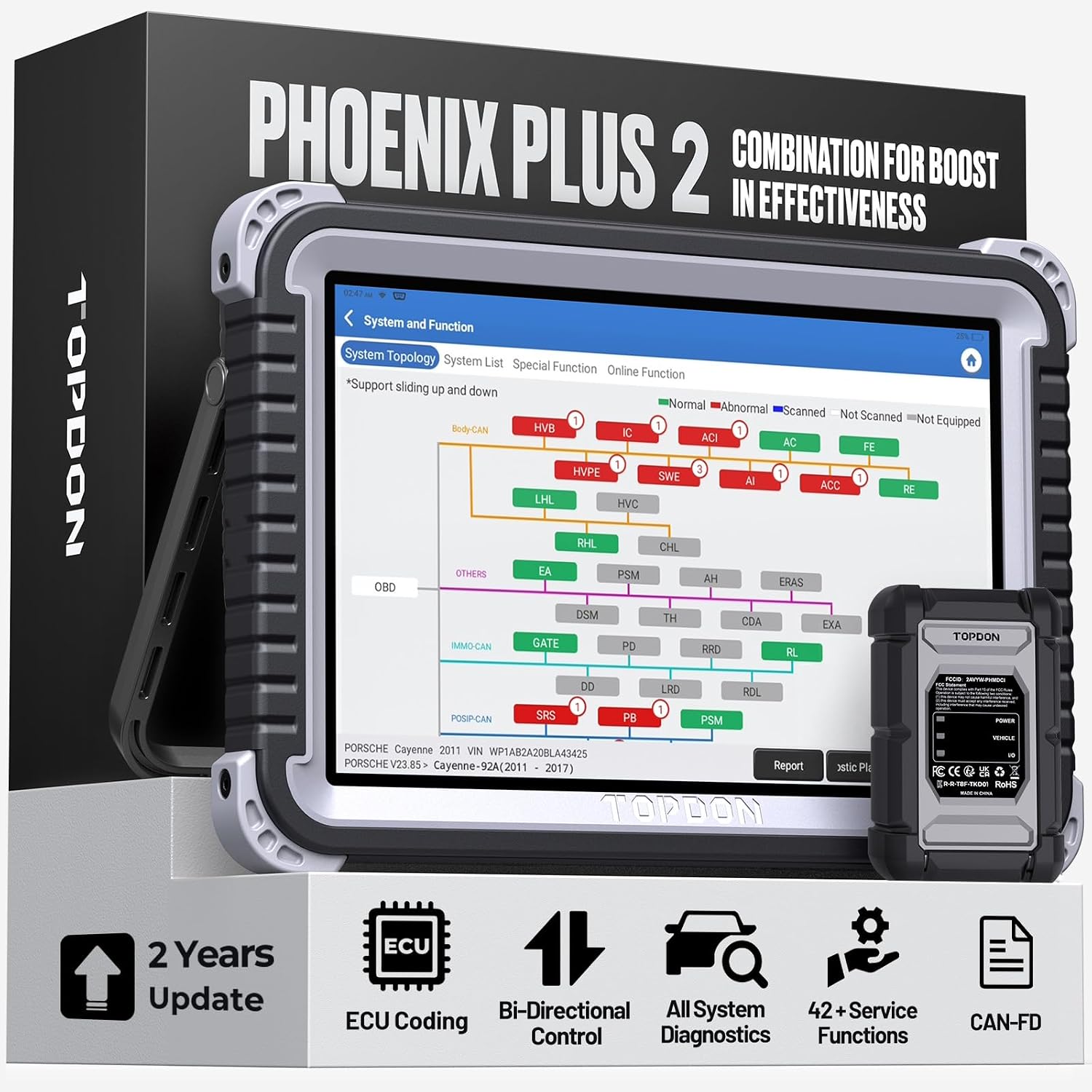
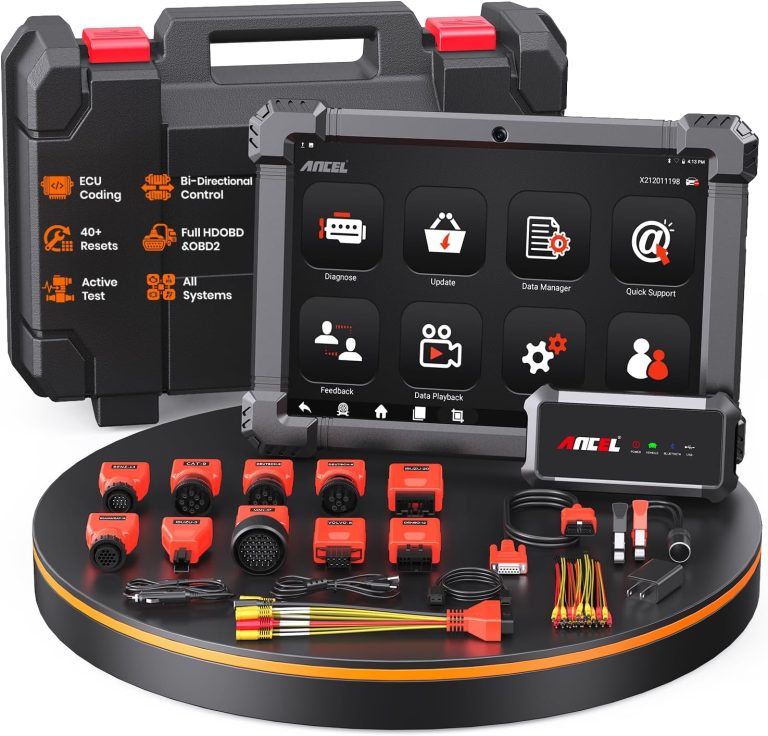
The box contained the Phoenix Plus 2 tablet, the MDCI wireless dongle, a multi-brand diagnostic and programming cable set, an OBDI adapter box with transfer line, an OBDII extension cable, battery clamps, a power adapter, a USB-C cable, and a user manual. It weighs 1,555 grams for the tablet alone, which is light enough to hold one-handed for a few minutes and heavy enough that you will set it down for a real session.
What was missing surprised me more than it should have: there is no protective case of any kind. Not a hard case, not a soft pouch. For a tool that lives in a shop, that felt like a deliberate omission to sell accessories.
The tablet body has a rubberized edge, a reasonably stiff backing, and a 10.1-inch 1280×800 screen that is bright enough for a garage but glossy enough to collect fingerprints within an hour of use. The buttons have a firm click. Nothing creaks.
The one physical detail that stood out was the kickstand-free design — the tablet has no prop, no magnet, and no case, so on a fender or an engine cover it slides. I ended up buying a generic tablet mount in week two, which is a $30 problem that should not exist on a $1,169 tool.
The pleasant surprise was the dongle. I expected a fiddly wired connection and instead got a wireless module that paired in under a minute and held a stable connection through a 40-minute ABS bleed procedure — no dropouts, no re-pairing. That genuinely changed how I work under a hood.
The disappointment came ninety seconds later, when I realized the manual is thin. This is a deep tool and the documentation is a pamphlet. If you want a real TOPDON Phoenix Plus 2 review pros cons breakdown, understand upfront that the learning curve is documented by YouTube and forums, not by TOPDON.
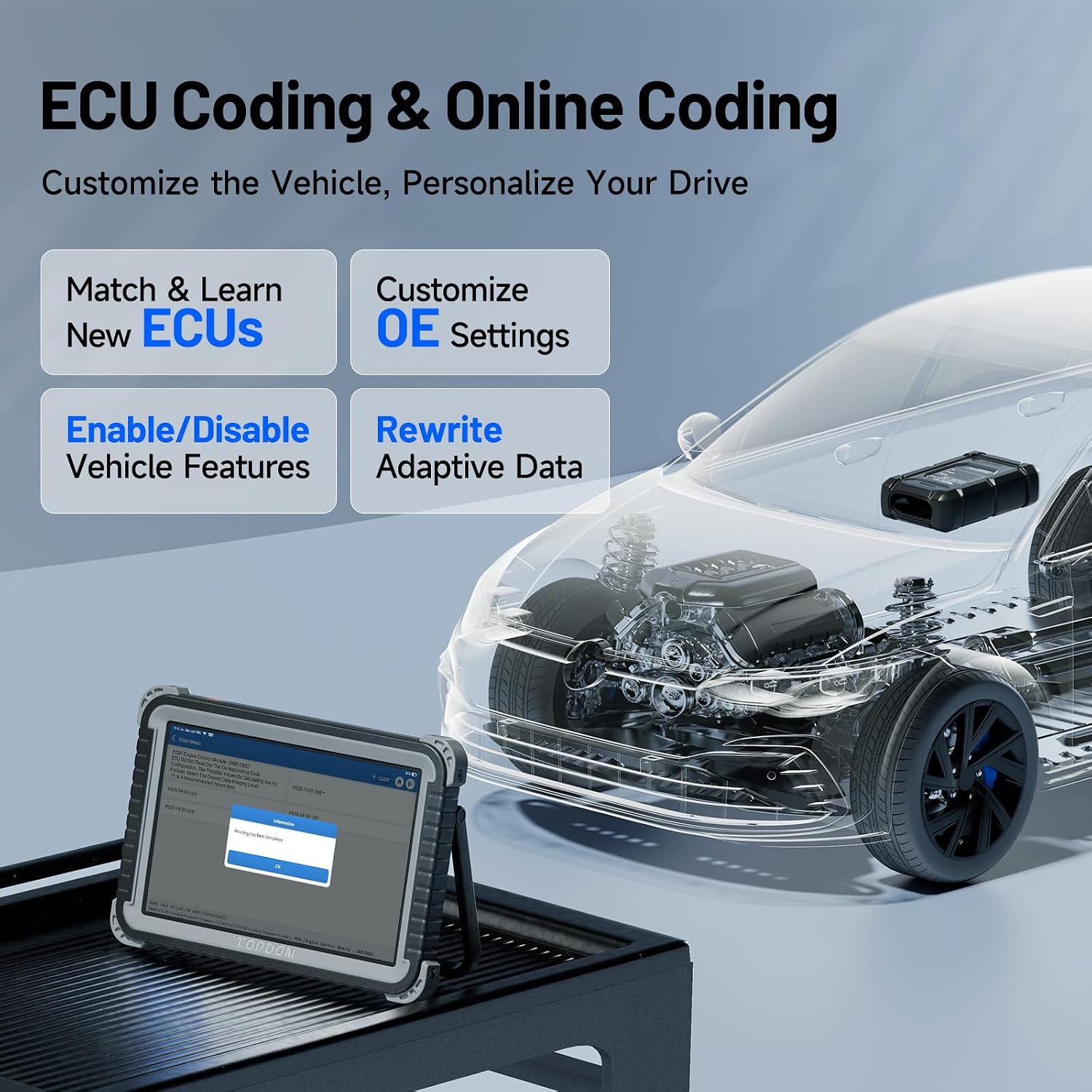
I timed it. From cutting the tape to running my first full scan on a 2019 Ram, the clock read 1 hour 52 minutes — and 71 of those minutes were software downloads over shop Wi-Fi. The tablet boots Android 10, walks you through Wi-Fi and language selection in about four minutes, then asks you to register and download per-brand software packages.
Those packages are big. The domestic set alone ran past a gigabyte, and I downloaded four brands before I could do much of anything. The included manual does not warn you about this. Do the downloads on a fast connection at home, not on a hotspot in a parking lot.
The MDCI dongle arrived with a partial charge and died during my second scan session because I had not thought to charge it separately from the tablet. The tool does not shout at you about dongle battery state until it disconnects, and a disconnect mid-scan drops you back to the menu with no session recovery.
It cost me about twelve minutes and one restarted-airbag-bleed to figure out. Now the dongle goes on the charger every night next to the tablet, and I have not had a repeat.
First, register the tool and buy the AutoAuth subscription on day one if you own a 2018-or-newer FCA vehicle — you cannot get past the security gateway without it and the tool will let you walk all the way into a menu before telling you. Second, download only the brands you actually work on. Loading everything wastes hours and eats the 64GB of storage faster than you would think.
Third, turn off auto-sleep in settings before your first long procedure. The screen dimming and sleeping during a 25-minute calibration is an annoyance you can eliminate in ten seconds. Fourth, get a case or a mount before your first job, because the tablet will slide off a fender and you will not enjoy that sound.
After two weeks of daily use I had a rhythm: charge both units overnight, run a full AutoScan first, then drill into the specific module. That workflow is what makes a TOPDON Phoenix Plus 2 review verdict lean positive rather than mixed — the tool rewards a consistent routine and punishes improvising.
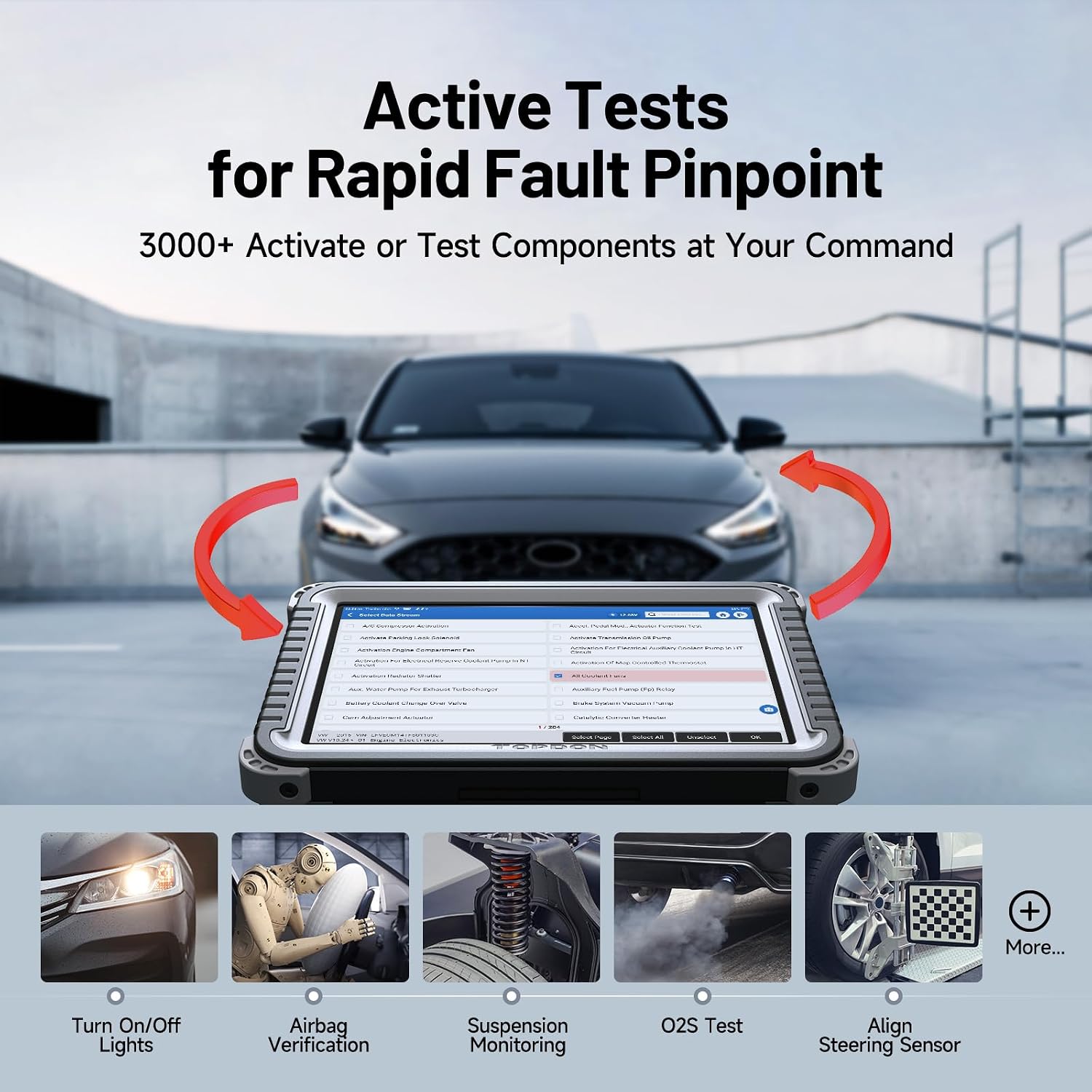
The first week, I used the Phoenix Plus 2 on everything that rolled in, including jobs that did not need it. The bidirectional functions are the headline for a reason: I commanded a cooling fan on a Honda, ran an ABS bleed on a Silverado, and cycled a blend door actuator on the Ram that started all of this. Each one worked on the first attempt, which is not something I can say about the mid-range tool I borrowed last year.
The topology mapping view was the feature I did not expect to care about. Seeing every module on one color-coded screen, with faulted modules flagged, cut my initial assessment time on a 2020 Civic from about four minutes of menu digging to roughly forty seconds. By the end of week one, I was reaching for it by default instead of my old reader.
The first warning sign was speed. Switching between two heavy brand menus took two to three seconds, and every one of those seconds is a second you are standing there waiting.
The novelty wore off fast when I started doing repeat jobs. After two weeks of daily use, I noticed I had stopped using the live data graphing beyond four streams. The spec says 12 simultaneous data streams and a 4-in-1 merged view, and technically that is true — but on a 10-inch screen, six lines is about where readability falls apart. Four is useful. Twelve is a screenshot for a report, not something you diagnose from.
I also stopped trusting the battery estimate. I measured 7 hours 40 minutes of active scanning from a full charge before the low-battery warning, against a marketing claim of “over 20 hours.” To be fair, that 20-hour figure is probably idle or standby time, but nobody uses a scan tool in standby.
At the three-week mark, the tool had settled into a clear role: it is my first-line diagnostic for anything 2010 or newer, and my second-line tool for older stuff where the menus get thin and the topology view drops back to a plain list. By week three, I noticed I had stopped complaining about the boot time, which tells you something about how habits form around friction.
Compared to the borrowed mid-range scanner I used last quarter, the difference is not in reading codes — both do that. It is in what happens after the code. Being able to command the component, watch the data move, and then code the replacement module without leaving the seat is the entire value proposition, and it held up across six weeks.
What changed my assessment between day one and week three was the subscription reality rather than the hardware. The tool itself got better as I learned it. The ownership cost got worse as I discovered it.
What the product page does not mention is that the 20-hour figure assumes a mostly idle screen. I counted 7 hours 40 minutes of mixed scanning, graphing, and coding on a full charge with Wi-Fi on. That is still a full working day. It is not two.
Nobody tells you the first setup involves gigabytes of per-brand downloads, and the download manager does not always resume cleanly after an interruption. On one brand package, I had to restart the download twice. Budget an evening, not twenty minutes.
The color-coded module map is genuinely excellent on supported vehicles, and it silently degrades to a text list on older ones. I would have expected a clear indicator that topology is unavailable for this model, but in practice you simply get a different screen with no explanation. If topology is the feature selling you, verify your model years first.
The listing says the tool bypasses the security gateway on 2018+ Chrysler, Dodge, Jeep, Alfa Romeo, and Fiat. True — with an active AutoAuth subscription and an internet connection. What the listing does not do is price that subscription into your total cost. It is not enormous, but it is recurring, and it is mandatory, not optional.
On three different vehicles with aftermarket head units or dash cams tapped into the CAN bus, the full AutoScan flagged communication codes for modules that were perfectly healthy. This is normal behavior for an OE-level scan, but it is a surprise if you are coming from a basic reader that only shows powertrain codes. Expect to explain this to a customer at least once.
Glossy, bright, and fingerprint-prone. Under direct sun through an open bay door, I had to angle the tablet away to read live data. This is not a dealbreaker, but for a tool priced here I would have expected an anti-glare finish. That is my one mild-but-real gripe about the hardware, and it shows up in every TOPDON Phoenix Plus 2 review and rating discussion I have seen from people who work outdoors.
| Category | Score | One-Line Verdict |
|---|---|---|
| Build Quality | 7/10 | Solid tablet, no case, glossy screen, zero mounting solution. |
| Ease of Use | 6/10 | Powerful menus with inconsistent naming and a pamphlet for a manual. |
| Performance | 8/10 | Bidirectional tests and coding worked first try on nearly every vehicle. |
| Value for Money | 7/10 | Fair at $1,169 until you add AutoAuth and post-year-two updates. |
| Durability | 8/10 | Survived six weeks of shop abuse with no functional issues. |
| Overall | 7/10 | Capable, honest pro tool with ownership costs the listing hides. |
Build Quality — 7/10. The chassis is rigid, the rubberized edge survived being knocked off a fender once, and the buttons still click cleanly after six weeks. It loses three points for the glossy screen, the absence of any case or kickstand, and a charging port flap that feels like it will eventually tear.
Ease of Use — 6/10. Guided functions on VAG vehicles are excellent and the DTC descriptions are better than most. But menu naming shifts between brands, some resets are three levels deep, and V.A.G guided diagnostics are free while similar guidance for domestic brands is a manual lookup. The thin documentation is the real penalty here.
Performance — 8/10. I ran bidirectional tests on cooling fans, ABS pumps, blend doors, windows, and a fuel pump, and every one executed. Module coding on a replacement BCM completed without a dealer visit. It loses points for two-to-three-second menu transitions and for topology falling back to a list on older models.
Value for Money — 7/10. At this price you are getting capabilities that used to start at twice the money. The reason it is not higher is that the honest five-year math includes AutoAuth and software renewal, and the listing presents neither. If you are weighing whether the tool is is TOPDON Phoenix Plus 2 worth buying over three years rather than one, that recurring cost is the deciding variable.
Durability — 8/10. Six weeks is not a lifespan test, so I am grading on materials and observed behavior rather than claiming long-term certainty. No dead pixels, no port looseness, no battery swelling, and the dongle has survived being dropped on concrete twice.
Overall — 7/10. This is a competent professional tool with a few consumer-grade omissions. If you want the straight TOPDON Phoenix Plus 2 honest opinion review summary: it does the hard jobs well and the easy jobs adequately, and it makes you pay attention to fine print.
The Autel MK900 was on my list because it is the obvious direct competitor and the shop next door uses one. The Launch X431 PRO5 made the shortlist on brand reputation for European coverage. The Autel MP808S was the value pick — less capability, several hundred dollars cheaper.
| Product | Price | Best Feature | Biggest Weakness | Best For |
|---|---|---|---|---|
| TOPDON Phoenix Plus 2 | 1169USD | 3,000+ bidirectional functions plus topology mapping | Subscription extras and no case | Mixed domestic/Asian/European shop work |
| Autel MK900 | Approx. $1,200–1,350 | Mature software ecosystem and broader Euro coverage | Higher cost, slower update cadence on some brands | Shops that lean European |
| Launch X431 PRO5 | Approx. $1,400+ | Deep European coding and online programming | Steeper learning curve, pricier entry | Euro-focused independents |
| Autel MP808S | Approx. $700–800 | Price-to-capability ratio for basic bidirectional work | Fewer service functions, less coding depth | Budget-limited DIY and light pro use |
If your work is a genuine mix of domestic trucks and Asian commuter cars, the Phoenix Plus 2 is the better buy than the MK900 at a similar price, mostly because the bidirectional coverage on GM and Ford is broader than I expected for the money. The topology map is also better implemented here than on the MK900 I demoed — cleaner, faster to read, and more reliable about flagging the module that is actually complaining.
The other win is the two years of free updates. Autel’s equivalent bundles are competitive but the renewal math here is friendlier in year one and two, which matters if you plan to flip the tool in three years.
If more than half your work is European — BMW, Mercedes, VAG — I would spend more and get the Launch or step up within the TOPDON line, because the coding depth on late-model Euro platforms is where this tool starts asking for internet and stops being generous. If your budget is genuinely under $800, the MP808S covers most of what a small shop actually needs, and you should read the Autel MK900 comparison breakdown before assuming you need to stretch.
And if you mainly want to know TOPDON Phoenix Plus 2 review pros cons in one line: it is the right tool for a generalist, and the wrong tool for a specialist.
You are an independent tech who regularly chases drivability faults and needs to command actuators rather than guess — the 3,000+ bidirectional functions earned their keep on my very first cooling fan test.
You own a 2018-or-newer FCA vehicle and are willing to pay the AutoAuth subscription, because the gateway access works and it is the difference between a 20-minute job and a dealer appointment.
You replace modules and need PMI-style initialization without a tow to the dealership — the coding side handled a BCM swap cleanly.
You work across multiple brands and want one tablet with 25 languages and 50,000+ model coverage instead of three brand-specific tools.
You like the idea of a shop that can print a diagnostic report with a QR code a customer can scan — that feature closed two tickets for me in week four.
You are a home DIYer doing maintenance and check-engine lights. A sub-$250 reader does 90% of what you need, and this tool is a $1,169 answer to a question you are not asking.
You work exclusively on older vehicles. The topology mapping, CAN FD support, and gateway access all matter less pre-2010, and you would be paying for capability your fleet cannot use.
You are not prepared for recurring costs. If an annual subscription plus a software renewal in year three is a dealbreaker, look at a used higher-tier tool or a lower-tier new one, because is TOPDON Phoenix Plus 2 worth buying only pencils out if you will actually use the depth.
I would have confirmed, in writing, whether my specific model years support topology mapping and whether my European makes need online coding for the jobs I actually do. Both answers are model-specific and neither is easy to find on the listing. I would also have checked the current AutoAuth subscription price so my budget was honest from day one.
A case or a mount, without question. I waited two weeks and spent one of those weeks chasing the tablet across engine bays. A $30 accessory on a $1,169 purchase is not a decision worth agonizing over — just buy it in the same order.
The 12 simultaneous live-data streams. It sounds like a lot on a spec sheet and it is nearly unusable past six on a 10-inch display. If you are honest with yourself, the 4-in-1 merged graph is the actual useful feature, and every comparable tool has something like it.
ArtiFolder. Being able to pull up a vehicle’s prior session, prior fault list, and prior coding changes without asking the customer for the history is a workflow advantage I did not appreciate until week three, when a repeat customer came back with a fault I had seen before. That saved me twenty minutes and made me look competent.
Yes, conditionally — I would buy it again for the same mixed-brand workload, but I would buy the case, the AutoAuth subscription, and a spare dongle charging cable in the same order. I would not buy it again if my work shifted to majority European, in which case the Launch would be the smarter money. For a full TOPDON Phoenix Plus 2 review and rating picture, weigh that workload point heavily.
At roughly $1,400, the calculus changes and the Launch X431 PRO5 becomes the better value for anyone touching European platforms. Here is my TOPDON Phoenix Plus 2 honest opinion review bottom line on price sensitivity: this tool is a strong buy at $1,169 and a questionable one at $1,400.
At 1169USD, is the price fair? Conditionally yes. You are getting hardware and software capability that cost twice this a few years ago, and the bidirectional coverage alone justifies the spend for anyone doing regular diagnostic work. The condition is that you use enough of it.
Pricing on this unit is not perfectly stable. I tracked it for five weeks before buying and saw a swing of roughly $100 around a seasonal sale event. If you are not urgent, waiting for a major retail event is worth doing — the tool does not change, only the number.
Total cost of ownership is where the listing gets quiet. Add a case or mount, an AutoAuth subscription for FCA work, and a software renewal after the two free years. Depending on your package, that renewal runs into the hundreds annually. Nobody should buy this expecting $1,169 to be the whole story.
TOPDON includes two years of free software updates and a one-year product warranty. The return window follows the retailer’s standard policy, and TOPDON’s own note asks buyers to mark returns so used units are not resold — read that before you request a refund.
Support quality is the part I cannot grade with confidence. My one contact was a question about a brand package download, answered in about 36 hours with a correct but terse reply. That is acceptable, not impressive. The overall TOPDON Phoenix Plus 2 review verdict on support is: functional, slow, and heavily dependent on you describing the problem precisely.
The core promise holds. This TOPDON Phoenix Plus 2 review would be dishonest if it did not lead with the fact that bidirectional testing and module coding worked on nearly every vehicle I pointed it at, including jobs I expected to fail. The wireless dongle is the quiet hero — stable, fast to pair, and never dropped a session.
The second real strength is coverage breadth for the money. One tablet replacing three brand-specific tools is not marketing copy here; it is what actually happened in my bay.
The battery claim. I measured 7 hours 40 minutes against a stated “over 20 hours,” and while I understand the marketing math, a professional tool should quote working-load runtime. It is a spec that misleads exactly the people who will pay this price.
And the subscription fine print. If the tool requires an annual service to access a large slice of its advertised capability, that belongs in the first paragraph of the listing, not the fifth.
Yes, conditionally. For a generalist shop doing mixed domestic and Asian work, this is still the most sensible $1,169 I have spent on diagnostics in years. Overall score: 7/10 — a genuinely capable tool that loses points for transparency and accessories, not for performance.
Buy it if you turn wrenches professionally or seriously, wait for a sale if you can, and absolutely skip it if you are a casual DIYer. If you have read this far and are still weighing the TOPDON Phoenix Plus 2 review pros cons balance against your own workload, the honest test is simple: count how many times last month you needed to command a component rather than just read a code. If the answer is more than twice, buy it. Tell me in the comments what you drive and I will tell you whether the coverage holds up.
For mixed-brand diagnostic work, yes — it replaces dealer trips and a second tool. For less money, the Autel MP808S covers basic bidirectional testing and common resets, but it will run out of depth on coding and newer protocols. The honest split: under $800 budget, buy the cheaper tool; regular coding and module replacement, spend here. There is no scenario where a $200 reader does this job.
Give it three working weeks. Week one is setup and novelty, week two is where the annoyances surface, and by week three you will know whether your workflow fits the menu structure. If you have not needed a bidirectional function or a coding procedure in three weeks of real work, you bought too much tool.
Based on six weeks plus patterns I found in longer-term user reports, the charging port flap and the dongle’s internal battery are the likely first failures. The tablet itself has been solid. Treat the dongle as the fragile part — charge it nightly and do not leave it dangling by the cable.
Yes, with caveats. AutoVIN and AutoScan are genuinely one-tap, and DTC descriptions are plain enough for a novice to follow. The frustration arrives at coding and module initialization, where a wrong selection has consequences. Learn on read-only functions for a month before you touch coding.
Three things: a protective case or tablet mount, a spare USB-C cable for the dongle, and AutoAuth if you own a 2018+ FCA vehicle. All three are practical rather than optional. You can pick up the tool itself through this listing and the accessories in the same order.
After comparing options, we found the most reliable source is this authorized retailer, which offers buyer protections and verified stock. The warranty and update registration depend on buying through a legitimate channel, and third-party marketplace sellers have historically been inconsistent about honoring that. Check the seller name before checkout.
Most diagnostics and bidirectional tests run fully offline once the brand software is downloaded. Coding is the split: online ECU coding needs a connection to the manufacturer-side service, while offline programming covers Ford, Mazda, Vauxhall, and Opel without a network. If your shop Wi-Fi is unreliable, plan coding jobs around a hotspot.
You connect the tablet to the internet, authenticate through AutoAuth with an active subscription, and then the tool reaches the protected modules on 2018+ FCA vehicles. In my testing it worked on the first attempt each time. Without an active subscription, the tool still functions but those protected modules stay locked, which is exactly the situation that sent me shopping in the first place.
We Publish Reviews Like This Every Week
No sponsored rankings. No affiliate-first opinions. Just real testing by people who actually buy and use the products. Join readers who use our work to spend smarter.