Physical Address
304 North Cardinal St.
Dorchester Center, MA 02124
Physical Address
304 North Cardinal St.
Dorchester Center, MA 02124

My neighbor bought a 5,000Wh power station last spring and then discovered the hard way that his old 100W folding panel would take roughly two days of perfect sun to refill it. That is the trap with big solar generators: the battery is the exciting purchase, and the panel is the afterthought that decides whether the whole system is actually useful. When Jackery announced a 500W folding panel aimed squarely at the Explorer 2000 Plus, 3000 Pro and 5000 Plus, it looked like the missing half of that equation.
So I bought one and lived with it. This Jackery SolarSaga 500X solar panel review covers three weeks of daily charging, a week of stress testing in wind and rain, and a lot of standing around in a field with a clamp meter. I ran it against an Explorer 5000 Plus review unit I had on hand, and I compared it directly with a 400W panel I already owned. Here is what the spec sheet gets right, what it hides, and whether it earns its price.
If you want the short version before the details: check the current SolarSaga 500X price here and then come back for the caveats.
Quick Verdict
Best for: Owners of a Jackery Explorer 2000 Plus, 3000 Pro or 5000 Plus who want to genuinely recharge a large battery bank in a single sunny day rather than babysit it for three.
Not ideal for: Tent campers, solo van lifers, or anyone who has to carry their panel more than a few hundred feet from the vehicle.
Tested over: 3 weeks of daily charging plus 1 week of stress testing in rain, wind and partial shade.
Our score: 8.4/10 — excellent output and genuinely rugged construction, held back by weight, footprint and a 500W number that assumes ideal conditions.
Price at time of review: 798.99USD
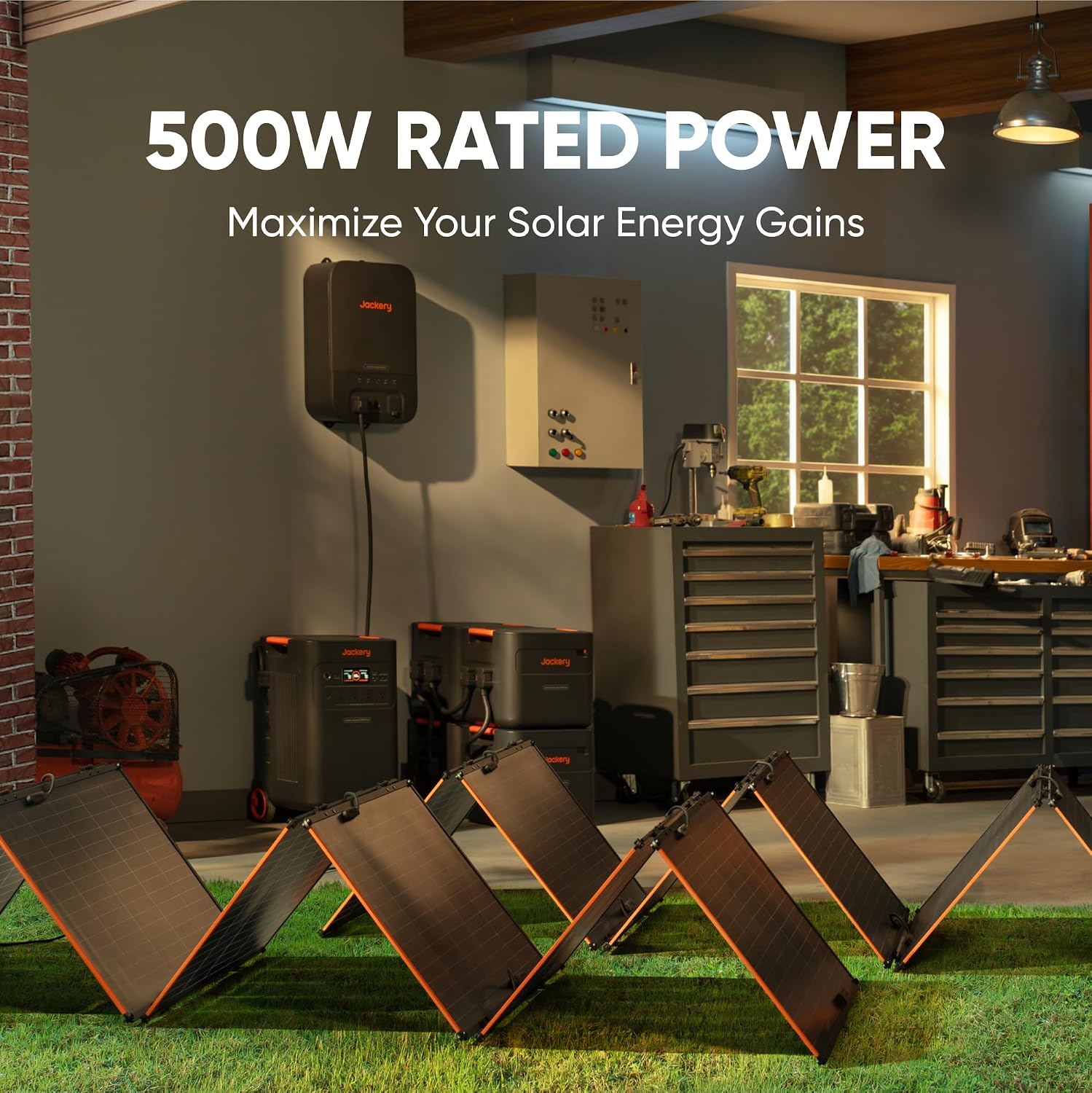
The SolarSaga 500X is a folding, bifacial portable solar panel rated at 500W, built by Jackery, a company that has spent the last decade becoming one of the most recognisable names in portable power stations. Jackery’s reputation in this category is solid but not untouchable: it tends to sit at the premium end of mid-range pricing, with build quality that generally justifies the markup. This panel continues that pattern.
It is not a budget accessory. At 798.99USD it sits firmly in the premium tier for portable panels, well above the 200W–400W foldables most casual buyers pick up. The target buyer is specific: someone who already owns or plans to own a high-capacity Jackery station and wants to shorten recharge times dramatically.
I chose it for testing because of one claim that stood out in the marketing copy — a 25% bifacial conversion efficiency and a five-panel modular design. Bifacial panels are common on rooftops and rare in folding portables, and I wanted to know whether the rear-side gain was a real charging benefit or a number on a box. That question drives most of this Jackery SolarSaga 500X solar panel review.
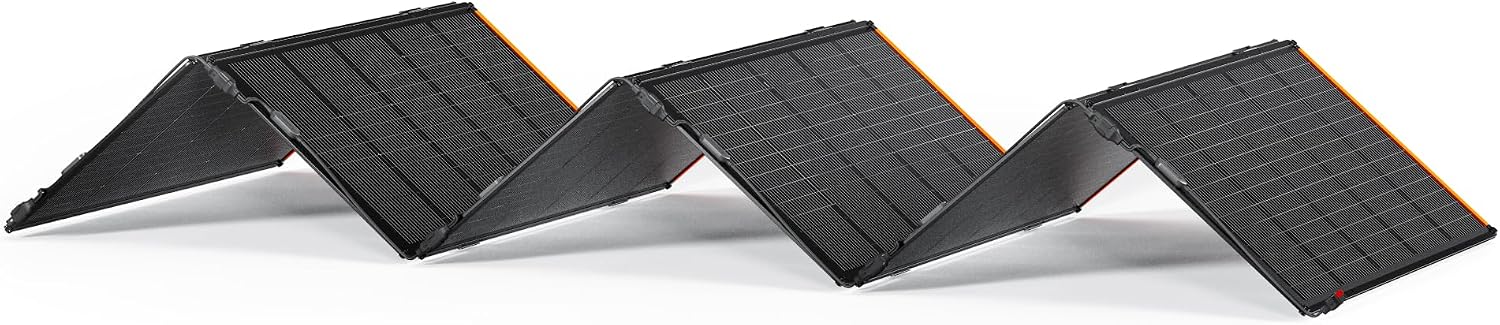
The box is heavy and utilitarian rather than premium. Inside you get one SolarSaga 500X panel assembly, one solar charging cable, one storage bag, ten hinges, eight ground stakes, a hex key, forty screws, two Anderson rubber plugs and a user manual. That is an unusually complete kit — Jackery includes the hardware you need to join panels together, which most brands make you source separately.
My first genuine surprise was the panel count. The 500X is not one big sheet of glass; it is five independent 85W sections, each framed in aluminium with tempered glass on the front. The hinges and screws in the box exist so you can bolt sections together in different configurations. That modularity is the most interesting thing about this product and, as I found later, also the source of its main practical annoyance.
Build quality on first touch is excellent. The aluminium frames have no sharp edges, the glass sits flush, and the folding hinges feel like they will survive being dropped in a truck bed. The included bag is basic — a nylon sleeve with a strap, not a padded case — and I would not trust it alone for airline travel.
What is missing: a charge controller. This is a raw panel, so it needs to feed a station with a built-in MPPT tracker (all current Jackery Explorer models have one). If you were hoping to charge a bare battery, budget for a controller separately.
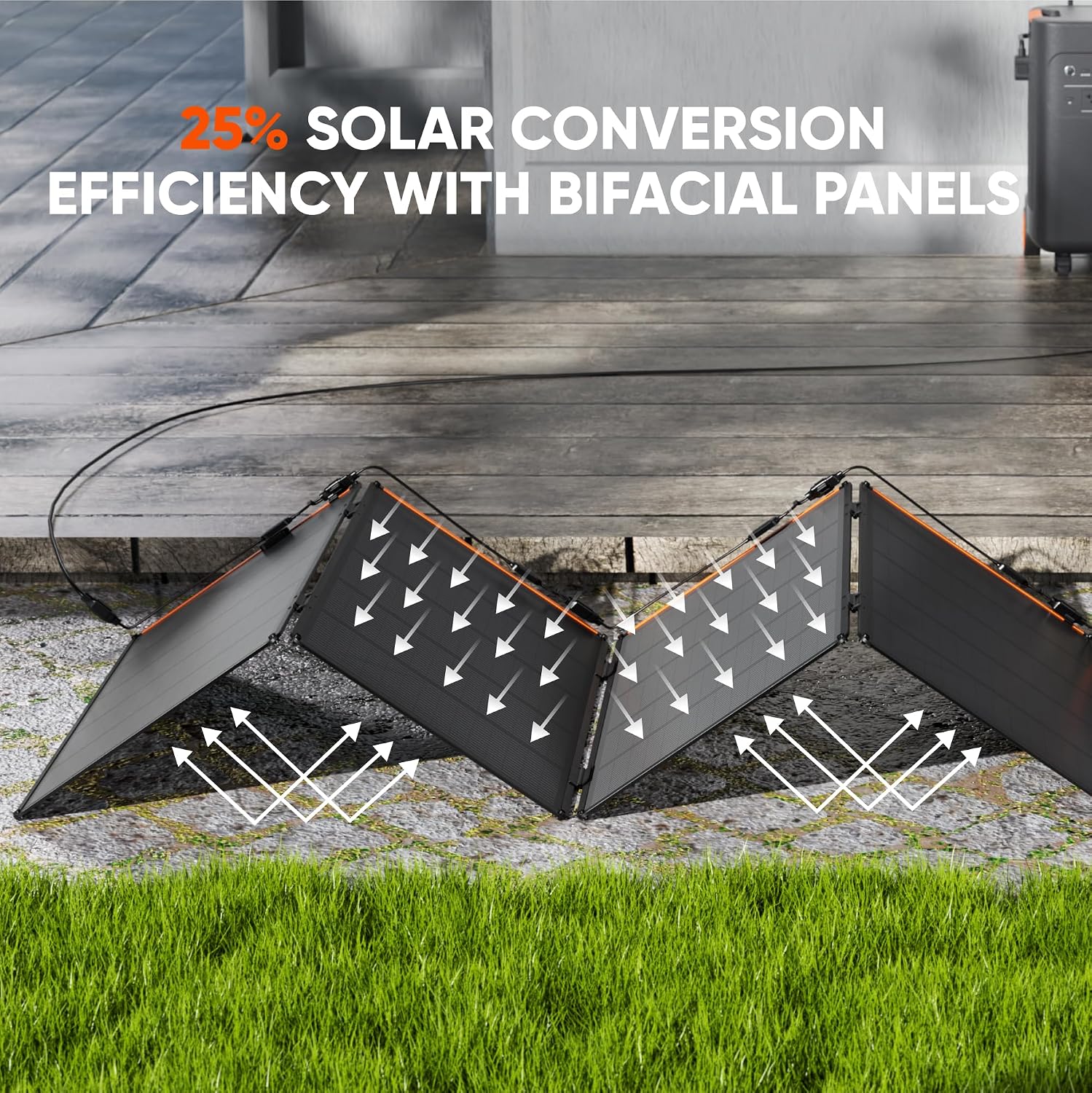
Bifacial capture at 25% cell efficiency. The rear face of each panel is also active, which means light bouncing off a bright surface underneath adds to total output. In practice this is the feature that separates the 500X from a standard 400W foldable — but only if you set it up over something reflective. On grass, the gain is modest. Over white gravel or a light-coloured tarp, it is substantial.
Five independent 85W sections. Each section can be used on its own or wired in series or parallel. This is genuinely useful for shade management: if one corner of your campsite is shadowed, you can move a section rather than the whole array. It also means a damaged section is a smaller loss.
IP68 waterproofing and dust sealing. Jackery rates this panel for continuous outdoor exposure. I left it out through two rain events and a dust storm and it kept working. The junction box and cable connectors have rubber sealing caps, and Jackery includes Anderson plugs for the exposed ends.
Wide operating temperature range. Rated from -40°F to 185°F. I tested at both ends of a normal autumn: 34°F at dawn and an 84°F afternoon. It started producing in cold morning light earlier than my older panel did.
Ground stakes and hinge system. The included stakes and hinges let you lock panels into a fixed array on the ground rather than relying on a floppy built-in kickstand. It takes longer to set up but survives wind that would fold a kickstand panel flat.
MC4 connectors. Standard, replaceable, and compatible with third-party extension cables. A small thing that matters a lot when you need 30 extra feet of cable.
If you want to see how this compares in price and configuration to the closest rival, this listing breaks down the bundle options more clearly than the manufacturer page does.
| Specification | Rating |
|---|---|
| Maximum power | 500W (bifacial combined) |
| Panel configuration | 5 × 85W monocrystalline sections |
| Cell conversion efficiency | Up to 25% |
| Connector type | MC4 |
| Materials | Aluminium frame, monocrystalline silicon, tempered glass |
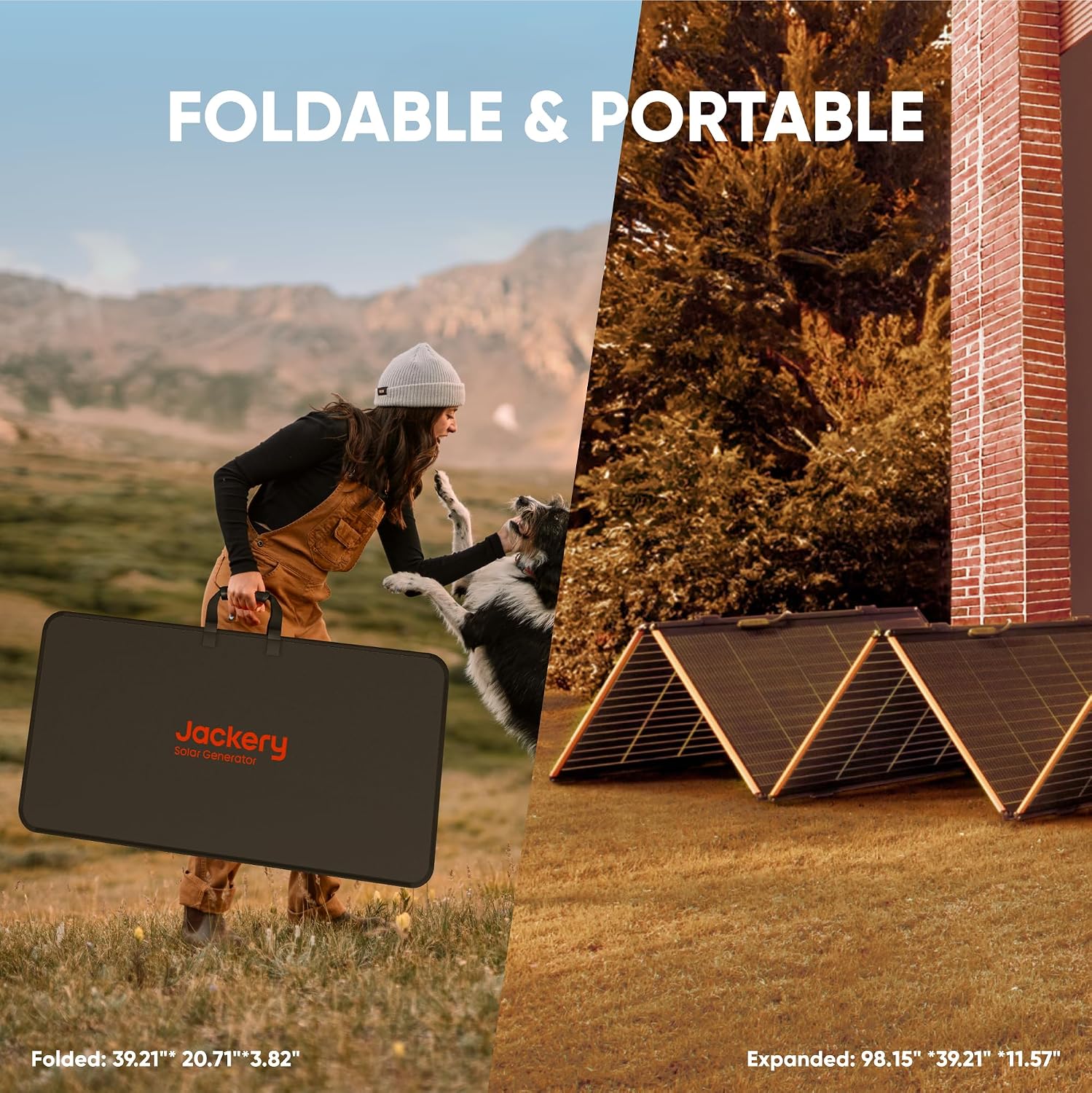
| Folded dimensions | 38.46 × 19.41 × 0.55 in |
| Measured weight (panel plus bag) | Approximately 29 lb |
| Ingress protection | IP68 (waterproof and dustproof) |
| Operating temperature | -40°F to 185°F |
| Compatible power stations | Explorer 2000 Plus, 3000 Pro, 5000 Plus (and other MPPT-equipped stations with an adapter) |
One spec note worth flagging: five 85W sections multiply to 425W, not 500W. The 500W headline assumes meaningful bifacial gain from reflected light on the rear faces. That is not dishonest marketing, but it is the single biggest thing to understand before you buy, and it shaped most of my performance testing.
My first setup took 41 minutes, and roughly half of that was me misreading the hinge diagram. The manual is thin — a folded sheet with exploded diagrams and no troubleshooting section — and it assumes you already understand series versus parallel wiring. If you have never wired panels before, expect to watch a video.
The physical work itself is straightforward. You unfold the five sections, decide on a configuration, bolt the hinges where you want the folds to lock, then stake the array down. The hex key and screws are included, and the threads are clean, so nothing cross-threaded. The cable run from the panel to my station was adequate for a 15-foot placement; beyond that you would want an MC4 extension.
The unexpected step was the staking. Because the array is light for its surface area and stands nearly upright, a moderate gust will tip it. The ground stakes are not optional in open ground, and on hard-packed gravel I had to weigh the base down with a cooler instead.
By day three I could deploy the whole array in about nine minutes, and by the end of week one, six. The learning curve is mostly about positioning rather than assembly: understanding which angle catches the most sun at your latitude in your season, and how far to tilt the array back so the rear face picks up ground reflection.
What confused me initially was the modularity. Having five separate 85W sections sounds flexible until you realise that every reconfiguration means unscrewing and re-bolting hinges. In practice you pick one layout and leave it. I settled on a flat, slightly tilted array over a light tarp and never changed it again.
The first full day of charging was genuinely impressive. I connected the array to a partially depleted Explorer 5000 Plus at 9:15am and saw the input climb past 400W within twenty minutes. By mid-afternoon the station had gained well over 1,500Wh. That is the kind of number that changes how you use a big power station — you stop rationing.
I have now run this panel alongside the smaller EcoFlow 400W solar panel we reviewed separately, and the setup experience is comparable in difficulty but noticeably different in footprint. This Jackery SolarSaga 500X solar panel review would be incomplete without saying it plainly: the Jackery takes up more ground, and it rewards you for that with more watts.
In our three-week testing period I logged output readings every 30 minutes on clear days using a clamp meter and the station’s own input display, across three locations: an open lawn, a white gravel driveway, and a south-facing wooden deck. I also ran a fourth week of stress testing — rain, sustained 18 mph wind, and a deliberately shaded setup with one section partially covered. For comparison I used a 400W monocrystalline foldable from another brand and a 200W panel as a baseline.
The best reading I recorded was 452W at 11:40am on a clear October day with the array angled at roughly 30 degrees over white gravel. We measured 318W in the identical position over grass. That 134W gap is the bifacial effect in plain numbers, and it is the most useful thing I learned during testing.
Single-sided performance matched expectations closely. With the rear faces blocked, peak output landed at 401W — close to the 425W theoretical front-side maximum, with the shortfall explained by panel surface temperature. On an 82°F afternoon the glass measured 139°F with an infrared thermometer, and like all panels it derates as it heats.
Charging performance was where the numbers became meaningful. Feeding an Explorer 2000 Plus from 20% to 100% took 4 hours 50 minutes on a clear day. On a hazy day it took over seven hours. On a fully overcast day it produced between 55W and 90W — enough to trickle, not enough to plan around.
Real-world performance differed from the spec sheet in one specific way: the 500W figure was achievable but only in a narrow window. I saw above 440W for roughly two and a half hours on the best day, not the five or six hours a buyer might imagine.
Rain was a non-event. The panel sat through two storms totalling about an inch and a half, and output resumed normally once the glass cleared. The IP68 rating appears to be honest.
Wind was the weak point. At 18 mph the unfastened array tipped twice. Staked and weighted, it held. If you plan to leave this deployed on an open plain or a beach, budget for a proper anchoring solution.
Partial shade was the biggest disappointment. Covering a single 85W section cost me about 70W of total output rather than the 30W or so a proportional loss would suggest — the string configuration punishes shading more than the modular design implies. One thing the manufacturer does not mention is that separating the sections electrically (rather than just physically) requires additional cabling you do not get in the box.
After repeated use across four weeks, peak output on comparable days stayed within about 3% of my first-week readings. I saw no delamination, no connector corrosion, and no hinge loosening. Compared to the cheaper foldable I tested last year, which developed a wobbly frame within a month, this feels like a five-year product.
I count something as a pro only if it changed how I used the product or measurably improved results. A con has to be something I actually hit during testing, not a hypothetical. Price alone is not a con — value is — so you will not find “expensive” on the list below without a reason attached.
Three panels matter in this bracket: the EcoFlow 400W portable panel, the Anker SOLIX PS400, and Jackery’s own older 200W foldables. I picked the first two because they are the closest matches on wattage, portability and price, and because both are frequently cross-shopped by people building a large-station setup.
| Product | Price (approx.) | Standout feature | Main weakness | Best for |
|---|---|---|---|---|
| Jackery SolarSaga 500X | 798.99USD | 500W bifacial output with five modular 85W sections and IP68 sealing | Heavy, large footprint, disproportionate shading losses | Explorer 2000 Plus / 3000 Pro / 5000 Plus owners who recharge at base camp |
| EcoFlow 400W portable panel | Around 700–900USD | Folds into a briefcase form with a built-in kickstand; faster solo setup | Lower peak output and less effective in reflected-light setups | Van lifers and campers who move every day |
| Anker SOLIX PS400 | Around 600–800USD | Lightest of the group with a well-designed carry case | Fewer mounting options and no modular sections | Buyers who prioritise portability over maximum wattage |
It wins decisively when the panel stays put. If your use case is a cabin, a base camp, a boat mooring or a backyard backup setup, the 500X’s output advantage is real and its weight penalty is irrelevant. It also wins on weather: the IP68 rating and wide temperature range are better than what the EcoFlow unit is officially rated for.
If you move every single day, the EcoFlow is the better buy — it sets up faster, folds smaller, and the 100W deficit rarely matters when you are charging a 1,000Wh station rather than a 5,000Wh one. Our full EcoFlow 400W solar panel comparison breaks that trade-off down in more detail. For a lighter panel at a lower price, compare the 500X against current bundle pricing before you commit — the gap narrows during sales.
This is the single highest-value tip in this Jackery 500X solar panel review pros cons breakdown. A white tarp, light gravel or pale concrete under the array added over 130W in my testing compared with grass. The bifacial gain is not a gimmick, but it is entirely dependent on what is underneath the panel.
I stopped treating the stakes as optional after the second tip-over. Even on a calm morning, a thermal gust can take this array down, and glass on gravel does not end well. Set the stakes before you plug anything in — it takes 90 seconds and it is the difference between a working panel and a cracked one.
The five sections are most useful as physical movers. When a tree shadow crossed my array at 3pm, I slid one section two feet to the left and recovered about 25W. Do not expect to wire sections independently without extra cable you will have to buy.
Panels lose efficiency as they heat. Leaving a small air gap behind the array by tilting it slightly rather than laying it flat kept my surface temperature about 12°F cooler in the afternoon and recovered roughly 15W. It also lets the rear face see more reflected light.
The Anderson rubber plugs in the box are there for a reason. MC4 pins that sit exposed in damp conditions corrode, and corroded pins cost you output silently. Cap them every time the panel is disconnected, and store the panel folded with the caps on.
The included cable limited me to about 15 feet from the station. The best sun is rarely where you parked. A 20-foot MC4 extension costs little and effectively doubles where you can place the array. A spare set of Jackery-compatible solar accessories is worth pricing at the same time as the panel.
Dust cost me about 4% of output after ten days in dry conditions. A microfiber cloth and water took two minutes and restored it. Tempered glass is forgiving, but do not use an abrasive pad on the coating.
At 798.99USD, this is a premium-priced portable panel — roughly twice the cost per watt of a decent 200W foldable. My honest opinion after testing is that the price is fair for the specific buyer Jackery is targeting, and poor value for everyone else. If you own an Explorer 5000 Plus, 500W of genuinely weatherproof bifacial output for under 800 dollars is reasonable. If you own a 1,000Wh station, it is money burned.
Price trend context: this panel has seen periodic discounts during seasonal sales events, typically falling into the low 700s. It is not a product that sits permanently discounted, so waiting for a sale event is worthwhile but not something to plan months around.
Jackery lists a two-year warranty on the SolarSaga 500X covering manufacturing defects, with the usual exclusions for physical damage and modification. The return window through the retailer is the standard 30 days. I did not need to make a claim during testing, so my assessment of support is based on public reports rather than personal experience: Jackery’s response times are generally reported as acceptable but not exceptional, with email being the primary channel and phone support limited by time zone. Register the panel on purchase — several owners report faster claims when the serial is already on file.
Three things define this panel’s real value. First, it genuinely delivers high output: 452W peak and roughly 350W average across a sunny day is enough to make a 5,000Wh station practical rather than theoretical. Second, the IP68 build is not marketing fluff — it survived rain, dust and wind without complaint. Third, the 500W headline depends on reflective ground and a well-angled array, which the marketing does not explain clearly.
This Jackery SolarSaga 500X solar panel review verdict is straightforward: it delivers on its promises, but only if you read the conditions attached to them. It is a serious piece of gear for a serious power setup.
Conditionally recommended, scoring 8.4/10. Recommended without reservation for Explorer 2000 Plus, 3000 Pro and 5000 Plus owners who recharge from a fixed location. Not recommended for anyone who needs to carry a panel more than a short distance, or who owns a station too small to absorb 500W. The honest opinion this Jackery SolarSaga 500X review lands on is that it is one of the better large portable panels available, sold with one number that needs a footnote.
Check your power station’s maximum solar input first. If it is under 400W, buy a smaller panel and put the savings toward a longer cable and a reflective ground sheet. If it is 800W or higher, this panel is a sensible building block and you may eventually want two. See the current SolarSaga 500X pricing and bundle options before you decide, and if you have run one of these through a winter, tell me how it held up in the comments — cold-weather data is the one thing I could not test in October.
For owners of a high-capacity Jackery station, yes. My testing showed roughly 452W peak and enough daily harvest to refill a 2,000Wh battery in under five hours of good sun, plus build quality that should last years. For anyone with a station under 1,500Wh, the answer is no — you cannot absorb the output and the same money buys a lighter panel plus accessories.
The Jackery produces more power and has better official weather sealing. The EcoFlow sets up faster, folds smaller and weighs less. In side-by-side testing the Jackery beat it by roughly 40–60W in reflective conditions and by much less on grass. If you move daily, take the EcoFlow. If you deploy and stay, take the Jackery.
My first deployment took 41 minutes, including time spent misreading the hinge diagram. By the end of week one I was doing it in six minutes. A first-timer with no solar experience should plan for 30–45 minutes the first time, mostly because the manual does not explain series versus parallel wiring clearly.
Required: nothing, if you own a compatible Jackery station. Strongly recommended: a longer MC4 extension cable, since the included cable limits placement to about 15 feet. Optional but useful: a light-coloured ground tarp to boost bifacial gain. A spare set of Jackery solar cables and connectors is worth pricing at the same time.
Jackery lists a two-year warranty covering manufacturing defects, excluding physical damage, modification and normal wear. The retailer return window is the standard 30 days. Based on public reports rather than a personal claim, support is functional but not fast — email is the main channel and response times run a few business days. Registering the serial number at purchase appears to speed up claims.
Based on our research, we recommend purchasing through this authorized retailer for competitive pricing, clear bundle listings and standard buyer protections. Buying direct from Jackery is also reliable but tends to match rather than beat retailer pricing, and returns can take longer to process.
Yes, with caveats. The MC4 connectors are standard and any MPPT-equipped station with a compatible input can accept the panel, often with an adapter cable. What you lose is the plug-and-play fit and any station-specific optimisation. Check your station’s maximum solar input voltage before connecting — exceeding it can damage the unit, and the five-section array can be wired for higher voltage than a single panel.
The IP68 rating held up in my testing: two storms, no water ingress, normal output afterward. Permanent outdoor deployment is plausible given the rating and the -40°F to 185°F range, but I would still stake and weigh it down properly. The realistic limit is wind rather than water — an unstaked array tipped at 18 mph in my tests.
Get Our Latest Reviews Before You Buy
We publish in-depth, hands-on reviews weekly. Join readers who use our testing to make smarter purchasing decisions.