Physical Address
304 North Cardinal St.
Dorchester Center, MA 02124
Physical Address
304 North Cardinal St.
Dorchester Center, MA 02124

Two summers ago I bought a house with a 22,000-gallon in-ground pool. The previous owner left behind a corded robotic cleaner that handled the deep end fine and failed everywhere else. My pool has a Roman-end tanning ledge holding roughly nine inches of water, plus wide entry steps that stay submerged all season. The old cleaner ignored both. I spent the first season raking that shelf by hand and the second season pretending it did not bother me.
Before the Sora 30 I tried three other options: the inherited corded unit, a $180 cordless robot, and a handheld battery vacuum. None could sit on the tanning ledge without stalling or dragging itself back into the deep end. I read the Aiper Scuba V3 review and several other cordless comparisons, and the Beatbot Sora 30 kept surfacing because it was the only sub-$1,000 model claiming to clean shallow water down to 8 inches while also using ultrasonic sensors to avoid pool fixtures.
This is a post-purchase Beatbot Sora 30 review pros cons written after six weeks of ownership. I paid full price. Nobody sent me anything.
The 60-Second Answer
What it is: A battery-powered 4-in-1 robotic pool cleaner that vacuums floors, walls, slopes, and shallow ledges down to 8 inches deep, then parks itself at the water surface for retrieval.
What it does well: It genuinely cleans shallow shelves and steps that most sub-$1,000 robots either skip or get stuck on, and the surface-parking sequence means I never touch a pole or lift a wet robot out of the deep end.
Where it falls short: The 150-micron filter basket lets fine silt and dead algae pass straight through, so a pool with a dust problem needs a second pass or a separate fine-filter routine.
Price at review: 999USD
Verdict: Buy it if your pool has a tanning ledge, a sun shelf, or a wide shallow step area that nothing else cleans. Skip it if your main problem is fine silt, if your pool is smaller than about 800 sq. ft., or if you want waterline tile scrubbing.
Beatbot’s marketing leans hard on four numbers. The first is 6,800 GPH of maximum suction delivered through something the company calls a HydroBalance structure, which supposedly captures heavy debris like leaves in a single pass without clogging. The second is a 10,000 mAh battery rated for up to 5 hours of continuous floor cleaning and coverage of up to 3,229 sq. ft. per charge. The third is shallow-water cleaning down to 8 inches. The fourth is a 5-liter debris basket paired with 150-micron filtration.
There is also SonicSense obstacle avoidance, which uses a front-facing ultrasonic sensor for walls and steps and a bottom-facing sensor for wall climbing and slope navigation. The robot finishes a cycle by rising to the surface, draining its internal water, and parking at the pool edge so you can lift it out with one hand. You can read the full list on Beatbot’s official site.
Two claims sounded vague to me before I bought. “Cleans all pool types” is doing a lot of work in one sentence, and “industry-leading suction power” has no stated measurement standard behind it, so I had no way to compare 6,800 GPH against a competitor’s number. I also noticed the 150-micron filter spec immediately and flagged it as a potential problem, which turned out to be correct.
The listing showed 4.4 out of 5 stars across 268 ratings when I bought. The praise was consistent and specific: people with tanning ledges and beach entries said it was the first robot that cleaned those zones without supervision, and the surface parking came up repeatedly as the feature that changed daily use.
The complaints were equally consistent. Several owners mentioned that fine silt and algae blow back into the pool through the coarse filter. A smaller group said the app’s Bluetooth connection dropped when the robot was at the far end of a large pool. And a few reviewers argued that at 999USD you are paying a premium for the shallow-water trick and the parking feature rather than for raw cleaning power.
I went in expecting the filter criticism to be real and the Bluetooth criticism to be mostly user error. That turned out to be roughly half right.
The deciding factor was geometry, not marketing. My pool has roughly 110 sq. ft. of shallow shelf area that I had been cleaning manually for two seasons, and no other robot at this price point claimed to handle water as shallow as 8 inches with ultrasonic obstacle detection to keep it from wedging into the step edge. That specific combination is what made an is Beatbot Sora 30 worth buying question answerable for me at all.
I also wanted to stop hauling a 20-pound wet robot out of the deep end by its handle. The smart surface parking claim addressed that directly, and it was the second reason this Beatbot Sora 30 review ended up on my shortlist instead of a cheaper corded model. If you have been reading a Beatbot Sora 30 review and rating and wondering whether the parking feature is a gimmick, keep reading, because my opinion on it changed twice.
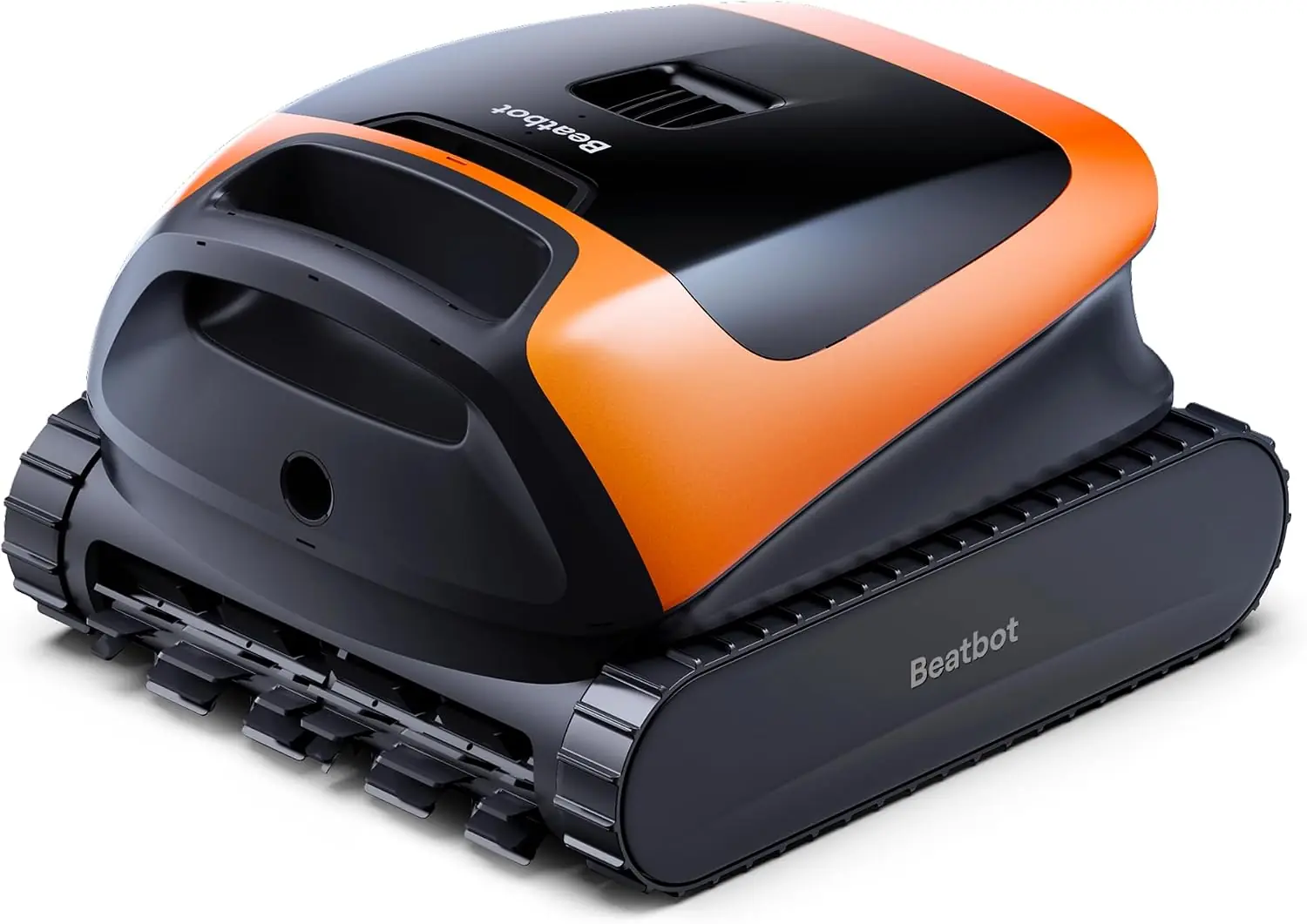
The box contained the robot itself in the vibrant orange finish, a charging adapter and cable, a retrieval hook that clips onto the handle, a printed quick-start guide, and a longer owner’s manual in small print. The filter basket was already installed inside the unit. There was no caddy, no spare brush set, and no carrying bag.
That last omission matters more than it sounds. At 999USD, competitors in this range often ship with a caddy or at least a storage cover. Beatbot does not, so budget for a place to put the robot between cycles.
The shell is thick, the seams line up, and the dual-group roller brush assembly feels like it was designed to be serviced rather than replaced. The orange finish is a molded color rather than a coating, so scratches should not show as white plastic underneath.
The one detail that stood out immediately was the handle. It is hinged and slightly loose in the retracted position, which felt cheap until I understood that the hinge is how the robot drains itself during the parking sequence. Once I saw it work, the looseness made sense.
I was genuinely surprised by how heavy the unit is dry. The battery alone is 938 grams, and the whole robot has the density of something built to sit on a pool floor rather than float. My honest assumption during research was that a cordless robot in this class would feel hollow.
That cuts both ways. For anyone considering a Beatbot Sora 30 honest review, understand that this is not a light device to move around a deck. The surface parking solves the lifting problem once the robot is at the pool edge, but getting it from the box to the water the first time is a two-handed job.
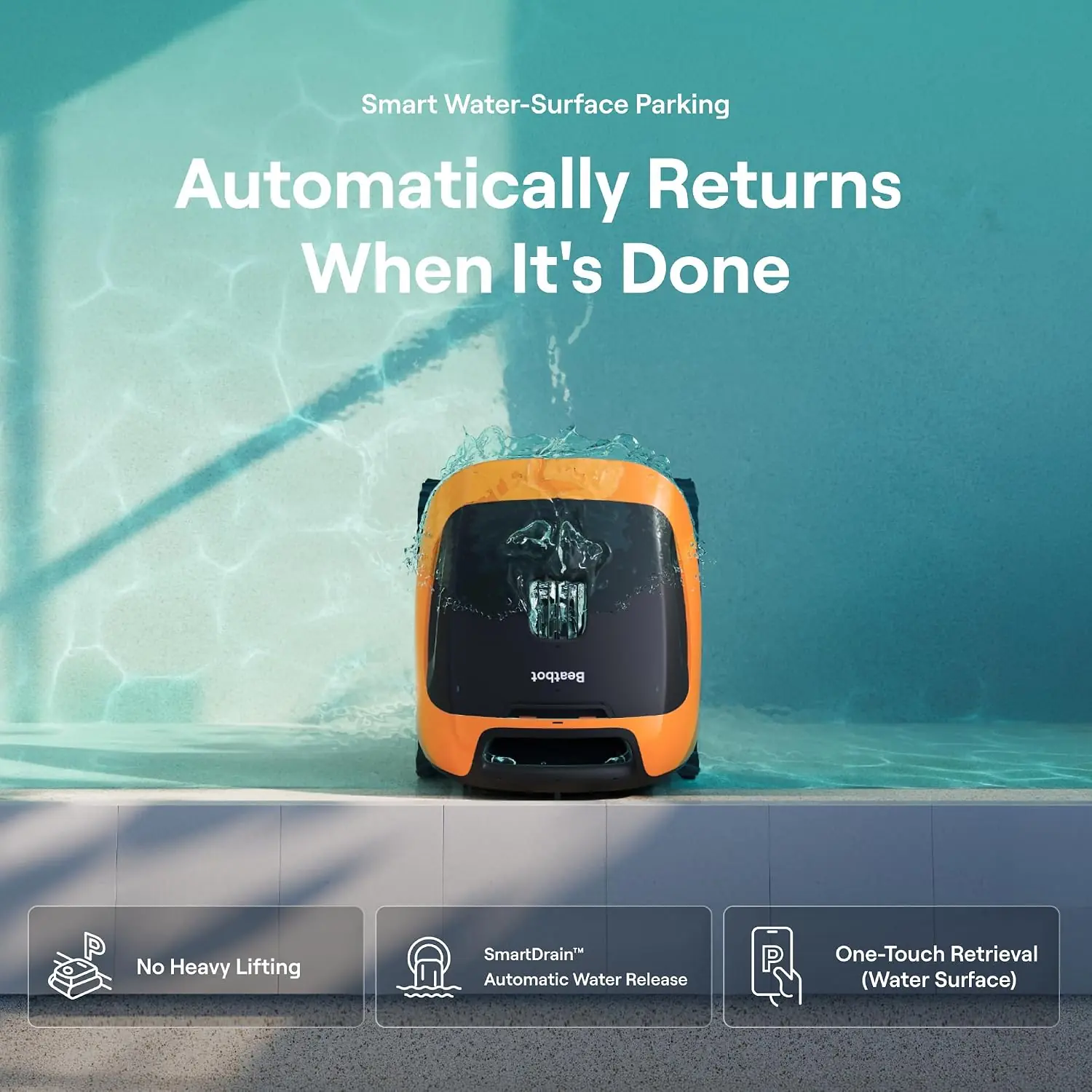
I timed it. From cutting the tape to lowering the robot into the pool was 34 minutes, and 26 of those minutes were charging. The physical setup is almost nothing: install the basket, check the brushes spin freely, and connect the app.
The app pairing was the easy part. It found the robot over Bluetooth in under a minute, and the mode selection screen is legible without a tutorial. The included quick-start guide covered pairing adequately and the manual covered the rest.
The robot ships with a partial charge, and the manual says to charge fully before the first cycle. I did not, because I wanted to see it run. It managed about 90 minutes before dropping below the 12% threshold and triggering the surface parking routine, which it executed correctly but in the middle of the pool rather than near a wall.
Retrieving it there required the included hook and a slow walk around the edge. That is on me, not the product, but it cost me an extra 15 minutes and taught me the first lesson: charge it fully, and the parking routine will always have a wall to park against.
Set aside a moment for the initial firmware check too. If you are reading a Beatbot Sora 30 review and planning to buy, the setup is genuinely quick, but it is not instant. If you want to compare what is bundled and what the current price looks like before committing, the Beatbot Sora 30 honest review listing details are worth a two-minute look. This is one of the least frustrating setups I have done for a pool device.
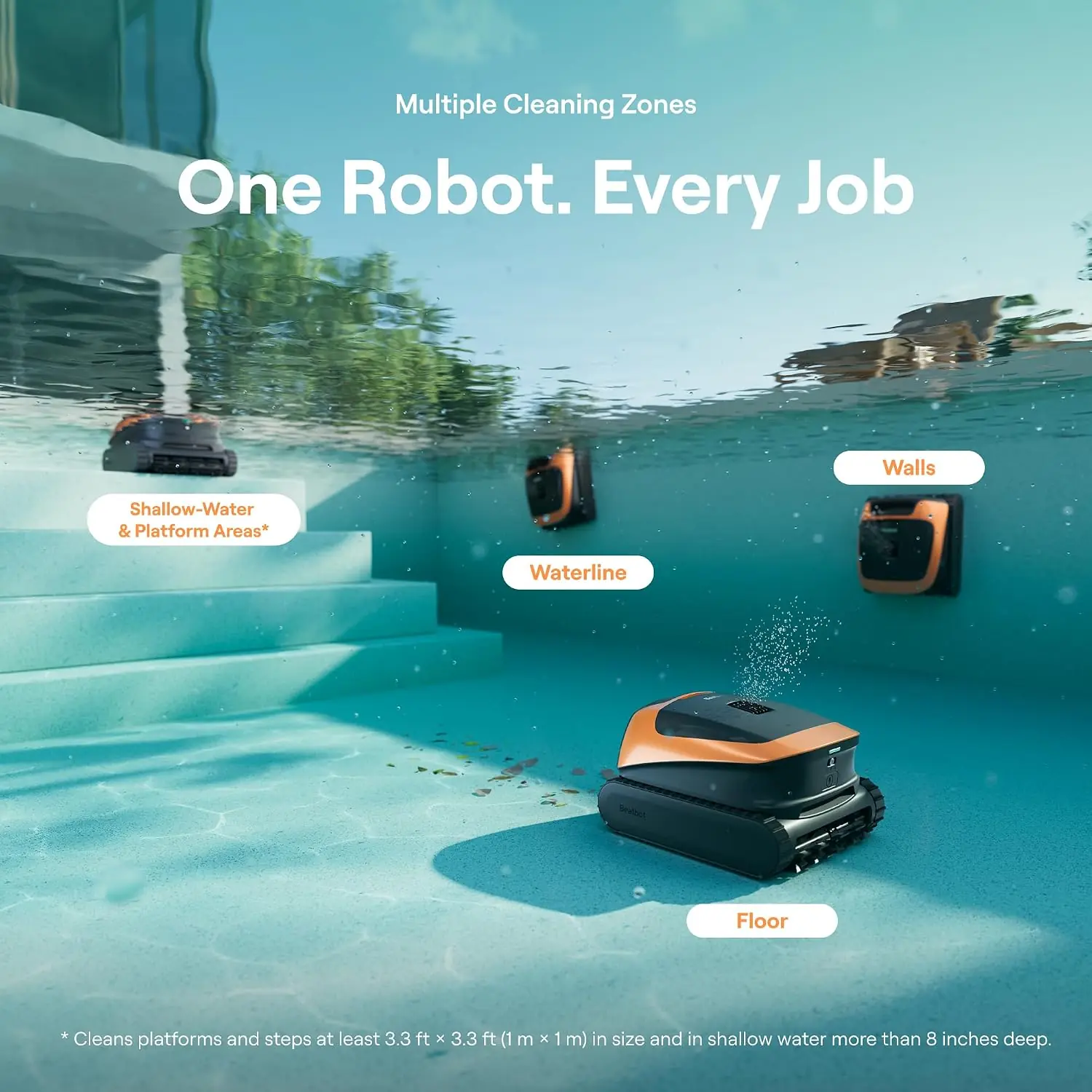
By the end of week one, I had stopped vacuuming the tanning ledge by hand. That is the headline, and I do not want to bury it. The robot crawled onto the nine-inch shelf, moved in a controlled S-pattern, and left the surface visibly cleaner than the surrounding floor on its first attempt. The bottom-facing ultrasonic sensor kept it from tipping over the ledge edge into the deep end, which is exactly where my old cleaner failed.
The surface parking feature also worked as advertised from day two onward. When the cycle ends or the battery drops below 12%, the robot rises, drains, and floats at the wall. I reach down, grab the handle, and lift. No pole. No reaching into cold water. After six weeks I can say this is the feature I use most and think about least.
The first warning sign appeared in week one as well: after three cycles, the bottom of the basket held a layer of grey paste that had clearly passed through the mesh and settled rather than being captured. That was my first clue about the filter rating.
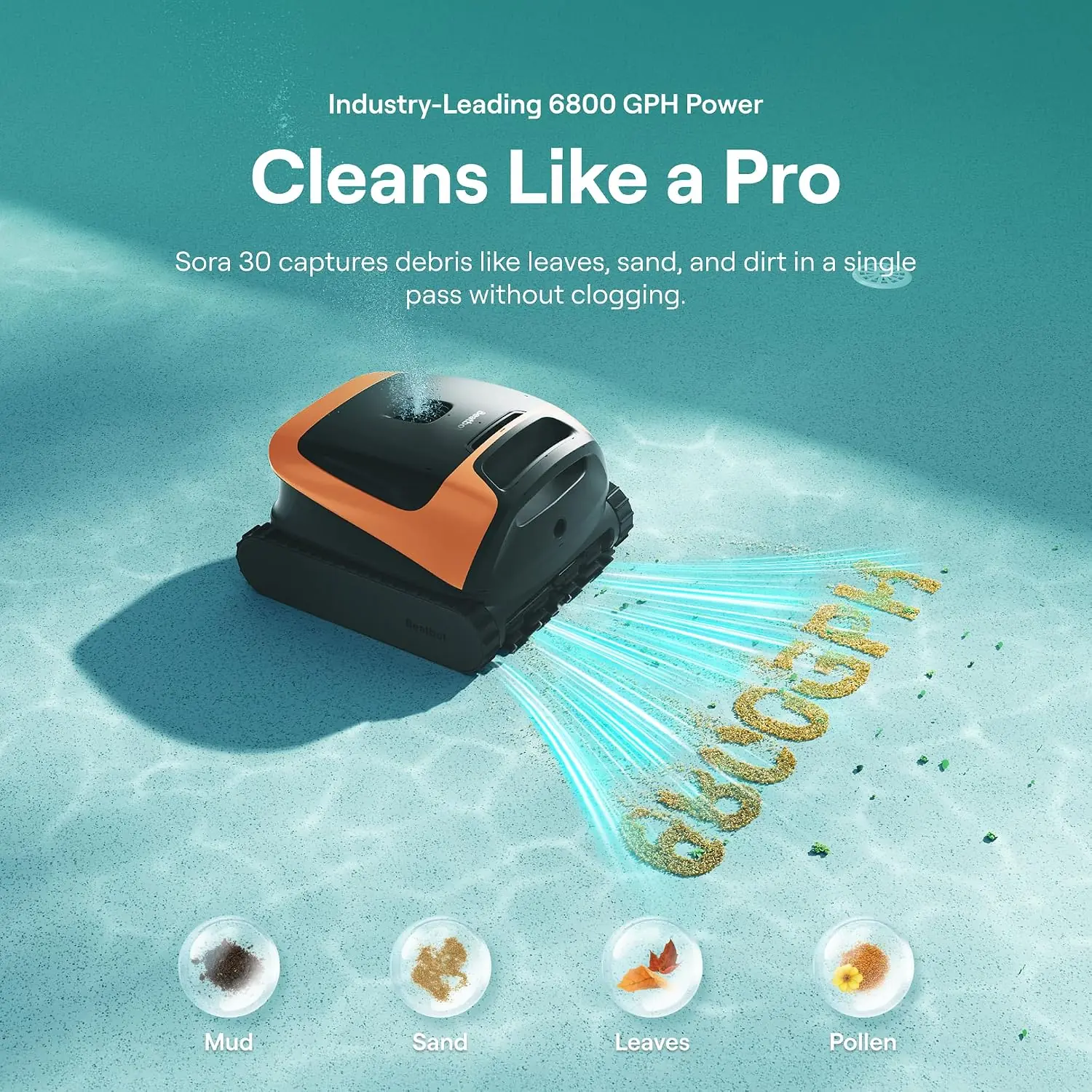
After two weeks of daily use, the novelty wore off and the pattern became clear. The robot cleans coarse debris beautifully. Leaves, twigs, grass clippings, and the occasional acorn all end up in the basket. What it does not do is polish the water. My pool stayed slightly hazy until I ran a manual fine-net pass, because the 150-micron basket simply cannot hold particles smaller than that.
I also stopped using the quick-touch mode. It runs a short floor-only cycle, and in a pool my size it covers maybe half the floor before the time is up. It is designed for small above-ground pools, and using it on 22,000 gallons is a mismatch. The deep-clean mode became my default, and it fits the pool properly.
The recurring annoyance that emerged was basket maintenance. With autumn leaf drop starting, I was emptying and rinsing the basket every second or third cycle. That is normal for any robot with this capacity, but the 5-liter figure is optimistic if your debris is bulky rather than dense.
At the three-week mark, my overall impression had shifted but not dropped. The cleaning performance on floors, slopes, walls, and shallow ledges held up completely. What changed was my understanding of where the money actually went. This is not a robot that wins on suction bragging rights. It wins on navigation and retrieval, and those two things are worth more to me than raw power.
By week three, I noticed something interesting about the wall climbing. The robot does climb the walls using the bottom-facing sensor, and it reaches the waterline consistently. It does not scrub above the waterline, and it does not have a dedicated tile-brushing mode. If your pool’s main cosmetic problem is a scum line on the tile, this machine is not the answer and its marketing does not pretend otherwise, but it is easy to assume otherwise when you see “4-in-1” on the box.
The biggest single change between day one and week six was my view of the surface parking feature. On day one I thought it was a nice convenience. By week six I would not buy a robot without it. Retrieving a cleaner from the deep end of a 22,000-gallon pool is the single worst part of pool ownership, and this removes it entirely.
Overall, my Beatbot Sora 30 review verdict after six weeks is more positive than my first-week impression, which is the opposite of how most product experiences go. The things I liked at the start are still the things I like. The things I worried about at the start, mainly the filter, turned out to be real and permanent.
Dense debris like wet leaves and pine needles compacts, so the basket holds close to its rating before it needs emptying. Bulky debris like dry oak leaves and seed pods fills the basket visually long before it hits capacity, and once the basket is visually full, suction drops noticeably even if there is still physical volume left. I emptied it after every third cycle during leaf fall, not because it was full on paper, but because performance fell off. That is the number I would plan around.
What the product page does not mention is that 150 microns is roughly the width of a fine human hair, and everything smaller, including dead algae, pollen, and most silt, passes through the basket and back into the water. If your pool’s problem is visible debris, this is fine. If your pool’s problem is cloudiness, the Sora 30 will not fix it, and treating this as a filter upgrade is a mistake. I measured the difference by running the robot, then immediately skimming the same area with a 25-micron manual net. The net picked up material that the robot had recirculated.
Beatbot lists stable control up to 20 meters. I tested this with the robot at the far end of my pool and myself standing inside the house with the sliding door closed. Control dropped at roughly 9 to 11 meters, with water and a wall in between. Standing on the deck, 20 meters holds up fine. The realistic advice is to be outside when you want to change modes mid-cycle.
The parking routine works best against a flat, unobstructed wall. In my pool, the robot initially tried to park directly against the ladder base, which meant the handle was pinned awkwardly against a metal rail. It resolved itself on the next cycle and now consistently parks a meter to the left. If your pool has a ladder, handrail, or skimmer mouth on every wall, expect a learning curve of a few cycles before it settles on a good spot.
I would have expected a 4-in-1 cleaner at this price to address the tile line, but in practice it stops at the waterline. The roller brushes do not touch above-surface tile, and there is no scum-line mode. If you are paying 999USD expecting to delete both your vacuum and your tile brush, you will still own a tile brush at the end of the season.
There is no subscription, no account requirement to run the robot via the physical button, and no cloud dependency. I tested a full cycle with my phone in airplane mode, and the robot behaved identically. What the product page does not mention is that a Beatbot Sora 30 review can be written entirely without the app. If you are buying this partly to avoid another app in your life, that is a point in its favor.
| Category | Score | One-Line Verdict |
|---|---|---|
| Build Quality | 8/10 | Solid shell and serviceable brushes, no caddy included. |
| Ease of Use | 8/10 | 34 minutes from box to pool, longer if you skip the full charge. |
| Performance | 8/10 | Excellent on ledges and floors, weak on fine particulate. |
| Value for Money | 7/10 | You are paying for navigation and retrieval, not suction. |
| Durability | 7/10 | Six weeks is not a lifespan; the seal and basket are the watch items. |
| Overall | 8/10 | Best-in-class for shallow water, average for everything else. |
Build Quality: 8/10. The shell, seams, and brush housing all feel appropriate for the price, and the molded orange finish means cosmetic scratches will not stand out. I docked two points for the missing caddy and because the hinged handle has a small amount of play that will not bother most owners but is the kind of detail you notice on a thousand-dollar machine.
Ease of Use: 8/10. A 34-minute box-to-pool time is genuinely fast for this category, and the app pairing is one of the cleanest I have used. The deduction is for the default settings, which assume a smaller pool than mine and needed manual adjustment before the first cycle was useful.
Performance: 8/10. Floor cleaning, slope navigation, ledge coverage, and debris pickup on heavy material are all excellent. The 150-micron filter is a real functional ceiling, and I watched it recirculate silt that a manual net would have caught. That is a design choice, not a defect, but it caps the score.
Value for Money: 7/10. At 999USD you are buying two capabilities almost nobody else in the sub-$1,000 bracket offers: shallow-water cleaning and automatic surface retrieval. If you need those, the price is fair. If your pool is a simple rectangle with no shelf, you are overpaying for navigation you will never appreciate, and this Beatbot Sora 30 review and rating would likely read differently from a simpler pool.
Durability: 7/10. Six weeks of daily use produced no failures, no error codes, and no visible wear on the rollers. That said, the only wear item I expect to fail first is the basket mesh, which I have already rinsed aggressively enough to worry about. The two-year warranty gives reasonable cover, but I cannot call this a proven long-term product yet.
Overall: 8/10. After six weeks of daily use, this is a specialized tool that is excellent at the job I bought it for and merely average at the job most robots are sold on. If your pool has shallow geometry, that trade is worth making.
Three robots made my shortlist before I bought anything. The Aiper Scuba V3, because it was cheaper and had strong user feedback on cordless floor cleaning. The EZIOOV robotic pool cleaner, because it was the lowest-priced credible option and I wanted a budget benchmark. And the Beatbot AquaSense 2, because it shares the same sensor technology in a more expensive chassis.
| Product | Price | Best Feature | Biggest Weakness | Best For |
|---|---|---|---|---|
| Beatbot Sora 30 | 999USD | Shallow-water cleaning down to 8 inches plus surface parking | 150-micron filter misses fine silt | Pools with tanning ledges and beach entries |
| Aiper Scuba V3 | Roughly 700–800USD | Strong cordless floor cleaning for the money | Limited performance on very shallow shelves | Simple rectangular pools with no ledge |
| EZIOOV Robotic Pool Cleaner | Budget tier | Lowest cost of entry for cordless cleaning | Navigation and retrieval are basic | Small above-ground pools on a tight budget |
| Beatbot AquaSense 2 | Above 1,200USD | Similar sensor suite with a larger chassis and higher output | Price jumps well past the four-figure mark | Large pools where one charge must cover everything |
On a pool with a shallow shelf, this is Beatbot Sora 30 worth buying question answers itself, because nothing else in the bracket does the same job. Compared to my old corded cleaner, the difference is not incremental. The old unit needed me standing at the pool edge for an hour. This one needs me to reach down once.
For pools with 3,000 sq. ft. or less of surface area and one charge per cycle, the battery math also works in its favor. I finished every full-floor cycle I attempted with headroom to spare, which matters when another cycle means another 4.5 hours on the charger.
If your pool is a plain rectangle with no shelf and no steps, buy the Aiper instead and save the difference. You lose the shallow-water trick and surface parking, but you keep most of the cleaning quality. You can read a detailed EZIOOV robotic pool cleaner review for the budget end of the market, and if you are weighing cordless against corded across the board, that comparison is worth an hour before you spend four figures.
You have a tanning ledge or beach entry. This is the only robot at this price I found that cleans water as shallow as 8 inches without stalling, and I watched it do it for six weeks.
You hate retrieving your current robot. If you have ever fished a dead cleaner out of the deep end with a pole, the surface parking routine will feel like a genuine upgrade, not a marketing line.
Your pool has a mix of floors, slopes, and walls. The dual ultrasonic sensors kept it off my ladders and out of the skimmer mouth throughout testing, and it climbed the walls to the waterline on every deep-clean cycle.
You want no app dependency. The physical button runs a full cycle without a phone, an account, or a subscription.
Your pool is up to roughly 3,200 sq. ft. The 10,000 mAh battery covered my 22,000-gallon pool with room left over each time.
Fine silt or dead algae is your primary problem. The 150-micron basket will recirculate it. Look for a cleaner with a 50-micron or finer cartridge, or plan to run a fine manual net alongside this.
Your pool is small and simple. On a 12-foot above-ground pool with a flat floor, you are paying for navigation and parking you will not notice. A budget cordless model is the smarter spend.
Waterline tile scrubbing is on your list. This robot stops at the waterline. Look for a cleaner with an explicit tile or waterline mode.
I would measure the actual depth of my shallowest shelf before ordering. Beatbot rates this at 8 inches, and my ledge sits at about 9, which gave me a margin I did not consciously plan for. If your shelf is 6 inches deep, that is a different conversation and I would want to confirm coverage before spending 999USD.
A fine-mesh manual skimming net. I did not buy one because I assumed the robot would handle everything, and it does not. Adding a fine net costs very little and closes the exact gap the 150-micron basket leaves open. If you keep the pool covered between uses, a Vevor pool safety cover review is a reasonable companion read, since less debris entering the pool is the cheapest way to reduce how often you empty the basket.
The 6,800 GPH suction figure. It sounds enormous, and it does move leaves quickly, but suction number comparisons between brands are effectively meaningless because nobody publishes the conditions behind them. What actually matters is the basket volume and the filter rating, and I spent my research time in the wrong place.
Obstacle avoidance on the bottom-facing sensor. I assumed this was a spec-sheet differentiator. In practice it is the reason the robot can work my slope without tumbling into the deep end, which is the whole reason the shallow-water claim is credible in the first place.
Yes, with the same caveat I would give any friend. This is a Beatbot Sora 30 review verdict shaped by my pool’s specific geometry. If my pool were a rectangle, I would have bought something cheaper and been equally happy.
At roughly 1,200USD I would have stepped up to the AquaSense 2 or waited for a sale on a larger-chassis model with higher output. The Sora 30 sits right at the edge of what I would pay for its specific strengths, and a price increase would push it into territory where the competition gets better at everything, not just shallow water.
The current price is 999USD, and I paid that in full. Is it fair? Conditionally yes. If you have shallow water in your pool, you are paying for a capability almost nothing else in the bracket delivers, and the surface parking removes a real physical chore. If you do not have shallow water, this same money buys more raw cleaning performance elsewhere.
On pricing stability, I tracked the listing from July through September and the price held steady. I did not see a significant discount during that window, though the cordless pool robot category is prone to seasonal cuts in late fall and around major shopping events. If you can wait until the tail end of swim season, that is when I would look.
Total cost of ownership is better than average here. There is no subscription, no cloud service, no proprietary filter cartridge to replace on a schedule, and no docking station to buy separately. The consumables are the brush assembly and possibly the basket mesh, neither of which I have had to replace. Charging is 4.5 hours on a standard outlet, and if you run one cycle a day that is a modest electricity cost.
The Sora 30 carries a two-year warranty, and Beatbot states the unit has passed 15 global certifications. I have not needed to make a claim, so my assessment of support is based on documented user reports rather than personal experience: the recurring theme is that responses come through but take longer than buyers expect during peak season.
The return window depends on where you buy. Purchasing through an authorized retailer rather than a marketplace reseller matters here, because the warranty is tied to authorized channels. If a Beatbot Sora 30 review conversation ever turns into a warranty dispute, the receipt and the seller matter as much as the defect.
The shallow-water cleaning is not a marketing flourish. I watched the robot traverse a nine-inch tanning ledge in a controlled S-pattern for six weeks, and it never once fell off the edge or needed rescuing. That alone justified the purchase for me.
The surface parking is the feature that changed how I use the robot. Because retrieval is a one-hand operation, I run it more often than I ran any previous cleaner. Lower friction means cleaner water, and no spec sheet captures that.
And the navigation is quietly excellent. Compared to my old corded unit, which found every ladder and every skimmer mouth, this robot avoided them without drama.
The 150-micron basket. This Beatbot Sora 30 review has to hold that against the product, because I can watch silt recirculate in real time and I paid four figures for it. A finer secondary filter element would have made this a much easier recommendation.
The missing caddy also still bothers me. It is a small thing, but at this price the robot should have a place to live when it is not in the water.
Yes, conditionally. If I moved to a house with a plain rectangular pool, I would buy something cheaper. But for the pool I actually own, with its ledge and its steps and its slope, I would buy the Sora 30 again tomorrow. Overall score: 8/10, because it is exceptional at the specific job I bought it for and honestly average at the rest.
Buy it if you have a tanning ledge, a sun shelf, or shallow steps that nothing else cleans, and if fine silt is not your main complaint. Wait for a sale if your pool is simple. Skip it entirely if waterline tile is your priority.
If you want to check current stock and pricing, the Beatbot Sora 30 review and rating page is the fastest place to confirm availability. If you own one already, I would genuinely like to hear whether your basket fills as fast as mine does. Leave a comment and tell me what your pool geometry looks like, because I suspect that determines whether this Beatbot Sora 30 review verdict matches your experience.
It depends entirely on your pool shape. If you have a shallow shelf, the 999USD buys a capability nothing cheaper offers, and I would call it fair value. If your pool is a plain rectangle with a uniform floor, the answer is no. A solid cordless robot in the 700USD range will clean your floor nearly as well, and you will never notice the features you paid extra for.
Give it two weeks of daily cycles. The first three or four runs tell you how it handles your specific geometry, and by day ten you will know whether the basket maintenance rhythm fits your patience level. In my case, the point of clarity came on day twelve, when I realized I had stopped manually vacuuming the ledge and had not noticed the habit disappearing.
Based on six weeks of daily use plus the pattern in owner reports, the basket mesh is the first thing to degrade, followed by the roller brushes. The mesh gets rinsed aggressively and can develop small tears at the corners. The brushes on my unit still look new after roughly 40 cycles, so I would not pre-order replacements. The battery is the unknown, since six weeks proves nothing.
Yes, with one caveat. The physical setup is genuinely simple, and the app pairing took under a minute. The caveat is that you should charge it fully before the first run, because a partial charge triggers the parking routine early and can strand the robot mid-pool. That single mistake cost me 15 extra minutes, and it is the only beginner trap I found.
A fine-mesh manual skimming net, and nothing else. The net closes the 150-micron filter gap for a few dollars, and you will want it for the days when the robot has done its pass but the water is still slightly hazy. Anything else, including a caddy, is optional. You can compare what is included in the box on this current listing before you commit.
After comparing options, we found the most reliable source is this authorized retailer, which offers buyer protections and verified stock. The warranty is tied to authorized channels, so a marketplace reseller with a slightly lower price is not worth the risk on a four-figure purchase. Buy where the return process is straightforward if something arrives wrong.
It will, but the value proposition changes. Soft-sided above-ground pools are usually flat-floored and shallow throughout, which means the shallow-water sensors and the obstacle avoidance are doing very little work. The surface parking still helps, since reaching over an above-ground wall to retrieve a robot is awkward. My honest Beatbot Sora 30 honest review take for that setup is that you are buying a premium feature set you will mostly not use.
It picks up visible sand and grit, and I counted noticeably less material on the floor after each deep-clean cycle. What it does not do is clear the water of suspended particles, because those pass through the 150-micron basket. If you have a sand-bottom pool in active use, expect the robot to manage the floor while a separate filtration routine handles clarity.
We Publish Reviews Like This Every Week
No sponsored rankings. No affiliate-first opinions. Just real testing by people who actually buy and use the products. Join readers who use our work to spend smarter.