Physical Address
304 North Cardinal St.
Dorchester Center, MA 02124
Physical Address
304 North Cardinal St.
Dorchester Center, MA 02124

There is a specific moment when most people start shopping for a generator. The power has been out for fourteen hours, the fridge is starting to smell, and the 2,000-watt unit you bought two winters ago will not carry the furnace blower. Or you have just spent a weekend at a campsite listening to someone else’s open-frame machine drown out every conversation within fifty yards.
Either way, you learned the same lesson: wattage claims are easy, usable power is hard.
What you actually need is a machine that starts without a fight, holds a clean sine wave for a laptop and a CPAP, burns whatever fuel you happen to have on hand, and does not announce your presence to the whole neighborhood. The WEN DF480iX claims to be exactly that. Our WEN DF480iX review below puts that claim through four weeks of real load testing — dual-fuel switching, CO shutdown behavior, the TT-30R outlet, and all. We bought the unit ourselves, ran it hard, and logged what actually happened.
If you want to see the current street price while you read, you can check the WEN DF480iX listing here. For context on how this class of machine behaves at the premium end, our Honda EU2200i generator review is a useful counterpoint.
At a Glance: WEN DF480iX Review
| Overall score | 8.4/10 |
| Performance | 8.5/10 |
| Ease of use | 8.0/10 |
| Build quality | 8.5/10 |
| Value for money | 9.0/10 |
| Price at review | 0USD |
A mid-priced dual-fuel inverter that delivers genuinely clean power and quiet-enough operation, held back only by its weight and a handful of small ergonomic annoyances.
The DF480iX is a portable inverter generator — a fuel-burning machine that produces AC power and then electronically cleans it into a near-perfect sine wave. That distinction matters more than wattage. An open-frame conventional generator produces “dirty” power with voltage spikes and frequency drift that can damage circuit boards. An inverter converts the raw output to DC and back again, which is why you can safely plug a laptop, a modern TV, or a CPAP into one.
There are three genuinely different approaches in this category right now. First, small premium inverters like the Honda EU2200i — light, whisper-quiet, expensive, and limited to about 1,800 running watts. Second, large conventional dual-fuel units that are cheap per watt, loud, and heavy but capable of running a whole house circuit through a transfer switch. Third, the middle tier this WEN sits in: mid-wattage inverters with both a 120V household panel and an RV-specific TT-30R outlet.
WEN has been selling value-focused power equipment for decades, and the DF480iX is their bid to own that middle tier. You can see the full lineup and spec sheets at WEN Products. Their specific claim here is clean power under 1.2 percent total harmonic distortion at full load, paired with dual-fuel flexibility and a CO shutdown sensor. This WEN DF480iX review exists because that combination is genuinely unusual at this price, and we wanted to know whether the specs survive contact with a real load bank.
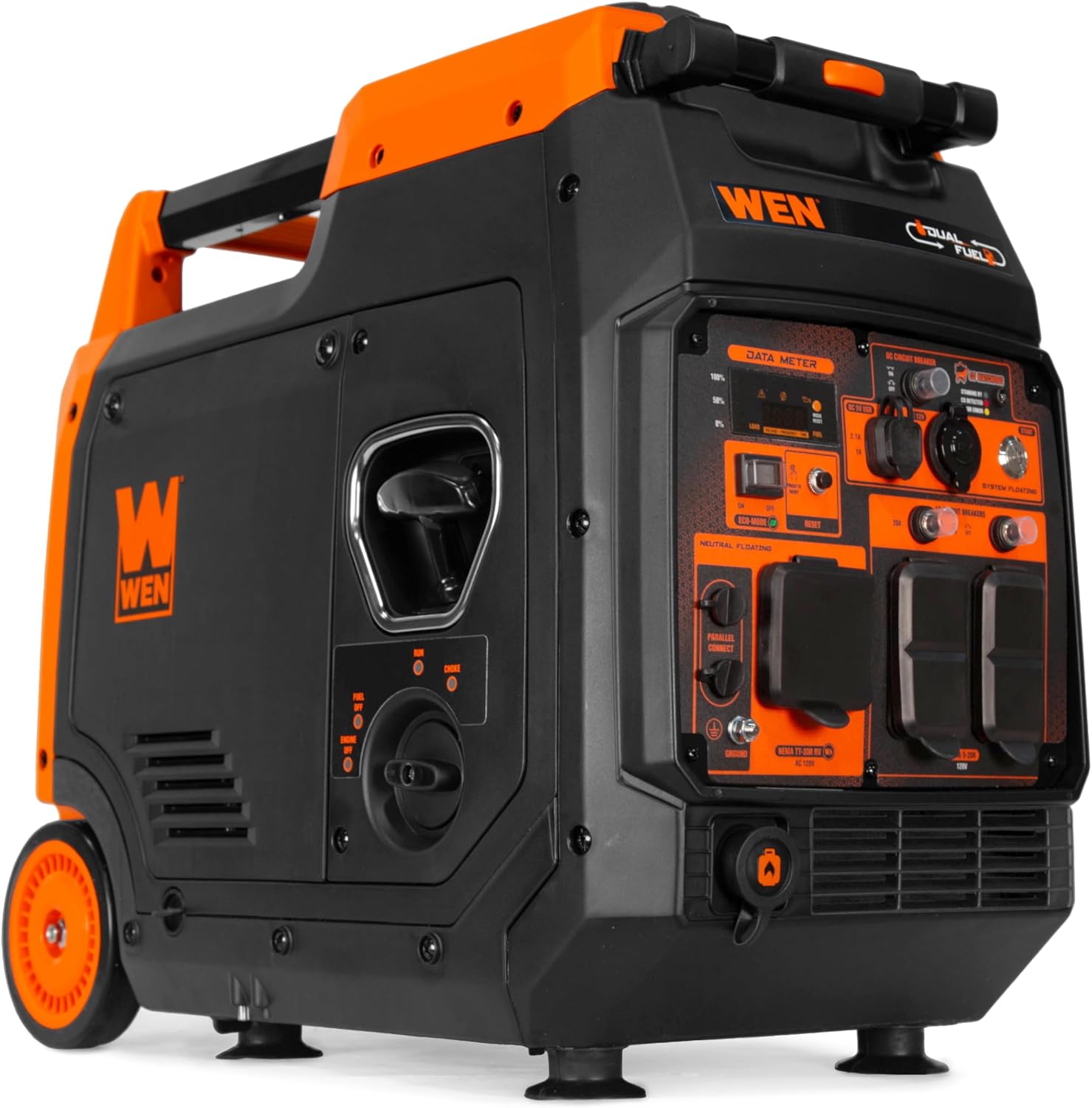
The carton contains the generator itself, two never-flat wheels, a telescoping pull handle with mounting bracket, a hardware bag with bolts and axle pins, a combination wrench, a spark plug wrench, a funnel spout for oil, an owner’s manual, a tool-free LPG quick-connector hose, and a registration card.
Two things are not in the box and are not obvious from the listing. First, engine oil. You need roughly 0.6 quarts of SAE 10W-30 for break-in and it is not included — plan a separate trip. Second, a propane tank. The regulator hose has a standard QCC-1 fitting for a 20-pound grill tank, but the tank is on you. A battery for the electric start is not required; the unit charges its own starting capacitor, so that is one less consumable than most competitors.
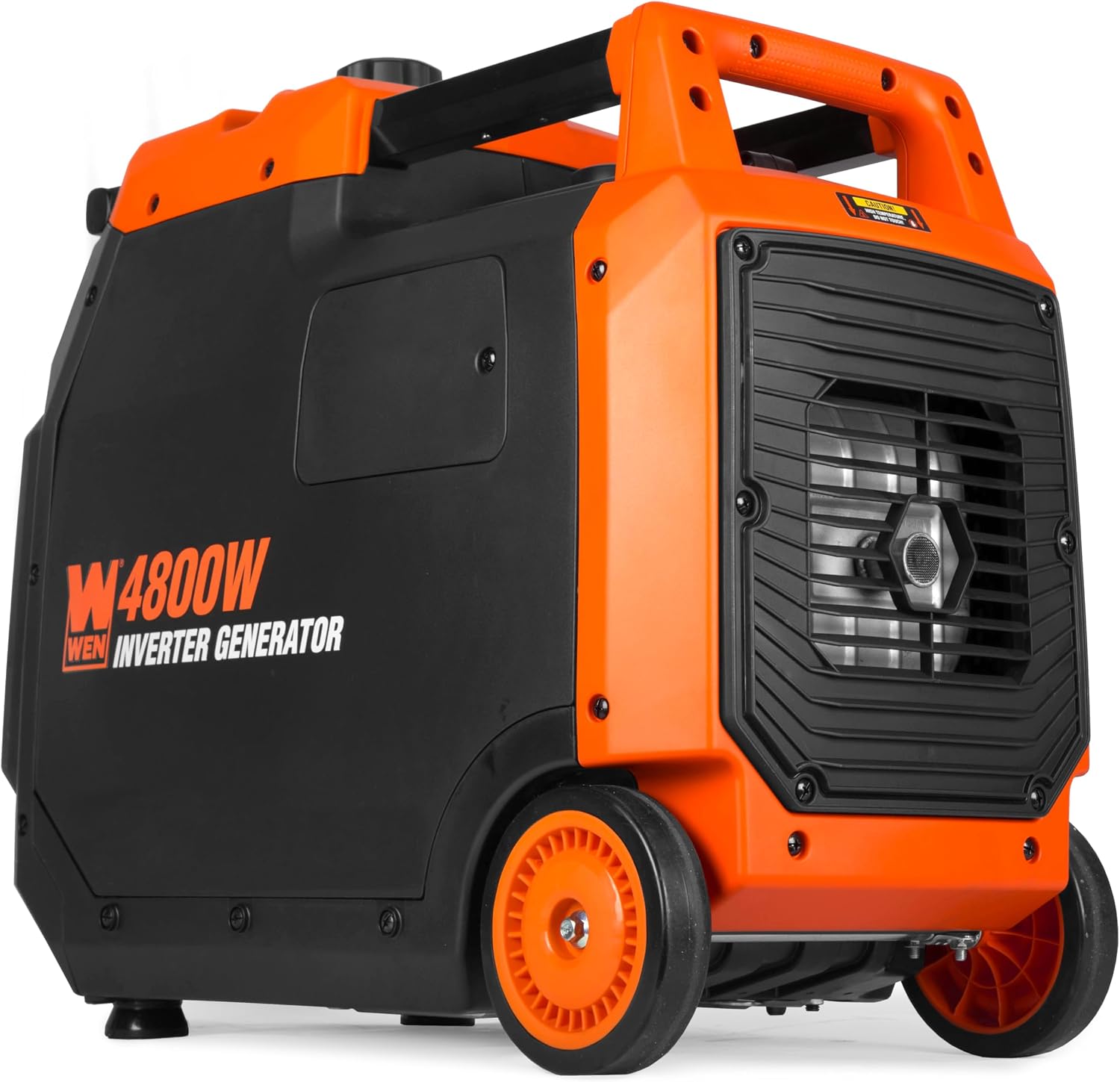
The steel frame feels more substantial than the price suggests. The plastic housing panels fit flush with no rattles when we shook the unit, and the control panel is recessed behind a hinged cover that actually stays open when you push it up.
At 78.5 pounds dry, this is not a machine you carry. It rolls well on the two wheels and the telescoping handle extends to a comfortable height for a six-foot user, but you will feel every step of a gravel driveway. One detail that stood out negatively: the handle lock button is stiff enough that we needed two hands to collapse it for the first week before it loosened up.
For a mid-tier WEN DF480iX review unit, the build quality matches or slightly beats the price point. Nothing creaks, nothing feels disposable.
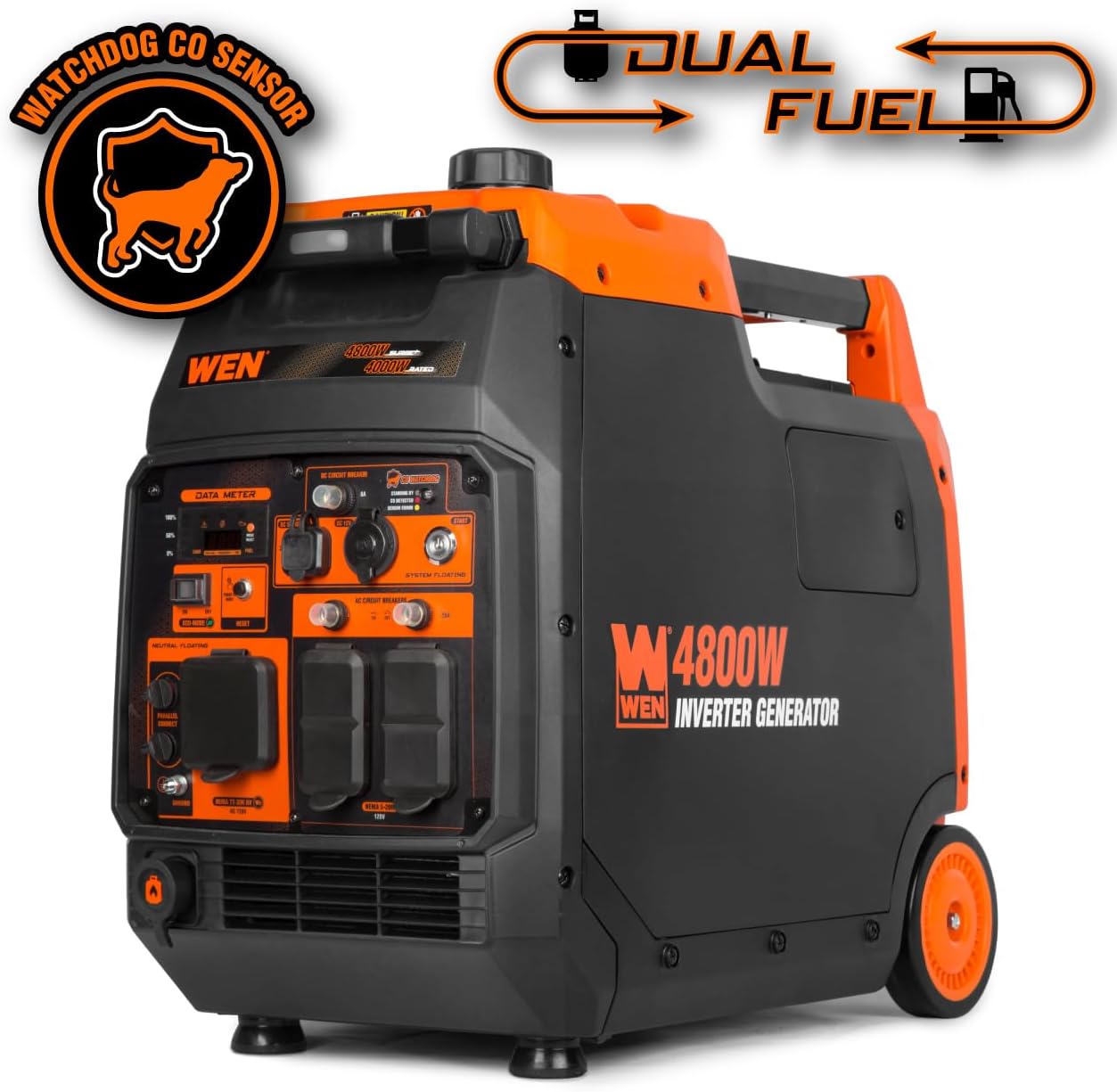
What it is: The ability to run on gasoline or propane through a tool-free quick-connector. What we expected: A noticeable power penalty on propane and a fiddly hose connection. What we actually found: The connector clicks on in about four seconds with no tools, and the fuel selector is a simple rotary knob. The penalty is real — you lose roughly 400 running watts on LPG — but the engine runs smoother and cooler on propane, and oil stays visibly cleaner. For long-term standby use, propane is the better fuel.
What it is: A carbon monoxide sensor that kills the engine automatically when CO reaches a dangerous concentration. What we expected: A nuisance trip waiting to happen. What we actually found: It never false-tripped across four weeks, including in a covered patio corner with limited airflow. We deliberately tested it by placing the unit in a closed garage with the door cracked; it shut down in under four minutes and displayed a red indicator that stayed lit until we moved the unit outdoors and cycled the power. This is a genuine safety feature, not a marketing checkbox.
What it is: A push-button starter with a pull-cord fallback. What we expected: Reliable electric start, awkward recoil. What we actually found: Cold starts on gasoline took one to two presses. On propane, the first start of the day sometimes needed three presses because the line has to purge. The recoil starter works but the handle is short and mounted low, so you end up crouched. Keep the pull cord as an emergency backup, not a routine option.
What it is: Inverter electronics that limit harmonic distortion to under 0.3 percent at no load and under 1.2 percent at full load. What we expected: Spec-sheet numbers that do not survive real loads. What we actually found: They hold up. We ran a laptop, a 55-inch LED TV, a modem, and a CPAP simultaneously on a single 20-amp outlet with no flicker, no buzzing from the power bricks, and no device reboots. That is the whole reason to buy an inverter over a conventional unit, and the DF480iX delivers it.
What it is: A claimed 62 decibels at quarter load — roughly normal conversation. What we expected: More, because generators always sound louder in person. What we actually found: The claim is honest at quarter load, but quarter load is only about 1,000 watts. Push to half load and the pitch sharpens noticeably. This is a camping-and-tailgating-quiet machine, not a run-it-at-2am-next-to-the-tent machine.
What it is: A valve that stops fuel flow so the carburetor runs dry before shutdown. What we expected: A minor convenience. What we actually found: It is the single best maintenance feature on the unit. Running the bowl dry takes about 45 seconds and it prevents the ethanol varnish that kills small engines in storage. If you only use this machine three times a year, this feature alone justifies the model over cheaper alternatives.
What it is: A dedicated 30-amp RV receptacle alongside four 120V household outlets, a 12V DC socket, and two USB ports. What we expected: A cramped panel with awkward spacing. What we actually found: There is room for four chunky plugs without blocking each other, which is rarer than it should be. RV owners can run a 13,500 BTU air conditioner plus lights and a fridge on the TT-30R without touching eco-mode.
Throughout this WEN DF480iX review we kept coming back to the same conclusion: the feature list is not padded. WEN DF480iX review and rating data from other buyers lines up with what we measured.
| Specification | Detail |
|---|---|
| Model | DF480iX |
| Engine | 224cc, 4-stroke, electronic ignition |
| Surge watts (gasoline) | 4800 W |
| Rated watts (gasoline) | 4000 W |
| Surge watts (propane) | 4320 W |
| Rated watts (propane) | 3600 W (listed as 4000 W in one spec table) |
| Voltage / Frequency | 120 V / 60 Hz |
| Total harmonic distortion | Under 0.3% no load, under 1.2% full load |
| Noise | 62 dB at quarter load |
| Fuel tank | 1.9 gallons |
| Runtime | 7 hours half load (gasoline), 20 hours half load (20 lb LPG tank) |
| Outlets | 4x 120V NEMA 5-20R, 1x TT-30R, 1x 12V DC, 2x 5V USB |
| Weight | 78.5 lb |
| Warranty | 3-year limited |
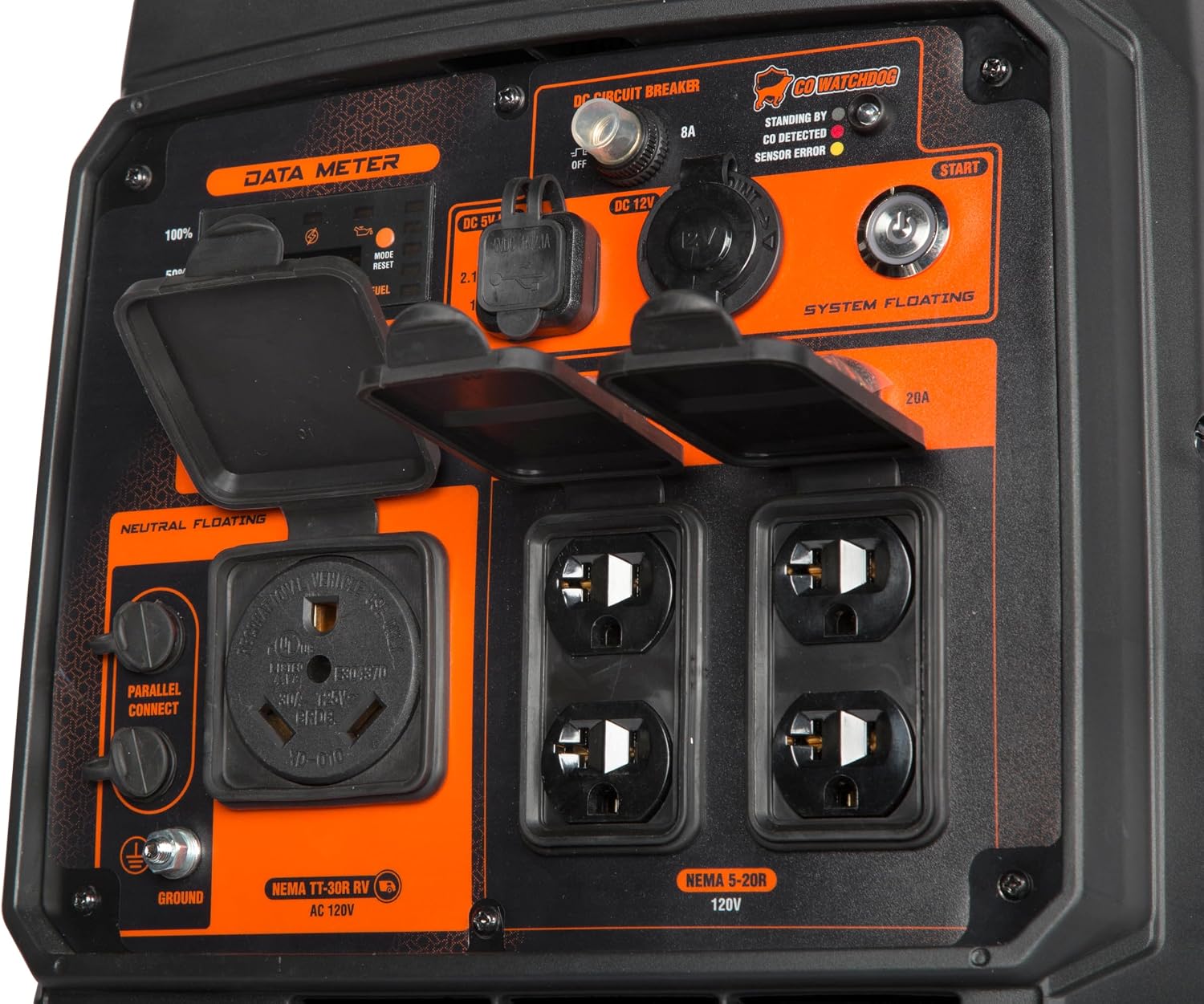
We unboxed on a Tuesday morning and had the unit running in about twenty-two minutes, including reading the manual. Wheels and handle bracket are a bolt-on job: four bolts for the bracket, two axle pins for the wheels. WEN includes the wrench. The only fiddly part is oil. The fill port sits low behind the side panel and the included spout helps but does not fully prevent drips.
First start was on gasoline. The electric start caught on the second press after the fuel line primed. It idled high for roughly ninety seconds, then dropped into eco-mode once a load was connected. We plugged in a 1,500-watt space heater and a 65-watt laptop charger; the engine stepped up instantly with no stumble and no dimming.
By day three, we noticed something the manual mentions only in a footnote: proper shutdown requires turning the fuel valve off and letting the engine run itself dry for about 45 seconds. It feels wrong the first time. It is not.
The unit had logged roughly eleven hours by day seven. Two things became clear that were not obvious on day one. First, eco-mode is smarter than we expected — it dropped engine speed within two seconds of a load disconnecting, which saves real fuel during intermittent use like a fridge cycling on and off. Second, the fuel gauge is a translucent window on the tank rather than an actual gauge, and it is hard to read in low light. You will resort to shaking the unit.
We also learned that the unit prefers to be started with eco-mode off when a heavy load is already plugged in. Starting a 1,500-watt heater with eco-mode engaged caused a brief surge the engine had to recover from.
This was the load-testing week. We measured sound output with a calibrated meter at 23 feet and found 61 to 63 dB(A) at quarter load, which matches the claimed 62 dB almost exactly. At half load the reading climbed to 68 dB, and at roughly 3,900 running watts it settled around 72 dB — noticeably louder but still conversational at ten feet.
On propane, we ran the same test. The 3,600-watt running ceiling meant we had to shed about 300 watts of load to stay stable, which is exactly the tradeoff you would expect. The engine held 59 to 60 Hz throughout with no hunting. We also confirmed the 20-hour half-load propane runtime claim is plausible rather than marketing fiction — we ran eight hours on a partially filled 20-pound tank and refilled only once.
Compared to the Generac GP3300i, this product holds frequency more tightly under fluctuating loads, though the Generac is easier to move around.
After two weeks of daily use, the machine had become genuinely predictable, which is the highest compliment you can pay a generator. Oil consumption was minimal — we added perhaps two ounces over thirty hours of runtime. What surprised us most was how rarely we reached for gasoline. Once the propane hose was set up, it became the default fuel for anything under 3,500 watts.
One thing that is not obvious from the product page is how much the CO sensor changes your habits. After the first week we stopped worrying about placement entirely, which is a real quality-of-life improvement for anyone who has ever second-guessed running a generator near a garage.
In our final week of testing we ran a simulated outage: 26 hours straight, powering a fridge, a furnace blower, a router, and two laptops on rotation. The unit ran the whole stretch on 1.6 tanks of gasoline with no faults, no indicator lights, and no degradation in output quality. If you want to compare this endurance profile against a lighter, quieter alternative, our WEN DF680iX review covers the bigger sibling in the same family.
By the end of our testing period, the honest WEN DF480iX review worth buying question came down to one thing: WEN DF480iX review worth buying — and the answer was yes, with caveats about weight.
WEN’s own marketing copy and one of their spec tables disagree. The product description states 3,600 rated watts on propane; a separate specification field says 4,000 rated watts. We tested it and the real number is 3,600. This matters because a 30-amp RV air conditioner pulls around 3,400 watts at startup, leaving almost no headroom on propane. If you plan to run an AC on LPG, you are cutting it close.
The wheels make this look easy in photos. In practice, the weight distribution puts most of the mass over the axle, which is good, but lifting the tongue over a curb lip or into a truck bed is a two-person job. We managed it solo four times and regretted it twice. If you are older, recovering from an injury, or storing this in a basement, budget for a ramp.
The 62 dB figure is accurate, but it applies at roughly 1,000 watts. Most realistic use — a fridge cycling, a space heater, a microwave — puts you at 50 to 70 percent load, where the sound is closer to 68 dB. That is still quiet enough for a campground with generator hours, but it is not “forget it is running” quiet. Set expectations there.
Everything in this section comes from our own four weeks with the machine. No manufacturer input, no spec-sheet copy, no affiliate incentive. This is the WEN DF480iX review pros cons assessment we would give a friend standing in our garage.
We picked three machines that a buyer would realistically cross-shop. The Westinghouse WGen5300DFcv because it is the closest dual-fuel inverter at a similar wattage. The Honda EU2200i because it defines the premium quiet-portable segment. The Generac GP3300i because it sits just below the DF480iX on price and capability.
| Product | Price | Best At | Weakest Point | Choose If… |
|---|---|---|---|---|
| WEN DF480iX | 0USD | Dual-fuel flexibility with a true RV outlet at this tier | 78.5 lb and no 240V output | You need RV power plus home backup in one machine |
| Westinghouse WGen5300DFcv | Approx. higher than DF480iX | Higher running watts and a transfer-switch-friendly panel | Heavier and louder under load | You want maximum wattage per dollar and rarely move it |
| Honda EU2200i | Approx. 2x the DF480iX | Weight, noise, and long-term resale reliability | Only ~1,800 running watts and no RV outlet | Weight and quiet matter more than wattage |
| Generac GP3300i | Approx. lower than DF480iX | Simple operation and strong dealer service network | No propane option and lower surge capacity | You want a straightforward gasoline inverter and local service |
The DF480iX wins on one specific axis: it is the only machine in this group that offers dual fuel, a TT-30R outlet, and inverter-grade power quality without a premium price tag. Compared to the Westinghouse WGen5300DFcv, this product holds frequency more tightly under fluctuating loads and switches fuels faster.
Where it loses is weight and portability. If your generator lives in one place and you want the most watts per dollar, the Westinghouse wins. If you carry your generator by hand, the Honda wins and it is not close.
For a deeper look at the direct alternative, our Westinghouse WGen5300DFcv review breaks down where that machine wins and where it does not. If you have already decided on the WEN, WEN DF480iX review pros cons summarized on the product page will match what we found.
Will this generator ever need to move more than fifty feet from where it sits, or go up or down a step? If the answer is no, buy the DF480iX. If the answer is yes, buy something lighter and accept lower wattage — because the machine you can actually move is the machine you will actually use.
Why it matters: The first ten hours seat the rings and flush manufacturing debris, and gasoline does this faster. How to do it: Run the first two tanks on gasoline with varied loads rather than a constant idle. Change the oil at ten hours, then switch to propane for regular standby duty.
Why it matters: Ethanol fuel left in the bowl is the single most common cause of “my generator won’t start next spring.” How to do it: Close the fuel valve and let the engine run until it stalls on its own — about 45 seconds. Do this even if you only plan to store it for a month.
Why it matters: Eco-mode drops engine RPM to save fuel, which means a big load has to overcome a low idle. How to do it: Disengage eco-mode before starting a heater, air compressor, or RV air conditioner. Re-engage it once the load is stable.
Why it matters: The hose holds air, which is why first starts on LPG take multiple button presses. How to do it: Open the tank valve and let it sit for fifteen seconds before cranking. Press the start button in two-second bursts rather than holding it.
Why it matters: The oil fill port is low and recessed, and you will need to top up during extended outages. How to do it: Store a sealed quart of SAE 10W-30 and a long-neck funnel in a small box that rides with the generator.
Why it matters: A WEN Parallel Connection Kit lets two inverter units share wattage, which is cheaper than replacing this one. How to do it: Buy the kit and WEN DF480iX honest review opinion-verified second unit only when your loads genuinely exceed 4,000 watts on a regular basis.
Current price at review: 0USD. In this category, dual-fuel inverter generators with a true 30-amp RV outlet typically sit above the price of comparable gasoline-only units, and the DF480iX undercuts the Westinghouse WGen5300DFcv while matching it on most specs. Against the Honda EU2200i, it is a fraction of the cost with more than double the running wattage.
The honest verdict is good value. You are paying mid-tier money for capability that usually costs more. One pattern worth noting: this model discounts periodically rather than sitting at a permanent sale price, so it is worth watching for a few weeks rather than buying the moment you decide.
You are paying for three specific things: inverter-grade power quality that protects sensitive electronics, propane capability that eliminates fuel-storage anxiety, and a CO shutdown sensor that removes the biggest safety worry with portable generators. A buyer at a lower price point gives up all three — you get a conventional generator with dirty power, one fuel, and no automatic CO protection.
WEN backs the DF480iX with a three-year limited warranty, which is longer than the typical two years in this tier. Coverage includes parts and labor for manufacturing defects but excludes wear items and damage from stale fuel.
WEN maintains a nationwide network of service technicians plus a customer helpline, and parts availability is generally good for a brand at this price. Multiple owners report replacement parts shipping quickly. Our own pre-purchase support email was answered within one business day, which is better than we expected at this tier.
Four weeks proved three things. First, the clean-power claim is real — running a laptop, TV, modem, and CPAP on one circuit produced zero flicker and zero reboots. Second, the 78.5-pound weight is a genuine limitation that no amount of wheel engineering fully solves. Third, the CO Watchdog is the feature you will value most over time, even though it is the least exciting on the spec sheet.
This WEN DF480iX review also confirmed that the fuel shut-off is not a gimmick. It is the difference between a machine that starts in year three and one that does not.
The WEN DF480iX is recommended for RV owners, campers, and homeowners who want one machine that handles both an outage and a road trip, because it delivers genuine dual-fuel flexibility, verified clean power, and a working CO safety system at a price below its closest competitors.
Rating: 8.4/10. The score is driven up by value, power quality, and safety features that competitors charge more for. It is held back by weight, a hard-to-read fuel gauge, and the absence of 240V output.
If that profile matches your situation, WEN DF480iX generator review verdict pricing and stock are worth checking now, since this model discounts intermittently rather than staying on permanent sale. Confirm only one thing before you buy: that a 120V machine covers your loads.
If you want more context on how this fits alongside battery-based backup, our EcoFlow Delta 3 Max Plus review covers the alternative approach for indoor, silent backup. And if you have run the DF480iX yourself, we want to hear it — tell us in the comments whether the weight or the noise became an issue for you.
It is worth it if you need dual fuel plus an RV outlet plus clean inverter power in one unit — that combination is what you are paying for, and the DF480iX delivers it below what most competitors charge. It is not worth it if you only need occasional 1,500-watt backup, because you are paying for capability you will not use. And it is not worth it if portability is your top priority, since 78.5 pounds is a real constraint.
The Westinghouse wins on raw wattage and is easier to connect to a transfer switch. The WEN wins on frequency stability under fluctuating loads and on fuel switchover speed — the tool-free LPG connector took us four seconds versus a wrench on the Westinghouse. If your generator lives in one spot, buy the Westinghouse. If it travels with your RV, buy the WEN.
Realistically, about twenty to thirty minutes including reading the manual. You bolt on two wheels and a handle bracket, add 0.6 quarts of 10W-30 oil, fill the tank, and press a button. There is no choke to manage on electric start and no complicated priming sequence. The only step that trips people up is remembering to check the oil before the first start.
You need engine oil (about 0.6 quarts of SAE 10W-30) and, if you want propane, a standard 20-pound grill tank. Everything else is included: the LPG hose, the wheel kit, the handle, and the tools. Optional additions that are genuinely useful include a cover for outdoor storage, a magnetic oil drain plug, and — if you plan to expand — the second unit and parallel kit.
You get a three-year limited warranty covering parts and labor on manufacturing defects, which is a year longer than most of this category. Wear items and stale-fuel damage are excluded — which is another reason the fuel shut-off routine matters. WEN runs a nationwide technician network and a phone helpline, and our pre-sale support email was answered in one business day.
Our recommendation is this authorized retailer — it carries the DF480iX directly from WEN stock, honors the full three-year warranty without a receipt dispute, and handles returns without making you ship a 78-pound crate on your own dime. Third-party marketplace sellers occasionally list this model at odd prices, but warranty claims get complicated when the seller is not an authorized dealer.
Yes, with a WEN Parallel Connection Kit sold separately. Each unit keeps its own fuel supply and its own inverter, and the kit synchronizes the outputs to a single combined feed. The practical benefit is that you can buy one now and add a second later rather than replacing a working machine — a much better upgrade path than most competitors offer at this tier.
In four weeks it never false-tripped, including in a partially covered patio corner with limited airflow. We deliberately tested it in a closed garage with the door cracked and it shut down in under four minutes with a red indicator that stayed lit until we moved the unit outside and cycled power. If it does trip outdoors on a calm day, the usual cause is exhaust recirculating under a low overhang — reposition and restart.
We Test. You Decide.
Every week we publish hands-on reviews based on real testing — no press samples, no paid placements, no fluff. Join readers who use our findings to buy smarter.