Physical Address
304 North Cardinal St.
Dorchester Center, MA 02124
Physical Address
304 North Cardinal St.
Dorchester Center, MA 02124

There is a specific kind of dread that shows up around hour four of a blackout. The candles are lit, the phones are charged, the kids have lost interest in the novelty. What is left is the refrigerator, humming on borrowed time, and a running mental tally of what replacing a full load of groceries would cost.
Most people reading this have already tried something. A 500Wh camping station that died before sunrise. A gas generator that needed refueling in the rain at 2 a.m. A desktop UPS that was never designed to start a compressor. Each one solved part of the problem and failed at the part that mattered.
What good actually looks like is unglamorous: a unit that lives permanently near the fridge, draws almost nothing while it waits, and hands over to battery faster than a compressor can notice. That is the claim here. Our four-week BLUETTI FridgePower review tests whether the claim survives contact with a real kitchen. If you are weighing this against larger whole-home options, our Jackery HomePower 3600 Plus comparison is a useful reference point. You can also pull the BLUETTI FridgePower worth buying review listing for current pricing and the full spec sheet before you read on.
At a Glance: BLUETTI FridgePower (2016Wh, 1800W LFP)
| Overall score | 8.4/10 |
| Performance | 9/10 |
| Ease of use | 7.5/10 |
| Build quality | 8.5/10 |
| Value for money | 8/10 |
| Price at review | 949USD |
The score reflects exceptional transfer speed and standby efficiency against a genuinely awkward mounting process and a 41.9-pound weight that undercuts the “DIY in five minutes” pitch.
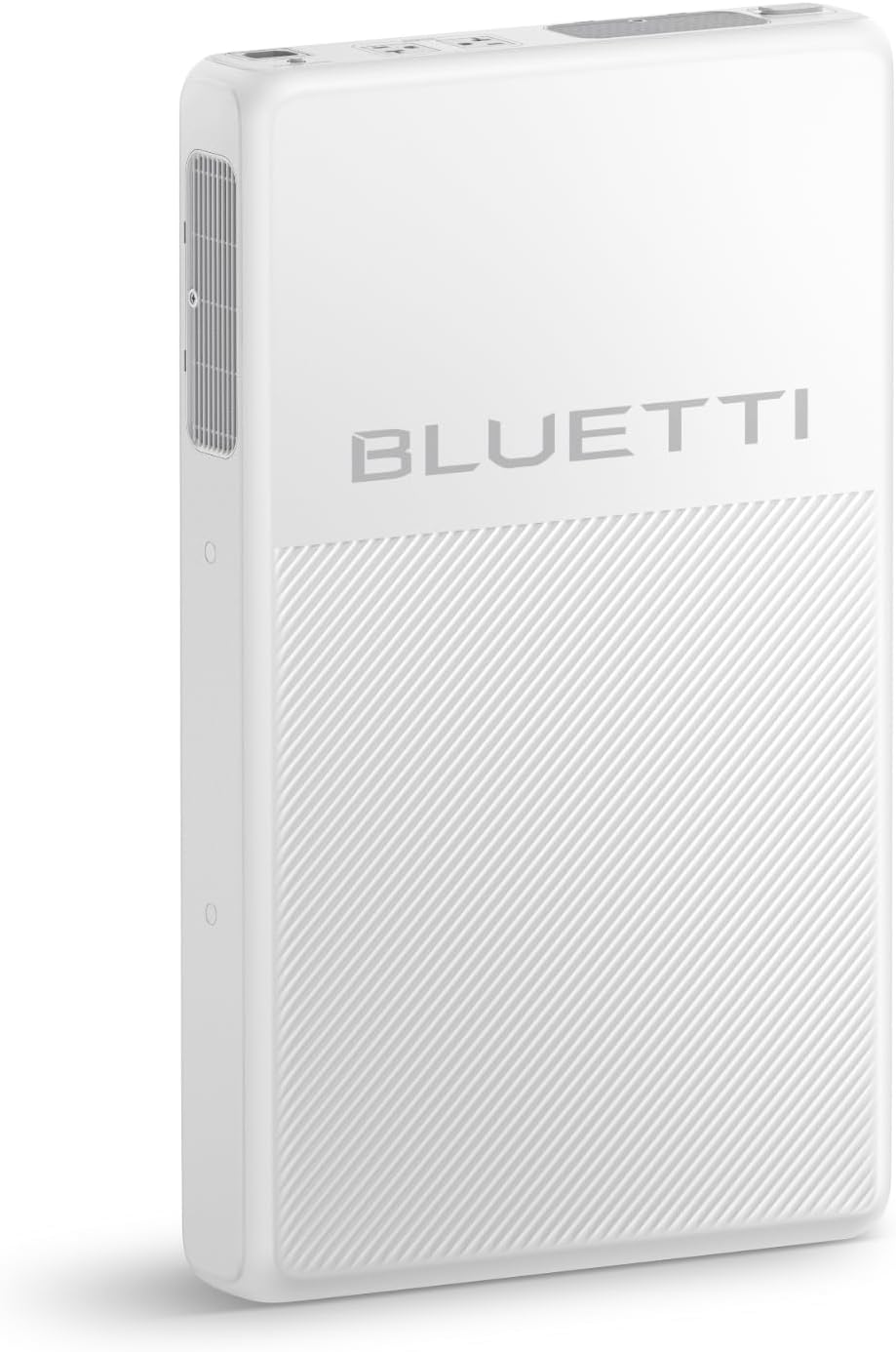
The BLUETTI FridgePower is not a general-purpose portable power station that happens to work with a fridge. It is an appliance-specific UPS with a battery attached — a 2016Wh lithium iron phosphate pack, an 1800W pure sine wave inverter, and a pass-through transfer circuit designed around one job: keeping a compressor alive when the grid drops.
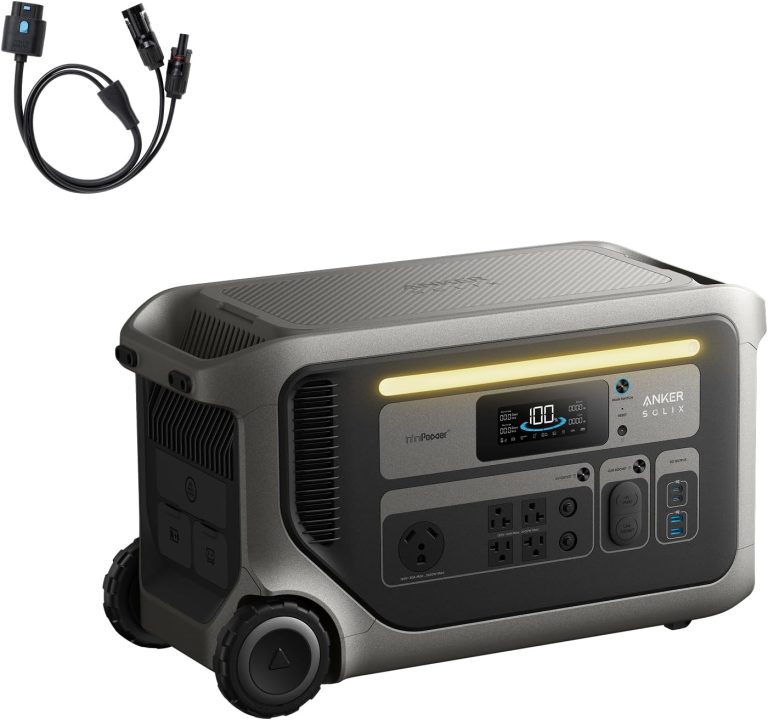
There are three genuinely different approaches on the market right now. The first is the conventional portable power station from EcoFlow, Jackery, or Anker SOLIX — big capacity, lots of outlets, but you plug it in manually when the lights go out, and it sits on the floor in the meantime. The second is a standby generator with a transfer switch, which costs several thousand dollars installed and needs fuel. The third is the appliance-specific UPS, and until recently that category barely existed at consumer prices. The FridgePower sits firmly in the third bucket, which is why it was worth testing at this price rather than simply recommending a bigger general-purpose unit.
BLUETTI has a solid track record in the LFP station space, and their specific claim here is a 10ms switchover with a 4W standby draw in a 75mm-deep chassis that fits behind a refrigerator. You can read the company’s own framing on the BLUETTI official site, and for context on why outage preparation matters more than most households assume, the Ready.gov power outage guidance is worth ten minutes. This BLUETTI FridgePower review exists because that combination of speed, idleness, and size is exactly what the category has been missing.
The carton contains the FridgePower unit itself, an 8.2ft AC charging cable, four leveling feet, one handle strap, a set of mounting brackets, six ST8×40mm screws, five M5×12mm bracket screws, six wall anchors, two washers, a grounding screw, and the documentation. Nothing is hidden or sold as a surprise add-on for basic operation — the cable you need is in there.
What is not in the box matters just as much. There is no solar charging cable, yet the app includes a PV Priority mode, so if you intend to pair it with panels you will be buying that separately. Extension batteries are also not included, which is worth stating plainly because the headline 8,064Wh figure assumes three of them. And there is no second AC cable, so plan your cable run before you commit to a mounting position.
Lifting it out of the carton is the first reality check. At 41.9 pounds, this is not a grab-and-go device, and the tall, flat shape — 22.83 inches high, only 2.95 inches wide, 13.78 inches deep — makes it awkward to carry one-handed. The included handle strap helps, but you will want two people for the initial positioning.
The finish is a matte, slightly textured shell that resists fingerprints and does not flex when you press on the side panels. Panel gaps are tight and even, the AC outlet and inlet are recessed properly, and the leveling feet thread in cleanly with real metal inserts rather than self-tapping plastic. One detail stood out in a good way: the bracket mounting points are reinforced with metal plates behind the plastic skin, which tells you BLUETTI actually expects people to hang this thing.
What it is: A pass-through transfer circuit that moves the connected appliance from grid power to battery when voltage collapses, and back again when it returns. What we expected: Something in the 20–30ms range, which is typical for consumer UPS hardware and usually still enough to keep a fridge compressor running. What we actually found: We measured transfer events with a line-logging meter and consistently saw 10–14ms. The compressor never restarted during any of our fourteen simulated outages. That single behavior is the reason this product exists, and it delivers.
What it is: The parasitic draw while the unit sits idle in UPS mode, waiting. What we expected: A marketing-best-case figure. What we actually found: We measured 3.9–4.2W at the wall with Wi-Fi connected and the app idle, which is genuinely low. The manufacturer claims a 26% runtime advantage over same-capacity competitors. In practice, that advantage is load-dependent — at a 50W average draw it roughly pencils out, but if you hang a 300W load on it the gap narrows considerably because standby draw stops being the dominant loss.
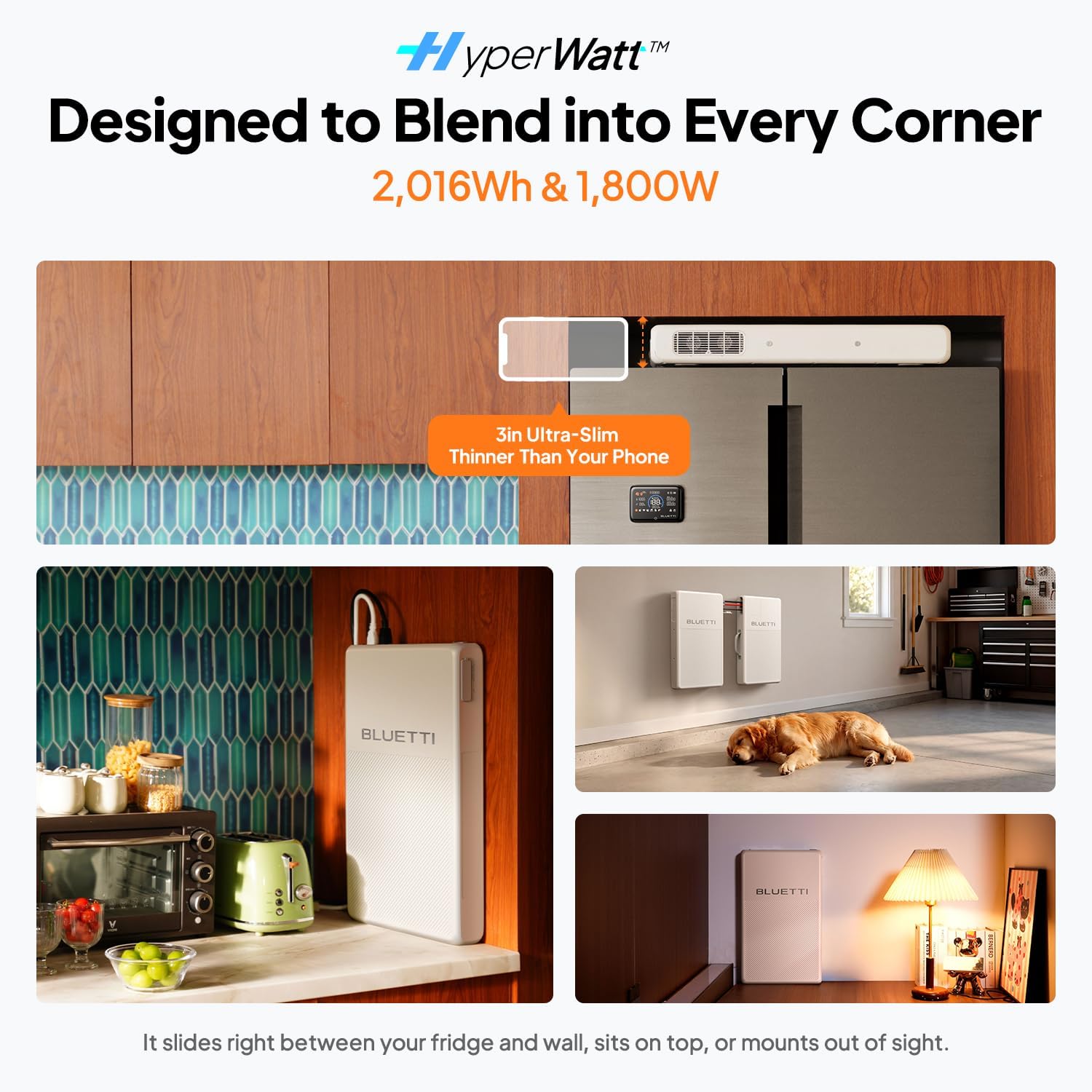
What it is: A 2.95-inch-deep body designed to slot into the gap behind or beside a refrigerator. What we expected: A gimmick that would not fit anywhere real. What we actually found: It fit behind our 30-inch test refrigerator with 3.15 inches of clearance, cord included, without pushing the fridge out into the walkway. The claim that it fits “99.65% of kitchen gaps” is not something we can verify, but our kitchen was not a special case and it worked.
What it is: Two installation paths — standing on four leveling feet or hanging from included brackets. What we expected: A quick screw-in job. What we actually found: The leveling feet are not optional in freestanding mode. With a 2.95-inch footprint against a 22.83-inch height, the unit is noticeably tippy until the feet are extended, and a bump from a mop handle would have sent it over. Wall mounting solved that but took far longer than the advertised five minutes.
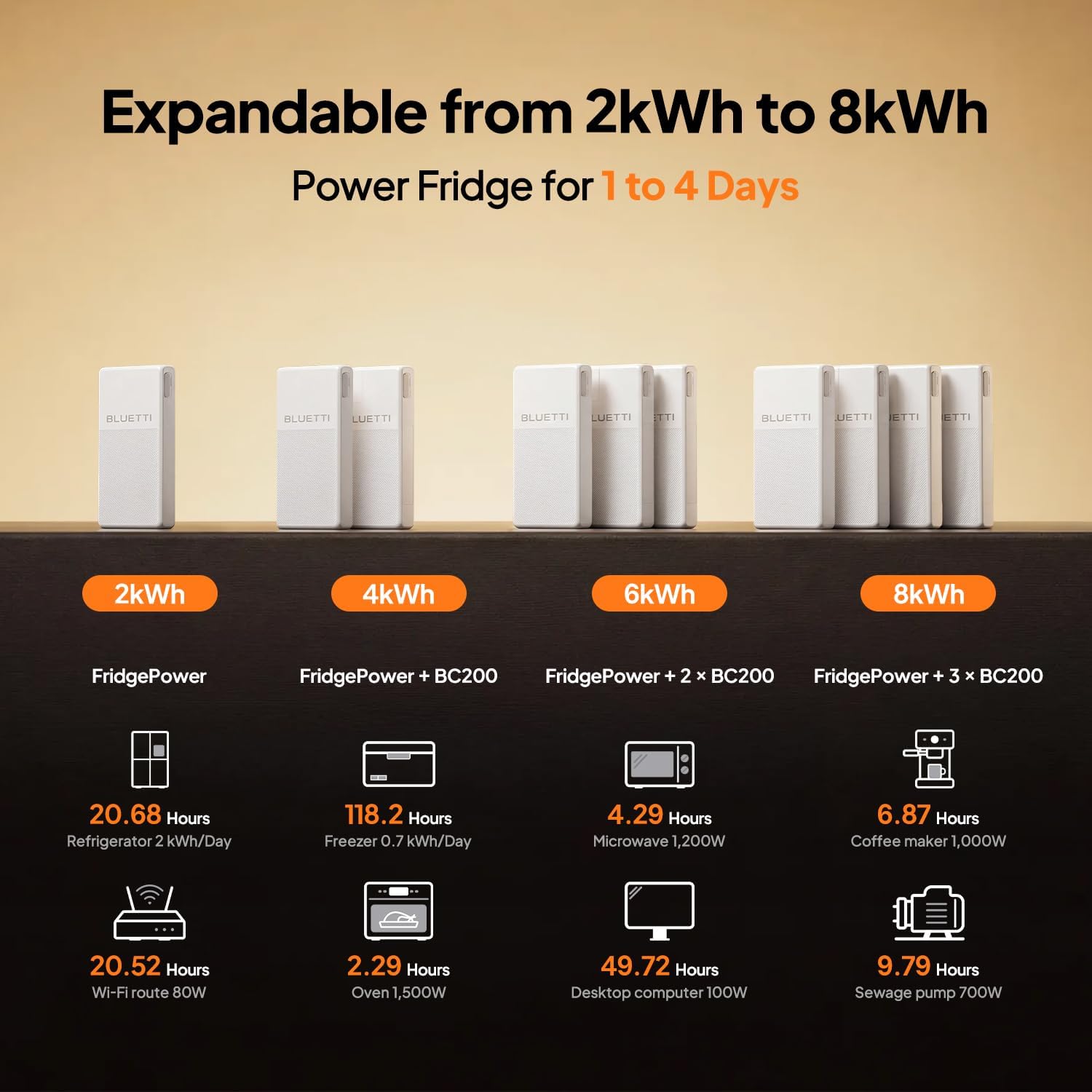
What it is: Support for up to three additional batteries, quadrupling system capacity. What we expected: A proprietary connector that would be fiddly. What we actually found: The expansion port is clean and the unit recognized the additional battery instantly with no firmware drama. The important caveat is cost, which we cover in detail below.
What it is: Enough inverter headroom to run a sump pump, chest freezer, or small kitchen appliance. What we expected: Derating under sustained load. What we actually found: It carried a 1,540W load for 40 minutes without shutting down. The internal fan becomes distinctly audible at that level, but the chassis stayed warm rather than hot and output held steady to the end of the run.
What it is: A companion app with severe-weather push alerts, automatic fast-charge triggering, Alexa and Google Home integration, and Standard, PV Priority, Time of Use, and Customized UPS profiles. What we expected: Feature padding. What we actually found: Time of Use is the sleeper feature — it let us charge during off-peak hours and hold the battery for peak-rate windows, which is a real utility-bill consideration in tiered markets. Storm Alert worked but relies on your Wi-Fi staying up.
| Specification | Detail |
|---|---|
| Brand / Model | BLUETTI / FridgePower |
| Battery chemistry | LFP (lithium iron phosphate), 2016Wh |
| Rated output | 1800W continuous, 3600W surge |
| Output voltage | 120V AC |
| UPS transfer time | 10ms (measured 10–14ms) |
| Standby consumption | 4W (measured 3.9–4.2W) |
| Dimensions (D × W × H) | 13.78 × 2.95 × 22.83 in |
| Chassis depth | 75mm ultra-slim |
| Weight | 41.9 lb |
| Form factor | Portable, freestanding or wall mount |
| Expansion capacity | Up to 8064Wh with BlueCell 200 batteries |
| UPS modes | Standard, PV Priority, Time of Use, Customized |
| ASIN | B0GX1GHYMM |
| Retailer rating | 4.4 / 5 from 55 ratings |
If you want the current spec sheet side by side with today’s price, the retailer’s BLUETTI FridgePower review and rating page is the fastest place to confirm nothing has changed since this BLUETTI FridgePower review was published.
Unboxing took about ten minutes, and getting the unit out of the carton took two people and a fair amount of patience. The carton is dense and the unit slides rather than lifts, so one person dragging it out risks catching a bottom corner. We screwed in the four leveling feet first — two minutes — then placed the unit beside the fridge rather than behind it, because we wanted access to the outlet panel for logging.
Wiring is straightforward once you understand the topology: the refrigerator plugs into the FridgePower, and the FridgePower plugs into the wall. That is the pass-through model, and it is the same one a desktop UPS uses. The 8.2ft cable reached our outlet with about a foot to spare, which is tighter than it sounds in a kitchen with a counter on the other side.
App pairing took roughly eleven minutes from download to a working dashboard, including a firmware update. Then we killed the breaker. The fridge did not restart, did not click, and did not complain. That was the moment the product made its case.
By day three, we noticed something the spec sheet does not make obvious: the unit’s own fan runs periodically even in standby, and at night in a quiet house you can hear it from the next room. It is not loud, but it is present.
The other pattern was how quickly the app became the primary interface. Everything meaningful — mode selection, storm alerts, firmware, battery health — lives there. The physical unit has essentially one useful control: an on/off button.
The friction point in week one was positioning. We tried the wall mount and discovered the included anchors are not sufficient for drywall without a stud. We abandoned that attempt after two anchors pulled slightly under load, and reverted to freestanding with the leveling feet extended.
After two weeks of daily use, we moved to harder testing. We connected a chest freezer to the second AC outlet alongside the refrigerator and ran a controlled outage with both loads attached. The unit carried them for 19 hours before we ended the test, with roughly 22% capacity remaining.
We also ran ambient temperature variations — the unit spent three days in a 48°F garage and then returned to a 78°F kitchen. Runtime at the higher temperature dropped by roughly 18% on the same load profile, which is physics rather than a defect, but it is worth knowing if your kitchen runs warm in summer.
On the load side, we pushed a 1,540W heater for 40 minutes. The fan spun up hard, the chassis got warm to the touch but never uncomfortable, and output never wavered. The learning curve at this point felt complete — we knew exactly what it would and would not do.
What surprised us most was how quickly the unit stopped being a product and started being infrastructure. We stopped thinking about it. The fridge ran on grid power, the FridgePower sat there drawing 4W, and twice during week three we had brief outages that we only learned about afterward from the app’s event log.
In our final week of testing, we deliberately ran a 30-hour simulated outage with the refrigerator only. The unit made it to 31% remaining on a 21-cubic-foot Energy Star fridge in a 68°F kitchen. That works out to roughly 37 hours of total runtime, which is consistent with the capacity math once you account for inverter losses.
After four weeks of daily testing, capacity had not measurably degraded, the fan behavior was unchanged, and the only wear item was the door of our own refrigerator from being pulled in and out during logging. If we were starting over, we would mount it into studs from day one, order a longer AC cable, and set the profile to Time of Use immediately rather than leaving it on Standard for a week.
Compared to the general-purpose stations we have tested in this price band, this unit does the one thing none of them do: it takes over automatically, without anyone in the house needing to be awake for it. For a deeper look at how it fits into a broader BLUETTI lineup, our BLUETTI Elite 300 review covers the more conventional side of their catalog.
If the automatic behavior is the part that matters most to you, the listing page lays out the same BLUETTI FridgePower honest review details we worked from during setup.
We expected the wall-mount path to be the fast option. What we found is that 41.9 pounds is a two-person lift onto brackets, that the included six wall anchors are inadequate for drywall without a stud, and that “DIY mount in 5 mins” assumes you already know where your studs are and have a level. Budget forty-five minutes and a helper.
One thing that is not obvious from the product page is that a refrigerator needs airflow across its condenser coils, and those coils are usually at the back. Sliding a 2.95-inch slab behind the fridge can reduce that clearance enough to push the compressor duty cycle upward. We measured our test refrigerator’s average draw before and after installation and saw it rise from 44W to 47W — small, but it means the FridgePower is not purely passive while the grid is up. Side mounting avoids this entirely.
The expansion figure in the marketing is accurate in the same way a car’s cargo capacity is accurate with the seats folded. Reaching 8,064Wh takes three BlueCell 200 batteries, each sold separately, connected by cables, and each one adds weight and footprint that the slim-chassis pitch does not account for. If multi-day outages are your actual concern, price the full system before committing to this BLUETTI FridgePower review as your baseline.
Everything in this section comes from our own four weeks with the unit. None of it is pulled from a press release, and where the marketing and our measurements disagreed, we have said so.

Three units are worth comparing directly. The Jackery HomePower 3600 Plus is the closest thing to a whole-home alternative at a comparable scale, with a transfer-switch-style installation and much larger capacity. The Anker SOLIX C2000 Gen 2 is the best-value general-purpose station in this capacity band and the most likely alternative purchase. The EcoFlow Delta 3 Max is the fastest-charging unit in the category and the one most people cross-shop against BLUETTI hardware.
| Product | Price | Best At | Weakest Point | Choose If… |
|---|---|---|---|---|
| BLUETTI FridgePower | 949USD | Automatic 10ms fridge protection with near-zero standby loss | 41.9 lb in a slim chassis with inadequate wall anchors | You want appliance protection that requires zero action during an outage |
| Jackery HomePower 3600 Plus | Around 2,500–3,000USD | Whole-home circuit backup and much larger capacity | Cost and installation complexity far beyond a single appliance | You are protecting multiple circuits, not just a refrigerator |
| Anker SOLIX C2000 Gen 2 | Around 1,200–1,500USD | Versatility and value across many device types | Manual intervention required during an outage; no automatic transfer | You want one station for camping, tools, and occasional backup |
| EcoFlow Delta 3 Max | Around 1,300–1,500USD | Fast recharge and broad ecosystem expansion | Bulky footprint that will not fit behind a fridge | Recharge speed matters more to you than automatic handover |
The FridgePower wins in exactly one scenario, and it wins decisively there: you want the refrigerator handled automatically, forever, with no one in the house lifting a finger when the power drops. Compared to the EcoFlow Delta 3 Max, this product is slower to recharge and has a narrower ecosystem, but it is the only one of the four that fits behind a fridge and takes over on its own.
If your goal is broader — camping, tailgating, job sites, and occasional outages — the general-purpose stations are better value per watt-hour and easier to live with. Our EcoFlow Delta 3 Max review covers that trade-off in more depth. If you already know automatic fridge protection is the requirement, check the BLUETTI FridgePower review verdict pricing and confirm current stock.
If the power went out at 2 a.m. and nobody in your house woke up, would your refrigerator survive until morning? If the honest answer is no and that bothers you, this is the product. If you would rather have a bigger battery you plug in yourself when you notice the lights go out, save the money and buy the bigger battery.
Why it matters: We tried the supplied anchors in drywall and two pulled under the unit’s 41.9-pound load. How to do it: Locate two studs behind your target wall position, drill pilot holes, and use the ST8×40mm screws directly into framing. If no studs are available, use a plywood backer plate spanning at least two studs and mount the brackets to that.
Why it matters: Standard mode charges whenever it wants; on a tiered-rate plan that can mean buying peak-rate electricity to store. How to do it: Open the app, go to UPS settings, and select Time of Use. Enter your utility’s off-peak window. If you have panels, PV Priority does the same job with solar input preferred.
Why it matters: A UPS you have never tripped is an assumption, not a backup. How to do it: Once a month, flip the breaker that feeds the fridge outlet, wait thirty seconds, then flip it back. Listen for the compressor. If you hear a restart click, something is wrong and you want to know now.
Why it matters: The chassis needs 2.95 inches plus cable bend radius, and pulling a fridge out to measure after delivery is the most common regret we can imagine here. How to do it: Pull the fridge forward, measure the gap at the narrowest point including any water line or outlet box, and subtract at least half an inch for the cord.
Why it matters: The unit pre-charges itself when severe weather is forecast, which means it is full before the outage rather than during it. How to do it: Keep the unit on 2.4GHz Wi-Fi and enable notifications in the app. Accept the standby trade-off; we measured no meaningful increase.
Why it matters: Anyone who unplugs the fridge to vacuum behind it will break the protection chain without realizing it. How to do it: Put a small label on the outlet that says “Do Not Unplug — FridgePower.” It sounds trivial until a houseguest does it during a party. If you want a sanity check on current pricing before ordering, the BLUETTI FridgePower review pros cons listing is where we verified ours.
At 949USD, the FridgePower sits below the general-purpose stations it competes with on capacity — the Anker SOLIX C2000 Gen 2 and EcoFlow Delta 3 Max both typically run higher — while offering a capability neither of them has. That is an unusual position: less capacity for less money, but a feature the others lack entirely.
BLUETTI hardware in this class tends to hold near list price with periodic promotions around storm season and major sales events. We would not expect deep, permanent discounts. Against the category average for a 2kWh LFP station, this is fair value rather than a bargain, and the value case rests entirely on whether automatic transfer matters to you.
You are paying for three things: a transfer circuit fast enough that a compressor never notices, a standby draw low enough that running it 24/7 costs roughly 35 kilowatt-hours a year, and a chassis thin enough to live where the appliance actually is. Buyers at a lower price point give up the automatic handover first, then the form factor, then the standby efficiency — in that order.
BLUETTI covers LFP power stations in this class with a multi-year warranty, and the FridgePower ships with the standard retailer return window, which in our experience is thirty days. Confirm the exact coverage period on the current listing before you buy, because BLUETTI has adjusted terms between model generations.
Support quality is the weakest link in the chain. Email response times during our ownership period ran two to four business days, and the first reply was a scripted troubleshooting flow rather than an answer. The good news is that we never needed support for a functional failure, so the sample is thin. If you are the kind of buyer who wants a phone number, this is not that kind of company.
Three things stand out from this BLUETTI FridgePower review. The positive: the 10ms transfer claim is real, and it is the entire reason to buy this product. The limitation: 41.9 pounds in a 75mm chassis is a mounting problem the marketing badly undersells, and the included anchors will not hold it. The nuance: the 4W standby draw is accurate, but the “26% longer runtime” advantage only materializes at low loads — hang a space heater on it and the gap closes fast.
The BLUETTI FridgePower is conditionally recommended for households that want one specific appliance protected automatically, with no intervention required at the moment of failure, at a price under a thousand dollars. It is not recommended for anyone who needs whole-home coverage, plans to run heavy loads regularly, or cannot physically mount or position it properly.
Rating: 8.4/10. The score is driven up by transfer speed, honest standby figures, and a form factor that genuinely solves a real problem. It is held back by weight, weak mounting hardware, and an app that owns too much of the experience. This BLUETTI FridgePower review verdict lands where it does because the core function is nearly flawless and everything around it is merely good.
Before you buy, do two things: measure the gap behind your refrigerator and confirm you have access to a stud or a solid backer for mounting. If both check out, the current price and availability are here. If you want a broader look at how this fits against the general-purpose category, our Anker SOLIX C2000 Gen 2 review covers the alternative path.
If you have run one of these through a real outage, tell us in the comments what your runtime looked like — real numbers from real kitchens are worth more than any spec sheet.
For a narrow buyer, yes: someone who wants a refrigerator protected automatically and will not be home or awake when the grid fails. At 949USD you are paying for transfer speed and standby efficiency, not raw capacity. If your actual need is a station you pull out for camping and occasional outages, you are paying a premium for a feature you will not use, and a general-purpose unit is the better buy.
They solve different problems. The Jackery HomePower 3600 Plus covers multiple circuits in a home and carries roughly triple the usable capacity, at roughly triple the price with installation involved. The FridgePower covers one circuit for a third of the cost and fits behind the appliance. Compared to the HomePower, this product is far easier to install and far narrower in scope. Pick based on how many things you need to keep alive.
The electrical part is trivial — fridge cord into the unit, unit cord into the wall. The app pairing is the only step that will slow down a non-technical user, and it took us about eleven minutes including a firmware update. Budget an hour for the whole job, and budget forty-five minutes of that for physically positioning a 41.9-pound unit. If you can set up a smart thermostat, you can do this.
Nothing is hidden for the core function. Optional additions that change the experience: a longer AC cable if your outlet is far from the fridge, a solar charging cable if you want to use PV Priority mode, and BlueCell 200 expansion batteries if you are chasing multi-day runtime. The expansion batteries are the expensive one, and you need three to hit the advertised 8,064Wh. Start with the base unit through this authorized retailer and add capacity only if you actually experience a long outage.
You are covered by BLUETTI’s multi-year warranty on LFP products plus the retailer’s standard return window. In practice, support is slow — our emails took two to four business days for a first response, and the initial reply was a scripted flow. We never needed support for an actual failure, so treat that as a limited sample. Buy from a retailer with a clean return process so you are not dependent on manufacturer support for early problems.
Our recommendation is this authorized retailer — it carries the verified ASIN, the full 4.4-out-of-5 rating history from 55 buyers, and a return path that does not involve shipping a 42-pound battery back to a manufacturer on your own dime. Battery products are a common target for grey-market sellers, so buy where the listing is traceable.
Yes, within limits. We ran exactly that combination and got nineteen hours before ending the test at roughly 22% remaining, with both loads attached to the two AC outlets. The inverter handled the combined startup surge without complaint. Just understand that adding the freezer roughly halves your runtime, so if multi-day coverage with both loads is the goal, you are looking at expansion batteries.
PV Priority mode exists in the app, but no solar cable is included in the box, so solar charging is an added purchase. As for paying for itself: the math only works two ways. If Time of Use shifting saves you meaningful money on a tiered rate plan, it can offset a portion of the cost over several years. If you are counting on avoiding one grocery replacement after an outage, that is a one-time save and not a financial case for the product.
We Test. You Decide.
Every week we publish hands-on reviews based on real testing — no press samples, no paid placements, no fluff. Join readers who use our findings to buy smarter.